
A documented comparison for retail, restaurant and multi-site operators weighing a move off Solink. Every cell comes from the vendor's own current documentation, and where a vendor publishes nothing this page says so.
Solink is a strong platform for a storefront estate, and most teams who leave it are not leaving because it failed. They leave because the estate stopped being all storefront. These four are the platforms that come up in that conversation, each with the case where it is the right answer.
Every platform here reads the cameras you already own. What separates them is how much of your estate arrives covered on day one.
Four platforms plus Solink's own reference row, on the criteria that decide this category. Checked August 7, 2026.
Swipe the table sideways to see every column.
Spot AI, Solink and Verkada rows were read off each vendor's own current documentation on August 7, 2026. Coram AI and Lumana rows carry only what is confirmed in dated reference material; every unconfirmed cell is marked not publicly specified rather than guessed.
Rarely because it stopped working. Solink is one of the more transparent platforms in this category: it names 48 camera manufacturers rather than saying camera agnostic and leaving you to test it, it publishes SOC 2 Type II and an NDAA statement, and it puts the appliance behind your firewall with no inbound ports. For a multi-unit operator whose loss sits at the register, that is a well-matched product.
The reason to look is almost always shape. Solink reasons from the transaction outward, and the three agents it ships, Overnight Guard, Loss Prevention and Store Readiness, all assume a site with a register in it. The moment a distribution centre, a plant or a yard joins the estate, one half of it is covered by shipped agents and the other half becomes custom work that you scope, build and tune with the Skills and Tolerance Meter controls Solink provides.
The second reason is price visibility, and it is not unique to Solink. Nothing about cost is published: no list price, no per-camera figure, no tiers, no contract terms. Only Verkada in this set publishes per-device MSRPs, which is worth stating plainly because Spot AI does not publish list pricing either.
The question is not which platform has more features. It is how much of your estate arrives covered on day one, and how much becomes a project.
What each one is, where it is strong, and where it is not. Every entry carries at least one honest minus, Spot AI's included.
A software-led video AI platform that works with the cameras a business already owns. It ships 15+ pre-trained Video AI Agents spanning vehicle break-in, fire, cash register theft, after-hours intrusion, personal protective equipment, forklift near-miss, falls and crowding in hazard zones, so a mixed estate gets shipped coverage on both the store side and the industrial side. Iris builds anything else in natural conversation in about eight minutes. Full-resolution video stays on the Intelligent Video Recorder in the building and only event metadata crosses the network.
A cloud-managed physical security platform built around its own hardware, with cameras, access control, environmental sensors, alarms and intercoms administered together in Command. It reaches third-party cameras through Command Connector, which Verkada states is an ONVIF Profile S conformant client that also ingests RTSP feeds, inside documented stream conditions. Alone in this set, it publishes per-device MSRPs and license terms.
A newer entrant that raised about $66 million in total after a $35 million Series B in June 2026, and reports 1,500-plus sites. It markets Deep Investigation, autonomous agents that go beyond similarity search, and the honest framing is after-the-fact investigation rather than live deterrence. Its base has been education, healthcare and manufacturing, and it now names retail and hospitality as well.
A newer video AI platform aimed at retail teams, with documented point-of-sale integration. It belongs on this list because it competes for the same transaction-anchored use case Solink owns, which makes it a like-for-like swap rather than a change of approach. Its public documentation is thinner than the others here, so most of the evaluation has to happen in the demo rather than off the website.
Six questions that separate these platforms in an evaluation. Four of them are the ones people forget.
This is the whole decision. Count the sites that have no register: distribution centres, plants, yards, campuses. If the answer is none, Solink's shape fits and the case for moving is weak. If it is a third or more, ask each vendor which detections for those sites arrive pre-trained and which are custom work.
Ask for the pre-trained list by name, not a count. Then mark your own required detections against it. A platform with fifteen agents that miss your three is worse than one with five that hit them, and the only way to know is to compare lists rather than totals.
Spot AI publishes about eight minutes through Iris in natural conversation. Solink documents the flow, naming the agent, selecting Skills, setting a schedule and tuning a Tolerance Meter, but publishes no time. Ask to build one during the evaluation, on your footage, and time it. Then ask who owns the tuning after go-live, because that is the setting that decides how noisy month two feels.
Almost everyone says camera agnostic. Solink names 48 manufacturers, which is unusual and genuinely useful. Verkada publishes stream conditions instead: ONVIF Profile S, same local area network with no dynamic NAT or L3 translation, 2MP to 4K, 5 to 20 FPS and no B-frames. Either form of disclosure beats a claim, so ask for whichever the vendor has.
Three different products hide behind the word deterrence. Some platforms only raise an alert. Some verify first and then trigger a deterrent themselves, which is how both Solink and Spot AI describe their agents. Some route every event to a person before anything happens at the site. Ask which one you are buying, ask what the deterrent physically runs on at each location, and price the staffing for whatever the platform still escalates.
Verkada publishes per-device MSRPs and license terms. Solink, Spot AI, Coram AI and Lumana publish nothing, so the comparison comes from quotes on the same site list. Ask every vendor to break the quote out by camera count, retention tier and which agents are included at that price, because the last of those is where the difference usually hides.
Spot AI is the answer to one specific version of this question: the estate is mixed, the storefront half is already handled, and the plants, warehouses or yards need the same quality of coverage without becoming a build project. Fifteen or more pre-trained agents span both sides, Iris covers the gaps in about eight minutes, and the cameras stay where they are.
It is not the answer to every version. If the estate is one store format and the loss is at the register, Solink's named point-of-sale integrations are deeper than anything Spot AI publishes, and depth in the thing you actually do beats breadth you will never use.
A camera-agnostic platform lets you test the claim rather than take it. Both Spot AI and Solink pilot on the cameras you already own, so the honest comparison costs a week rather than a purchase order.
Watch the AI coworkers work on your live feeds before a platform decision.
Customer-reported outcomes from named Spot AI customers.
Blackmon Oil runs a vehicle loitering filter to keep parking lots clean and safe at its around-the-clock stores, with a smaller overnight crew.
Bridge33 Capital standardized video across 25 plus properties, each acquisition arriving with a different camera system, and cut footage search from hours to minutes.
Unique Industries covers more than a million square feet with a three-person safety team, catching near misses and falls on the cameras already installed.
"We've set up a Spot AI vehicle loitering filter to keep our parking lots clean and safe, especially for our 24/7 stores. Even with a smaller overnight crew, we want eyes on the lot at night."
The four covered here are Spot AI, Verkada, Coram AI and Lumana. Spot AI suits a mixed estate needing shipped agents for safety and operations as well as security. Verkada suits a build specified end to end. Coram AI suits after-the-fact investigation at scale. Lumana is the closest like-for-like swap for a retail estate that wants to keep the transaction-anchored approach.
Usually because the estate changed rather than because the platform failed. Solink's three shipped agents, Overnight Guard, Loss Prevention and Store Readiness, all assume a storefront. Once a plant, warehouse or yard joins the estate, that half needs custom agents you build and tune yourself, and teams start asking what arrives pre-trained instead.
Yes, and it is more explicit about it than most. Solink states there is no rip-and-replace and its integrations page names 48 camera manufacturers, including Axis, Hanwha, Avigilon, Pelco, Bosch, Panasonic and Sony. Recording can run locally through Solink hardware or supported NVRs, in the cloud, or as a hybrid.
Only Verkada, which lists per-device MSRPs and license terms on its pricing page. Solink, Spot AI, Coram AI and Lumana publish nothing, so any cost comparison across them has to come from quotes on the same site list, broken out by camera count, retention tier and which agents are included.
Yes, and on its own. Solink's February 2026 launch post for AI Agents describes agents that read intent, confirm the event is real, and then trigger deterrents such as audio broadcasts, while its homepage calls AI Agents autonomous AI that takes action in real time. The claim that Solink stops at detection and exception reporting is out of date and no page here repeats it.
Book a quick demo and see how the latest in video AI drives higher productivity and keeps every site secure — around the clock.
Request a Demo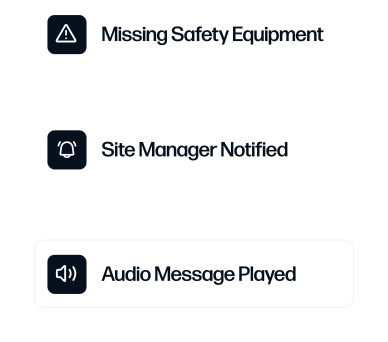




.png)
.png)
.png)
.svg)