
What Solink's own documentation says it does not do, or does not yet say it does, written for retail and restaurant teams running due diligence. Every constraint carries the source behind it, the operational impact, and the workaround.
Every constraint below comes from Solink's own current documentation, checked on August 7, 2026. Where Solink documents nothing, this page says so rather than guessing. Spot AI sells a competing platform, so nothing here rests on an anonymous source or an aggregated user rating, and four claims that circulate about Solink are corrected on this page: it is not detection-only, its agents do deter; it is not vendor-locked for new detections, customers build their own; it is not cloud-only, it records locally behind your firewall; and it is NDAA-compliant.
Solink ships three agents and a builder for everything else. Which side of that line your detections fall on is the decision this page is really about.
A constraint list is only useful next to an honest account of the product.
Solink's integrations page names 48 camera manufacturers, from Axis, Hanwha and Avigilon to Pelco, Bosch, Panasonic and Sony. Most platforms in this category say camera agnostic and leave you to test it. A published list is something a procurement team can check a fleet against before signing.
Named integrations with Toast, Square and NCR on point of sale, Olo for delivery, and Brivo for access control. For an operator whose real problem is register fraud, tying an exception to the video of that exception is the whole job, and Solink was built around it.
SOC 2 Type II, an appliance that sits on-premises behind the customer's firewall with no inbound ports and all connections initiated outbound, plus MFA, SSO and independent penetration tests. The platform is also stated NDAA-compliant with no Section 889 components.
Each is a consequence of how the platform is built or how new the agent layer is, rather than a defect. What matters is whether it collides with your starting point.
Solink's pricing page publishes no list price, no per-camera figure, no plan tiers and no contract terms. It collects business details and offers a tailored quote for a custom plan.
A budget cannot be modelled before a sales cycle, and two sites cannot be compared without going back to the vendor. In a category where some vendors now publish per-device MSRPs, that is a real difference in how early finance can be brought into the decision.
Ask for pricing on the exact site list, broken out by camera count, retention tier and which agents are included, then ask which of those lines change at renewal. Get the same breakdown from every vendor on the shortlist so the comparison is like for like.
Solink announced AI Agents on February 18, 2026. The AI Agents page carries a Request access call to action rather than a plain general-availability statement.
The part of the platform that does the reasoning is about six months old at the time of writing, and it is not clear from the public pages whether every account can turn it on today or which plan it sits in. That is a question for an evaluation, not a disqualification.
Ask directly: is the agent layer generally available on the plan being quoted, which agents are live in production for customers of your size, and what changes at renewal. Put the answer in writing next to the quote.
Solink names three agents: Overnight Guard, which watches sites after hours; Loss Prevention, which sifts transactions to surface shrink; and Store Readiness, which checks hours, cleanliness and brand standards.
The three map cleanly onto a retail or restaurant footprint and cover it well. They do not cover the industrial side of a mixed estate: personal protective equipment, forklift and pedestrian proximity, falls, or crowding in a hazard zone. An operator running both store and plant environments will find one half of the estate served by shipped agents and the other half needing custom work.
List the detections you need by site type before the demo, and mark which are covered by a shipped agent and which need building. The split, not the total, is what tells you how much of the platform arrives ready.
Solink states that a wide variety of agents can be built using its templates or from scratch. The documented setup is: name the agent and define its role, select Skills, set a schedule, and tune a Tolerance Meter.
Customer-built agents are a genuine strength and correct a claim that still circulates about this platform. They also move the work: someone on your side owns defining the role, choosing the skills and finding the right tolerance, and a tolerance dial is the setting that decides how noisy the system feels on day thirty. Solink publishes no build time for this.
Ask to build one during the evaluation, on your footage, and time it. Ask who tunes tolerance after go-live, and how a tuning change is rolled across every site rather than one at a time.
The security page publishes SOC 2 Type II, GDPR and an NDAA statement covering Section 889, alongside MFA, SSO and independent penetration tests by third parties. It takes no published HIPAA position. Checked August 7, 2026.
For a retail or restaurant estate this is a non-issue, and the posture on offer is a strong one. It becomes a live question the moment the estate includes a clinical space: a pharmacy counter, an on-site health clinic, an occupational health room inside a distribution centre. Those cameras see patients, and a compliance reviewer will want a position in writing rather than an inference from SOC 2.
Ask for the HIPAA position, and any business associate agreement, before a clinical space joins the estate rather than after. Put the same question to every vendor on the shortlist, because publishing SOC 2 Type II is not the same as taking a HIPAA position.
The same five constraints in one view, sized to paste into an evaluation document.
Swipe the table sideways to see every column.
Solink data comes from Solink's own public documentation and product pages, checked on August 7, 2026. Gaps are marked as not publicly specified.
If your estate is stores or restaurants, your loss sits at the register, and your point of sale is Toast, Square or NCR, most of the constraints above stop applying. You are buying the thing the platform was built to do, on a published camera list, behind your own firewall, with the transaction tied to the video of the transaction.
Spot AI starts from the agent layer rather than the transaction, which is why its constraint list looks different. It ships 15+ pre-trained Video AI Agents covering vehicle break-in, fire, cash register theft, after-hours intrusion, personal protective equipment, forklift near-miss, falls and crowding in hazard zones, so a mixed estate of stores and plants is served by shipped agents on both sides rather than one.
For anything not on that list, Iris builds a custom detection in natural conversation in about eight minutes, which is a published number rather than an unmeasured build. Full-resolution video stays on the Intelligent Video Recorder in the building and only event metadata crosses the network, and the platform is stated SOC 2 Type II, NDAA-compliant and HIPAA-aligned.
The useful question is not which platform has fewer constraints, but whether the shipped agents cover the estate you actually run.
None of that makes Spot AI the right answer for every buyer. Solink's point-of-sale integration surface is deeper and more explicitly documented, its published camera list is longer, and for an operator whose entire problem is register fraud across one store format, that depth is worth more than breadth it will never use. Spot AI does not publish list pricing either. A constraint list earns its keep by lining each platform's shape up against your starting point, and here that starting point is the mix of environments you have to cover.
A live pilot on your cameras answers in a week what a spec sheet cannot.
Customer-reported outcomes from named Spot AI customers.
Blackmon Oil runs a vehicle loitering filter to keep parking lots clean and safe at its around-the-clock stores, with a smaller overnight crew.
Liberty-Perry School District resolves an incident in about five minutes, after evaluating ten systems before choosing Spot AI.
A top five North American EV charging network reports an 80% reduction in incidents with autonomous deterrence and no human monitoring.
"We've set up a Spot AI vehicle loitering filter to keep our parking lots clean and safe, especially for our 24/7 stores. Even with a smaller overnight crew, we want eyes on the lot at night."
Five, all documented: pricing is not published in any form; the AI Agent layer was announced in February 2026 and carries a Request access call to action; three agents ship, all anchored to the storefront; custom agents are built and tuned by the customer with no published build time; and the security page takes no published HIPAA position.
Yes, and it is more explicit about it than most. Solink states there is no rip-and-replace and its integrations page names 48 camera manufacturers, including Axis, Hanwha, Avigilon, Pelco, Bosch, Panasonic and Sony. Recording runs locally through Solink hardware or supported NVRs, in the cloud, or as a hybrid of both.
Yes to both, and three claims to the contrary are out of date. Solink announced AI Agents on February 18, 2026 and names three: Overnight Guard, Loss Prevention and Store Readiness. Its launch post describes agents that read intent, confirm the event is real and then trigger deterrents such as audio broadcasts, and the homepage calls AI Agents autonomous AI that takes action in real time. Customers can also build their own agents from templates or from scratch.
Solink publishes SOC 2 Type II certification and states its software platform is NDAA-compliant with no Section 889 components. The appliance sits on-premises behind the customer's firewall with no inbound ports and all connections initiated outbound, and the company documents MFA, SSO and independent penetration tests. It publishes no HIPAA statement, so a healthcare-adjacent buyer should ask.
It depends on how much of your estate is not a storefront. If the answer is most of it, an agent-first platform covering safety and operations alongside security is the usual fit. Spot AI ships 15+ pre-trained Video AI Agents across both sides and builds custom detections through Iris in about eight minutes.
Book a quick demo and see how the latest in video AI drives higher productivity and keeps every site secure — around the clock.
Request a Demo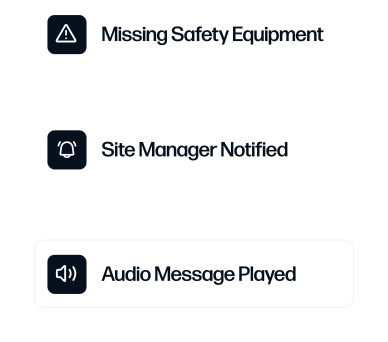




.png)
.png)
.png)
.svg)