






Understanding the basics
Video AI agents: Intelligent software that analyzes video feeds to detect specific behaviors, objects, or anomalies (like a person entering a restricted zone) and triggers automated responses.
False positives: Incorrect alerts triggered by routine motion, such as wind blowing a tarp or a stray animal, which often plague traditional motion detection systems.
Human-in-the-loop: A security workflow where AI filters the vast majority of data, but a human verifies critical alerts to ensure accuracy and determine the appropriate response.
Virtual perimeter: A digital boundary drawn on a camera feed that triggers an alert only when a person or vehicle crosses it, rather than alerting on all motion within the frame.
Every general superintendent knows the sinking feeling of arriving at the job site on a Monday morning to find the gate chain cut. It isn’t just the cost of the stolen skid steer or the missing copper wire that hurts—it is the operational cascade that follows. You face police reports, insurance paperwork, rapid schedule delays, and the scramble to find rental replacements at premium rates.
For years, construction site security relied on two imperfect options: expensive human guards who cannot be everywhere at once, or passive camera systems that merely record the crime for you to watch later. Neither option fully addresses the core problem: responding quickly to incidents to reduce damage.
Today, video technology has evolved from passive recording to active deterrence. By deploying an AI security guard for construction sites, operations leaders can now replicate human-like discernment and response capabilities at scale. This approach does not just record theft; it helps deter unwanted activity by detecting threats in real-time and distinguishing between a plastic tarp flapping in the wind and a genuine intruder.
The high cost of reactive security on construction sites
For a site superintendent, security is not just about mitigating theft; it is about protecting the project schedule (SPI) and budget (CPI). The construction industry faces estimated annual theft losses ranging from $300 million to $1 billion (Source: National Equipment Register). However, the direct replacement cost is often the smallest part of the equation.
When a critical piece of equipment disappears, the ripple effects are swift:
Schedule delays: Work stops while crews wait for replacement tools or materials.
Insurance premiums: Repeated claims can lead to higher deductibles or coverage exclusions.
Operational distraction: Superintendents spend hours filing reports and managing investigations instead of managing trades.
Morale impact: Crew productivity drops when workers feel the site is insecure or disorganized.
Why traditional motion detection fails superintendents
To combat these risks, many sites install standard motion detection cameras. Unfortunately, these systems often create more problems than they solve due to excessive false alarms. A standard motion sensor cannot tell the difference between a thief and a stray dog, leading to "alert fatigue."
Security teams receive an average of 11,000 alerts daily, with up to 70% being false positives (Source: Databahn.ai). For a superintendent managing a 20-acre site, getting pinged every time the wind blows is unsustainable. Eventually, notifications get turned off, and the construction site security pain points remain unresolved.
How Spot AI addresses superintendent roadblocks
To move from reactive firefighting to more proactive control, video systems must understand the context of the job site. Spot AI maps directly to the core frustrations found in construction operations:
Superintendent pain point | Spot AI solution | Benefit |
|---|---|---|
Reactive Security (Finding out about theft the next day) | Vehicle/Person Enters No-go Zones | Detects potential intruders in real time, enabling a faster response to minimize the risk of theft. |
False Alarm Fatigue (Wasting time on non-events) | Intelligent AI Agents | Distinguishes between routine site activity or weather and genuine security events. |
Information Silos (Disconnected data) | Unified Cloud Dashboard | Accessible from any device, integrating security data with daily operations. |
Safety Compliance (Manual spot checks) | Missing PPE Detection | Automatically identifies workers without hard hats or vests to support OSHA compliance. |
Equipment Loss (Misplaced assets) | Vehicle/Forklift Absent | Alerts managers when equipment moves from designated laydown areas. |
Implementing human-like responses to deter unwanted activity
The goal of an AI security guard for construction sites is to mimic the logic and responsiveness of a human guard without the physical limitations. This involves three distinct phases: detection, verification, and response.
1. Intelligent detection beyond simple motion
A human-like AI security response starts with understanding what an incident looks like. Unlike simple pixel changes, video AI analytics can identify specific objects and behaviors.
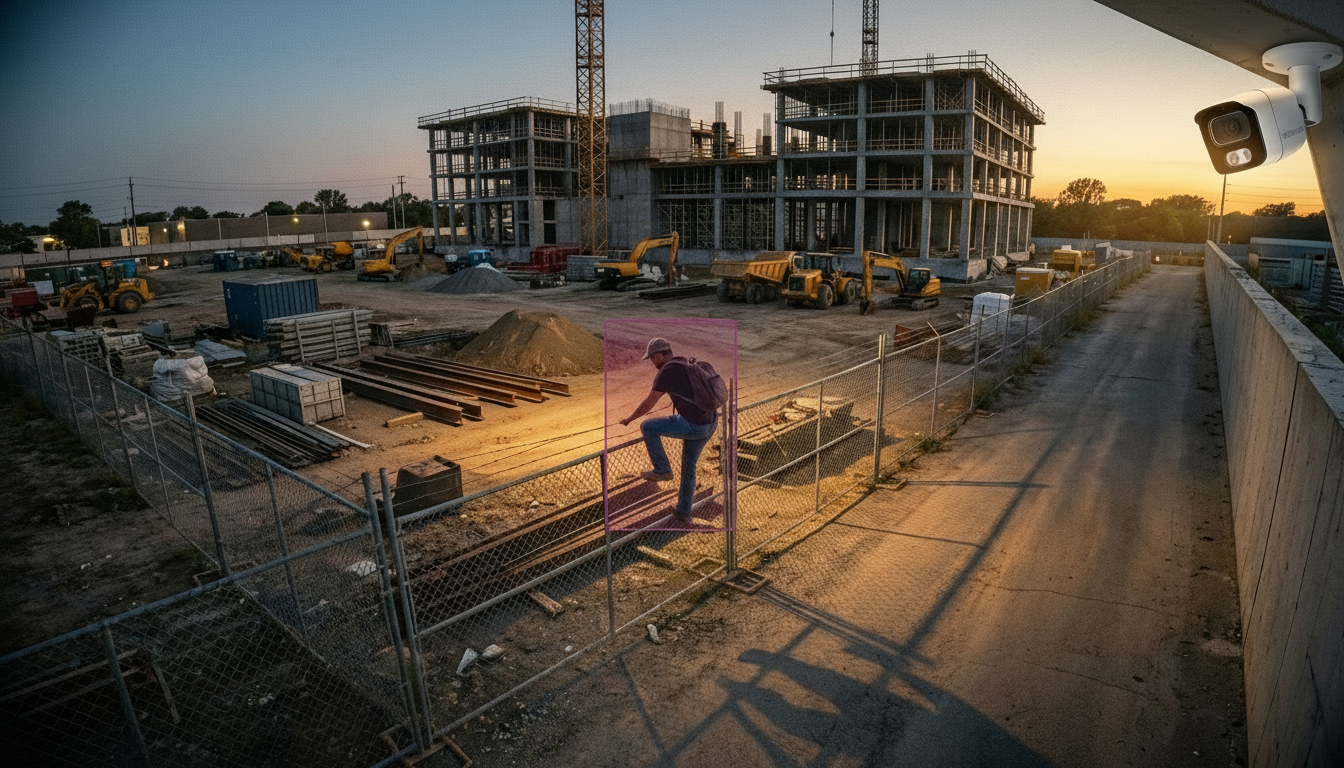
Virtual perimeters: You can draw digital lines around laydown areas or site boundaries. The system ignores traffic passing by outside the fence but triggers an alert the moment a person enters no-go zones.
Loitering detection: If a vehicle pulls up to the gate at 2 AM and stays there, the system recognizes this as suspicious behavior, distinct from a vehicle simply driving past.
Vehicle recognition: AI can identify unauthorized vehicles entering the site, helping to guard against theft at construction sites by flagging unknown trucks near material storage.
2. Filtering out the noise
A human guard knows that a tumbleweed is not a security event. AI agents now possess similar discernment. By using deep learning models trained on construction environments, these systems filter out environmental noise—rain, snow, shadows, and wildlife—that typically triggers false alarms. This can lower the number of false positives significantly (Source: Avatier), helping ensure that alerts are more actionable.
3. Real-time intervention
When a valid incident is detected, speed is critical. AI systems process video in real-time, generating alerts in seconds. This allows for timely action, such as:
Triggering on-site talk-down speakers to warn intruders they are being watched.
Notifying remote monitoring services to dispatch law enforcement.
Alerting the superintendent via mobile app to verify the situation.
This rapid response capability helps cameras play a more active role in deterring vandalism on job sites.
Enhancing safety and accountability with AI teammates
While security is a primary driver, the same AI cameras for construction security can double as operational teammates. For a General Superintendent, the ability to monitor safety compliance and subcontractor accountability without physically walking the entire site can improve efficiency.
Automating safety compliance
Ensuring hundreds of workers adhere to safety protocols is a constant hurdle. AI agents can continuously scan for safety violations that put the project at risk of OSHA citations or stop-work orders.
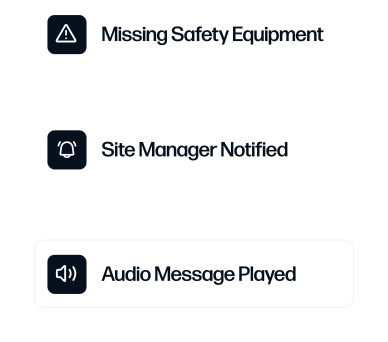
Missing PPE: The system detects individuals not wearing hard hats or high-visibility vests and flags these instances for review. This allows you to conduct targeted "toolbox talks" rather than blanket warnings.
Restricted access: Identifying workers entering hazardous zones, such as active demolition areas or crane swing radiuses, helps reduce the risk of accidents.
Unsafe behavior: AI can identify people running or climbing in designated unsafe areas, helping you address risky behaviors before an incident occurs.
Improving subcontractor accountability
Disputes over schedule delays or site damage often devolve into finger-pointing. Video AI analytics for construction provides objective, time-stamped evidence to resolve these issues quickly.
Delivery verification: Confirm exactly when materials arrived and who signed for them.
Damage attribution: If finished work is damaged, video evidence can pinpoint exactly when it happened and which trade was responsible.
Work progress: Automated time-lapse and activity monitoring help verify if subcontractors had the reported headcount on site.
Comparison: Spot AI vs. traditional systems vs. human guards
When evaluating best security systems for construction superintendents, it is important to compare the total value and operational impact.
Feature | Spot AI | Traditional Camera Systems | Human security guards |
|---|---|---|---|
Detection Speed | Real-time | Post-incident (Reactive) | Real-time (if looking) |
False Alarm Rate | Low (AI filtered) | High (Motion based) | Low |
Coverage | Wide coverage / 24/7 monitoring where cameras are installed | Limited by camera count | Limited by patrol route |
Cost Efficiency | High (Scalable software) | Medium (Hardware heavy) | Low (High labor cost) |
Data Value | High (Searchable, Safety, Ops) | Low (Video only) | Low (Logbook only) |
Deployment | Fast (Plug-and-play) | Slow (Complex wiring) | Quick |
5 steps to deploy AI security on your job site
Implementing automated incident detection for construction technology does not require a complete overhaul of your infrastructure. Modern solutions are designed for the temporary and rugged nature of construction environments.
Assess high-risk zones: Identify your primary access points, material laydown areas, and tool storage containers. These are your priority zones for minimizing intrusion risk on construction sites.
Choose flexible hardware: For sites without permanent power or internet, consider solar-powered trailers or pole-mounted units that connect via cellular (4G/5G) networks.
Establish virtual perimeters: Configure your AI agents to monitor boundaries. Set specific rules for after-hours vs. work hours to avoid triggering alerts during active shifts.
Integrate with workflows: Ensure your security alerts feed into the systems you already use. Spot AI’s open APIs allow for integration with project management tools, ensuring security data isn't siloed.
Train your team: Use the data for coaching, not for assigning blame. Show subcontractors the video evidence of safety wins and misses to build a culture of accountability.
Best practices for maximizing ROI
To get the most out of AI-enabled security guard response technology, look beyond simple theft mitigation.
Cut investigation time: Use AI-powered search ("show me all red trucks from Tuesday") to shorten investigation time from hours to minutes.
Negotiate insurance rates: Many insurers offer lower premiums for sites with documented, insight-driven security measures (Source: Roehr).
Optimize equipment use: Track vehicle/forklift absent alerts to understand utilization rates. If a rental lift sits idle for three days, you can off-hire it sooner to save costs.
Make Security a Strategic Asset, Not a Liability
The role of the site superintendent is evolving. You are no longer just managing construction; you are managing data, risk, and logistics at a scale that manual processes cannot support. Relying on reactive video systems that only record crime is a liability your project cannot afford.
By adopting human-like AI monitoring systems, you gain a system that offers around-the-clock observation and helps filter out noise so you can focus on building. From deterring unwanted activity at the perimeter to supporting safety compliance in the building, video AI helps your cameras provide more actionable information.
Want to see how Spot AI’s video AI platform works on a real job site? Request a demo and experience intelligent security in action.
Frequently asked questions
What are the best practices for construction site security?
Effective security combines physical barriers with intelligent monitoring for the construction industry. Best practices include establishing a secure perimeter with fencing, ensuring adequate lighting, using AI-enabled cameras for real-time alerts for construction security, and maintaining strict access control logs. Regularly reviewing video data to identify and address vulnerabilities is also critical.
How can AI improve security on construction sites?
AI improves security by transforming passive cameras into active detectors. It enables automated incident detection for construction by identifying unauthorized people or vehicles in real-time, lowering false alarms through intelligent filtering, and allowing for a faster response to potential theft. It also supports safety by detecting PPE violations and unsafe behaviors.
What technologies are most effective for deterring theft?
The most effective technologies combine AI cameras for construction security with on-the-spot deterrence mechanisms. This includes virtual perimeter detection, loitering alerts, and license plate recognition. Systems that offer remote construction site monitoring solutions allow for 24/7 oversight without the high cost of on-site guards.
How do I implement real-time monitoring on a construction site?
Implementing real-time monitoring on a construction site typically involves deploying mobile camera units, such as solar-powered trailers or pole-mounted cameras, that connect via cellular networks. These systems link to a cloud-based dashboard where AI agents analyze footage and send verified alerts to superintendents or monitoring centers.
What are the ROI considerations for AI security solutions?
ROI is calculated by comparing the cost of the system against averted losses (theft and vandalism), lower insurance premiums, and operational savings. For example, deterring a single major equipment theft can often exceed the annual cost of the system. Additionally, labor savings from less time spent on manual site walks and investigations contribute significantly to ROI.
About the author
Rish Gupta is CEO and Co-founder of Spot AI, focused on business strategy and practical applications of video intelligence. With experience in AI-powered security, Rish helps organizations get more value from their video data.






.png)
.png)
.png)