






Managing multiple manufacturing facilities often feels like navigating a dense fog. You know the machinery is running and the shifts are staffed, yet you lack real-time visibility into what is actually happening on the production floor. For many operations leaders, video systems are simply reactive tools—passive recording devices used only after an incident occurs. By then, the damage to production schedules or safety records is already done.
The shift to an AI video management system (AI VMS) changes this dynamic. Instead of storing hours of footage that no one watches, an AI VMS serves as an assistant that monitors operations, safety, and security. It turns video data into useful insights, helping teams standardize shifts, reduce downtime, and support compliance without adding headcount.
This article explores how an AI VMS provides a fast, secure, and user-friendly platform for operations, using your existing cameras to capture context that supports better operations.
Key terms to know
Before discussing the specific benefits, it is helpful to define the core technologies driving this shift in manufacturing operations.
Term | Definition |
|---|---|
AI VMS | An AI-driven video management system that uses computer vision to analyze video feeds in real time, detecting specific behaviors, objects, and anomalies automatically. |
Computer Vision | A field of artificial intelligence that enables systems to "see" and interpret visual data, identifying patterns like missing PPE or blocked exits without human intervention. |
Edge Computing | Processing data locally on hardware at the facility rather than sending all raw video to the cloud. This reduces bandwidth usage and latency. |
OEE (Overall Equipment Effectiveness) | A gold standard for measuring manufacturing productivity, calculated based on availability, performance, and quality. |
False Positive | An incorrect alert generated by a system, such as a shadow triggering a motion alarm. AI helps minimize these by understanding context. |
Solving the manual investigation time drain
One of the most persistent frustrations for operations leaders is the time lost to manual investigations. When a safety incident or production stoppage occurs, finding the relevant footage often involves hours of scrubbing through timelines. This pulls site managers and superintendents away from high-value tasks, turning them into video analysts.
An AI VMS solves this by indexing video metadata, making footage searchable much like a web browser. Instead of watching hours of video, a user can search for specific attributes—such as "person," "vehicle," or "forklift"—and swiftly retrieve relevant clips.
Benefits of intelligent video search:
Rapid incident resolution: teams can locate specific events in minutes, not days, allowing for timely coaching and process improvements.
Keyword-based retrieval: the system converts visual data into searchable terms, eliminating the need to know the exact time an event occurred.
Productivity gains: by shortening investigation time, project managers and supervisors reclaim hours each week for proactive planning.
Gaining visibility across multiple sites
Managing operations across dispersed manufacturing plants or distribution centers creates substantial visibility gaps. Leaders often struggle to allocate resources effectively because they lack a unified view of activity levels and risks across all locations. Traditional on-premise systems trap data in local silos, making remote oversight impractical without a VPN or site visit.
A cloud-native AI VMS unifies these disparate feeds into a single dashboard. This allows executives to monitor twenty or more sites simultaneously from any device, helping teams follow standard operating procedures (SOPs) more consistently across locations.
How centralized visibility improves operations:
Remote accessibility: authorized users can view live feeds and recorded footage from any location, facilitating real-time decision-making without travel.
Standardized performance: leaders can compare workflows across sites, identifying top-performing facilities and replicating their processes elsewhere.
Scalable management: a unified platform enables the management of more sites per supervisor, acting as a force multiplier for lean teams.
Transforming reactive security into forward-looking risk management
False alerts are a major source of fatigue for security and operations teams. Traditional motion detection systems are easily triggered by weather, shadows, or animals, leading staff to ignore notifications potentially missing genuine incidents. This "cry wolf" effect leaves facilities vulnerable to theft and unauthorized access.
Video AI analytics filter out this noise by distinguishing between routine motion and actual incidents. By recognizing the difference between a person, a vehicle, and a harmless environmental factor, the system helps ensure alerts are meaningful and actionable.
Impact on security and risk:
Fewer nuisance alarms: AI filtering minimizes nuisance alerts, allowing teams to focus on real security incidents.
Real-time intervention: timely alerts for unauthorized entry or loitering enable security personnel to intervene via two-way audio before a loss occurs.
Perimeter protection: virtual tripwires and geofencing protect hazardous or restricted zones, triggering alerts only when specific boundaries are breached.
Driving operational efficiency and minimizing downtime
Beyond security, AI VMS technology can positively impact Overall Equipment Effectiveness (OEE). Unplanned downtime and inefficient changeovers are costly disruptions that are often difficult to diagnose with data logs alone. Video adds the missing context, showing exactly why a machine stopped or why a changeover took longer than scheduled.
By visualizing production bottlenecks, manufacturers can move from guesswork to data-informed improvements.
Operational improvements driven by video AI:
Downtime analysis: video evidence allows teams to categorize downtime causes accurately (e.g., material jam vs. operator error), enabling targeted fixes.
Changeover optimization: visual analysis of changeover procedures helps identify inefficiencies, often shortening changeover times by 15-30% through standardized best practices (Source: Spot AI).
Cycle time reduction: identifying parallel tasks and process delays through video review helps streamline workflows and increase throughput.
Automating compliance and safety documentation
Regulatory compliance is a constant pressure, with OSHA inspections and insurance audits requiring rigorous documentation. Manual record-keeping is prone to error and often fails to capture the reality of the shop floor. An AI VMS automates this process, creating a reliable audit trail of safety adherence.
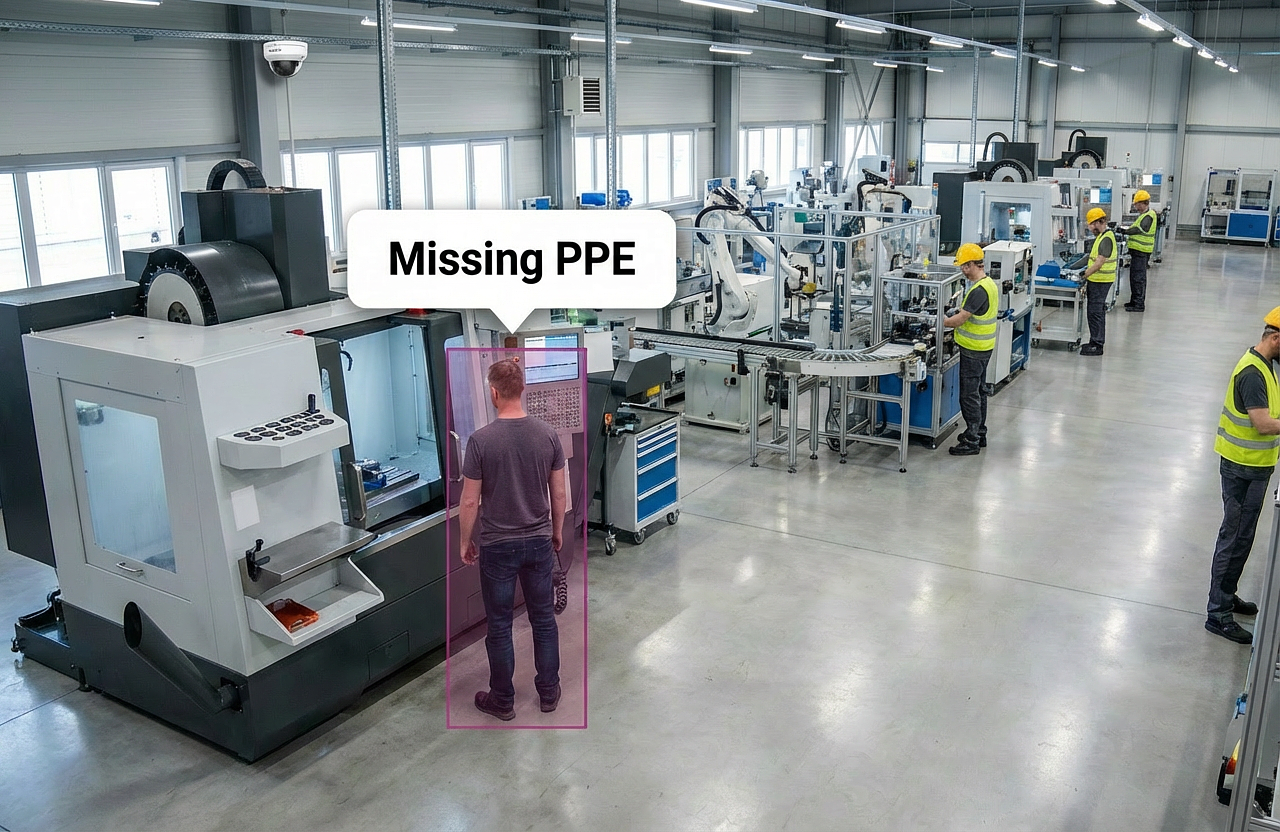
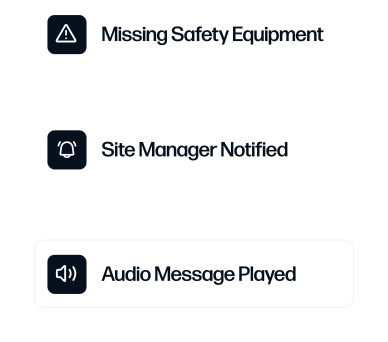
The system can detect specific safety violations, such as missing PPE or entry into dangerous zones, and log them automatically. This not only simplifies audit preparation but also fosters a culture of safety by providing objective feedback for coaching.
Compliance capabilities:
PPE detection: the system automatically identifies workers missing required safety gear, such as hard hats or high-visibility vests.
Hazard zone monitoring: alerts are triggered when personnel enter restricted areas or get too close to active machinery, helping to avoid accidents.
Audit readiness: automated logs and time-stamped video clips provide verified, time-stamped evidence of compliance for regulatory bodies and insurance carriers.
Comparing video management solutions
When selecting a platform, it is crucial to evaluate how different systems handle deployment, scalability, and intelligence.
Feature | Spot AI | Traditional NVR/DVR | Cloud-Only Cameras |
|---|---|---|---|
Deployment Speed | Plug-and-play; live in minutes | Complex wiring and configuration | Depends on bandwidth availability |
Camera Compatibility | Works with most IP cameras | Proprietary lock-in often required | Proprietary cameras required |
AI Capabilities | Built-in AI agents for ops & safety | Limited or requires expensive add-ons | Basic motion detection usually |
User Limit | Unlimited users | Per-user licensing fees | Per-user fees common |
Bandwidth Usage | Low (Edge processing) | High (if remote viewing) | High (constant upload) |
Ensuring enterprise-grade security and privacy
For manufacturing organizations, data security is paramount. Protecting intellectual property and complying with regulations like GDPR or NDAA requires a robust architecture. An AI VMS must be secure by design, ensuring that video data is encrypted and access is strictly controlled.
Modern platforms utilize edge computing to keep sensitive video data on-premise while sending only metadata and alerts to the cloud. This hybrid approach helps meet strict IT security requirements while still offering the flexibility of remote access.
Security features to look for:
End-to-end encryption: video data should be encrypted both in transit and at rest to mitigate the risk of unauthorized interception.
NDAA compliance: for facilities with government contracts, ensuring hardware components meet National Defense Authorization Act standards is essential.
Granular access controls: role-based permissions ensure that users only see the cameras and data relevant to their specific job function.
Moving from Reactive Recording to Proactive Improvement
The transition from traditional video monitoring to an AI VMS represents a practical upgrade for manufacturing operations. By providing a fast, secure, and user-friendly platform, this technology addresses common pain points like blind spots, manual investigation drains, and disconnected data. It helps leaders proactively manage safety, support compliance, and drive continuous improvement through useful insights.
Rather than just recording problems, an AI VMS helps guard against them. It can improve risk management and optimize changeover times for higher throughput; actual return on investment will vary by organization and insurer decisions.
Want to see Spot AI in action? Request a demo and explore how video AI can streamline your manufacturing operations.
Frequently asked questions
How can AI VMS improve operational efficiency in manufacturing?
An AI VMS improves efficiency by identifying bottlenecks and analyzing production workflows in real time. It helps shorten changeover times by 15-30% through visual analysis of procedures and helps minimize unplanned downtime by enabling rapid root cause analysis of equipment stops (Source: Spot AI).
What are the security benefits of using AI VMS?
An AI VMS strengthens security by significantly filtering out false alarms, ensuring teams focus on genuine incidents. It also provides proactive tools like loitering detection and unauthorized entry alerts, allowing for rapid intervention before theft or damage occurs.
How does AI VMS ensure compliance in manufacturing environments?
The system helps with compliance by monitoring for safety violations such as missing PPE or unauthorized access to hazard zones. It creates time-stamped video logs that serve as objective evidence for OSHA inspections and internal audits.
What features should a manufacturing VMS include?
A manufacturing-focused VMS should include camera-agnostic compatibility, edge computing to minimize bandwidth impact, intelligent search capabilities, and specific AI models for safety (PPE detection) and operations (vehicle/person differentiation).
What is the ROI of implementing AI VMS in manufacturing?
Organizations often report ROI through lower scrap and rework costs, fewer manual data collection tasks, and minimized production downtime; any insurance premium changes depend on the insurer and are not guaranteed.
About the author
Joshua Foster is an IT Systems Engineer at Spot AI, where he focuses on designing and securing scalable enterprise networks, managing cloud-integrated infrastructure, and automating system workflows to enhance operational efficiency. He is passionate about cross-functional collaboration and takes pride in delivering robust technical solutions that empower both the Spot AI team and its customers.






.png)
.png)
.png)