






Unplanned downtime is a significant expense for manufacturers, with individual incidents costing millions (Source: MRO Magazine). For production supervisors, the most frustrating aspect of these losses isn't always a catastrophic machine failure—it is the variability between shifts. One shift hits every target, while the next struggles with the exact same equipment and processes, leading to defects, safety risks, and missed throughput goals.
Conventional methods like paper logbooks and morning huddles often fail to capture the nuance of why these discrepancies occur.
To close this gap, many manufacturers are using video AI to assist teams and improve shift-to-shift consistency. By using cameras as data sources, teams can standardize operations, enhance handover communication, and provide visual evidence to solve problems at the root.
Understanding the roots of shift variability
Before implementing new technology, it is vital to define the specific friction points that hinder consistent performance. For a production supervisor responsible for OEE (Overall Equipment Effectiveness) and safety compliance, the inability to be physically present 24/7 creates substantial operational blind spots.
The "hidden factory" and performance gaps
The "hidden factory" refers to the unutilized production potential masked by average OEE scores. A facility running at 60% OEE is operating at approximately half its true capacity (Source: Symestic). This gap often stems from minor process deviations that go unnoticed during off-shifts.
Without real-time visibility, supervisors face several documented challenges:
Blind spots during off-shifts: Supervisors cannot monitor second and third shifts, leading to anxiety about safety violations or equipment misuse.
Inconsistent SOP adherence: Workers may cut corners or interpret standard operating procedures (SOPs) differently when supervision is lower, leading to quality defects.
Reactive incident response: Legacy video systems require hours of manual review after an incident, making it hard to mitigate risk in real time.
Communication breakdowns: Critical context regarding equipment quirks or quality tweaks is often lost during shift handovers, forcing the incoming team to operate with incomplete information.
The cost of poor communication
Research indicates that conventional shift note systems fail to capture essential context, often locking critical information in emails or individual memory. When a night shift operator adjusts a machine setting to handle a material variance but fails to document the "why" for the morning team, the result is often a morning of scrap and rework. Digital shift note systems cut manager communication time and mitigate missed maintenance calls.
How video AI acts as an intelligent teammate
Video AI helps standard cameras function as intelligent sensors that assist teams by monitoring for specific behaviors and operational anomalies. Instead of only recording footage for later review, these systems can detect deviations and surface insights that help supervisors coach their teams and standardize processes.
1. Standardizing SOP adherence across all shifts
Maintaining consistent SOP adherence is a primary hurdle when supervisors lack direct oversight of off-shifts. Minor deviations—skipping a cleaning step or improper tool staging—accumulate into major quality issues.
Video AI systems address this by monitoring production activities against established procedures.
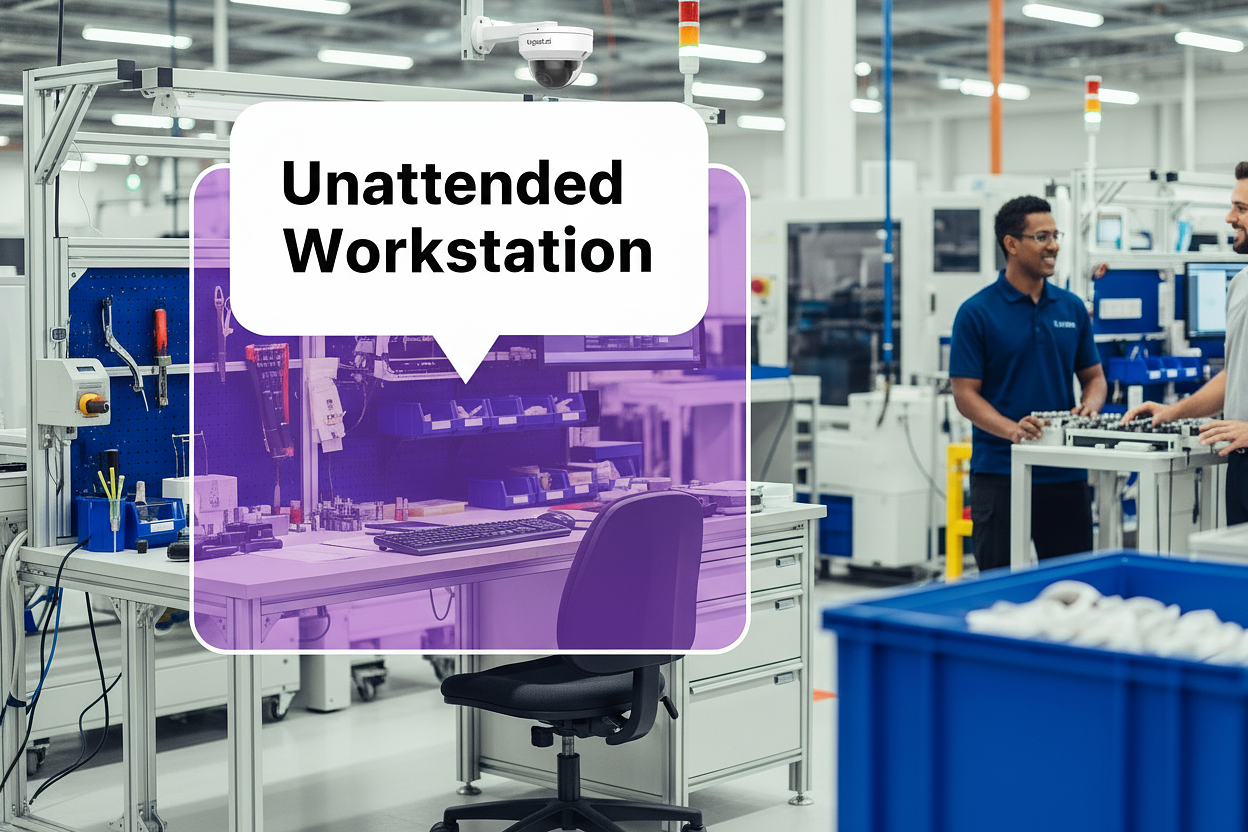
Automated verification: The system recognizes workflow sequences and flags deviations, such as an unattended workstation or a person entering a no-go zone.
Consistency metrics: Supervisors can view adherence metrics to identify which shifts or lines consistently deviate, allowing for targeted, data-backed coaching rather than blanket warnings.
Visual feedback: Showing a team member a clip of the deviation is more effective than a verbal reprimand. Visual information is processed significantly faster than text or verbal instruction (Source: SafetyCulture).
2. Optimizing changeover coordination
Changeover time—the duration required to switch production from one product to another—is a critical factor in OEE. Inconsistent changeovers between shifts can hurt productivity.
Video AI supports Single Minute Exchange of Die (SMED) methodologies by providing an objective timeline of the process.
Benchmarking: Video analysis provides precise measurements of tool staging, adjustment, and testing times.
Identifying bottlenecks: Supervisors can compare a 15-minute day shift changeover against a 45-minute night shift changeover to identify exactly where the delay occurred—whether it was searching for tools or waiting for approval (Source: Center for Lean).
Real-time tracking: Systems can monitor changeover progress and alert supervisors if a changeover exceeds the target duration, allowing for rapid intervention (Source: Spot AI).
3. Accelerating root cause analysis for quality control
When a quality issue arises, the top priority is to understand why it happened and prevent it from recurring. Traditional methods often lead to hours of speculation and manual video review. Video AI accelerates root cause analysis by giving supervisors instant access to the visual context behind a defect, helping them connect the issue to a specific process deviation or equipment malfunction.
Feature | Benefit for production supervisors |
|---|---|
In-process verification | Embeds quality checks at each production stage rather than just the end, minimizing scrap. |
Defect localization | Provides precise coordinates and classification of defects, speeding up root cause analysis. |
Smart Search | Instantly find footage of the specific production run, operator, or machine associated with a quality issue, eliminating hours of manual video review. |
Visual Timelines | Compare the process that produced a defective part against a "golden standard" run to pinpoint exactly where a deviation occurred. |
Collaborative Annotations | Share annotated video clips with engineering or maintenance to provide clear, unambiguous evidence for faster problem-solving. |
By using video to quickly identify the root cause of quality deviations—such as an incorrect machine setting or a skipped SOP—manufacturers can resolve issues faster, reduce scrap, and improve First Pass Yield (FPY).
Strengthening shift communication and handovers
To assist teams and improve shift-to-shift consistency, data must move freely between personnel. Video AI bridges the gap between what happened and what is reported.
Digital shift handovers with visual evidence
Conventional logbooks rely on written descriptions that can be vague or illegible. Modern digital handover systems combined with video AI provide a shared record everyone can reference.
Visual context: Instead of writing "machine 4 made a weird noise," an operator can attach a video clip of the incident to the digital shift log. Incoming teams can see and hear the issue before they step onto the floor.
Structured templates: Uniform checklists help ensure that safety observations, equipment status, and quality issues are documented consistently.
Read-back verification: Protocols where incoming supervisors confirm receipt of critical information guard against misunderstandings.
Integrating with collaboration tools
Siloed data slows down response times. Integrating video AI alerts with platforms like Microsoft Teams helps the right people get the right information quickly.
Automated routing: An operational alert from video AI, such as a machine stoppage or process deviation, can swiftly generate a Teams message for supervisors while creating a work order in the maintenance system.
Cross-functional visibility: Maintenance, engineering, and operations can view the same video evidence in a shared channel, facilitating faster problem-solving without the need for physical meetings.
Measuring success: KPIs for shift consistency
To validate the impact of using video AI, supervisors should track specific metrics that reflect stability and efficiency.
KPI | Definition | Impact of video AI |
|---|---|---|
Shift performance consistency score | The variation in output between shifts. | Organizations have seen 15–30% lower shift variability within 90 days of implementation (Source: Spot AI). |
Overall equipment effectiveness (OEE) | Availability × Performance × Quality. | Identifying micro-stops and changeover delays can help recover hidden capacity. |
First pass yield (FPY) | Percentage of units produced correctly the first time. | Automated inspection and SOP monitoring raises First Pass Yield (FPY). |
Mean time to repair (MTTR) | Average time to fix failed equipment. | Video evidence helps technicians diagnose the root cause remotely, speeding up repairs. |
Spot AI vs. traditional video systems
When evaluating tools to assist teams and improve shift-to-shift consistency, it is important to distinguish between passive recording and active video AI agents.
Feature | Spot AI | Traditional / legacy monitoring systems |
|---|---|---|
Deployment speed | Plug-and-play hardware can connect to existing cameras quickly, often within minutes depending on setup. | Often requires "rip-and-replace" of cameras and extensive cabling. |
Intelligence | AI Agents actively detect SOP violations, safety risks, and bottlenecks. | Passive recording; relies on humans to watch hours of footage. |
Accessibility | Cloud-based dashboard accessible from most devices with internet access. | Footage often locked in a local server room; difficult to access remotely. |
Collaboration | Built-in tools to share clips, annotate video, and integrate with Teams. | Difficult to export or share footage; often requires physical USB transfer. |
Searchability | Smart search helps find events (e.g., "red forklift") quickly. | Manual scrubbing through timelines takes hours. |
Spot AI is designed to support operations leaders. By making computer vision accessible, it helps production supervisors manage multi-zone coverage and standardize shifts efficiently.
Best practices for implementation
Implementing video AI is not just a technical upgrade; it also affects team processes and norms.
Start with a pilot: Focus on a high-impact use case, such as monitoring a specific bottleneck or safety zone, to demonstrate quick wins.
Involve the team: Position the technology as a tool to "assist teams" and reinforce safety, not to police individuals. Explain how it reduces manual logging and protects them from false accusations.
Standardize the response: Define clear protocols for who receives alerts and what actions they must take. An alert without a workflow is just noise.
Review and coach: Use the data in daily huddles. Show the team the trends—both positive (improved safety) and negative (SOP drift)—to drive continuous improvement.
Standardize Every Shift and Close Performance Gaps
Inconsistent shifts are not inevitable. They are often the result of information gaps that conventional tools cannot close.
By using video AI to assist teams and improve shift-to-shift consistency, production supervisors can get a more complete view of their operations.
From reducing changeover times and ensuring consistent work processes to helping the third shift operate as safely and efficiently as the first, video AI helps teams work more consistently. It turns video footage into usable operational context, helping leaders move from reactive firefighting to planned improvements.
Curious how Video AI Agents can help you standardize shift performance? See Spot AI in action with a personalized demo.
Frequently asked questions
What are the best practices for shift handover?
Effective shift handovers require preparation, structured communication, and verification. Best practices include reviewing shift performance metrics before the meeting, using a standardized checklist (covering safety, quality, and equipment status), and utilizing digital logs with visual evidence (photos/video) to improve clarity. A "read-back" protocol where the incoming supervisor confirms critical details is also essential (Source: SafetyCulture).
What tools can enhance team collaboration in manufacturing?
Tools that unify communication are critical. This includes digital shift log platforms that centralize operational notes and video AI systems that integrate with collaboration apps like Microsoft Teams. These integrations allow alerts and visual evidence to flow directly into team chat channels, enabling faster cross-functional problem solving between operations, maintenance, and engineering (Source: Microsoft Manufacturing).
How can you minimize downtime in manufacturing?
Minimizing downtime requires moving from reactive to planned maintenance strategies. Video AI and IoT sensors can surface equipment condition context (e.g., vibration, temperature) so teams can investigate issues sooner. Additionally, analyzing video of changeovers helps teams apply SMED principles to curtail planned downtime, while real-time alerts allow for faster response to micro-stops (Source: MachineMetrics).
What are the benefits of using video analytics in factories?
Video analytics offer improved safety through automated hazard detection (e.g., missing PPE), higher operational efficiency by identifying bottlenecks, and better quality control. They also lower administrative overhead by automating parts of data collection and incident review, allowing supervisors to focus on coaching and process improvement (Source: Spot AI).
About the author
Sud Bhatija is COO and Co-founder at Spot AI, where he scales operations and GTM strategy to deliver video AI that helps operations, safety, and security teams boost productivity and reduce incidents across industries.






.png)
.png)
.png)