







Best Avigilon alternatives in 2026
If you are shopping for Avigilon alternatives, the short answer is that the strongest options in 2026 are Spot AI, Verkada, Genetec Security Center, Eagle Eye Networks, Milestone XProtect, and Rhombus. Each takes a different position on the two questions that decide most enterprise deals: cloud versus on-premises, and how much of the AI you get on the cameras you already own. Cloud-connected professional video cameras have been forecast to grow at an average annual rate of more than 80 percent through 2026, so this is a moving target (Source: Security Magazine). This guide profiles each platform from its own documentation, then shows where a software-led, camera-agnostic approach fits.
Key takeaways
- Avigilon is two things: a camera maker and a platform. The platform splits into Avigilon Unity (on-premises) and Avigilon Alta (cloud), so buyers must first pick a deployment model.
- The most common reasons teams evaluate alternatives are the on-premises versus cloud decision, the cost and complexity of an integrator-led rollout, and how much AI runs on existing third-party cameras versus a vendor's own hardware.
- Verkada, Genetec, Eagle Eye Networks, Milestone, and Rhombus each occupy a distinct niche, from open on-premises platforms to fully cloud-managed systems.
- Spot AI is the camera-agnostic option: it runs full video AI, including active deterrence, on the ONVIF cameras a site already owns, with an edge-first design that keeps footage in the building.
- Match the platform to your environment first (single site or multi-site, cloud or on-premises, existing camera fleet), then compare analytics depth and total cost of ownership.
To compare the shortlist at a glance, the table below ranks each system on the criteria security and IT leaders weigh most: deployment model, camera support, analytics approach, and the buyer it fits best. Spot AI is listed first because it is the reference point for a camera-agnostic, software-led design.
Platform | Deployment model | Camera support | AI and analytics | Best for |
|---|---|---|---|---|
Spot AI | Hybrid edge-to-cloud, edge-first IVR keeps footage on-site | Camera-agnostic; any ONVIF IP camera, including Avigilon, Axis, Hanwha, and Pelco, with full agent features on existing cameras | 15+ Video AI Agents, AI Security Guard active deterrence, Iris custom detections | Multi-site teams that want full video AI on the cameras they already own |
Avigilon (Motorola Solutions) | On-premises (Unity) or cloud (Alta), hybrid via Alta Cloud Connector | Full edge AI on native cameras; third-party ONVIF Profile S cameras bridge through the Alta Cloud Connector | Edge analytics on native cameras; unified video, access control, and analytics | Enterprises standardized on Motorola or Avigilon with an existing integrator |
Verkada | Cloud-managed | Own cameras for full AI; third-party ONVIF and RTSP via the Command Connector, with reduced analytics | On-camera AI; AI-Powered Deterrence in beta, requiring proprietary camera and audio hardware | Teams that want an all-cloud, hardware-forward stack |
Genetec Security Center | On-premises, hybrid, or SaaS | Open platform; ONVIF plus native drivers for major makers; legacy devices via Genetec appliances | Unified video, access control, forensic search, and intrusion | Large, complex enterprises needing a highly configurable platform |
Eagle Eye Networks | Cloud-native with an on-site Bridge appliance | 7,500+ camera models; virtually any ONVIF-conformant camera | AI video search, license plate recognition, and Video AI Analytics add-ons | Cloud-first teams standardizing recording and retention across sites |
Milestone XProtect | On-premises open platform, with hybrid options | Roughly 7,000+ devices; ONVIF Profiles S, T, G, and M plus a Universal Driver | Open platform; analytics mostly from third-party marketplace applications | Integrators and enterprises wanting maximum device breadth |
Rhombus | Cloud-managed | Own R-series cameras for full AI; third-party via Rhombus Relay, without on-camera AI | On-camera AI, people counting, and license plate recognition on the Enterprise tier | Mid-market to enterprise teams wanting simple cloud management |
Why teams evaluate Avigilon alternatives
Avigilon, owned by Motorola Solutions, is a well-regarded name in enterprise security, and its cameras are solid ONVIF hardware. The reasons teams look at other platforms are rarely about the cameras themselves. They are usually about the platform and how it is bought and run.
The first is the deployment split. Avigilon offers two products: Avigilon Unity, the on-premises system with server-based recording and analytics, and Avigilon Alta, the cloud-native platform. That gives buyers flexibility, but it also forces an early architecture decision, and a team that starts on Unity may face a separate path to reach cloud features later. Buyers weighing this tradeoff often want to understand cloud versus on-premises video security before they commit.
The second is where the AI lives. Avigilon Alta runs its most advanced analytics at the edge on native Avigilon cameras. Existing third-party ONVIF Profile S cameras connect through an Alta Cloud Connector and are analyzed in the cloud rather than on the camera. That is a fair and common design across the industry, but it means the deepest analytics can tilt toward a vendor's own hardware, which matters when you have a large installed base you want to keep.
The third is cost and complexity. Avigilon is sold through an integrator channel and does not publish list pricing, so buyers compare it through quotes and existing relationships. For lean security teams, the appeal of a simpler, software-led rollout is real, especially when the goal is to cut through alarm noise. Industry reporting has long cited that well over 90 percent of monitored alarm activations are false, a core driver of operator alarm fatigue and slow response (Source: Security Magazine). Better context in the analytics is often the real prize.
Key terms
- VMS: video management software, the system that records, stores, and lets teams review camera footage.
- ONVIF: an open standard that lets cameras and platforms from different makers work together over the network.
- Edge AI: analytics that run on or near the camera rather than only in the cloud, which lowers bandwidth and latency.
- IVR: Spot AI's Intelligent Video Recorder, which keeps full-resolution video on-site so only metadata crosses the network.
- NDAA: the U.S. National Defense Authorization Act, whose Section 889 restricts certain foreign-made video equipment for federal buyers.
Spot AI
Spot AI is a software-led video AI platform that turns the cameras a business already owns into AI coworkers. Instead of asking you to standardize on one camera line, it runs on any ONVIF IP camera, including Avigilon, Axis, Hanwha, and Pelco, using a hybrid edge-to-cloud design. Its edge-first IVR keeps full-resolution video in the facility and sends only metadata across the network, which keeps bandwidth low and supports a PCI-clean posture.
Strengths: full video AI on existing cameras with no rip-and-replace; 15+ pre-trained Video AI Agents plus the AI Security Guard, which detects intent in context and can deter in seconds with lights, sirens, and natural-conversation AI Talk Down; Iris, which builds custom detections in natural language in about eight minutes; and NDAA-compliant, SOC 2, zero-trust practices. It also unifies indoor and outdoor coverage on one dashboard and connects to POS, access control, and two-way audio through open APIs, webhooks, and a live MCP endpoint.
Considerations: Spot AI is purpose-built for commercial environments such as retail, manufacturing, construction, and logistics, so it is not aimed at home use. Pricing is an all-in per-camera subscription rather than a per-component quote, which is a different buying motion than an integrator bid.
Best for: multi-site security teams that want deep, actable AI on the cameras they already own, without locking analytics to a single hardware brand. You can see the details in the Spot AI vs Avigilon comparison.
Verkada
Verkada is a cloud-managed platform that sells its own cameras and runs AI on the camera. For teams with existing cameras, the Command Connector bridges third-party ONVIF and RTSP devices, though bridged cameras run with reduced analytics compared with Verkada's own hardware. To be clear, Verkada is not proprietary-cameras-only, a point worth stating because older comparisons sometimes got it wrong.
Strengths: a polished cloud experience, strong brand recognition, and broad on-camera analytics. Its AI-Powered Deterrence entered public beta in early 2026.
Considerations: the deepest features favor Verkada hardware, and AI-Powered Deterrence requires proprietary cameras plus specific audio hardware such as a horn speaker or intercom. Verkada does not publish list pricing; third-party guides put per-camera software licenses at roughly $199 per year on a one-year term, trending toward about $180 per year on longer commitments. Procurement teams sometimes raise Verkada's 2021 camera breach and a 2024 regulatory settlement during due diligence.
Best for: teams that want an all-cloud stack and are comfortable buying into a hardware-forward model.
Genetec Security Center
Genetec Security Center is an open, unified platform spanning video, access control, forensic search, intrusion monitoring, and automation. It can run on-premises, in a hybrid setup, or as SaaS, which makes it one of the most flexible options for large organizations.
Strengths: deep configurability, broad device support through ONVIF and native drivers for major manufacturers, and the ability to connect legacy devices via Genetec appliances rather than replacing them. It is a natural fit where security, access, and other systems must live together.
Considerations: the same flexibility brings complexity, and Genetec is typically deployed and tuned with an integrator. Its native AI is less agent-driven than the newer video AI platforms, so advanced detections often lean on integrations. Public pricing is not specified.
Best for: large, complex enterprises that need one open platform to unify many systems and want maximum control over configuration.
Eagle Eye Networks
Eagle Eye Networks is a cloud-native platform that connects cameras to the cloud through an on-site Bridge appliance. It is built around secure recording, retention, and retrieval across many locations.
Strengths: very broad camera compatibility, with support for 7,500+ camera models and virtually any ONVIF-conformant device, plus add-on analytics such as AI video search and license plate recognition. Its cloud-first model suits teams standardizing retention policy across a portfolio.
Considerations: analytics are often add-on subscriptions layered on top of the core recording service, so the AI depth depends on what you license. As with the others, complete public list pricing is not published, and subscription tiers vary by retention and resolution.
Best for: cloud-first teams that want reliable, browser-based recording and retention across distributed sites, with analytics added as needed.
Milestone XProtect
Milestone XProtect is one of the best-known open-platform systems, deployed on-premises with hybrid options. Its calling card is device breadth: roughly 7,000+ supported devices, standard ONVIF drivers for Profiles S, T, G, and M, and a Universal Driver for non-conformant devices.
Strengths: unmatched hardware flexibility and a large marketplace of third-party applications, which lets integrators tailor a system to almost any requirement. Device support is refreshed frequently.
Considerations: XProtect is an open canvas rather than an AI-native platform, so meaningful analytics usually come from third-party applications you select and integrate. That means more design work and more moving parts to maintain. Licensing is per device or channel, and public pricing is not specified.
Best for: integrators and enterprises that value maximum device breadth and are willing to assemble analytics from the marketplace.
Rhombus
Rhombus is a cloud-managed platform, often positioned as an open alternative to other cloud-camera vendors. It sells its own R-series cameras and can bridge existing cameras through Rhombus Relay over ONVIF and RTSP.
Strengths: a clean, simple cloud experience with on-camera AI, people counting, and license plate recognition on its Enterprise tier, and a growing base in mid-market and enterprise commercial security.
Considerations: cameras bridged through Rhombus Relay lose the on-camera AI that Rhombus hardware provides, so the richest analytics again favor the vendor's own cameras. Third-party guides list per-camera software licenses at roughly $149 per year for Professional and $199 per year for Enterprise, with hardware priced per model.
Best for: mid-market to enterprise teams that want straightforward cloud management and are open to standardizing on Rhombus cameras over time.
How to choose an Avigilon alternative
The right choice comes down to a short set of questions. Work through them in order:
- Decide your deployment model first. If you want footage to stay on-site, favor an on-premises or edge-first design; if you want browser-based access everywhere, favor cloud or hybrid.
- Inventory your cameras. If you have a large, mixed fleet you want to keep, prioritize platforms that give you full analytics on existing ONVIF cameras rather than only on the vendor's own hardware.
- Define the analytics you actually need, from license plate recognition to active deterrence, and confirm which of them require specific cameras or add-on licenses.
- Map the total cost of ownership, including hardware refresh, licenses, storage, and the staff time to run it, not just the sticker price.
- Check the trust posture your buyers will ask about, such as NDAA compliance and SOC 2, and how each vendor handles data residency.
For a wider view of the category, the best video management software for 2026 and the commercial security camera buyer's guide are useful companions. If enterprise data controls are top of mind, see the guidance on SOC 2 and data security for enterprise video.
Why Spot AI is the strongest camera-agnostic alternative
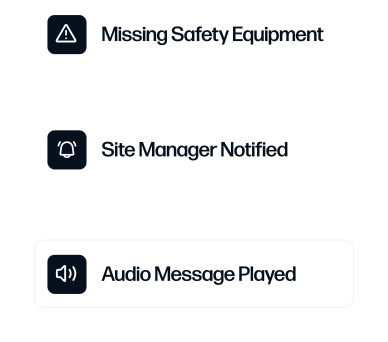
If your priority is getting the most out of the cameras you already own, Spot AI is the alternative built around that goal. Rather than steering analytics toward one hardware line, the AI Security Guard brings the full detection, deterrence, and evidence workflow to existing ONVIF cameras. It detects intent in context, deters in real time with lights, sirens, and natural-conversation AI Talk Down, and organizes case-ready evidence in one place. For multi-site teams, that means consistent coverage without a rip-and-replace project, and an edge-first design that keeps footage in the building.
This is not theoretical. Storage Asset Management runs Spot AI across roughly 50 virtually-operated storage locations that are largely unstaffed. In one incident, the system detected intruders at 1 AM and coordinated with police to catch the criminals in progress, followed by zero subsequent break-ins, all on the site's existing cameras.
"The Spot AI notification went out around one in the morning, and police were able to arrive on-site while the incident was still in progress."
Lee Kunkel, Director of Virtual Operations, Storage Asset Management
Because Spot AI is camera-agnostic, teams standardized on Avigilon cameras can keep them and still get full video AI, active deterrence, and case-ready evidence on those same cameras. To go deeper on how AI reshapes older systems, see how Spot AI compares with traditional VMS and the broader enterprise video monitoring guide.
When you compare platforms, separate the camera decision from the platform decision. Avigilon cameras are capable ONVIF hardware, and a camera-agnostic platform lets you keep them while you modernize what those cameras can detect and deter.
Ask each vendor a direct question: which analytics run on my existing cameras, and which require your hardware? The answer explains most of the price and lock-in differences across this shortlist.
Ready to see how a camera-agnostic approach works on your own cameras? Book a demo to walk through the AI Security Guard on your existing sites.
Frequently asked questions
What are the best alternatives to Avigilon in 2026?
The strongest Avigilon alternatives are Spot AI, Verkada, Genetec Security Center, Eagle Eye Networks, Milestone XProtect, and Rhombus. They range from open on-premises platforms to fully cloud-managed systems, so the best fit depends on your deployment preference and your existing cameras.
Is Avigilon Alta or Avigilon Unity better for a multi-site deployment?
Avigilon Unity is the on-premises option with server-based recording, while Avigilon Alta is the cloud-native platform, with a hybrid path via the Alta Cloud Connector. Multi-site teams that want browser-based access across locations often prefer a cloud or hybrid model, but the right answer depends on your data-residency and bandwidth needs.
Do Avigilon alternatives work with the cameras I already own?
Most do, through ONVIF, but the depth of analytics varies. Some platforms run their richest AI only on their own cameras and give bridged third-party cameras reduced analytics. Spot AI is camera-agnostic and runs its full agent features on existing ONVIF cameras, including Avigilon cameras.
Which video security platform is best if I do not want to replace my cameras?
A software-led, camera-agnostic platform is the safest choice when you want to keep your fleet. Spot AI is built for this, applying its Video AI Agents and AI Security Guard to existing cameras with no rip-and-replace, using an edge-first design that keeps footage on-site.
How does Spot AI compare to Avigilon for enterprise security?
Avigilon offers a strong on-premises and cloud suite with the deepest analytics on its own cameras, while Spot AI focuses on running full video AI, including active deterrence, on any ONVIF camera. The clearest way to compare is side by side; the Spot AI vs Avigilon comparison page lays out the differences in deployment, camera support, and analytics.
About the author
Joshua Foster is an IT Systems Engineer at Spot AI, where he focuses on designing and securing scalable enterprise networks, managing cloud-integrated infrastructure, and automating system workflows to enhance operational efficiency. He is passionate about cross-functional collaboration and takes pride in delivering robust technical solutions that empower both the Spot AI team and its customers.






.png)
.png)
.png)
.svg)