




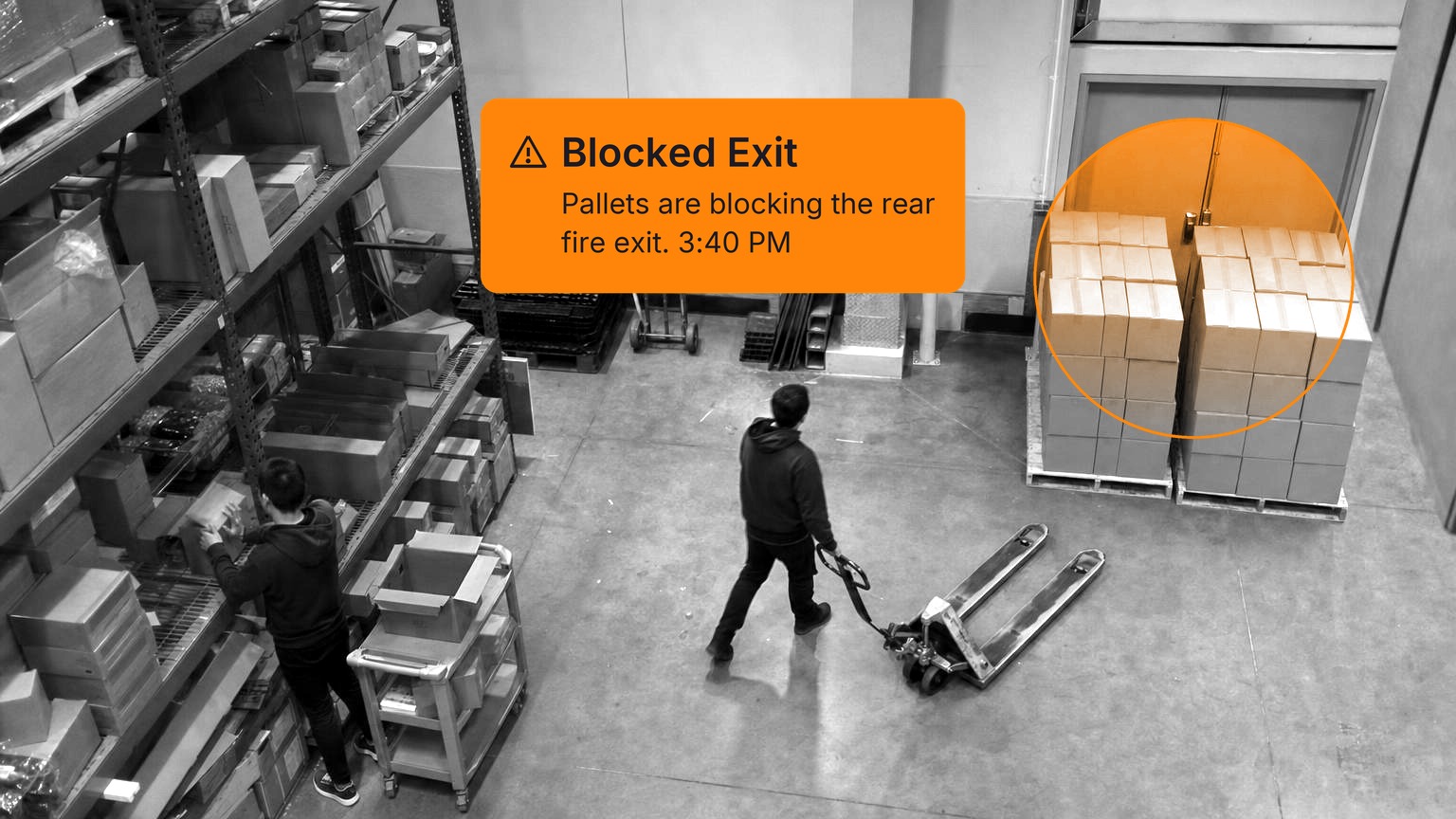


A blocked fire exit doesn't announce itself. It starts with a single pallet of overstock leaned against a back door during a busy Tuesday receiving shift. By Thursday, a second pallet joins it. By the following week, the exit is functionally sealed — and nobody on the team has flagged it because nobody was looking. That quiet drift from "temporary" to "permanent" is how most retail safety violations take root, and it's exactly the kind of hazard that manual walkthroughs routinely miss.
The stakes are concrete: the Occupational Safety and Health Administration (OSHA) can levy penalties of up to $16,550 per serious violation and $165,514 for willful or repeated violations as of January 2026 (Source: PI World). For a retailer operating dozens or hundreds of locations, those numbers compound fast. But the financial exposure is only part of the equation — a blocked exit during an actual emergency puts lives at risk in a way no fine can capture.
This article breaks down the rules behind exit route compliance, calls out the backroom hazards that build up over time, and shows how video AI can automatically flag problems between walkthroughs.
Key terms to know
Two regulatory frameworks govern exit route compliance in retail. Understanding both helps you run a safety program you can stand behind during an inspection.
Term | Definition |
|---|---|
Means of egress | The continuous, unobstructed path from any occupied point inside a building to a public way outside. It includes three components: the exit access (path to the exit), the exit itself (the protected passage), and the exit discharge (the final path to the street or open area) (Source: US Made Supply). |
OSHA Standard 1910.37 | The federal regulation requiring all workplaces — including retail stores — to maintain exit routes that allow occupants to evacuate safely at all times (Source: Infodeck). |
NFPA 101 Life Safety Code | The National Fire Protection Association standard that sets technical design requirements for exit width, travel distance, fire-rated doors, emergency lighting, and signage (Source: JDJ Consulting). |
General Duty Clause | The catch-all provision of the OSH Act holding employers responsible for providing a workplace free from recognized hazards likely to cause death or serious harm (Source: J.J. Keller). |
Together, OSHA 1910.37 and NFPA 101 create a dual obligation: exit routes must exist in your floor plans and remain physically clear during every hour of operation.
Why blocked exits are the most common — and most overlooked — retail violation
OSHA citation data from the 2024–2025 fiscal year confirms that blocked or obstructed exit routes remain among the most frequently cited violations across retail and general industry (Source: OSHA QuickTakes). The violations inspectors flag most often include:
Exits blocked by merchandise, equipment, or storage
Inadequate or obscured exit signage
Non-functional emergency lighting
Exit doors that don't open properly or are locked from the inside
Exit corridors that fail to meet minimum width requirements
What makes these violations persistent is that they rarely result from deliberate neglect. Safety professionals describe the pattern as normalization of deviation — standards erode incrementally as daily operational demands push inventory, displays, or equipment into prohibited areas, and no systematic process catches the drift before an inspection or incident (Source: Kinexio). Retail environments are especially vulnerable because lease spaces are often smaller than ideal, seasonal inventory creates temporary storage needs that become permanent, and backrooms operate out of public view with less management attention (Source: US Made Supply).
The hidden hazards beyond blocked doors
Blocked fire exits get the headlines, but they're rarely the only violation present when an inspector walks through a retail stockroom. Several related hazards tend to accumulate alongside obstructed egress routes.
Electrical panel clearance violations
OSHA Standard 1910.303 requires a minimum of three feet of clear space in front of electrical panels (Source: Emedco). In retail stockrooms, merchandise, cleaning supplies, or seasonal inventory frequently encroaches into this zone. The result: emergency responders can't access disconnect switches quickly, and stored items risk contact with live electrical components.
Fire extinguisher accessibility
OSHA Standard 1910.157 mandates monthly visual inspections of portable fire extinguishers — checking tamper seals, pressure gauges, and proper mounting — with documented results (Source: Creative Safety Supply). When merchandise stacks up around extinguisher locations, both accessibility and inspection compliance break down simultaneously.
Fire-rated door integrity
Fire doors separating sales floors from stockrooms or utility areas must remain closed and fully functional at all times (Source: International Fire and Safety Journal). Loss prevention teams frequently observe these doors propped open for convenience — a practice that completely negates their protective function (Source: Ideal Partners).
Emergency lighting and signage
Exit signs must remain visible from all parts of the building, and emergency lighting must have functional backup batteries tested on a documented schedule (Source: Facility Network). Dead batteries, burned-out bulbs, and signs obscured by seasonal decorations are among the most common maintenance failures in retail (Source: DynaFire).
Hazard category | OSHA standard | Common retail cause | Typical detection gap |
|---|---|---|---|
Blocked exit route | 1910.37 | Overflow inventory, seasonal stock | Missed between quarterly audits |
Electrical panel obstruction | 1910.303 | Stockroom storage creep | Rarely checked outside annual inspection |
Inaccessible fire extinguisher | 1910.157 | Merchandise stacked around mount | Monthly inspection skipped or incomplete |
Fire door propped open | NFPA 101 | Staff convenience in high-traffic areas | Not monitored after initial installation |
Failed emergency lighting | 1910.37 / NFPA 101 | Battery degradation, bulb burnout | Tested infrequently or not documented |
Why manual audits can't keep pace with multi-location retail
How do you maintain exit route compliance across 50, 100, or 400 stores — each with different backroom layouts, different managers, and different inventory pressures?
The traditional answer is periodic safety audits: corporate safety staff or third-party auditors visit each location on a quarterly or annual cycle, walk a structured checklist, and document findings. The approach has clear limitations when applied at scale:
Point-in-time snapshots miss ongoing drift. An annual audit captures compliance status on one day out of 365. A violation corrected the morning of an audit may reappear the following week with no one aware.
Documentation quality varies. One auditor may photograph every finding in detail while another at a different location conducts a cursory walkthrough. Without standardization, trend analysis across the portfolio becomes unreliable (Source: Autosmarts).
Correction timelines stretch. Under manual processes, the average time from violation identification to verified correction can span 18 days or more — the entire period between audit discovery and follow-up verification (Source: SafetyCulture).
Resource constraints force trade-offs. A single auditor conducting 50 store audits per year across a 100-store district leaves half the locations unaudited. Increasing frequency requires proportionally more staff or contractor spend (Source: Qminder).
Store managers prioritize sales metrics. Safety compliance is typically a secondary concern unless an incident occurs or an inspection is announced — creating a structural misalignment between who controls daily operations and who owns compliance outcomes (Source: CAC).
The net effect is an inherently reactive posture: violations develop, persist, and are only discovered after the fact — during a scheduled audit, an OSHA visit, or worse, an incident.
How video AI turns exit monitoring into a 24/7 automated process
Video AI closes the gap in manual audits by catching violations between walkthroughs. Instead of waiting for someone to spot a problem on a walkthrough, a camera already positioned in the stockroom or near a back door can flag an obstruction as soon as it shows up.
Here's how the detection workflow operates in practice:
Zone configuration. Exit routes, electrical panel clearance zones, and fire extinguisher locations are mapped within the camera's field of view based on store floor plans.
Object detection. The system identifies people, merchandise, equipment, and other objects within each frame and assesses whether they occupy designated clearance zones.
Temporal filtering. Brief, incidental obstructions (a worker walking past an exit) are distinguished from sustained violations (a pallet parked in front of a door for hours) through configurable time thresholds.
Alert generation. When a sustained obstruction is detected, the system sends a notification to the manager on duty or the designated safety contact — complete with a time-stamped clip showing the violation.
Audit trail creation. Every alert, response, and correction is logged automatically, building a documented compliance history for each location.
This turns exit route checks from a few times per year into a system that catches issues in real time — including overnight receiving shifts, weekend skeleton crews, and holiday rushes when backroom pressure peaks.
Exception-based reporting keeps alerts meaningful
A common concern is alert fatigue. If the system generates dozens of notifications daily for conditions that don't require action, teams stop paying attention. Well-designed video AI platforms reduce this with exception-based reporting: the system runs continuously but only notifies teams when something is actually out of standard (Source: Quick Response). The result is higher signal-to-noise — fewer distractions, faster decisions on the alerts that matter.
What Spot AI delivers for multi-location retail safety
Spot AI's unified video AI platform is built for multi-site retail teams that need consistent execution across every backroom. The system works with any existing IP camera — no rip-and-replace required — and can be live in under a week.
Several capabilities map directly to the safety compliance obstacles outlined above:
Compliance obstacle | Spot AI capability | Operational outcome |
|---|---|---|
Blocked exits go undetected between audits | No-go zone detection configured around exit routes | Alerts fire when merchandise or equipment enters a designated clearance zone |
Violations persist for days or weeks | Time-stamped alerts sent to manager on duty | Correction happens in hours, not weeks |
Manual audits don't scale across 50+ stores | Cloud dashboard with portfolio-wide visibility | One view across every location, accessible from anywhere |
Inconsistent documentation across locations | Automated audit trail with video evidence | Every detection, alert, and correction is logged with timestamps |
Investigation after an incident takes hours | Intelligent search by time, location, or activity | Relevant footage located in minutes rather than hours |
Camera outages create blind spots | Camera health alerts | Notifications when a camera goes offline, so gaps are addressed before they become liabilities |
Spot AI works with any IP camera and deploys without new wiring, making it practical for retailers who need to extend safety monitoring across existing infrastructure without a capital-intensive hardware overhaul.
Building a safety compliance program that scales
Technology alone doesn't solve the compliance gap. Effective programs combine automated detection with organizational alignment and clear accountability. The following framework reflects best practices documented across multi-location retail implementations:
Start with a pilot. Select 5–10 locations representing different store formats and backroom configurations. Configure detection zones for exit routes, electrical panels, and fire extinguisher locations. Measure baseline violation rates before activation.
Set clear response expectations. Define correction deadlines by severity — for example, exit obstructions corrected within 24 hours, electrical panel violations within 48 hours. Track compliance with these deadlines as a performance metric.
Integrate safety into existing workflows. Route alerts through the same systems store managers already use for facility maintenance. When safety corrections arrive through familiar channels, they receive appropriate priority rather than being treated as a separate, lower-priority process.
Track meaningful KPIs. Measure violations detected per location per period, average time from detection to correction, and correction completion rates. These metrics reveal whether the program is driving sustained behavioral change or just catching the same recurring issues (Source: Safety Champion).
Expand based on evidence. Use pilot data to build the business case for broader rollout. Documented improvements in detection rates and correction times give leadership the proof they need to approve enterprise-wide investment.
Considerations and limitations
No monitoring system eliminates all compliance risk. Several factors deserve honest assessment before and during deployment:
Camera coverage depends on existing infrastructure. Detection only works where cameras have a clear view. Stores with limited camera coverage in backroom areas may need additional hardware to monitor critical exit zones.
Calibration requires iteration. Detection thresholds, time parameters, and zone boundaries need tuning during initial deployment. A system that generates too many alerts for non-issues will lose credibility with store teams. Expect several weeks of refinement during the pilot phase.
Organizational buy-in matters. Store managers who view automated alerts as "corporate policing" will disengage. Framing the system as a tool that helps them stay ahead of compliance issues — rather than one that catches them making mistakes — drives stronger adoption (Source: SeaChange).
Automated detection supports human decision-making. Video AI surfaces likely violations and provides evidence, but corrective action still requires people. The system augments teams; it does not replace the judgment and follow-through that effective safety management demands.
Turning compliance evidence into a strategic advantage
The documentation that automated monitoring generates serves purposes well beyond day-to-day operations. When an OSHA inspector arrives unannounced, having months of time-stamped records showing ongoing monitoring, rapid correction, and declining violation rates demonstrates the kind of systematic due diligence that regulators recognize (Source: Kinexio). Insurance carriers increasingly require documented compliance evidence before renewal, and a clean audit trail can influence both premium negotiations and claims outcomes (Source: Risk Logic).
For leaders responsible for safety outcomes across a region, this shift — from scrambling to prepare for inspections to maintaining a standing record of compliance — changes the conversation entirely. Instead of defending gaps, you're presenting evidence of a program that works.
"In our old approach, we were always reactionary. We'd review footage after an incident occurred, but we needed to move beyond that. With facilities spread across 800 acres, it's impossible for our team to see everything happening in real-time."
Mike Tiller, Director of Technology, Staccato (Source: Spot AI Customer Stories — Staccato)
For teams managing safety compliance across multiple retail locations, Spot AI can flag blocked exit routes, create time-stamped evidence, and help teams verify that issues get resolved. Request a demo to see how Spot AI's video AI platform supports exit-route monitoring between walkthroughs.
Frequently asked questions
What are the OSHA requirements for exit routes in retail
OSHA Standard 1910.37 requires that all exit routes remain continuously unobstructed and accessible during operating hours. Exit doors must open from the inside without keys, special tools, or specialized knowledge. The General Duty Clause adds a broader obligation: employers must maintain a workplace free from recognized hazards that could cause serious injury or death. For retail environments, this means exit routes shown on floor plans must also be physically clear at all times — not just during inspections.
How can video AI help with retail safety compliance
Video AI systems can be configured to monitor designated exit routes, electrical panel clearance zones, and fire extinguisher locations around the clock. When the system detects an obstruction that persists beyond a configured time threshold, it sends an alert to the responsible manager with a time-stamped video clip. This replaces the point-in-time snapshot of a manual audit with ongoing detection, enabling corrections in hours rather than weeks. The system also creates an automatic audit trail documenting every detection and response.
What are the best practices for maintaining clear exit routes
Effective exit route management combines physical controls with monitoring. Mark exit clearance zones with floor tape or paint so boundaries are visible to staff. Designate specific overflow storage areas away from exits so inventory pressure doesn't default to exit corridors. Conduct brief daily safety walks focused on exit routes, and supplement those walks with automated monitoring that catches violations between human checks. Set clear correction deadlines and track compliance as a store-level performance metric.
What are the consequences of blocked fire exits
Financial consequences include OSHA penalties of up to $16,550 per serious violation and $165,514 for willful or repeated violations as of 2026. Beyond fines, retailers face increased insurance premiums, civil liability if an incident occurs at a location with documented violations, and potential workers' compensation claims. The most serious consequence is the safety risk itself: a blocked exit during a fire or other emergency can delay evacuation and put lives in danger.
How do I conduct a fire safety audit in retail
A thorough fire safety audit covers exit routes, fire-rated doors, emergency lighting, exit signage, fire extinguisher accessibility, electrical panel clearance, and hazardous material storage. For each element, verify both the physical condition and the documentation — inspection tags on extinguishers, testing records for emergency lighting batteries, and maintenance logs for fire doors. Use a standardized digital checklist to maintain consistency across locations, and capture photographic evidence of both compliant and non-compliant conditions. Supplement periodic audits with automated monitoring to maintain visibility between scheduled inspections.
About the author
Sud Bhatija is COO and Co-founder at Spot AI, where he scales operations and GTM strategy to deliver video AI that helps operations, safety, and security teams boost productivity and reduce incidents across industries.

