




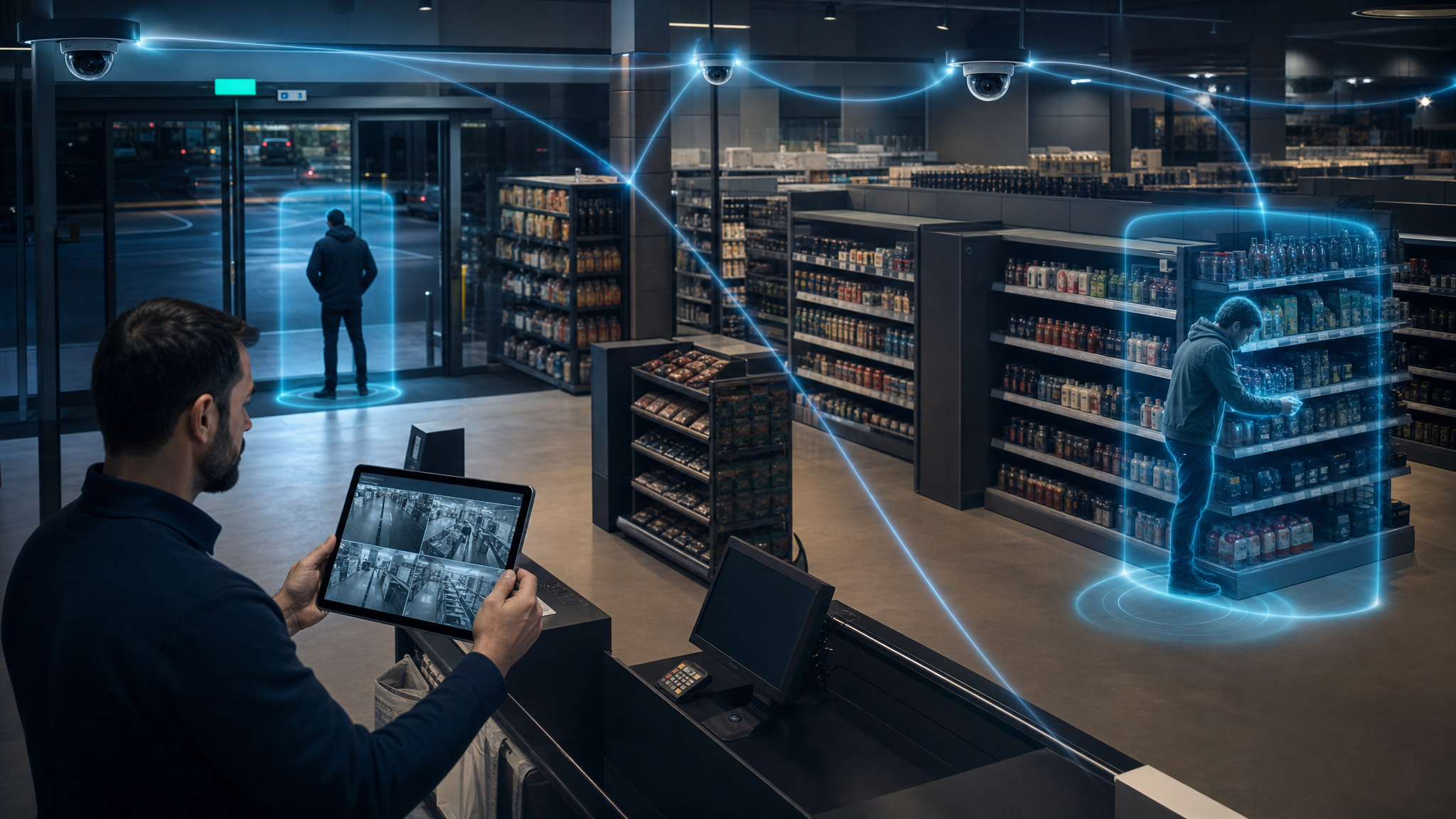


Best Eagle Eye Networks alternatives for retail loss prevention in 2026
If you lead loss prevention for a retail chain, you are not shopping for cloud storage. You are trying to reduce shrink, deter loitering, resolve POS-related cases faster, and stretch guard spend across many stores without adding manual review. The strongest Eagle Eye Networks alternatives in 2026 are camera-agnostic, AI-driven platforms that detect incidents in context, support deterrence in the moment, and produce case-ready evidence. This matters more than ever: retailers saw a 93 percent increase in the average number of shoplifting incidents per year in 2023 compared with 2019, alongside roughly a 90 percent rise in associated dollar losses (Source: National Retail Federation). The loss-prevention AI market is growing accordingly, from 8.4 billion USD in 2025 to a projected 26.7 billion USD by 2034 (Source: Dataintelo).
Key takeaways
- The best Eagle Eye Networks alternatives for retail are judged on shrink reduction, response time, and investigation speed, not storage capacity alone.
- Spot AI is the strongest fit for retail LP teams that want a camera-agnostic AI Security Guard: it turns existing cameras into AI coworkers that detect in context, support deterrence, and build case-ready evidence.
- Camera-agnostic, ONVIF-compatible platforms let chains reuse a mixed hardware estate and avoid rip-and-replace across many stores.
- POS-adjacent investigation support, multi-site management, and evidence export are decisive for refund abuse, sweethearting, and organized retail crime cases.
- One Spot AI retail customer, All Star Elite, reported reducing cash shrink from 6 percent to 1 percent and improving investigation efficiency by over 50 percent.
The short answer: which alternative fits retail loss prevention best
For most multi-store retail LP teams, the answer comes down to whether a platform can move past record-and-review into detect, deter, and investigate. Eagle Eye Networks is a recognized cloud video management system, and its alternatives span a spectrum from cloud VMS modernization to full AI video security.
Spot AI sits at the AI-forward end. It is camera-agnostic, works with any IP camera, and turns the cameras you already own into AI coworkers that surface loitering, after-hours activity, parking lot incidents, and POS-adjacent anomalies. As a result, it maps cleanly to retail LP outcomes: fewer false alarms, faster investigations, deterrence workflows, multi-store visibility, and time-stamped evidence. For a deeper look at the security teammate framing, see the Spot AI platform and the AI Security Guard.
The broader market backs this shift. Specialized loss-prevention AI is growing at a 13.7 percent CAGR, while the general video surveillance market grows at 7.8 percent through 2031 (Source: MarketsandMarkets). Buyers are reallocating budget toward analytics and detection, not just retention.
Eagle Eye Networks alternatives compared for retail LP
The table below ranks the leading named systems retailers evaluate against Eagle Eye Networks, scored through a loss prevention lens. Spot AI is listed first because it is positioned on the criteria most tied to retail LP outcomes. Competitor cells reflect only what is publicly verified to us; where a fact is not confirmed, it reads "Not publicly specified" rather than a guess.
| System | Best fit for retail | Camera compatibility | Real-time AI alerts | Loitering detection | POS-adjacent investigations | Multi-site management | Deterrence / escalation | Evidence export | Deployment complexity |
|---|---|---|---|---|---|---|---|---|---|
| Spot AI | Chains wanting an AI Security Guard on existing cameras for active LP | Camera-agnostic, works with any IP / ONVIF camera; no rip-and-replace | Yes: context-aware detections via pre-trained Video AI Agents | Yes, with after-hours and zone-based alerts | Centralized case management with clip attachment and annotation | Cloud-native dashboard across locations | Yes: AI Talkdown with escalation levels, lights, sirens | Time-stamped, case-ready video evidence | Most sites go live in days |
| Eagle Eye Networks | Cloud VMS modernization | Not publicly specified | Not publicly specified | Not publicly specified | Not publicly specified | Not publicly specified | Not publicly specified | Not publicly specified | Not publicly specified |
| Verkada | Not publicly specified | Not publicly specified | Not publicly specified | Not publicly specified | Not publicly specified | Not publicly specified | Not publicly specified | Not publicly specified | Not publicly specified |
| Rhombus | Not publicly specified | Not publicly specified | Not publicly specified | Not publicly specified | Not publicly specified | Not publicly specified | Not publicly specified | Not publicly specified | Not publicly specified |
| Genetec | Not publicly specified | Not publicly specified | Not publicly specified | Not publicly specified | Not publicly specified | Not publicly specified | Not publicly specified | Not publicly specified | Not publicly specified |
| Milestone | Not publicly specified | Not publicly specified | Not publicly specified | Not publicly specified | Not publicly specified | Not publicly specified | Not publicly specified | Not publicly specified | Not publicly specified |
Where competitor cells read "Not publicly specified," that reflects the absence of verified public capability detail available to us, not a judgment that a feature is missing. Confirm each capability with the vendor during your evaluation.
Key terms
- Cloud VMS: a cloud video management system focused on recording, retrieval, and remote access, with light analytics.
- AI video security: a platform that interprets scenes, classifies behavior, sends context-aware alerts, and supports investigation workflows.
- Camera-agnostic: a platform that works with any IP or ONVIF camera, so a chain can reuse a mixed hardware estate without rip-and-replace.
- POS-adjacent investigation: linking register transaction data (voids, returns, no-sale) to synchronized video to resolve refund abuse and sweethearting.
Eagle Eye Networks vs Spot AI for retail loss prevention
The clearest framing for retail LP is eagle eye networks vs spot ai on outcomes, not infrastructure. A cloud VMS keeps footage available and searchable. An AI video security platform aims to surface the moments that matter, in context, and route them into deterrence and case workflows.
Spot AI is built around three named AI coworkers, and the relevant one for retail security is the AI Security Guard: detect in context, support deterrence in seconds with AI Talkdown, lights, and sirens, and capture time-stamped evidence. Because it ships pre-trained Video AI Agents and lets teams build custom detections in plain language with Iris, LP leaders can stand up loitering, after-hours, and parking lot detections without a data science project. Learn more about the platform architecture.
Where each approach shines
- Pick a cloud VMS when the priority is modernizing storage, remote access, and basic search across stores.
- Pick an AI video security platform when the priority is reducing shrink, deterring loitering, and resolving POS-related cases faster.
- Pick a camera-agnostic AI platform when you run a mixed camera fleet and want to avoid rip-and-replace across the chain.
How the named alternatives compare through an LP lens
Eagle Eye Networks
Eagle Eye Networks is widely adopted as a cloud video management system for multi-site operators. It is a familiar baseline for remote access and centralized recording. For retail LP teams weighing eagle eye networks competitors, the question is whether you need active detection and deterrence layered on top of storage, or whether storage and search alone meet your goals.
Verkada
Verkada appears frequently in eagle eye networks vs verkada comparisons. Its specific retail LP capabilities are Not publicly specified in our verified profile, so confirm camera compatibility, loitering detection, POS integration, and deterrence workflows directly with the vendor before deciding.
Rhombus
Rhombus is another name retailers raise in eagle eye networks vs rhombus searches. Its detailed retail feature set is Not publicly specified to us, so validate multi-site management, evidence export, and real-time alerting against your store fleet requirements during a pilot.
Genetec
Genetec is commonly considered in eagle eye networks vs genetec evaluations, often for larger enterprise security operations. Because its retail-specific analytics and deployment details are Not publicly specified here, scope the implementation effort and POS-adjacent investigation support carefully.
Milestone
Milestone shows up in eagle eye networks vs milestone comparisons as an open-platform VMS. Its retail LP analytics are Not publicly specified in our profile, so confirm which AI capabilities are native versus add-on integrations for your stores.
How to choose an Eagle Eye Networks alternative for retail
Anchor the decision in LP outcomes, not feature checklists. The research consensus is that effective shrink reduction is data-driven and cross-functional, requiring video, POS, and operational data in one analytic environment (Source: McKinsey). Use this sequence to score each option:
- Shrink reduction: Can the platform detect the behaviors that drive your loss, including loitering near high-value merchandise, after-hours activity, and POS anomalies like excessive voids or no-sale events?
- Response time: Does it send context-aware alerts in real time, and can it support deterrence in the moment with talk-down, lights, or sirens?
- Investigation speed: Can investigators search by event type, attach clips to a case, annotate, and export time-stamped evidence quickly?
- Camera compatibility: Is it camera-agnostic and ONVIF-compatible, so you reuse existing hardware across a mixed estate?
- Multi-site management: Can you manage permissions, alerting thresholds, and camera health for the whole fleet from one cloud-native dashboard?
- Guard cost optimization: Can AI handle initial screening so limited guard hours focus on the most serious events?
That last point matters because incident volume has outpaced traditional guard-centric models. With shoplifting incidents up 93 percent between 2019 and 2023, staffing every store to physically respond to every event is impractical (Source: National Retail Federation). AI screening lets a smaller team cover more ground, while humans keep the judgment and de-escalation roles where they are essential.
What POS-adjacent investigation support looks like in practice
Many shrink events happen at or near the register: fraudulent returns, under-ringing, sweethearting, and distraction theft. The most useful platforms let you search for a transaction type, then jump straight to the matching video. That is how point of sale video analytics convert a void or refund pattern into verified, time-stamped evidence.
Spot AI supports this through centralized case management. LP teams attach video clips to cases, annotate them, and share documents, so a multi-store investigation lives in one database instead of scattered exports. See how a retail customer uses it in the All Star Elite story.
"The ability to formalize our incident reporting, have all our cases on one database, and attach videos to those cases has been a game changer. cameras, case management, and people counting, it's great having that all in one system."
Andrew Gonzalez, Corporate Director of Loss Prevention and Safety, All Star Elite
All Star Elite operates 80 sports apparel locations across U.S. shopping centers. After implementing Spot AI, the team reported reducing cash shrink from 6 percent to 1 percent, lowering merchandise shrink from 10 to 15 percent down to roughly 6 percent, and improving investigation efficiency by over 50 percent through centralized case management. These are customer-reported figures from one retailer, not a guarantee, but they illustrate what active LP workflows can support.
Multi-site visibility and deterrence across a store fleet
Organized retail crime is rarely a single-store problem. Offenders target multiple stores within a chain and move goods across regions, which makes centralized intelligence and evidence sharing essential. A camera-agnostic, cloud-native platform gives LP leaders one place to compare stores, spot patterns near high-value merchandise, and tune alert thresholds by site risk.
On deterrence, Spot AI ships AI Talkdown for natural-conversation escalation with multiple levels, alongside lights and sirens. Detect in context, support deterrence in the moment, and keep the case-ready evidence regardless of outcome. To see the full agent lineup, explore the Spot AI platform and additional customer stories.
Ready to evaluate a camera-agnostic AI Security Guard against your current cloud VMS? Book a demo and walk through loitering response, POS-adjacent investigations, and multi-store evidence workflows on your own cameras.
Frequently asked questions
What are the best Eagle Eye Networks alternatives for retail loss prevention
The best alternatives for retail LP are AI video security platforms that detect in context, support deterrence, and produce case-ready evidence, rather than cloud VMS tools focused on storage alone. Spot AI is a strong fit because it is camera-agnostic and turns existing cameras into AI coworkers for loitering, after-hours, and POS-adjacent detection. Other named systems retailers compare include Verkada, Rhombus, Genetec, and Milestone, which should be validated against your specific LP outcomes.
What is the difference between Eagle Eye Networks vs Spot AI
The core difference is record-and-review versus detect-deter-investigate. A cloud video management system keeps footage searchable, while Spot AI layers context-aware AI alerts, deterrence workflows like AI Talkdown, and centralized case management on top of any IP camera. For retail LP teams, that shifts the platform from passive storage toward active shrink reduction and faster investigations.
How can retailers reduce shrink with video analytics
Retailers reduce shrink by detecting the behaviors that drive loss in real time, supporting deterrence in the moment, and resolving cases faster with synchronized video and transaction data. One Spot AI retail customer, All Star Elite, reported cutting cash shrink from 6 percent to 1 percent and improving investigation efficiency by over 50 percent. Results vary by store and program, so treat customer figures as illustrative rather than guaranteed.
How does POS video integration help loss prevention
POS video integration links register exceptions, such as voids, returns, and no-sale events, to the matching video so investigators verify what happened in seconds. This is central to catching refund abuse, sweethearting, and distraction theft. It also produces time-stamped, case-ready evidence to share with stakeholders and law enforcement.
Can AI video security reduce guard coverage in retail stores
AI video security can help optimize guard deployment by handling initial screening and flagging only events that need a human response. Industry coverage frames AI analytics as a force multiplier rather than a replacement for staff. Guards and associates keep the judgment, intervention, and de-escalation roles, while AI extends their effective coverage across larger footprints and more stores.
About the author
Sud Bhatija, COO and Co-founder. Sud Bhatija is COO and Co-founder at Spot AI, where he scales operations and GTM strategy to deliver video AI that helps operations, safety, and security teams boost productivity and reduce incidents across industries.






.png)
.png)
.png)
.svg)