




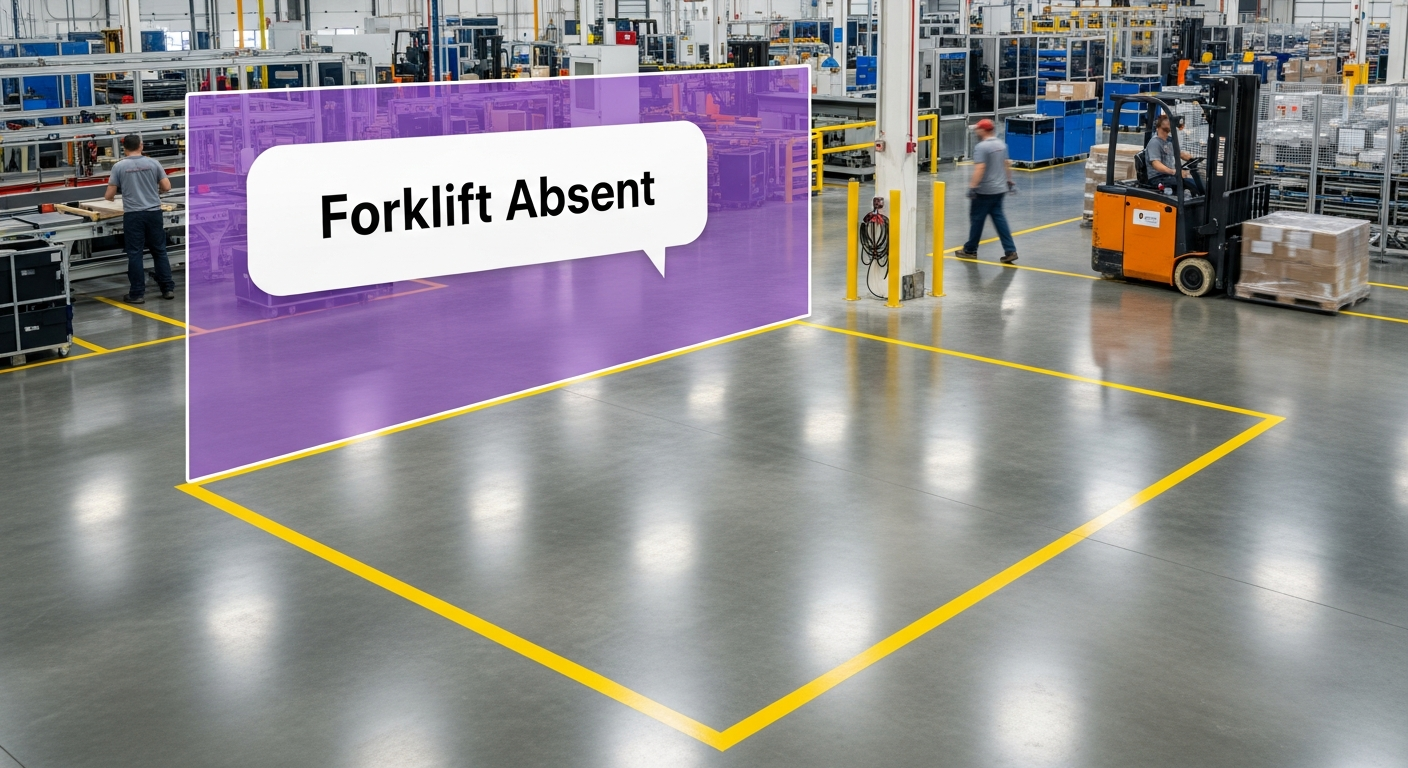


The loading dock is humming. Conveyors are moving, pickers are scanning, and the WMS indicates orders are flowing. Yet, at the end of the shift, throughput targets are missed, and shipments are delayed. For production managers, this is a familiar and frustrating scenario: the facility looks busy, but the metrics tell a different story.
Often, the root cause isn't a lack of effort or a shortage of inventory—it is the invisible friction caused by equipment availability. When a forklift is unexpectedly absent from its assigned zone, it creates a ripple effect that cascades through receiving, cross-docking, and shipping. Even a short period of unavailability for a single forklift can generate significant downstream inefficiency.
Traditional methods of managing fleet uptime—manual checks and reactive maintenance—leave team leads with blind spots. By the time you realize a forklift is down or parked in the wrong area, the constraint has already formed. This guide explores how using "forklift absent" alerts and real-time monitoring turns equipment information into practical insights, helping you identify and resolve bottlenecks before they slow down your shift.
Understanding the hidden cost of forklift absence
To solve the problem, we must first define it. Forklift absence refers to any scenario where a forklift is unavailable for its assigned task. This includes mechanical failure, scheduled maintenance, improper parking, or unexpected operator downtime.
While a forklift sitting idle on a charging dock might seem harmless, its absence from the floor disrupts the precise choreography of warehouse logistics. When equipment is missing, interdependent systems fail.
Receiving stalls: If a forklift assigned to cross-docking is absent, inbound pallets accumulate on the dock.
Labor becomes idle: Warehouse staff waiting for materials cannot transition to other tasks, creating artificial inefficiency.
Order fulfillment delays: Picking operations depend on replenishment. If the replenishment lift is absent, pickers stand idle, and shipments miss their cut-off times.
According to the National Institute of Standards and Technology, reactive maintenance accounts for 45.7% of machinery maintenance in industrial settings (Source: NIST Industrial Maintenance Report). This reactive approach often means absence is unexpected and disruptive, rather than planned and managed.
The difference between downtime and absence
It is critical to distinguish between equipment that is simply "off" and equipment that is "absent."
Downtime is a broad category that includes scheduled breaks or periods of low demand.
Absence is operational unavailability during a period of demand.
For an operations manager, knowing a forklift is "off" is less important than knowing it is "absent from the shipping zone during peak load out." Real-time monitoring systems bridge this gap by correlating equipment status with operational schedules.
Technologies for detecting forklift absence
Modern warehouses rely on three primary technologies to track equipment and detect absence. Each offers different levels of visibility and context.
1. Real-time location systems (RTLS)
RTLS uses Ultra-Wideband (UWB) technology to track tags attached to forklifts. It provides pinpoint accuracy (within 30 cm) regarding where a unit is located (Source: Sewio RTLS Technical Specifications).
Pros: Works in zero-visibility conditions (dust, cold storage) and provides exact location data.
Cons: Tells you where the unit is, but not necessarily why it isn't moving.
2. Telematics and fleet management
Telematics devices plug directly into the forklift to monitor vehicle health, battery status, and operator behavior.
Pros: Provides information on battery levels, impact detection, and active utilization.
Cons: Can indicate a vehicle is "idle," but cannot visually confirm if the operator is present or if the unit is blocked.
3. Video AI and computer vision
Video AI, such as the solutions offered by Spot AI, adds context that raw metrics do not provide. By analyzing video feeds from existing facility cameras or forklift-mounted units, AI agents can detect specific behaviors and contexts.
Contextual understanding: Distinguishes between a forklift that is broken down versus one that is simply parked while the operator is on break.
Safety integration: Detects safety violations like "Forklift Enters No-go Zones" or "Missing PPE" simultaneously with absence detection.
Works with existing cameras: Uses existing camera infrastructure to monitor areas for equipment presence.
How absence alerts reveal bottlenecks
Detecting that a forklift is missing is only the first step. The strategic value lies in using those insights to identify structural constraints in your logistics flow.
Correlating absence with operational delays
Advanced analytics allow managers to correlate equipment availability with performance metrics. By overlaying absence metrics with throughput reports, you can see relationships and likely contributing factors.
Baseline establishment: Determine normal task completion times and zone utilization.
Anomaly detection: Identify when specific areas show a drop in equipment presence.
Impact analysis: If shipping area availability drops by 10% and order processing time increases by 25%, the bottleneck is equipment-constrained.
Heat mapping for zone-specific issues
Heat maps visualize where forklifts spend their time and, crucially, where they are absent during peak hours.
Bottleneck indicator | What the heat map shows | Root cause |
|---|---|---|
Geographic Congestion | High density in aisles; low density in staging. | Poor facility layout or traffic flow. |
Zone Abandonment | Equipment absent from receiving during morning deliveries. | Shift scheduling misalignment. |
Cross-Zone Dependency | Shipping forklifts traveling deep into receiving areas. | Inefficient material staging processes. |
For example, one distribution center found its shipping forklifts were frequently idle despite a backlog of orders. Video analysis revealed the root cause wasn't the shipping team; it was a bottleneck in the receiving area. Shipping forklifts were forced to travel excessive distances to retrieve stock because receiving couldn't stage materials fast enough.
Key metrics for monitoring fleet efficiency
To effectively manage forklift operations, production managers should track specific KPIs that go beyond simple uptime.
Equipment availability rate: The percentage of scheduled operating time the equipment is actually operational. World-class warehouses target high availability rates.
Dock-to-stock time: The time elapsed from inbound receipt to the item being available for picking. Cutting this time from 8 hours to 4 hours effectively doubles inventory availability (Source: AllThings Supply Chain).
OEE (Overall Equipment Effectiveness): A comprehensive metric combining availability, performance (speed), and quality (handling accuracy).
Task completion variance: Monitoring the consistency of task times. High variance often indicates process bottlenecks or traffic congestion.
Integrating alerts with warehouse systems
For "forklift absent" alerts to be truly effective, they must integrate with the systems that drive your daily operations.
Warehouse management systems (WMS)
When your WMS is aware of real-time equipment status, it can optimize task routing. Instead of assigning a pick task to a forklift that is currently flagged as "absent" or "maintenance required," the system can dynamically route the task to the nearest available active unit.
Facilities that integrate real-time tracking with WMS dynamic routing can significantly reduce travel distance per task and shorten picking cycle times.
Planned maintenance coordination
Unplanned absence is the enemy of throughput. By feeding telematics data (vibration, temperature, usage hours) into maintenance software, you can shift from reactive repairs to scheduled maintenance planning.
Reactive: Fix it when it breaks (4-hour unexpected delay).
Planned: Schedule fixes during a lull using available sensor data (1-hour planned downtime).
Insight-driven maintenance strategies can lower overall maintenance costs by 10–40% and cut downtime by up to 50% (Source: McKinsey).
Technology selection framework
When choosing a solution to monitor forklift absence and bottlenecks, it is essential to compare how different technologies address the specific needs of a production environment.
Feature | Spot AI (Video AI) | RTLS (UWB) | Telematics (GPS) |
|---|---|---|---|
Deployment Speed | Fast (Uses existing cameras/cloud) | Slow (Requires infrastructure cabling) | Medium (Device installation per unit) |
Contextual Insight | High (Sees "why" via video) | Low (Location only) | Medium (Vehicle health data) |
Hardware Flexibility | High (Camera agnostic) | Low (Proprietary tags/anchors) | Low (Proprietary hardware) |
Safety Features | Advanced (PPE, No-go zones) | Moderate (Collision warning) | Moderate (Impact detection) |
Cost of Ownership | Scalable (Software-driven) | High (Infrastructure heavy) | Moderate (Per-asset fees) |
Spot AI uses existing infrastructure for faster setup, bringing absence detection together with safety signals like "Forklift Enters No-go Zones" and "Missing PPE," which are useful for facility management.
Implementation roadmap for managers
Deploying a monitoring system requires a strategic approach to ensure adoption and ROI.
Establish baselines (Weeks 1-2): Document current downtime, cycle times, and incident rates. You cannot improve what you do not measure.
Pilot phase (Weeks 3-6): Implement monitoring in a single high-impact area, such as receiving. Focus on identifying one major bottleneck.
Operator training: Be transparent. Explain that monitoring is about removing bottlenecks and improving safety, not for intrusive oversight.
Full integration (Months 3+): Connect absence insights to your WMS and maintenance schedules.
Review and optimize: Use heat maps and absence reports in your daily Gemba walks to support ongoing improvements.
Addressing safety and compliance
Forklift absence alerts also play a vital role in safety compliance. OSHA regulation 29 CFR 1910.178(m)(5) strictly defines when a forklift is considered "unattended". Automated alerts help ensure that unattended equipment is properly secured (brakes set, forks lowered), lowering liability and guarding against run-away accidents.
Furthermore, minimizing unexpected absence mitigates the chaotic "rush" that often leads to accidents. Facilities that implement comprehensive monitoring often report a significant drop in safety incidents.
Turning Absence Data into Operational Excellence
For operations managers, the goal is not just to track where forklifts are, but to ensure the continuous flow of materials that drives profitability. Forklift absence is often a symptom of deeper operational issues—maintenance gaps, layout inefficiencies, or process flaws.
By utilizing "forklift absent" alerts and video AI, you can shift from reacting after issues occur to improving processes earlier. You gain the visibility needed to distinguish between a broken machine and a broken process. This information helps you reclaim capacity, improve safety practices, and support your facility in meeting throughput targets more consistently.
Want to see how video AI highlights bottlenecks and improves your logistics flow? Request a demo to see Spot AI in action and learn how your camera feeds can support operational improvements.
Frequently asked questions
What is the difference between forklift absence and regular downtime?
Forklift absence specifically refers to equipment that is unavailable for assigned tasks during operational hours. Downtime is a broader term that includes planned breaks or idle time when equipment is available but not utilized. Absence creates bottlenecks; simple downtime may just indicate low demand.
How can I distinguish between planned and unplanned absence?
Integrated systems combine data sources to provide context. If a forklift is absent but has an open maintenance work order, it is planned. If Video AI shows the forklift parked in an operational zone with no operator present and no maintenance ticket, it is likely unplanned absence.
What are the best practices for forklift monitoring?
Best practices include establishing baseline metrics for availability, using a phased implementation approach (starting with one zone), transparently communicating with operators to ensure buy-in, and integrating monitoring data with WMS for dynamic routing.
How do I identify and resolve constraints in logistics using this information?
Use absence data to perform correlation analysis. If a drop in equipment availability in the receiving area consistently precedes a drop in shipping throughput, you have identified a dependency choke point. Use heat maps to visualize congestion and reorganize facility layout or shift schedules to smooth out the flow.
What are the compliance requirements for forklift operations regarding absence?
OSHA 29 CFR 1910.178 mandates that when a forklift is unattended (operator 25+ feet away or out of view), forks must be lowered, controls neutralized, power shut off, and brakes set. Monitoring systems can detect violations of this protocol to ensure compliance.
About the author
Sud Bhatija is COO and Co-founder at Spot AI, where he scales operations and GTM strategy to deliver video AI that helps operations, safety, and security teams boost productivity and reduce incidents across industries.






.png)
.png)
.png)