




A single parking lot camera trailer can cover a seasonal pop-up site, then relocate to a high-risk store across the district before the holidays. A fixed camera system at that same pop-up would still be waiting on permits. That tradeoff—fast coverage you can move versus permanent coverage you can build on—shows up in nearly every parking lot security decision retail teams face.
For professionals managing loss prevention across dozens of stores, the question isn't simply which technology is better. It's which deployment model fits each site's risk profile, timeline, and budget. This article breaks down the operational, financial, and on-the-ground differences between mobile security trailers and fixed camera systems, then introduces a third option that combines the strengths of both.
Key terms to know
Two deployment models dominate parking lot security conversations in retail. Understanding the distinction helps frame the decision ahead:
Term |
Definition |
|---|---|
Mobile security tower (also: parking lot camera trailer, mobile surveillance tower) |
A self-contained, trailer-mounted camera platform—typically solar-powered—that can be deployed, repositioned, or removed without permanent infrastructure. Often includes integrated lighting, speakers, and cellular connectivity. |
Fixed camera system |
Permanently installed cameras wired to on-premises network video recorders or cloud platforms. Requires trenching, cabling, electrical work, and ongoing network maintenance. |
Parking lot security tower |
A general term covering both mobile and fixed elevated camera platforms designed for outdoor retail environments. |
Context-aware AI |
Video AI that analyzes multiple objects and surrounding conditions before deciding whether to alert—filtering out weather, animals, and normal traffic to surface genuine threats. |
Automated responses—strobes, floodlights, voice-downs—triggered when a verified threat is detected, designed to interrupt incidents before they escalate. |
Why the parking lot has become a loss prevention priority
The perimeter is where shrink starts. Organized retail crime (ORC) networks frequently stage in parking areas before executing coordinated in-store sweeps. Vehicle break-ins trigger customer claims and brand fallout that go far beyond the value of what was stolen. After-hours trespass and loitering signal reduced operational control, inviting further criminal activity.
Between 2023 and 2024, retailers reported a 19% increase in shoplifting and merchandise theft incidents, with ORC networks accounting for a growing share of losses (Source: Capital One Shopping). For teams stretched across multiple stores, the math is stark: too many sites, too little LP coverage, and legacy video systems that only document what already happened.
How do you extend perimeter control without adding headcount? That question drives the mobile-versus-fixed decision.
Mobile security trailers: where they excel
A mobile security camera tower rental makes the most sense when speed, flexibility, or temporary coverage matters more than permanent infrastructure. Here are the scenarios where mobile trailers pay off fastest:
Seasonal and peak-period deployments
The holiday shopping window between Black Friday and Christmas accounts for a massive portion of annual retail sales. Parking lot crime rates historically peak during this same period. Mobile trailers let LP teams concentrate coverage during peak demand without maintaining year-round fixed installations at every location.
Incident response and emerging threats
When a store gets hit with multiple vehicle break-ins, a mobile parking lot security tower can arrive and go live within hours—not weeks. Three months of targeted coverage can disrupt a criminal pattern. If the threat resolves, the trailer redeploys to the next priority site.
New store openings and temporary facilities
Retailers opening new locations or running seasonal pop-ups need parking lot coverage before permanent infrastructure exists. A mobile unit bridges the gap, then moves on once fixed systems are installed—or the temporary site closes.
Portfolio-level risk rotation
A district LP team overseeing multiple stores doesn't need fixed cameras at every location. Deploying mobile trailers to the highest-risk sites concentrates resources where they matter most, then rotates coverage as threat patterns shift.
Key advantages of mobile trailers include:
Deployment speed: Operational rapidly, compared to the extended timelines required for fixed systems.
No infrastructure requirements: Solar power and cellular connectivity eliminate trenching, cabling, and electrical work.
Variable cost structure: Monthly rental converts capital expenditure into operational expense, scaling with demand.
Visible deterrence: Elevated platforms (typically 15–20 feet) create an unmistakable signal that the lot is monitored.
Maintenance included: Service agreements typically cover troubleshooting, repair, and replacement.
When evaluating mobile trailers, prioritize units with context-aware AI over basic motion detection. AI-powered trailers filter out false alarms from weather, animals, and normal traffic—so your LP team only responds to genuine threats. This single upgrade can dramatically reduce alert fatigue and make mobile deployments operationally sustainable across multiple sites.
Fixed camera systems: where they hold the advantage
Fixed installations aren't obsolete—they serve a different purpose. Permanent cameras excel when a location has a stable, well-understood risk profile and the infrastructure to support long-term deployment.
Consistent, high-traffic locations
Flagship stores or distribution centers with steady foot traffic and predictable threat patterns benefit from fixed cameras optimized for specific coverage zones. Once positioned, these systems generate continuous footage without repositioning.
Centralized portfolio management
Network-based fixed systems can plug into centralized video management platforms, so LP teams can review footage across dozens of locations in one place and keep reporting consistent.
Deep integration with existing security stacks
Fixed cameras connect to access control, point-of-sale (POS) platforms, and employee management systems—correlating parking lot activity with in-store events for richer investigation data.
However, fixed systems introduce constraints that compound at scale:
Long installation timelines: Site assessment, electrical work, cabling, and network configuration can take weeks.
High upfront capital: Comprehensive parking lot coverage typically requires significant capital investment per location.
Inflexibility: Repositioning a fixed camera requires a technician visit, structural modifications, and potential network reconfiguration.
Ongoing infrastructure overhead: Bandwidth demands, storage costs, and maintenance create recurring expenses.
Lease restrictions: Older facilities or leased properties may limit structural modifications.
Decision framework: matching deployment model to use case
The right choice depends on the site, the threat, and the timeline. This framework maps common retail scenarios to the deployment model that fits best:
Use case |
Mobile security trailer |
Fixed camera system |
Best fit |
|---|---|---|---|
Seasonal peak coverage (holiday, back-to-school) |
Deploy for the season, then redeploy |
Expensive to maintain year-round for seasonal need |
Mobile |
New store opening (pre-infrastructure) |
Live in hours, bridges gap until permanent install |
Requires completed construction and wiring |
Mobile |
High-risk store with active ORC pattern |
Rapid response; disrupt pattern in days |
Valuable long-term but too slow for urgent response |
Mobile first, then evaluate fixed |
Flagship store with stable, known risk profile |
Ongoing rental costs add up over years |
Optimized positioning for permanent coverage zones |
Fixed |
Multi-site portfolio (mixed risk) |
Rotate across highest-risk sites |
Capital-prohibitive to install at every location |
Mobile for rotation; fixed at top-priority sites |
After-hours and overnight asset protection |
Solar-powered, no grid dependency |
Continuous recording if infrastructure exists |
Either—depends on site permanence |
Pop-up or temporary retail facility |
No permanent infrastructure needed |
Not feasible for temporary locations |
Mobile |
For most multi-site retail portfolios, the answer isn't one or the other—it's a blended strategy. Fixed cameras anchor high-priority permanent locations. Mobile trailers fill gaps, respond to emerging threats, and rotate across the rest of the portfolio.
The parking-space problem (and why form factor matters)
Here's a practical hurdle that rarely appears in vendor brochures: traditional mobile security trailers occupy parking spaces. A standard trailer footprint of roughly 2.5 meters by 2.5 meters, plus the tow hitch and clearance zone, can consume two or more customer parking spots. During peak shopping periods—exactly when you need the trailer most—losing parking spaces creates friction with store operations teams and customers.
This is one of the biggest reasons store leaders push back on mobile deployments. If the security solution blocks parking or disrupts traffic flow, adoption stalls regardless of how well it deters crime.
Compact, purpose-built form factors solve this. Spot AI's outdoor units and mobile trailer systems are designed for an efficient footprint and optimal coverage. Platforms that mount to existing structures or occupy minimal parking space eliminate the operational friction that makes store teams resist deployment. The result: perimeter protection that doesn't compete with customer convenience.
How video AI turns passive cameras into active deterrence
Whether mobile or fixed, a camera that only records is a camera that only documents losses after the fact. The real shift in parking lot security comes from what happens between detection and response.
Spot AI's AI Security Guard acts as a force multiplier—sorting real threats across every camera feed so LP teams and SOC operators can focus on incidents that matter. Here's how the workflow operates:
Context-aware detection: Multi-object AI analyzes the scene—distinguishing between a delivery driver, a customer walking to their car, and someone exhibiting loitering or staging behavior.
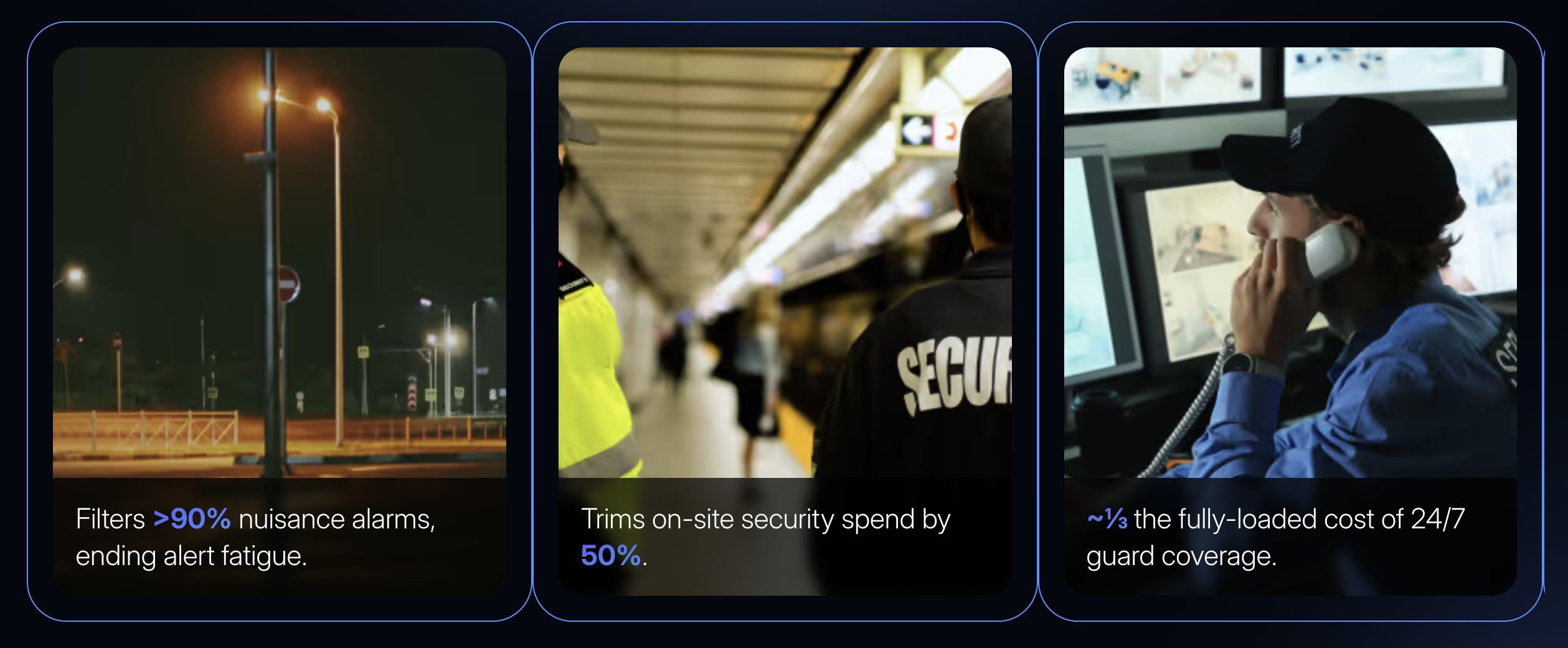
Verified alerting: Instead of flooding operators with nuisance alarms, the system filters the vast majority of false triggers. Alerts are delivered in near real-time.
Automated deterrence: When a verified threat appears, the system fires off strobes, floodlights, or voice-downs—human-like responses that de-escalate incidents before they become cases.
Escalation and evidence: If the situation warrants, the system generates time-stamped clips and case files that LP teams can share with law enforcement in minutes, not hours.
This workflow applies equally to mobile trailers and fixed installations. The camera hardware captures the scene. The AI decides what to do about it.
For teams managing coverage across a region, this means streamlined alert management, efficient incident review, and a consistent response across every store—without adding headcount.
For the strongest parking lot security posture, combine both deployment models with AI-powered analytics:
- Use fixed cameras at flagship and high-traffic permanent locations for continuous, integrated coverage.
- Rotate mobile trailers across the rest of your portfolio to address seasonal surges and emerging ORC patterns.
- Ensure both feed into a single cloud dashboard with context-aware AI so your LP team gets consistent, verified alerts—not noise.
Cost comparison: rental versus capital investment
Financial structure often determines which model a retail organization can actually deploy. The table below outlines the general cost dynamics:
Cost factor |
Mobile security tower (rental) |
Fixed camera system |
|---|---|---|
Upfront investment |
Low—monthly operational expense |
High—capital expenditure per location |
Monthly cost range |
Predictable rental fee, scales with demand |
Amortized capital plus ongoing maintenance, storage, and bandwidth |
Deployment timeline |
Rapid deployment |
Extended timeline |
Maintenance responsibility |
Typically included in service agreement |
Retail operations or contracted provider |
Scalability across portfolio |
High—redeploy units as threats shift |
Low—each location requires separate capital approval |
Infrastructure disruption |
Minimal—no trenching or wiring |
Significant—construction may interfere with operations |
For a district LP team overseeing multiple locations, deploying mobile trailers to the highest-risk sites on a rotating basis delivers effective coverage without the extensive capital required to install fixed systems everywhere. The variable cost model also makes it easier to justify spend internally—rental costs align with monthly LP budgets rather than requiring corporate capital allocation.
Limitations to consider with any deployment model
No single approach eliminates all risk. Honest evaluation requires acknowledging constraints:
Mobile trailers depend on clear sightlines and adequate solar exposure for off-grid operation. Extended overcast conditions may require backup power. Repositioning still requires coordination and transport logistics.
Fixed cameras lose value when threat patterns migrate to areas outside their coverage zone. Older installations may use incompatible components, creating maintenance headaches as equipment ages.
AI analytics reduce false alarms significantly but are not flawless. Human review remains essential for final verification and escalation decisions.
Visible deterrence discourages many opportunistic actors but may not deter determined, organized groups. Layered security strategies—combining video technology with lighting, access control, and law enforcement collaboration—deliver stronger outcomes than any single tool.
Choosing the right partner for multi-site retail coverage
The distinction between mobile and fixed matters less than the platform behind the cameras. A parking lot camera trailer running legacy motion detection generates the same alert fatigue as a fixed system with no analytics. What matters is whether the platform can triage real threats, deter incidents before they escalate, and give LP teams time back.
Spot AI works with any IP camera—existing or new—and connects mobile trailers, outdoor units, and fixed installations to a single cloud dashboard. The system goes live quickly, with no rip-and-replace required. For teams that need to cover more stores without more headcount, it acts as an always-on AI teammate that watches every feed, filters the noise, and acts when it counts.
See Spot AI in action
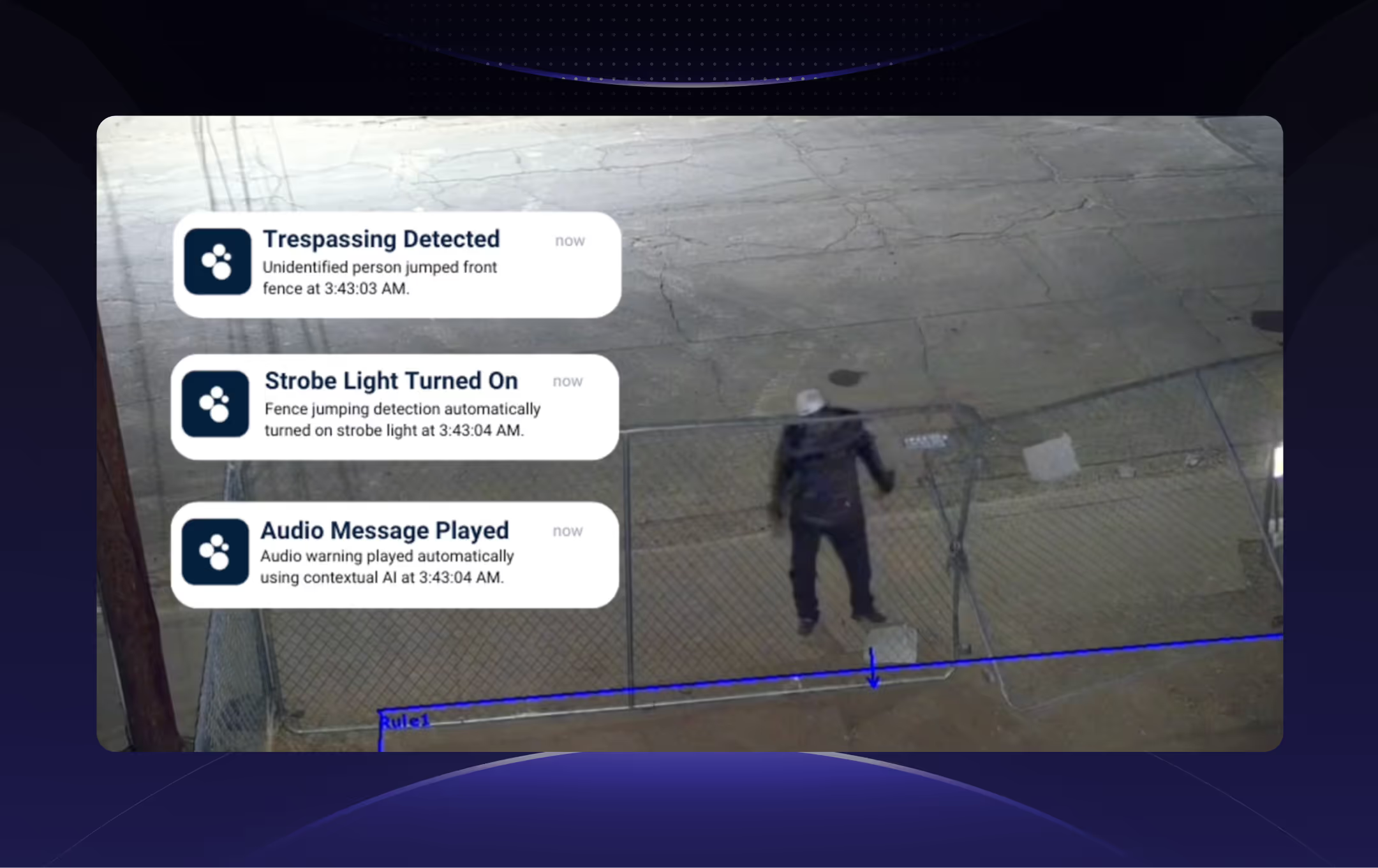

Whether a team is evaluating a mobile security tower rental for a high-risk holiday season or planning permanent coverage for flagship locations, request a demo to see how Spot AI's AI Security Guard filters false alarms and triggers active deterrence across mobile and fixed deployments.
"Spot AI has replaced all of our legacy systems and enables us to view and review all of our sites from one central location. And with cheaper costing than our on-site analog DVR systems, it was an easy choice to go with Spot AI."
Daniel A., Systems and Programs Coordinator (Source: G2)
Frequently asked questions
What are the benefits of using a mobile security tower for retail parking lots?
Mobile security towers offer rapid deployment (often within hours), visible deterrence from elevated camera platforms, and the flexibility to relocate as threat patterns change. For multi-site retail operations, they allow LP teams to rotate coverage across the portfolio—concentrating resources on the highest-risk locations without committing to permanent infrastructure at every store. Solar power and cellular connectivity mean no trenching, no wiring, and no grid dependency.
What features should I look for in a parking lot camera trailer?
Prioritize four-K resolution for license plate legibility at distance, integrated lighting for overnight coverage, and cellular or WiFi connectivity that doesn't depend on store network infrastructure. Most importantly, look for context-aware AI analytics that filter nuisance alarms and surface verified threats—motion detection alone generates too much noise to be operationally useful. Active deterrence capabilities like strobes and voice-downs add a layer that passive recording cannot match.
How effective are mobile security solutions in reducing theft?
Effectiveness depends on the combination of visible deterrence, detection accuracy, and response speed. Research and field deployments indicate that visible mobile camera platforms can meaningfully reduce incident attempts in retail environments. The greatest impact comes when mobile trailers are paired with remote monitoring and automated deterrence—interrupting incidents in progress rather than simply recording them for later review.
How do I decide between mobile and fixed cameras for a specific store?
Start with the risk profile and timeline. If the threat is temporary (seasonal surge, active ORC pattern, new store opening), mobile trailers deliver faster coverage at lower commitment. If the location has a stable, well-understood risk profile and existing infrastructure, fixed cameras offer consistent long-term coverage. Many retail portfolios benefit from a blended approach: fixed systems at flagship sites, mobile trailers rotating across the rest.
Do mobile security trailers take up customer parking spaces?
Traditional trailer-mounted units can occupy two or more parking spots—a real concern during peak shopping periods. Compact, purpose-built form factors address this by minimizing footprint. When evaluating vendors, ask specifically about unit dimensions and whether the system can mount to existing structures to avoid consuming valuable parking real estate.
About the author
Sud Bhatija is COO and Co-founder at Spot AI, where he scales operations and GTM strategy to deliver video AI that helps operations, safety, and security teams boost productivity and reduce incidents across industries.

