




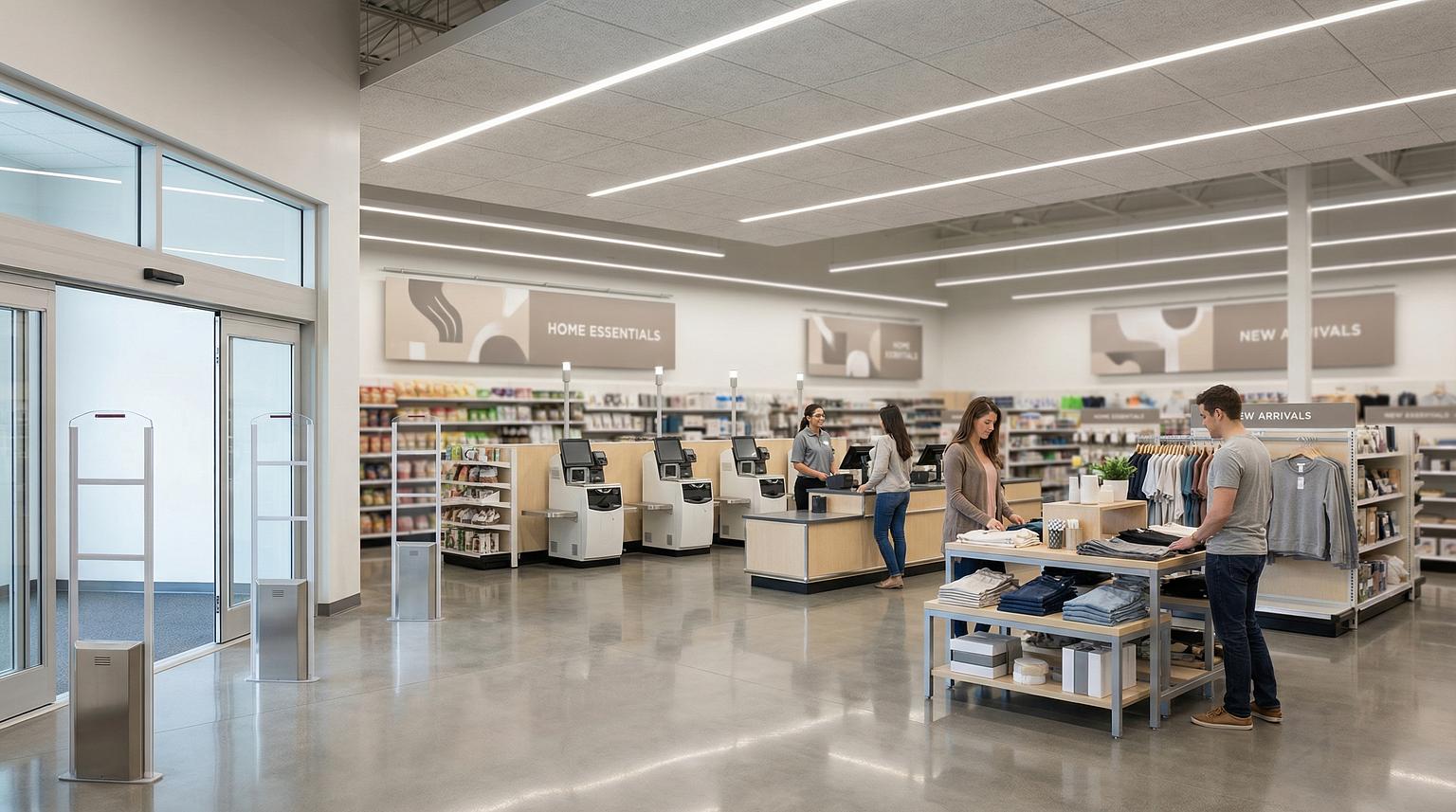


Retail shrinkage represents a significant cost to U.S. retailers annually. For mid-sized chains, that translates to substantial revenue walking out the door—through organized retail crime, employee dishonesty, process errors, and customer-related fraud. Loss prevention has never had more C-suite attention, and the vendor landscape has never been more crowded.
This article maps the major retail asset protection technology categories heading into 2026—video AI, active deterrence, license plate recognition (LPR), electronic article surveillance (EAS), RFID, exception-based reporting, and case management—and explains what each one does in a modern loss prevention program. It also examines where a unified video AI layer can tie these tools together, so teams can move from disconnected systems to faster decisions and measurable shrink reduction.
Key terms every LP team should know
Before evaluating any vendor or platform, it helps to speak the same language. The table below defines the core technologies referenced throughout this article:
Term |
Definition |
|---|---|
Video AI |
Artificial intelligence applied to camera footage to detect behaviors, generate alerts, and automate evidence retrieval—without requiring manual monitoring |
Active deterrence |
Automated responses (strobes, floodlights, audio talk-downs) triggered by verified detections to interrupt incidents as they unfold |
LPR (license plate recognition) |
Camera-based identification of vehicle plates, used to flag vehicles of interest or track repeat offenders across locations |
EAS (electronic article surveillance) |
Tags and gate systems that alert when merchandise leaves a store without being deactivated at the point of sale |
RFID (radio-frequency identification) |
Wireless tags that provide item-level inventory visibility, reducing administrative shrink and improving stock accuracy |
Exception-based reporting (EBR) |
Data analysis that flags unusual POS transactions—excessive voids, no-sale drawer opens, abnormal refunds—for investigation |
Case management |
Software that organizes investigation evidence, tracks incident status, and standardizes documentation for prosecution or internal review |
Where shrink actually comes from
Effective retail loss prevention systems start with understanding the problem. The NRF breaks total shrinkage into four categories, each requiring a different technology response:
Shrink category |
Primary technology countermeasures |
|---|---|
Organized retail crime and external theft |
Video AI, active deterrence, LPR, EAS |
Employee dishonesty |
EBR, POS-integrated video, access control |
Customer-related losses (returns fraud, etc.) |
EBR, video-verified returns, POS integration |
Administrative and process errors |
RFID, inventory management, cycle counting |
No single technology covers every category. That reality is what makes the vendor landscape so fragmented—and why LP leaders increasingly look for platforms that unify data across these silos.
The retail asset protection technology landscape in 2026
Video AI: from passive recording to active response
Legacy camera systems record footage. Video AI watches for specific behaviors and flags what matters. The difference matters because most LP teams don't have the staff to watch live feeds across dozens or hundreds of locations. Behavior-based analytics can flag concealment, loitering, and transaction avoidance patterns, reducing false positives compared to simple motion detection.
More importantly, video AI collapses investigation timelines. Systems that integrate video with POS timestamps allow teams to retrieve relevant evidence much faster. Integrated platforms significantly accelerate video evidence retrieval compared to manual searches.
The next step—and the one that separates 2026 solutions from 2022 ones—is active deterrence. Context-aware AI detects a verified threat, then fires off strobes, floodlights, or audio talk-downs to interrupt the incident before it escalates. This shifts LP from documenting losses to reducing them.
EAS and RFID: the physical layer
EAS remains the workhorse for external theft deterrence at the exit point, proving highly effective when tags are properly maintained. RFID adds a deeper layer: item-level inventory tracking that catches administrative errors and stock discrepancies before they compound into significant shrink.
Together, these technologies address the "what left the building" question. They don't, however, tell you who took it, how they behaved beforehand, or whether the same individual hit three other stores last week. That context requires video AI.
EAS and RFID handle the "what" and "where" of shrink, but video AI adds the critical "who" and "how." Layering these technologies together—rather than relying on any single solution—gives LP teams the full picture needed to identify repeat offenders, build stronger cases, and prevent future losses across multiple locations.
Exception-based reporting and POS integration
EBR identifies the transaction anomalies—excessive discounts, repeated voids, no-sale drawer opens—that signal internal theft or process breakdowns. When paired with synchronized video, LP teams can verify flagged transactions rapidly rather than pulling extensive footage. Exception-based reporting significantly reduces manual audit requirements.
Case management: closing the loop
Investigations generate evidence. Case management platforms organize it—linking video clips, POS data, incident reports, and witness statements into a single record with chain-of-custody documentation. For multi-location retailers, centralized case management also surfaces cross-store patterns that individual store teams would miss.
Why fragmented tools create blind spots
How do LP teams connect parking lot activity to in-store theft patterns when the camera system, the EBR platform, and the case management tool don't share data?
The answer, for most organizations today, is manual effort. An analyst pulls a clip from one system, cross-references a transaction in another, and pastes both into a third. That workflow is slow, error-prone, and impossible to scale across a large portfolio of locations.
A unified video AI layer addresses this by connecting your existing tools into one workflow. Rather than replacing EAS gates or RFID infrastructure, video AI integrates with POS, inventory, and access control systems to correlate data automatically. The result: faster triage, fewer false alarms, and investigations that close significantly faster.
Capability |
Fragmented stack |
Unified video AI layer |
|---|---|---|
Alert-to-evidence time |
Slow and manual |
Rapid and automated |
Cross-location pattern detection |
Manual, inconsistent |
Automated, centralized |
False alarm filtering |
Limited (motion-based) |
Context-aware, significant nuisance alarm reduction |
Active deterrence |
Separate hardware/vendor |
Integrated strobes, talk-downs, escalation |
Investigation turnaround |
Prolonged |
Accelerated |
Scalability across sites |
High IT burden per location |
Camera-agnostic, minimal infrastructure |
Evaluating loss prevention technology vendors
Not all platforms deliver the same outcomes. When comparing loss prevention solutions, LP leaders and technical evaluators should weight criteria that directly affect scalability, total cost of ownership, and operational burden.
The following framework reflects the priorities that matter most to teams managing multi-location portfolios:
Evaluation criterion |
What to look for |
Why it matters |
|---|---|---|
Camera compatibility |
Works with existing IP cameras (camera-agnostic, ONVIF/RTSP) |
Protects prior hardware investment; avoids rip-and-replace |
Deployment speed |
Live in days, not months; minimal wiring or network disruption |
Reduces store-level friction and IT burden |
Detection accuracy |
High true-positive rate; low false-alarm rate |
Fewer nuisance alarms means less alert fatigue for operators |
Active deterrence |
Integrated strobes, floodlights, and audio talk-downs |
Shifts from recording incidents to interrupting them |
POS and EBR integration |
Synchronized video with transaction data |
Accelerates investigation and reduces manual cross-referencing |
Scalability |
Consistent deployment model across all portfolio locations |
Standardizes LP posture without proportional headcount growth |
Edge + cloud architecture |
Local processing for low-latency alerts; cloud dashboard for fleet-wide visibility |
Balances speed with centralized management |
Support and uptime |
High availability; remote device health monitoring |
Minimizes truck rolls and coverage gaps |
Spot AI is built to meet these criteria. Its Intelligent Video Recorder (IVR) connects to any existing IP camera, processes video at the edge with NVIDIA GPUs, and pushes alerts and evidence to a cloud dashboard. Deployment typically takes under a week per site, with no new wiring required. The AI Security Guard—Spot AI's context-aware detection and deterrence agent—triages real threats, fires off strobes and talk-downs, and generates time-stamped incident logs that feed directly into investigation workflows.
For technical evaluators concerned about network impact, Spot AI's edge-first architecture keeps bandwidth predictable. For LP leaders focused on cost-to-protect, the platform positions at a fraction of the fully-loaded cost of 24/7 guard coverage—covering more locations without adding headcount.
Implementation: how to roll out without disrupting stores
Scaling retail asset protection technology across a portfolio requires a disciplined approach. The following sequence reflects industry best practices for phased deployment:
Baseline your shrink data. Establish current shrinkage rates, investigation turnaround times, and guard spend by location cluster before selecting technology.
Select initial pilot sites. Choose stores representing different sizes, loss profiles, and demographics. Avoid picking only high-shrink locations—you need a representative sample.
Define success metrics upfront. Align on KPIs with executive leadership: shrink reduction percentage, investigation time, cost per incident avoided, and deterrence events per month.
Run the pilot for a full quarter or season. This window captures seasonal variation and produces statistically meaningful data.
Integrate with existing workflows. Map video alerts to your current escalation procedures. Configure notifications based on staff availability and incident severity.
Train LP staff. Hands-on training on the new platform, followed by specialized training on analytics interpretation and evidence handling.
Expand in waves. Use pilot data to build the business case for regional rollout. Standardize playbooks so each new site follows the same deployment model.
Integration with existing workflows significantly reduces changeover friction compared to systems that require full process redesign. Spot AI's camera-agnostic approach means stores keep their current hardware, and the IVR plugs in alongside it—no parking-space loss, no extended construction periods, no store closures.
When rolling out LP technology across multiple sites, prioritize these steps for maximum impact:
- Baseline shrink data and define KPIs before selecting any vendor—this ensures you can measure real ROI.
- Pilot across a representative mix of store sizes and loss profiles, not just your highest-shrink locations.
- Budget for staff training and ongoing support—adoption is the single biggest factor in whether the technology delivers results.
Measuring what matters: KPIs for LP technology
Once deployed, loss prevention technology earns its budget through measurable outcomes. The table below outlines the metrics that matter most to both economic buyers and technical evaluators:
KPI |
Benchmark (high performers) |
What it tells you |
|---|---|---|
Shrinkage rate |
Consistently minimized |
Overall program effectiveness |
Investigation turnaround |
Accelerated resolution |
Team efficiency and technology leverage |
Video evidence retrieval |
Rapid extraction |
System integration quality |
Incident detection latency |
Near real-time |
Alert speed and coverage reliability |
Alert accuracy (true positive rate) |
High precision |
Signal-to-noise ratio for operators |
Prosecution rate |
Improved successful outcomes |
Deterrence credibility and evidence quality |
Cost per store protected |
Declining quarter-over-quarter |
Scalability and ROI trajectory |
Considerations before committing to a platform
No technology eliminates shrink entirely. LP leaders should weigh several factors before signing a multi-year agreement:
Detection accuracy varies by environment. Algorithms trained on generic retail data may underperform in your specific store layout. Ask vendors about custom model training and expect noticeable accuracy improvement with location-specific data.
Network and storage requirements add up. HD and 4K video demand significant bandwidth. Plan bandwidth and storage capacity carefully before deployment.
Staff adoption determines ROI. The best platform in the world fails if LP teams don't use it. Budget for training, ongoing support documentation, and a feedback loop that captures user pain points early.
Retention policies need alignment. Balance investigation needs with storage costs and organizational data governance requirements.
No system replaces human judgment. Video AI augments teams by surfacing the right information faster. Final decisions—whether to intervene, escalate, or prosecute—still require experienced professionals.
Extend your coverage with Spot AI
LP teams managing dozens or hundreds of locations face a straightforward math problem: incidents keep growing, budgets don't, and guard staffing can't scale proportionally. Spot AI's AI Security Guard acts as a digital force multiplier—watching every camera feed, triaging real threats with context-aware AI, and firing off deterrents in under one second. The result is fewer nuisance alarms, faster investigations, and a consistent security posture across every site.
The platform works with any existing IP camera, deploys in under a week, and integrates with POS and case management systems so evidence flows where it needs to go. For LP leaders who need to defend ROI to finance, and for technical evaluators who need a deployment that won't burden the network, Spot AI is built to satisfy both.
Want to see how video AI can support retail asset protection across your locations? Request a live demo to explore Spot AI's AI Security Guard, automated deterrence, and faster evidence workflows.
See Spot AI in action
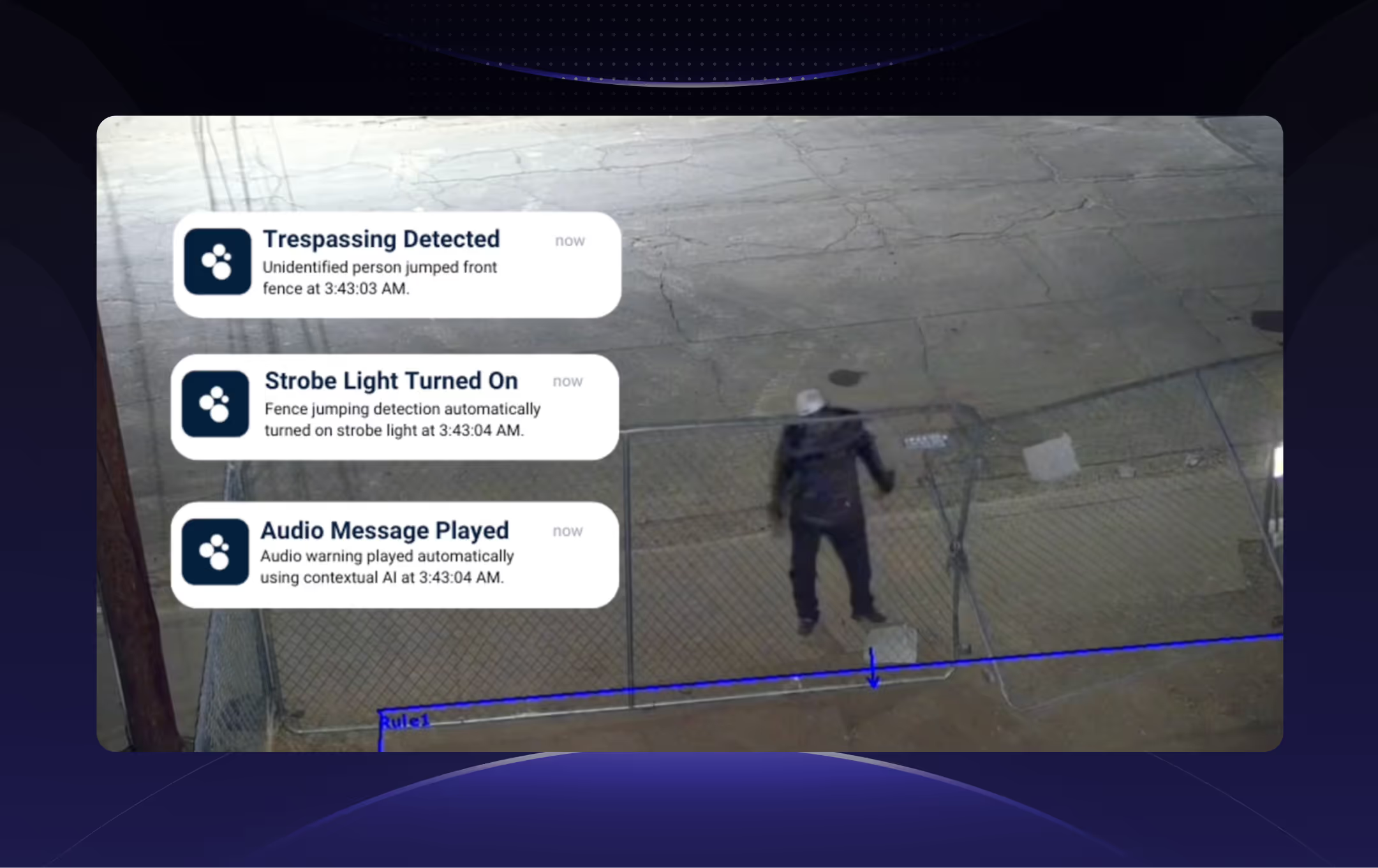

"The question was, 'how do we get more out of our existing systems?'. We needed something that could transform our camera system from a passive recording tool into a proactive partner in safety and security."
Mike Tiller, Director of Technology, Staccato
Read the full story
Frequently asked questions
What are the most effective loss prevention strategies in retail?
The most effective programs layer multiple approaches: physical deterrents (EAS tags, locked cases), transaction monitoring (exception-based reporting on POS systems), video AI for behavioral detection and evidence retrieval, and employee accountability programs. External theft and employee dishonesty account for the vast majority of total shrink, so strategies must address both internal and external loss vectors. Active deterrence—automated strobes and audio responses triggered by verified detections—represents the newest layer, shifting LP from documenting incidents to interrupting them.
How can technology enhance loss prevention efforts?
Technology accelerates three core LP functions: detection, investigation, and deterrence. Video AI flags suspicious behaviors without requiring manual monitoring, reducing false positives compared to motion-based alerts. Integrated platforms synchronize video with POS data so teams can verify flagged transactions rapidly. Active deterrence systems respond to verified threats with strobes and talk-downs, creating a consistent security presence across locations—even when staff aren't physically present.
How do loss prevention systems work?
A modern LP technology stack operates in layers. EAS gates and RFID tags track merchandise at the item level. POS integration and exception-based reporting flag unusual transactions. Video AI analyzes camera feeds for behavioral indicators—loitering, concealment, transaction avoidance—and generates alerts with time-stamped evidence. Case management platforms organize all of this into structured investigation records. The most advanced systems add active deterrence, where verified detections trigger automated responses (lights, audio warnings) to deter threats before they escalate.
What training is available for loss prevention professionals?
The Loss Prevention Foundation offers professional certification programs requiring extensive continuing education and industry experience. For technology-specific skills, video system operation and evidence retrieval require dedicated hands-on training. Specialized training in analytics interpretation and forensic evidence handling adds further proficiency. Organizations rolling out new platforms should budget for initial training, ongoing support resources, and periodic refreshers as system capabilities evolve.
How should multi-location retailers evaluate loss prevention technology vendors?
Start with detection accuracy and false-alarm rate to gauge signal quality. Assess camera compatibility—camera-agnostic platforms protect existing hardware investments. Evaluate deployment speed and IT burden per site, since solutions that require extensive wiring or network changes create rollout friction. Review integration capabilities with POS, inventory, and case management systems. Finally, check scalability: ask how the platform performs across a massive portfolio of locations, and request reference checks from retailers of similar size.
About the author
Sud Bhatija is COO and Co-founder at Spot AI, where he scales operations and GTM strategy to deliver video AI that helps operations, safety, and security teams boost productivity and reduce incidents across industries.

