




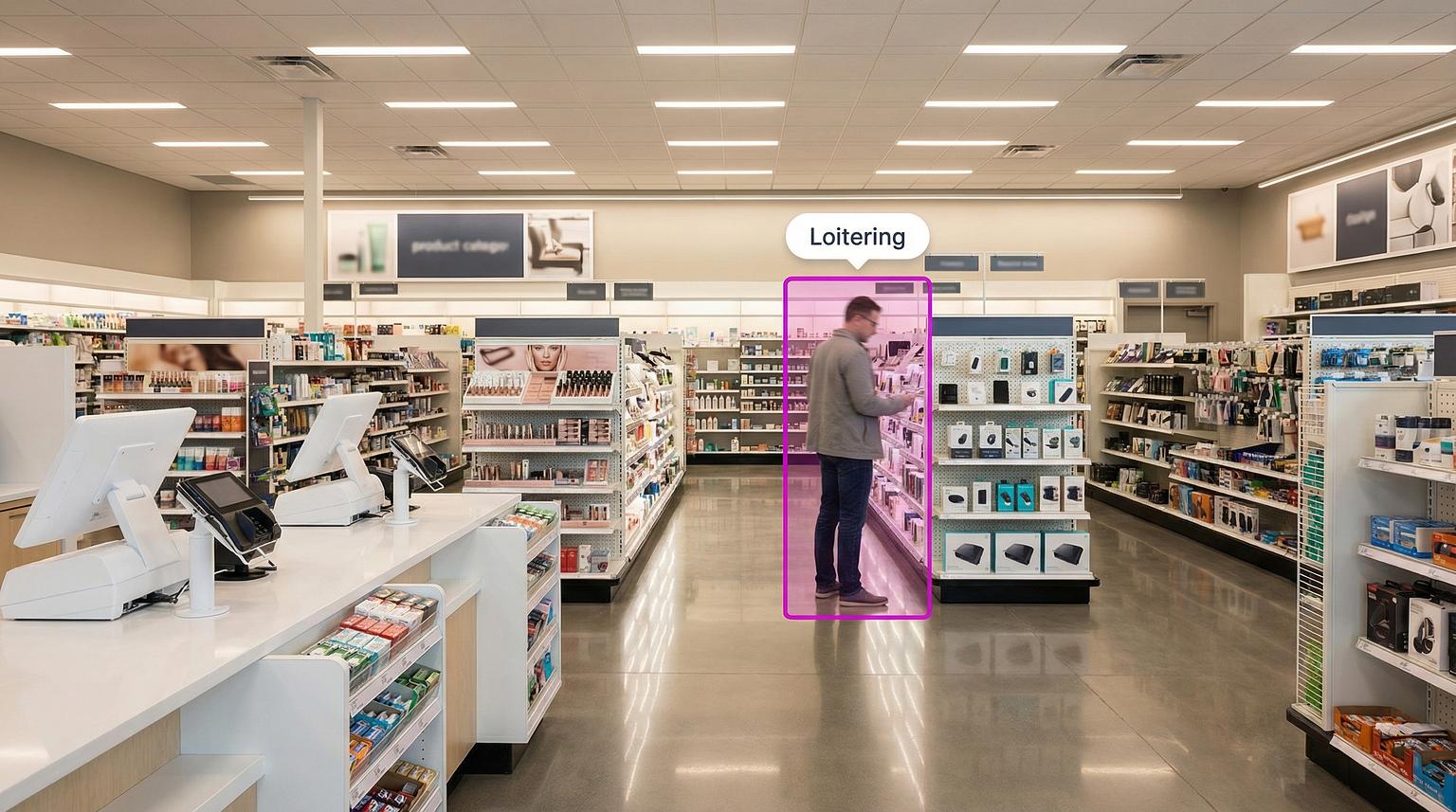


Retail theft cost American retailers an estimated $45 billion to $112 billion in 2024, and projections suggest losses could reach $47.8 billion in 2025 (Source: NRF 2025 Impact of Retail Theft & Violence). Behind those numbers sits a structural problem: most loss prevention (LP) programs still operate in silos. One tool detects. Another records. A third generates reports. And by the time an investigation wraps, the evidence trail is cold and the merchandise is gone.
What if one platform could run the whole workflow—detect the threat, act in real time, and close the case with time-stamped evidence? That end-to-end workflow, from deterrence through investigation, is what separates modern retail crime prevention from the patchwork approaches that leave LP teams stretched thin.
This article maps the detect → act → resolve workflow, explains what's happening at each stage, and shows how organizations with dozens of locations can run theft prevention from one platform.
Key terms for retail theft prevention
Before examining the workflow, a few definitions help set the baseline:
Term |
Definition |
|---|---|
Shrinkage (shrink) |
The gap between recorded inventory and actual inventory, expressed as a percentage of revenue. Causes include external theft, internal theft, vendor fraud, and administrative error. |
Organized retail crime (ORC) |
Coordinated, multi-person theft operations that steal merchandise at scale and resell it through fencing networks—online marketplaces, flea markets, or physical storefronts. |
Exception-based reporting (EBR) |
A data analysis method that flags transaction outliers—excessive voids, unusual discount patterns, repeated no-sale drawer openings—for LP review. |
Context-aware detection |
AI that analyzes multiple objects and the surrounding situation before deciding whether to alert, reducing nuisance alarms compared to simple motion-based triggers. |
Dwell time |
The amount of time a person or vehicle lingers in a specific zone, often used as a behavioral indicator for loitering or suspicious activity. |
Why siloed tools leave LP teams behind
Retail theft has changed faster than most LP stacks. Shoplifting incidents surged 93% from 2019 to 2023, followed by an additional 19% increase from 2023 to 2024 (Source: NRF). Only 10% of offenders account for 68% of total retail crime losses, and 66% of retailers now report transnational ORC involvement (Source: NRF).
Meanwhile, LP teams managing 30 to 40 stores face a familiar set of pain points:
- Blind spots outside the store create downstream risk. Parking lots, perimeters, and loading docks remain unmanaged environments where incidents begin long before anyone enters the building.
- Too many stores, too little time. Reviewing footage from multiple locations is slow and reactive. Investigations that should take minutes consume hours.
- Guards and traditional monitoring don't scale. Coverage quality varies by shift, location, and individual. Cost pressure is constant, and 75% of retailers added or increased uniformed security in 2024 without fully solving the coverage gap (Source: NRF).
- High false-alarm rates waste time. Motion-based alerts generate noise. Security operations center (SOC) operators spend more time dismissing nuisance alarms than responding to real threats.
- Proving deterrence ROI to leadership is difficult. LP professionals know that deterrence works—"deter more than you can apprehend" is a common refrain—but translating that belief into measurable incident reduction and cost avoidance requires better data.
These obstacles share a root cause: disconnected tools that force LP teams to bounce between systems to detect, deter, and build a case. A unified platform collapses those steps into a single workflow.
Stage one: detect threats with context-aware AI
Detection is the starting point, but not all detection is equal. Traditional motion alerts fire on every passing car, stray animal, or shifting shadow. The result is alert fatigue—the exhaustion caused by too many unimportant notifications—which trains operators to ignore alerts altogether.
Context-aware detection changes the equation. Instead of flagging all motion, video AI analyzes multiple objects and the surrounding situation before deciding whether to alert. A delivery driver approaching a loading dock at 2 p.m. is treated differently from an unknown individual scaling a fence at 2 a.m.
The types of activity that matter most for retail crime prevention include:
Detection type |
What it catches |
Where it matters |
|---|---|---|
Loitering |
People or vehicles lingering beyond a set dwell time |
Parking lots, perimeters, fire lanes |
After-hours trespass |
Unauthorized entry outside business hours |
Loading docks, fenced areas, back-of-house |
Fence jumping |
Perimeter breaches |
Distribution centers, outdoor storage |
Unauthorized entry |
Access to restricted zones without credentials |
Stockrooms, receiving docks |
Suspicious activity |
Behavioral patterns that deviate from normal |
High-value aisles, self-checkout areas |
License plates of interest |
Vehicles linked to prior incidents or ORC patterns |
Parking lots, entry/exit points |
Spot AI's AI Security Guard applies multi-object, context-aware AI across all connected camera feeds. It triages real threats and filters the vast majority of nuisance alarms, so operators focus on incidents that actually require a response. Alert latency is nearly instantaneous, meaning the system surfaces a verified threat before most human observers would notice the activity.
For teams covering dozens of locations, this detection layer replaces the need to watch every live feed manually. The AI watches. The team acts.
Tip: When evaluating context-aware detection, ask vendors how their system distinguishes between routine activity (e.g., a delivery at a loading dock) and genuine threats (e.g., after-hours trespass). The ability to filter nuisance alarms by more than 90% is a key differentiator that directly reduces operator fatigue and improves response quality across multi-site deployments.
Stage two: act with automated deterrence
Detection without action is just footage. The second stage of the workflow—automated deterrence—is where a platform shifts from passive to active.
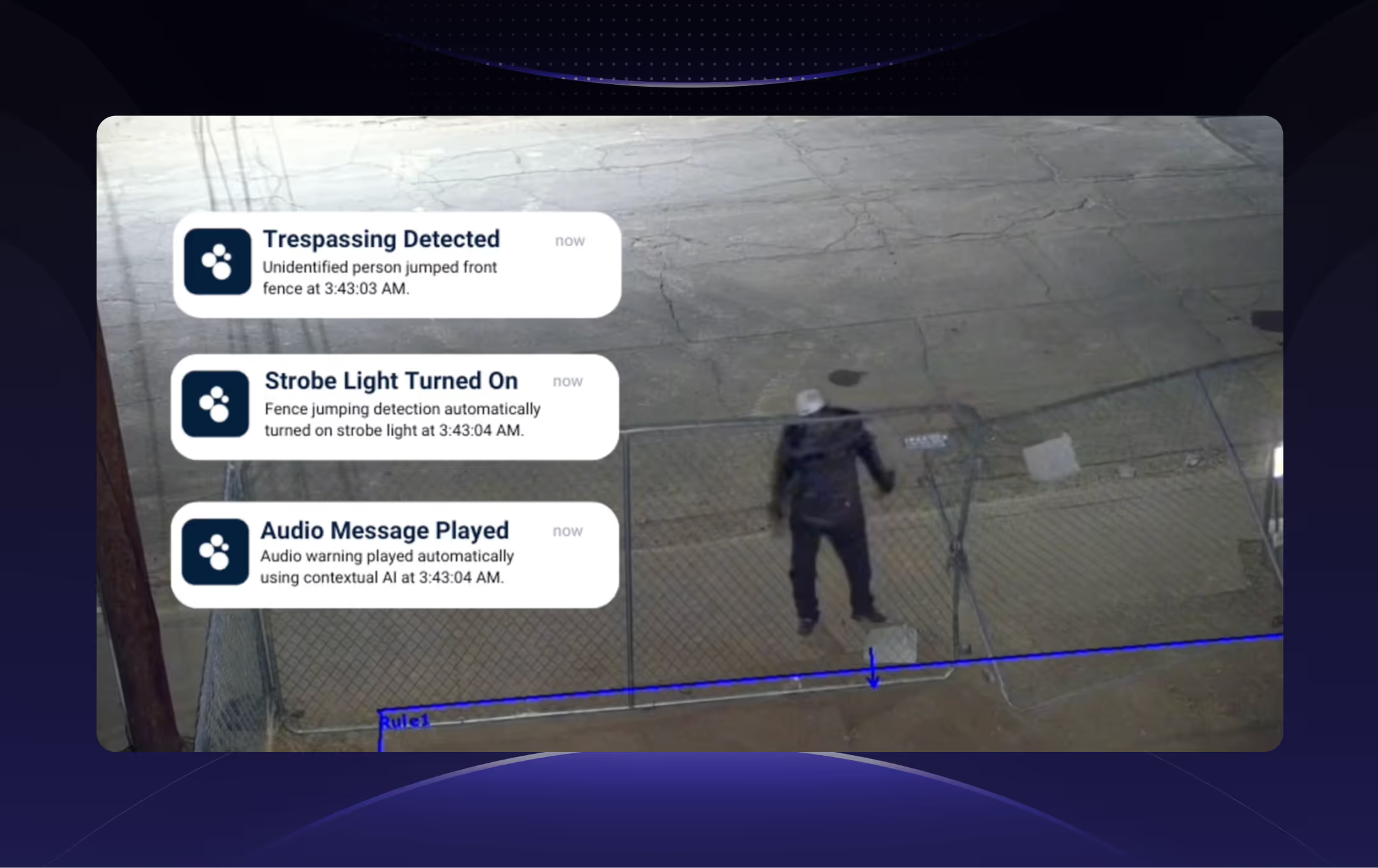
When the AI Security Guard verifies a threat, it can trigger a stepped response without waiting for someone to pick up a radio. The escalation sequence typically follows this order:
- Lights activate. Floodlights or strobe lights illuminate the area, signaling to the individual that they've been observed.
- Audio warning fires. A contextual talk-down delivers a situation-appropriate verbal response—distinguishing between a delivery driver and a trespasser—mirroring the interaction a trained security guard would have.
- Notification routes to the right person. The platform sends an alert with a verified clip to the on-duty LP manager, SOC operator, or store leader, depending on the escalation rules configured for that site.
- Law enforcement dispatch occurs if needed. If the situation escalates, the platform packages time-stamped evidence for rapid handoff.
This graduated approach—lights, then voice, then escalation—mirrors how trained security personnel respond, but it operates around the clock across every connected location. For LP teams that can't physically be at every store, automated deterrence acts as a digital force multiplier, extending coverage without adding headcount.
The financial impact is significant. Spot AI positions its AI Security Guard at a fraction of the fully-loaded cost of 24/7 guard coverage, and organizations using the system report substantial reductions in on-site security spend.
How does this compare to traditional alternatives? The table below maps the key differences:
Criteria |
Spot AI (AI Security Guard) |
Traditional guard service |
Legacy camera towers |
|---|---|---|---|
Coverage hours |
24/7 across all connected sites |
Shift-dependent; varies by location |
24/7 recording, but no active response |
Response type |
Automated strobes, talk-downs, and escalation |
Human judgment on-site |
None—passive recording only |
False-alarm handling |
Filters >90% of nuisance alarms |
Guard discretion (inconsistent) |
All motion triggers alert |
Scalability |
Deploy across locations from a single dashboard |
Requires proportional hiring per site |
Requires physical relocation of equipment |
Deployment speed |
Live in under a week; works with existing cameras |
Weeks to staff and train |
Days to weeks for physical setup |
Evidence packaging |
Automatic clips, time-stamped logs, case files |
Manual report writing |
Manual footage review |
Stage three: resolve cases with timeline-based investigation
Even the best deterrence won't stop every incident. When theft does occur, the speed and quality of the investigation determines whether merchandise is recovered, repeat offenders are identified, and cases hold up in prosecution.
Traditional investigation workflows are painfully slow. Teams scrub through hours of footage across multiple camera angles, manually stitch together timelines, and export clips in formats that may or may not be useful to law enforcement. For LP professionals managing a region, this process multiplies across every open case at every location.
A unified platform speeds this up by offering:
- Intelligent search. Instead of scrubbing footage frame by frame, teams type descriptive queries—"red truck" or "person with backpack"—and jump to the exact moment. Spot AI's attribute search identifies upper and lower clothing colors, vehicle make, color, and body style.
- Timeline-based reconstruction. The platform stitches together clips from multiple cameras into a single incident timeline, showing the sequence of events from arrival to departure.
- Automatic case file generation. Verified clips, time-stamped logs, and incident details compile into shareable case files—ready for law enforcement handoff or internal review.
- Click-to-share evidence. Case files export in formats law enforcement can use, reducing the back-and-forth that delays prosecution.
This investigation workflow matters especially for ORC cases, where coordinated theft operations span multiple stores and jurisdictions. California's Organized Retail Crime Task Force has conducted 4,489 total investigations since 2019, recovering nearly 1.6 million stolen items worth more than $73 million (Source: California Governor's Office). Multi-jurisdictional cases like these depend on clean, time-stamped evidence that can be shared across agencies—exactly the kind of output a unified platform produces.
How Tidewater Fleet Supply unified theft prevention across 17 locations
Tidewater Fleet Supply, a heavy-duty truck parts distributor and retailer operating 3 distribution centers and 14 retail locations across the Southeast U.S., faced significant theft and loss incidents due to inadequate legacy camera coverage. Their previous system made investigations difficult: footage searches took hours, remote access was limited to on-network connections, and cameras went down without warning—creating blind spots that went unnoticed.
After deploying Spot AI's cloud-based video platform, Tidewater unified all locations on a single dashboard, enabling faster, AI-assisted incident investigation across sites from Florida to Virginia. Camera health monitoring with instant alerts eliminated downtime-related blind spots and improved theft-prevention readiness across the entire network. Read the full Tidewater Fleet Supply case study for details on their deployment.
Practical considerations before choosing a platform
No platform stops theft entirely. Several factors influence how effectively a unified platform performs in practice:
- Existing camera infrastructure. A camera-agnostic platform that works with any IP camera avoids the cost and disruption of ripping and replacing hardware. Spot AI connects to existing cameras through its Intelligent Video Recorder (IVR), keeping deployment fast and capital costs low.
- Store team buy-in. If the platform creates complaints or confusion among store employees, adoption stalls. Ease of use—simple dashboards, clear alert workflows, and minimal training requirements—determines whether the system gets used daily or ignored.
- Integration with existing systems. Open APIs and webhook support allow the platform to connect with existing video management systems (VMS), POS exception reporting tools, and access control systems. Spot AI's open ecosystem avoids camera lock-in and integrates with existing operational stacks.
- Bandwidth and connectivity. Edge AI processing at the camera or recorder level reduces the amount of data that needs to travel to the cloud, maintaining low-latency performance even at locations with limited bandwidth.
- Quarterly security audits. Threat profiles change with new product lines, seasonal fluctuations, staffing changes, and neighborhood developments. Regular audits identify emerging vulnerabilities before they're exploited.
Key takeaway: Before committing to a platform, run a 30-day pilot at your highest-shrink location. Track nuisance alarm reduction, investigation time per case, and deterrence success rate. These three metrics give LP leadership the clearest picture of ROI and make the business case for regional rollout straightforward.
Measuring what matters: KPIs for the detect → act → resolve workflow
LP leaders need to demonstrate measurable impact—not just to justify the investment, but to build the case for scaling across a region. The following metrics map directly to the three-stage workflow:
Workflow stage |
KPI |
What it measures |
|---|---|---|
Detect |
Nuisance alarm reduction rate |
Percentage of false alerts filtered before reaching an operator |
Detect |
Alert latency |
Time from event occurrence to operator notification |
Act |
Deterrence success rate |
Percentage of detected incidents where the individual leaves before escalation |
Act |
Cost-to-cover per location |
Total security spend (guards + technology) divided by number of covered sites |
Resolve |
Investigation time per case |
Hours from incident to completed case file |
Resolve |
Evidence share rate |
Percentage of cases with evidence successfully shared with law enforcement |
Overall |
Incident volume trend |
Month-over-month change in incidents at covered locations |
Tracking these KPIs across a 30-, 60-, and 90-day pilot window gives LP teams the data they need to build an internal business case for broader rollout.
From pilot to regional standard with one platform
The detect → act → resolve workflow isn't a theoretical framework. It's an operational model that LP teams can pilot at a single high-risk location and scale across a region from one dashboard. The platform watches every camera, triages real threats, fires off deterrents when needed, and hands operators clean incident logs and case files—all before most legacy systems would finish buffering the footage.
For organizations ready to move from patchwork tools to a unified workflow, request a demo to see how the AI Security Guard detects threats, triggers deterrence, and packages time-stamped evidence across every location.
See Spot AI in action

"When I show managers the video evidence of unsafe practices, they get it immediately. It's not just me telling them there's a problem - they can see it for themselves."
Kevin, Unique Industries — Source: Spot AI Customer Story
Frequently asked questions
What technologies are most effective for retail theft prevention in 2025?
The most effective retail theft prevention programs layer multiple technologies rather than relying on a single tool. Electronic article surveillance (EAS) remains a foundational deterrent at exit points. RFID adds item-level tracking that identifies which SKU was taken, when, and from which zone. Video AI with context-aware detection surfaces behavioral indicators—loitering, concealment patterns, coordinated group activity—and reduces false alarms that overwhelm security teams. POS exception-based reporting flags transaction anomalies like excessive voids or no-sale drawer openings. The strongest results come from integrating these layers into a unified platform where detection, deterrence, and investigation share the same data.
How does AI enhance theft detection in retail environments?
AI-powered video analytics moves beyond simple motion alerts by analyzing context. Rather than flagging every moving object, the system evaluates multiple factors—time of day, location within the store, behavioral patterns, and object type—before deciding whether to alert. This approach filters the majority of nuisance alarms and surfaces only verified threats. For self-checkout areas, which present unique loss vulnerabilities, video AI can validate scanned items against visual input and flag mismatches for discreet staff intervention.
What are the legal consequences of retail theft?
Penalties vary by jurisdiction and typically escalate based on merchandise value and repeat offenses. Many states now allow aggregation of stolen values from multiple incidents to pursue more serious charges against organized groups (Source: NRF). In Arkansas, organized retail theft is classified as a separate felony category with enhanced penalties (Source: Arkansas Attorney General). Manhattan's District Attorney prosecuted 6,700 misdemeanor retail cases in 2025, a 14% increase over the prior year (Source: Manhattan DA). For LP teams, clean time-stamped evidence and organized case files directly influence whether prosecutors can pursue charges effectively.
What operational strategies help retailers minimize losses beyond technology?
Store layout plays a direct role in theft prevention. Positioning registers near exits creates a natural checkpoint. Keeping fixture heights below eye level eliminates hiding spots. Placing high-value merchandise in areas with maximum staff visibility rather than in corners reduces opportunity. Staff training remains one of the highest-impact investments—employees who recognize concealment behaviors, return fraud patterns, and suspicious activity report concerns through proper channels before losses compound. Quarterly LP walk-throughs catch emerging vulnerabilities tied to new product lines, seasonal shifts, or staffing changes.
About the author
Sud Bhatija is COO and Co-founder at Spot AI, where he scales operations and GTM strategy to deliver video AI that helps operations, safety, and security teams boost productivity and reduce incidents across industries.

