




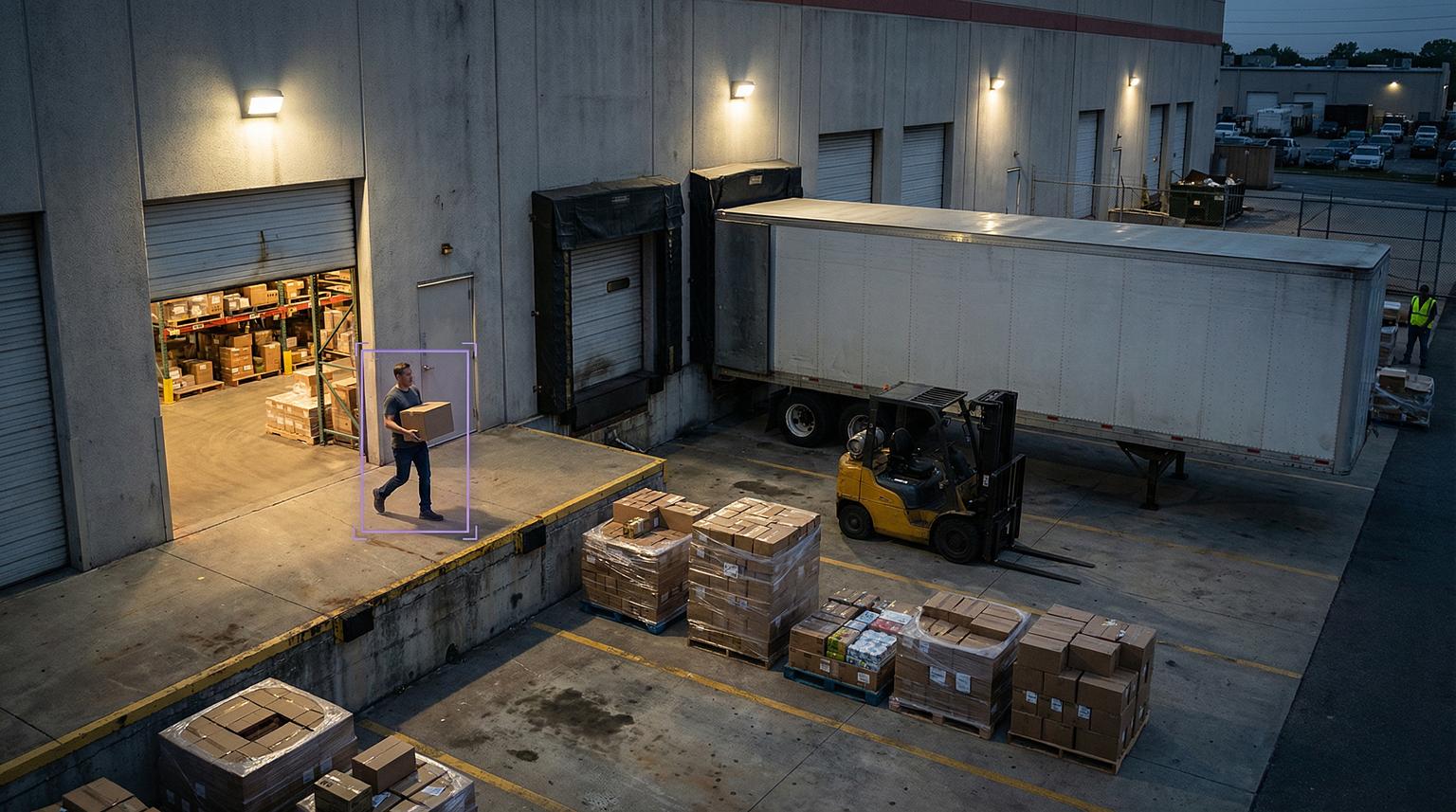


Loading docks account for a disproportionate share of retail shrink, yet they receive a fraction of the security attention directed at the sales floor. The reason is structural: docks sit at the back of the building, staffed intermittently, surrounded by trailers that block sightlines, and accessed by a rotating cast of drivers, vendors, and employees. That combination of high inventory value and low visibility makes the receiving area one of the fastest-growing targets for organized retail crime (ORC) and internal theft alike.
Identity fraud attempts in the cargo and logistics sector climbed 213 percent between 2024 and 2025, according to an analysis of more than one million identity verification transactions (Source: IDScan.net). Meanwhile, 67 percent of retailers report involvement of a transnational ORC group in thefts against their company in the past year (Source: National Retail Federation via The Street). The loading dock is where these two trends converge—and where loss prevention teams need a fundamentally different approach to coverage, response, and evidence.
This article breaks down the specific threat vectors at retail loading docks, the procedural controls that reduce exposure, and how video AI agents help teams detect, deter, and document dock activity in real time.
Key terms to know
Before examining dock-specific risks, a few terms are worth defining:
Term | Definition |
|---|---|
Blind receiving | A receiving method where the clerk gets a purchase order listing expected items but not quantities, forcing a physical count of every item |
Three-way match | Comparing the purchase order, packing slip/receiving report, and vendor invoice before authorizing payment |
Tailgating | When an unauthorized person follows an authorized individual through a controlled access point on a single credential swipe |
Dwell time alert | A notification triggered when a person or vehicle remains in a defined zone longer than a set threshold |
Exception-based reporting (EBR) | Automated flagging of transactions that deviate from normal patterns—excessive voids, high-value refunds, no-sale drawer openings |
Chain of custody | The documented trail showing who handled evidence, when, and how—required for evidence to be admissible in court |
Why loading docks are the highest-risk entry point in retail
The receiving dock is the moment where responsibility for the shipment transfers from vendor to retailer. If the receiving process is lax, organizations might be paying for goods they never actually received (Source: Protea Financial). That handoff creates a concentrated target with multiple distinct threat vectors:
Threat vector | How it works | Why it's hard to catch |
|---|---|---|
Short-shipping / vendor fraud | Delivery documentation lists items that never physically arrive | Clerks often trust paperwork instead of counting |
Employee collusion | Staff facilitate unauthorized removal of merchandise in exchange for compensation | Insiders know camera blind spots and shift schedules |
After-hours intrusion | Unauthorized access through dock doors during non-operational hours | Docks are typically unmonitored overnight |
Tailgating during deliveries | Unauthorized individuals follow legitimate drivers through open dock doors | High activity during peak hours masks extra bodies |
Trailer diversion | Cargo is redirected mid-transit or removed from secured staging areas | Loss isn't detected until inventory counts days or weeks later |
The compounding problem is timing. Receiving dock theft often goes undetected until inventory counts occur several days or weeks after the loss, at which point the perpetrator has relocated, the evidence trail has degraded, and witness recollection has faded (Source: Protea Financial).
Procedural controls that reduce dock exposure
Technology alone does not secure a loading dock. Disciplined receiving protocols form the first line of defense. Three practices deserve priority:
The three-way match and blind receiving
The foundational receiving protocol compares three documents before a bill is authorized for payment: the purchase order (what was requested), the packing slip or receiving report (what the vendor said they sent and what the team physically counted), and the vendor invoice (what the vendor is billing for). If the receiving report says 50 cases arrived but the invoice charges for 60, that discrepancy is caught before it becomes a loss (Source: Protea Financial).
Blind receiving takes this further. The receiving clerk gets a purchase order listing expected items but not quantities, forcing a physical count of every item rather than a glance-and-assume approach (Source: Protea Financial). This practice directly addresses vendor fraud and employee collusion schemes where staff and vendors coordinate to shortchange deliveries.
Separation of duties
Operational controls must separate three functions to block single-person circumvention:
Authorization — who approves the purchase of inventory
Custody — who physically holds and manages the inventory
Record keeping — who updates the accounting system
If the warehouse manager can also adjust inventory numbers in the system, they could theoretically steal merchandise and delete it from records. By separating roles, the bookkeeper acts as a check on the warehouse manager. If goods go missing, the records won't match the physical count, and the discrepancy gets flagged (Source: Protea Financial).
Cycle counting over annual inventory
Annual physical inventory counts are too slow because the lag between loss and detection gives theft time to repeat. Cycle counting programs provide regular verification of inventory levels without disrupting operations, and statistical sampling methods focus counting efforts on high-value or high-risk items (Source: Logimax WMS). For high-value merchandise like electronics and apparel, weekly or even daily counts of premium items deliver timely theft indicators compared to quarterly counts that let losses accumulate (Source: GRS Protection).
Where traditional guard coverage falls short at the dock
How do you maintain consistent coverage across 20, 30, or 40 stores when each location has a back door that's only staffed during receiving hours? The honest answer for most retail operations: you don't.
Guard coverage at loading docks is both expensive and inconsistent. Guards rotate shifts, take breaks, and can't monitor every angle of a dock simultaneously—especially behind trailers, where perpetual blind spots exist (Source: OpenDock). Overnight coverage multiplies cost without proportional return, and guard presence doesn't create a searchable evidence trail.
The result is a coverage model that depends on human attention at the exact moments when attention is hardest to sustain: late-night hours, early-morning deliveries, and high-volume receiving windows where speed pressure overrides verification discipline.
How video AI closes the loading dock blind spot
Video AI closes the gap between recording an event and acting on it—so the dock gets a real-time response, not a next-day review. Where traditional camera systems require someone to notice a problem and then manually scrub footage to understand it, video AI applies context-aware detection to flag anomalies as they happen.
Specific capabilities that matter at loading docks include the following:
Capability | What it does at the dock | Outcome |
|---|---|---|
Loitering detection | Flags people or vehicles lingering near dock doors, fences, or staging areas beyond a set threshold | Surfaces reconnaissance behavior before physical theft occurs |
Unauthorized entry / tailgating | Detects when multiple people pass through a controlled door on a single credential swipe | Catches the primary ORC tactic of employees facilitating external accomplice access |
After-hours motion alerts | Triggers notifications when movement occurs in dock zones during non-operational hours | Enables in-the-moment response instead of post-incident discovery |
Automatically records plate data for every vehicle entering and exiting the dock area | Identifies vehicles associated with previous theft incidents and flags banned vehicles | |
Dwell time alerts | Notifies when a delivery vehicle remains at the dock beyond the expected loading/unloading window | Surfaces potential diversion activity or documentation fraud |
Attribute search | Allows investigators to query footage by clothing color, vehicle type, or other visual attributes | Compresses investigation time from hours of scrubbing to minutes of targeted review |
These capabilities shift the operating model from "review footage after the fact" to "intervene while the event is still unfolding." Video intelligence systems detect early warning signs before theft occurs, enabling intervention while the situation is still low-risk (Source: ISS).
Contextual alerts reduce noise, not add to it
One of the biggest concerns for regional teams managing dozens of locations is alert fatigue. If a system generates more noise than signal, it gets abandoned. The distinction between legacy motion alerts and video AI detection lies in context: instead of "motion detected in zone 5 at 11:47 PM," a context-aware alert includes a short video clip, the camera name and map location, the rule that triggered and why, and a confidence score (Source: ISS).
This context-rich alerting means a team member can make a response decision without additional review time. When alarms trigger frequently without verification, teams become desensitized, law enforcement response credibility erodes, and real incidents get buried. Video-verified alarms change that dynamic by pairing alerts with visual confirmation and filtering false positives before they reach the team.
Building audit trails that hold up for prosecution
Catching theft is only half the equation. The other half is building evidence packages that prosecutors will actually pursue. Limited law enforcement resources and lack of prosecutors' willingness to prosecute are among the top reasons impacting retailers' ability to investigate or prosecute ORC activities (Source: National Retail Federation via The Street).
Stronger evidence packages improve those odds. The key requirements for prosecutable video evidence include:
Chain of custody documentation — every access to the video file must be logged, including who accessed it, when, for how long, and what actions were taken. Without a transparent chain of custody, defense attorneys can argue the evidence is unreliable or tampered with, causing courts to dismiss it (Source: Digital Evidence AI).
Metadata preservation — timestamp, camera identifier, video codec, and file hash must be captured and preserved from the moment of event capture (Source: Computer Forensics Lab).
Corroborating data layers — video alone is strong, but video paired with access control logs, receiving documentation discrepancies, and transaction records creates a multi-source evidence package that's far harder to challenge.
Timeline-based reconstruction — investigators need to present events in sequence, not as isolated clips. A unified timeline showing vehicle arrival, dock door opening, merchandise movement, and departure—all with timestamps—tells a story that's clear to prosecutors and juries alike.
Exception-based investigation workflows accelerate this process. Instead of asking investigators to "find something suspicious" across hours of footage, the system flags high-risk events first and links them directly to supporting video. Investigators review moments with statistical risk, not random footage, and repeat behaviors by store, shift, or personnel surface quickly.
How Tidewater Fleet Supply eliminated dock blind spots across 17 locations
Tidewater Fleet Supply, a distributor and retailer of heavy-duty truck parts operating three distribution centers and 14 retail locations across the Southeast US, faced significant theft and loss incidents tied to inadequate camera coverage. Their legacy system made investigations painful—searching footage could take hours, remote access was limited to the local network, and cameras went down without warning, creating the exact blind spots that criminals exploit.
After deploying Spot AI's cloud-based platform, Tidewater unified all 17 locations on a single dashboard, enabling centralized monitoring from Florida to Virginia. AI-powered search compressed investigation time, and camera health monitoring with alerts eliminated downtime-related coverage gaps. You can read the full Tidewater Fleet Supply case study for details on their deployment.
The Tidewater example illustrates a pattern: the biggest gains come not from adding more cameras, but from turning existing cameras into proactive teammates—searchable, alert-capable, and centrally managed across every location in the region.
OSHA compliance and dock safety overlap with security
Loading dock security and safety compliance share more infrastructure than most teams realize. OSHA regulation 29 CFR 1910.178 requires all powered industrial truck operators to receive formal training, practical instruction, and performance evaluation before operating any forklift (Source: Forklift Academy). Loading dock areas should be well-lit and always free of clutter, with someone present to supervise safe procedures for loading and unloading (Source: ComplianceSigns).
These safety requirements directly support security objectives: adequate lighting eliminates the shadows where theft occurs, supervisor presence adds a witness layer, and organized dock areas improve sightlines. Video systems that document training completion, safety procedures, and dock conditions serve double duty—supporting both OSHA compliance records and loss prevention evidence.
Considerations before deploying video AI at loading docks
No technology deployment is without limitations. Teams evaluating video AI for dock security should weigh several factors:
Camera placement matters more than camera count. Coverage of dock doors, vehicle approach zones, staging areas, and trailer interiors requires deliberate positioning. Adding cameras without strategic placement creates data volume without proportional visibility.
Environmental conditions affect performance. Loading docks feature irregular lighting (harsh exterior sunlight transitioning into warehouse shade), metal structures that create reflections, and high activity rates during peak hours. Systems must handle these conditions reliably.
Alerts require human follow-through. Video AI surfaces events and reduces noise, but someone still needs to review, decide, and act. Deployment without clear escalation procedures and staffing plans will underperform.
Integration amplifies value. Video analytics operating in isolation deliver less impact than systems integrated with access control, receiving documentation, and POS data. The strongest evidence packages combine multiple independent data sources.
Procedural discipline remains essential. Blind receiving, three-way matching, separation of duties, and cycle counting are not replaced by technology—they're reinforced by it.
Turning the back door into a controlled perimeter
The loading dock doesn't have to remain the weakest link in retail security. The combination of disciplined receiving protocols, strategic camera placement, and video AI that detects, alerts, and documents creates a defensible perimeter where a blind spot used to be.
For regional teams managing dozens of locations, the operational question isn't whether to invest in dock security—it's whether the current approach can scale. Can you investigate an incident at Store 37 without driving there? Can you produce a prosecution-ready evidence package in minutes instead of hours? Can you cover after-hours dock access across every location without doubling guard spend?
Spot AI's platform works with existing cameras, deploys in under a week, and centralizes every location on a single cloud dashboard—giving regional teams the ability to cover more stores without adding headcount.
"Before implementing this system, tracking tailgating relied entirely on human observation. Now we receive instant alerts when someone holds the door open or if multiple people enter in quick succession, allowing us to address security protocols in real-time rather than after the fact."
Mike Tiller, Director of Technology, Staccato (Source: Spot AI Customer Story)
If you want to see how Spot AI's video AI Agents can help teams detect dock activity, verify incidents, and speed up investigations across multiple sites, request a demo.
Frequently asked questions
What are the best practices for securing a retail loading dock
Start with procedural controls: implement blind receiving so clerks physically count every item, enforce a three-way match (purchase order, receiving report, vendor invoice) before authorizing payment, and separate authorization, custody, and record-keeping duties so no single person can circumvent controls. Layer in physical measures—adequate lighting, controlled access credentials that expire automatically for contractors, and strategic camera positioning covering dock doors, vehicle approach zones, and staging areas. Cycle counting high-value SKUs weekly or daily catches discrepancies while evidence and witness memory are still fresh.
How can video AI help reduce theft at loading docks
Video AI applies context-aware detection to camera feeds, flagging specific anomalies like tailgating through controlled doors, loitering near dock perimeters, after-hours motion in restricted zones, and vehicles dwelling beyond expected loading windows. Rather than requiring someone to manually review hours of footage, the system surfaces high-risk events with short video clips, timestamps, and camera location data—enabling rapid triage. License plate capture identifies vehicles tied to previous incidents, and attribute search lets investigators query footage by clothing color or vehicle type to find relevant moments in minutes.
What are the OSHA requirements for loading docks
OSHA regulation 29 CFR 1910.178 mandates formal training, hands-on instruction, and performance evaluation for all powered industrial truck operators before independent operation. Dock areas must be well-lit, free of clutter, and supervised during loading and unloading activities. Employers bear full responsibility for certifying operator competency—if an operator causes an incident and training documentation cannot be produced, the employer faces significant liability. Compliant programs require classroom instruction, practical training under supervision, and documented performance evaluation, with refresher training tracked and scheduled automatically.
How do video analytics improve incident response at docks
Traditional alarm systems generate minimal-context notifications ("motion detected in zone 5") that require manual footage review to assess. Video analytics include context in every alert: a video clip of the event, the specific rule that triggered, the camera location, and a confidence score. This allows teams to make response decisions without scrubbing timelines. When paired with access control logs and receiving documentation, investigators can reconstruct complete event sequences—vehicle arrival, dock door activity, merchandise movement, departure—with corroborating evidence from multiple independent sources, producing stronger cases for law enforcement.
About the author
Sud Bhatija is COO and Co-founder at Spot AI, where he scales operations and GTM strategy to deliver video AI that helps operations, safety, and security teams boost productivity and reduce incidents across industries.