




Organized retail crime (ORC) doesn't respect store boundaries. A crew that hits a location in one city on Monday can target another store 200 miles away by Wednesday—using the same vehicles, the same methods, and the same fencing network. For loss prevention teams responsible for 20, 30, or 40+ stores, the question isn't whether ORC rings are operating across your footprint. It's whether you can connect the dots fast enough to stop them.
License plate recognition (LPR) technology gives LP teams a way to do exactly that: identify repeat vehicles, share hot lists across locations, build stronger cases for law enforcement, and shift from reactive investigation to forward-looking deterrence. This guide breaks down how to deploy LPR as part of a coordinated, multi-location ORC prevention strategy—covering vehicle pattern analysis, hot-list management, task force collaboration, and evidence packaging.
Key terms to know
Before getting into the operational framework, a few definitions help set the foundation:
Term | Definition |
|---|---|
License plate recognition (LPR) | A camera-based capability that reads license plates automatically and checks them against a database or watchlist. A camera captures the plate, optical character recognition (OCR) software extracts the number, and the system checks it against configured lists. |
Organized retail crime (ORC) | Coordinated, large-scale theft by professional groups who steal merchandise for resale through fencing operations—distinct from opportunistic shoplifting. |
Hot list | A curated watchlist of license plates tied to known ORC incidents, trespassed individuals, or law enforcement alerts. When a listed plate enters a monitored property, the system generates a notification. |
Fencing operation | The downstream resale network that purchases stolen goods at wholesale prices and sells them through secondary channels, including online marketplaces. |
Booster crew | The team of professional shoplifters who execute the actual theft, often targeting specific high-value merchandise categories. |
Why ORC demands a multi-location response
ORC is not a single-store problem. Only 10% of offenders account for 68% of total retail crime losses, according to the National Retail Federation's 2025 report. That concentration means a small number of professional crews generate the vast majority of shrink—and they operate across geographies.
The numbers reinforce the urgency. Shoplifting incidents surged 93% from 2019 to 2023, with an additional 19% increase from 2023 to 2024 (Source: NRF). Meanwhile, 66% of retailers reported transnational ORC involvement in thefts since 2024 (Source: NRF), with documented connections to international criminal networks.
When ORC crews rotate between locations to avoid pattern recognition, single-store video systems can't connect the activity. Each incident looks isolated. LP teams end up investigating the same ring at five different stores without realizing it's one operation.
That's where cross-location LPR changes the equation.
How LPR enables cross-location vehicle pattern analysis
LPR cameras deployed at parking lot entrances and exits capture plate data for every vehicle entering and leaving a property. When that data flows into a centralized platform accessible across all locations, LP teams gain the ability to identify patterns that would otherwise stay invisible.
The operational workflow follows a clear sequence:
Capture at the perimeter. LPR cameras positioned at natural funnel points—parking garage entries, lot access roads, loading dock approaches—read plates as vehicles pass through.
Centralize the data. Plate reads from all locations feed into a unified dashboard, creating a single view of vehicle activity across the entire retail footprint.
Flag repeat appearances. The system identifies vehicles that appear at multiple locations within defined timeframes, surfacing patterns consistent with coordinated ORC activity.
Correlate with incidents. When a theft occurs, LP teams can cross-reference the plate data against the incident timeline to identify which vehicles were present—and whether those same vehicles appeared at other locations before or after.
Build the case. Time-stamped plate reads, paired with video footage, create an evidence trail that links incidents across jurisdictions.
This approach turns your perimeter into an early-warning system. Instead of reviewing footage after the loss, LP teams get an alert while the vehicle is still on the property—or before it reaches the next store.
LPR is most effective when cameras are placed at natural funnel points—parking lot entrances, exit lanes, and loading dock approaches—where every vehicle must pass through a defined lane. Prioritize these chokepoints over broad lot coverage to maximize plate capture rates across your footprint.
Building and managing hot lists that work
A hot list only works if your team has a clear process behind it. Poorly maintained lists generate noise. Well-managed lists help a small LP team cover more ground without adding headcount.
Effective hot-list management follows these principles:
Practice | Why it matters |
|---|---|
Tiered priority levels | Not every flagged plate warrants the same response. Vehicles tied to active law enforcement investigations need different routing than plates associated with prior trespass incidents. |
Regular list hygiene | Remove plates that are no longer relevant. Stale entries increase false matches and erode operator confidence in the system. |
Cross-retailer sharing | When ORC crews target multiple chains in the same market, sharing plate data between retailers (through task forces or industry groups) expands the detection net. |
Law enforcement integration | Plates flagged by local or state agencies should feed directly into the system, enabling alerts when wanted vehicles enter retail properties. |
Automated alert routing | High-priority matches should notify both on-site teams and regional LP leadership simultaneously, so response decisions happen quickly. |
When a vehicle on the hot list enters a shopping center, the alert reaches store-level teams and regional coordinators before the occupants even park. That advance warning lets LP position resources, notify local law enforcement, and observe the situation as it develops—rather than discovering the loss hours later during inventory reconciliation.
Collaborating with law enforcement and ORC task forces
LPR gets more useful when it plugs into the way ORC cases are actually worked—task forces, investigators, and prosecutors. Seventeen states have established ORC task forces that coordinate efforts across law enforcement, prosecutors, and the private sector (Source: Congressional Research Service).
California's ORC Task Force, led by the California Highway Patrol, illustrates what coordinated enforcement can achieve. In the first two months of 2026, the task force conducted 75 investigations, made 35 arrests, and recovered 33,354 stolen items valued at over $3.3 million (Source: California Governor's Office). Since its 2019 launch, the task force has completed over 4,489 investigations, made 5,061 arrests, and recovered nearly $73 million in stolen goods (Source: California Governor's Office).
For LP teams, the practical steps for task force collaboration include:
Identify your regional task force. Determine which state or local ORC task forces operate in your markets and establish a point of contact.
Share LPR data proactively. Provide plate reads associated with confirmed ORC incidents to task force investigators, enabling them to cross-reference against their own databases.
Receive law enforcement hot lists. Integrate plates from active investigations into your system so alerts trigger when wanted vehicles enter your properties.
Coordinate on multi-location cases. When LPR data shows the same vehicle at thefts across multiple stores, package that evidence and present it to task force investigators as a coordinated case rather than individual incidents.
Support prosecution with evidence. Provide time-stamped plate reads, correlated video clips, and incident timelines that help prosecutors elevate charges from misdemeanor theft to felony ORC.
This collaboration matters because felony-level charges change the risk calculus for ORC crews. When prosecutors can demonstrate coordinated, cross-jurisdictional activity—supported by LPR evidence linking the same vehicles to multiple incidents—perpetrators face organized crime charges rather than individual shoplifting citations.
Building evidence packages that support prosecution
LP teams often gather strong evidence but package it in ways that don't translate well for prosecutors. A well-structured evidence package connects the dots between incidents and makes the coordinated nature of ORC activity unmistakable.
An effective ORC evidence package includes these components:
Component | What to include |
|---|---|
Vehicle timeline | Time-stamped LPR reads showing the same plate at multiple locations, with dates, times, and site addresses. |
Correlated video clips | Footage from each location showing the vehicle arriving, occupants exiting, and (where available) theft activity inside the store. |
Incident reports | Store-level documentation of each theft event, including merchandise categories, estimated values, and employee observations. |
Pattern summary | A narrative connecting the incidents—showing how the same vehicle, and often the same individuals, operated across locations within a defined timeframe. |
Aggregate loss calculation | Total merchandise value across all linked incidents, which often pushes the case above felony thresholds and supports ORC-specific charges. |
The aggregate loss calculation is particularly important. A single theft of $300 in merchandise may fall below felony thresholds in many jurisdictions. But when LPR data links that vehicle to 15 similar incidents across a region, the combined loss supports felony prosecution and demonstrates the organized nature of the operation.
Practical considerations for multi-location LPR deployment
Rolling out LPR across a multi-site retail footprint comes down to a few operational decisions:
Camera placement matters more than camera count. LPR cameras perform best at natural funnel points where vehicles must pass through a defined lane. Parking lot entrances, exit lanes, and loading dock approaches typically offer the best capture rates.
Environmental conditions affect accuracy. Vehicle speed, viewing angle, lighting, and weather all influence read rates. Cameras should be positioned to account for local conditions—glare patterns, traffic speed, and lane width—rather than using a one-size-fits-all deployment template.
Data retention policies vary by jurisdiction. Establish clear rules for how long plate reads remain in the system, who can access the data, and when records are deleted. Audit logging should track all queries and exports.
Integration with existing video platforms determines value. LPR data in isolation tells you a plate was present. LPR data linked to video footage tells you who was in the vehicle, what they did, and how the incident unfolded. Systems that connect plate reads to camera feeds across locations create far richer investigative intelligence.
Alert routing prevents fatigue. Distinguish between high-priority alerts (active law enforcement hot list matches) and standard logging events. If every plate read generates a notification, operators will stop paying attention.
Key takeaways for multi-location LPR deployment:
- Choose a platform that centralizes plate reads and video from all sites into a single dashboard—isolated, per-store systems can't reveal cross-location ORC patterns.
- Establish tiered alert routing from day one so high-priority hot list matches reach LP leadership and law enforcement immediately, while routine reads are logged without generating notification fatigue.
- Package LPR evidence with correlated video and aggregate loss totals to help prosecutors elevate charges to felony ORC levels.
How Spot AI supports LPR-driven ORC prevention across locations
Spot AI's unified video AI platform connects existing cameras—including LPR-capable units—to a cloud dashboard that aggregates data across all sites. For LP teams managing dozens of locations, this architecture addresses several of the pain points outlined above.
Spot AI works with any IP camera, so retailers don't need to replace existing hardware to add LPR capability. The platform's license plates of interest analytics template flags vehicles on configured watchlists and alerts your team when those plates show up at any monitored property. Because the cloud dashboard spans all locations, a plate flagged at one store triggers alerts across the entire footprint.
The platform's search capabilities let LP teams find the right clips across weeks of footage and hundreds of locations using attributes like vehicle descriptions—not just time-based scrubbing. When an ORC incident occurs, investigators can search for a specific plate across every site to build the cross-location timeline that prosecutors need.
Spot AI's system can be live in under a week, with plug-and-play hardware that connects on-prem cameras to the cloud dashboard without extensive infrastructure work. For retailers evaluating a pilot, that speed means results can start flowing before the next budget cycle.
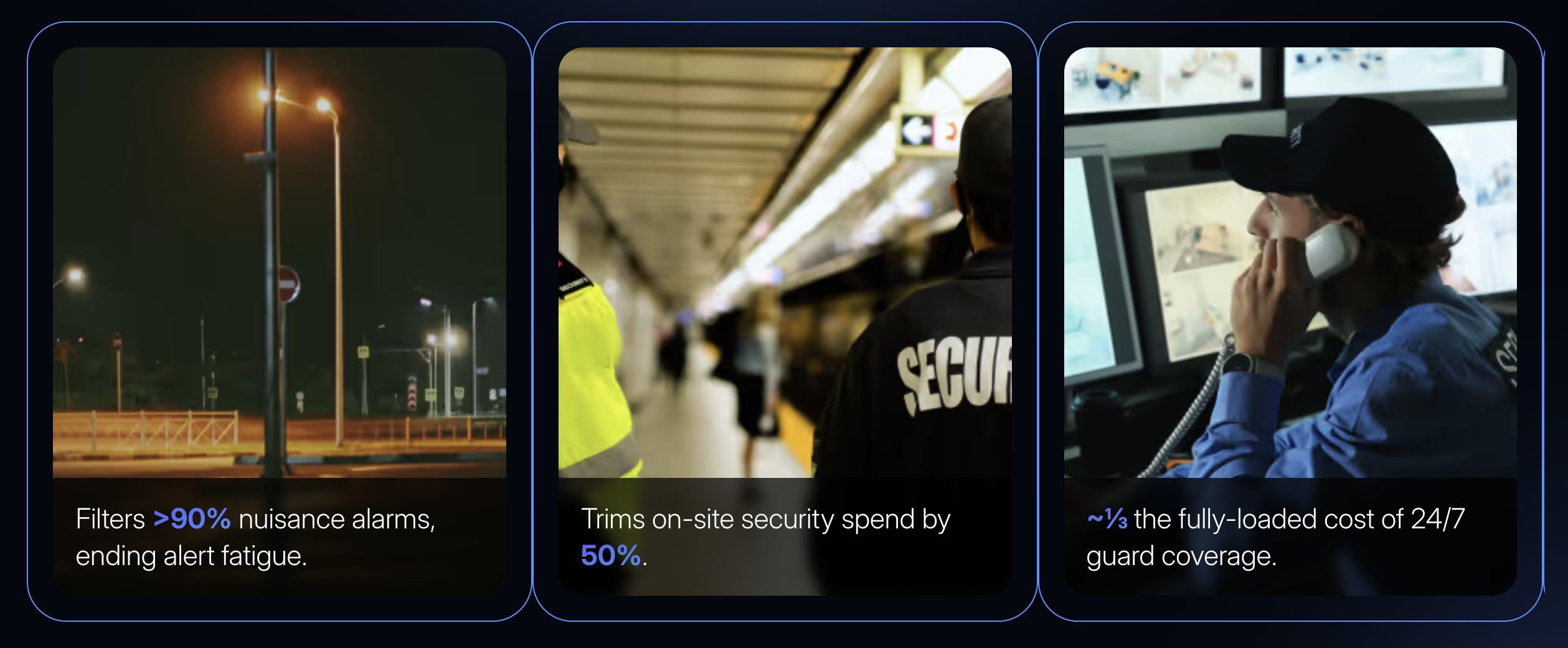
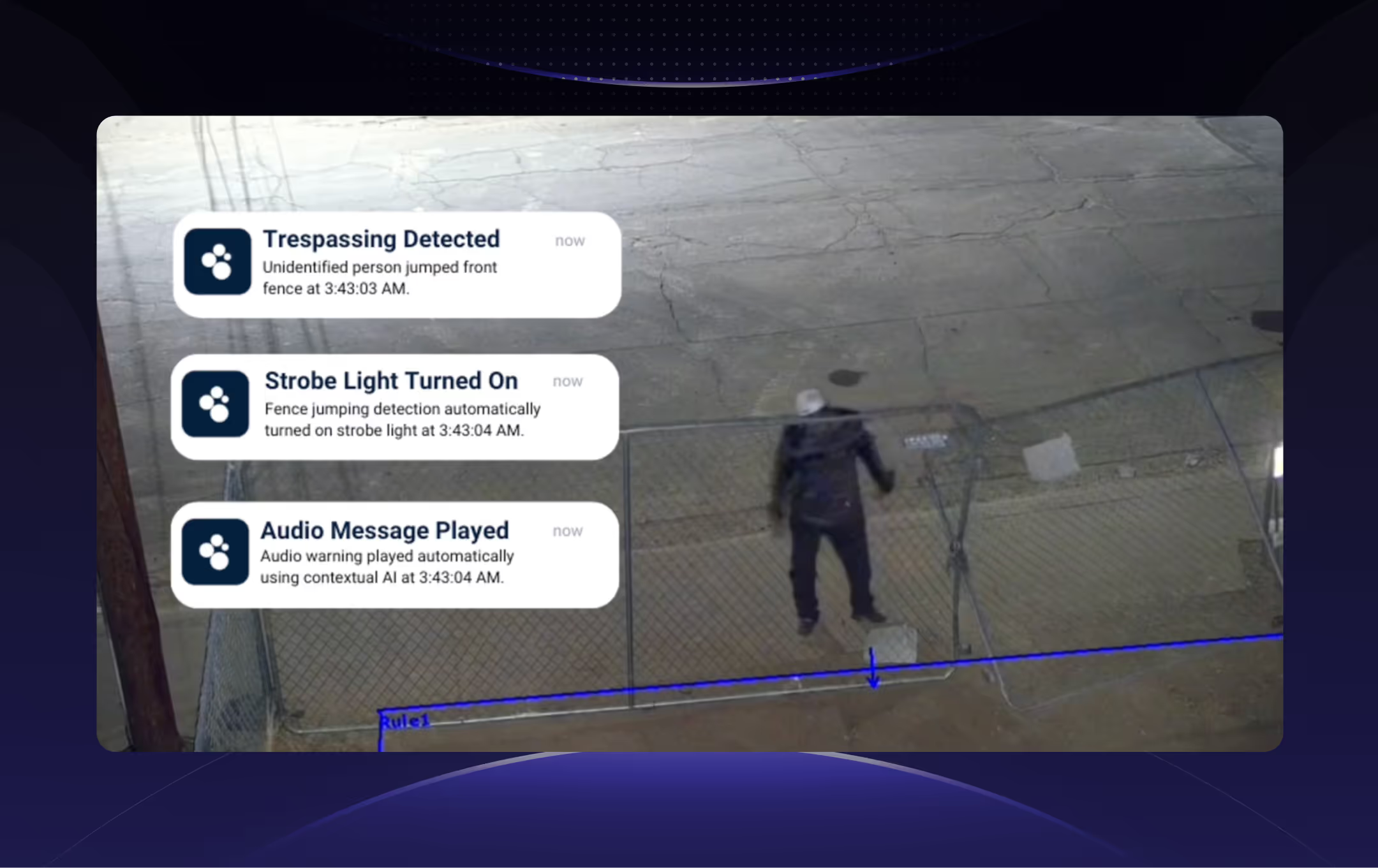
The AI Security Guard extends this capability to perimeter protection. Context-aware detections spot loitering, after-hours trespass, and suspicious vehicle activity in parking lots—then trigger strobes and talk-downs to push threats off the property before they escalate inside the store. This shifts the model from recording losses to deterring them at the perimeter.
For teams stretched across 20–40+ stores, the platform acts as a digital force multiplier: fewer blind spots, faster case building, and a consistent control presence across every location without adding headcount.
Turning LPR data into a regional ORC defense strategy
Book a demo to see how Spot AI connects LPR reads, video evidence, and automated deterrence in one platform—helping loss prevention teams link activity across sites, build cases faster, and deter ORC earlier.
See Spot AI in action

"You don't have time to dig through hours of footage. Spot.ai gives you actionable intel fast PPE compliance, motion events, license plates, you name it. All from a clean, easy-to-use dashboard."
kristen g., Operations Leader (Source: G2)
Frequently asked questions
What are the most effective methods for retail theft prevention across multiple locations?
The most effective approaches layer physical deterrence, employee training, technology, and law enforcement collaboration. Store design that maximizes visibility, electronic article surveillance, video systems with AI-powered analytics, and LPR at parking lot perimeters each address different stages of the theft cycle. When these layers feed into a centralized platform accessible across all sites, LP teams can identify patterns and coordinate responses that single-store systems miss entirely.
How does organized retail crime differ from regular shoplifting?
ORC involves coordinated groups of professional thieves who target specific merchandise categories, operate across multiple jurisdictions, and maintain established fencing networks to resell stolen goods. Regular shoplifting is typically opportunistic and involves a single individual. The key distinction: only 10% of offenders drive 68% of total retail crime losses (Source: NRF), meaning a small number of organized crews cause the majority of damage.
How can LPR technology assist in ORC prevention?
LPR cameras read plates at parking lot entry and exit points, then check those plates against configured watchlists. When a vehicle tied to a prior ORC incident enters any monitored property, the system alerts LP teams and can notify law enforcement—while the vehicle is still on-site. Across multiple locations, LPR data reveals which vehicles appear at different theft sites, enabling investigators to link incidents and build coordinated cases that support felony-level prosecution.
What legal actions can be taken against organized retail crime rings?
Prosecutors can pursue charges ranging from felony grand larceny (when aggregated merchandise value exceeds state thresholds) to federal organized crime offenses. The Combating Organized Retail Crime Act, pending in Congress, would establish a specific federal offense designation for ORC. Recent court decisions have also established that fencing operators can be sentenced based on the predicate conduct of booster crews, expanding criminal liability across the entire supply chain.
How do ORC task forces work, and how can retailers participate?
Seventeen states have established ORC task forces that coordinate law enforcement, prosecutors, and private-sector retailers around organized theft investigations (Source: Congressional Research Service). Retailers participate by sharing incident data, LPR reads, and video evidence with task force investigators. In return, they receive hot lists from active investigations and benefit from coordinated enforcement operations that target the criminal networks responsible for the largest losses.
About the author
Sud Bhatija is COO and Co-founder at Spot AI, where he scales operations and GTM strategy to deliver video AI that helps operations, safety, and security teams boost productivity and reduce incidents across industries.

