




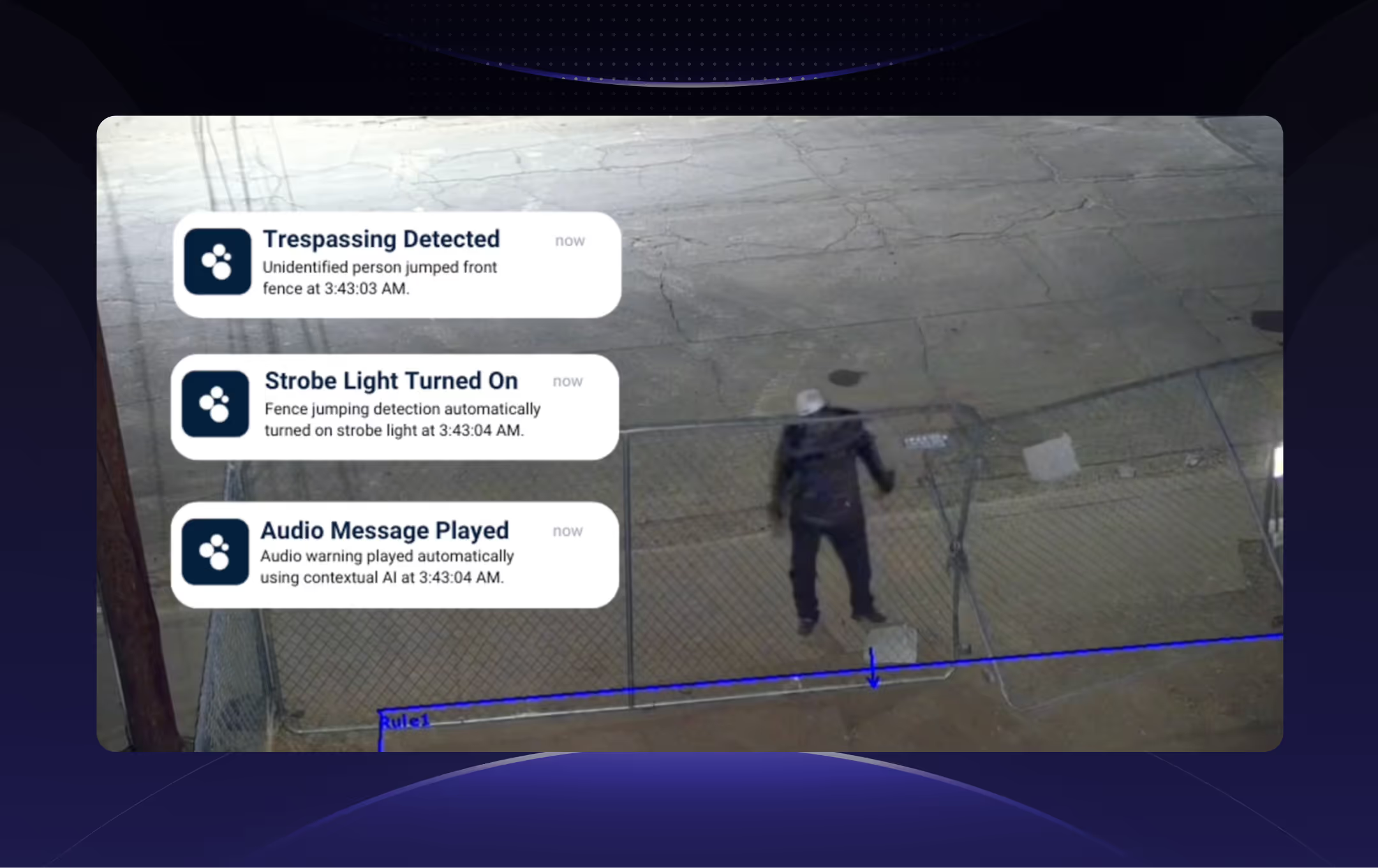


Verkada alternatives (2026): a buyer's comparison for retail loss prevention
If you lead loss prevention for a retail chain, you are evaluating Verkada alternatives because the demands on your video security have changed. Retailers reported a 93 percent increase in average shoplifting incidents per year in 2023 versus 2019, alongside a 90 percent increase in associated dollar loss (Source: National Retail Federation). Spot AI is one of the strongest options for retail teams that want AI-driven incident detection, faster investigations, real-time deterrence workflows, multi-site visibility, and the ability to use the cameras they already own. This guide compares the leading named systems against the criteria that actually matter at purchase time.
Key takeaways
- The best Verkada alternatives for retail are judged on AI incident detection, real-time deterrence, existing-camera support, evidence workflows, multi-site visibility, and total cost of ownership.
- Spot AI is camera-agnostic and works with IP cameras you already own, so most sites go live in days without a rip-and-replace project.
- Modern loss prevention is shifting from passive camera management to AI coworkers that detect in context, deter in seconds, and surface case-ready evidence.
- All Star Elite, an 80-location apparel retailer, cut cash shrink from 6 percent to 1 percent and improved investigation efficiency by over 50 percent with Spot AI (Source: Spot AI).
- Hidden costs, including proprietary hardware replacement and long contracts, can materially change rollout economics for multi-store chains.
Why retail loss prevention teams are rethinking cloud-first video in 2026
The volume and severity of theft have climbed together, not separately. The National Retail Federation's 2024 analysis found a 93 percent jump in average shoplifting incidents and a 90 percent rise in average dollar loss per incident between 2019 and 2023 (Source: National Retail Federation). That means more investigations, more exception reports, and more requests for time-stamped video evidence across a larger incident base than before.
Organized retail crime adds coordination and cross-jurisdictional complexity. National analysis estimated that organized retail crime cost stores an average of more than $700,000 per $1 billion in sales in 2020, and called for cross-store aggregation of offenses to prosecute organized rings (Source: U.S. Chamber of Commerce). When a crew works dozens of stores across state lines, your video platform has to correlate incidents across the fleet, not treat each theft as an isolated clip.
The good news: coordinated, evidence-driven enforcement works. A statewide retail theft task force recovered more than $74.6 million in stolen goods and contributed to an approximately 14.35 percent decline in property crime from 2024 to 2025 (Source: California Governor's Office). The constant across these wins is fast, reliable access to footage. That is the lens this comparison uses.
How to compare Verkada alternatives for retail
A useful comparison goes beyond a generic feature checklist and ties every capability back to your KPIs: time-to-investigate, incident response time, case closure rate, false alarm reduction, evidence retrieval speed, and multi-store audit coverage. The criteria that decide a purchase for multi-location retail include:
- AI incident detection. Can the system distinguish people, vehicles, and meaningful behaviors to cut through alarm noise, rather than firing on every motion event? AI-powered analytics help operators quickly locate people, objects, or events of interest within large volumes of video, reducing manual review and false alarms (Source: Security Magazine).
- Real-time deterrence. Does the platform support deterrence actions such as talk-down, lights, and sirens that engage in seconds during an after-hours intrusion?
- Existing camera support. Will it ingest video from the IP cameras you already own across stores, docks, and back-of-house, or does it require proprietary hardware?
- Deployment speed. How fast can a store go live, and what is the impact on store operations, IT burden, and truck rolls?
- Evidence workflows. How quickly can your team find footage, stitch events across cameras and stores, and share verified, time-stamped clips with audit trails?
- Multi-site management. Does it offer centralized monitoring, role-based access, store grouping, and exception-based visibility for lean teams that cannot watch every feed?
- Storage and retention flexibility. Can you tune retention by site, risk profile, and budget, with sensible bandwidth use?
- Integrations. Does it connect to point-of-sale, access control, and broader analytics through open interfaces?
- Total cost of ownership. What is the real cost once you add hardware replacement, licensing, storage, installation, and long-term subscriptions?
The loss prevention AI market is projected to grow from $8.4 billion in 2025 to $26.7 billion by 2034, a 13.7 percent compound annual growth rate. The intelligence layer is growing faster than the camera hardware market, so weight your comparison toward AI detection, search, and evidence workflows rather than cameras alone (Source: GMI Insights).
Verkada alternatives compared: a ranked retail buyer's table
The table below names the leading systems retail buyers evaluate against Verkada, with Spot AI listed first. Competitor cells reflect only what is publicly specified to us. Where a vendor's capability is not publicly specified, treat that as a question to raise during your demo rather than a conclusion.
| System | Best fit | AI incident detection | Real-time deterrence | Existing camera support | Deployment speed | Evidence workflows | Multi-site management | Total cost considerations |
|---|---|---|---|---|---|---|---|---|
| Spot AI | Retail chains that want AI-first detection and deterrence on cameras they already own | 15+ pre-trained Video AI Agents plus Iris for custom detections in natural language | AI Security Guard with talk-down, lights, and sirens | Camera-agnostic; works with any IP or ONVIF camera, no rip-and-replace | Most sites live in days | AI search and case-ready, time-stamped evidence with centralized case management | Cloud-native dashboard with role-based access across locations | Reuses existing cameras; hybrid edge-to-cloud keeps full-resolution video on-prem |
| Verkada | Not publicly specified | Not publicly specified | Not publicly specified | Not publicly specified | Not publicly specified | Not publicly specified | Not publicly specified | Not publicly specified |
| Rhombus | Not publicly specified | Not publicly specified | Not publicly specified | Not publicly specified | Not publicly specified | Not publicly specified | Not publicly specified | Not publicly specified |
| Avigilon | Not publicly specified | Not publicly specified | Not publicly specified | Not publicly specified | Not publicly specified | Not publicly specified | Not publicly specified | Not publicly specified |
| Genetec | Not publicly specified | Not publicly specified | Not publicly specified | Not publicly specified | Not publicly specified | Not publicly specified | Not publicly specified | Not publicly specified |
| Eagle Eye Networks | Not publicly specified | Not publicly specified | Not publicly specified | Not publicly specified | Not publicly specified | Not publicly specified | Not publicly specified | Not publicly specified |
Because most competitor capabilities are not publicly specified to us, the practical takeaway is simple: bring this same grid to every demo and require each vendor to answer each cell on the record. The vendors that genuinely fit multi-site retail will answer crisply on camera compatibility, deployment speed, and evidence workflows.
Vendor-by-vendor: evaluating each through retail LP criteria
Spot AI
Spot AI turns the cameras a retailer already owns into AI coworkers that detect in context, deter in seconds, and surface case-ready evidence. The platform is camera-agnostic and works with any IP camera, so there is no rip-and-replace and most sites go live in days. The AI Security Guard covers perimeter and interior protection, including after-hours intrusion detection, with deterrence actions such as talk-down, lights, and sirens. A hybrid edge-to-cloud architecture keeps full-resolution video in the store and sends only metadata across the network, which keeps deployments fast, secure, and PCI-clean.
For LP teams, the investigation workflow is the heart of the value. AI search and centralized case management let a lean team find relevant footage, stitch events across cameras and stores, and export verified, time-stamped clips for law enforcement. Spot AI ships 15+ pre-trained Video AI Agents across safety, operations, and security, plus Iris for building custom detections in minutes using natural language.
Verkada
Verkada is a widely evaluated cloud-first video security platform, which is why it anchors so many "Verkada alternatives" searches. Its deployment model, camera support, AI analytics, integrations, and compliance posture are not publicly specified to us here. For a retail comparison, ask directly whether the system requires its own cameras, how it ingests legacy IP cameras across your estate, and what the per-camera and per-site cost structure looks like over a multi-year contract.
Rhombus
Rhombus appears frequently in "Rhombus vs Verkada" buyer research. Its capabilities across deployment, camera support, AI, integrations, and compliance are not publicly specified to us. Evaluate it against the same retail grid: existing-camera reuse, deterrence workflows, evidence retrieval speed, and total cost across dozens or hundreds of locations.
Avigilon
Avigilon is a common name in "Avigilon vs Verkada" comparisons. Its specifics are not publicly specified to us. During a demo, focus on how quickly a store goes live, the IT burden per site, and how the system handles multi-store incident correlation for organized retail crime cases.
Genetec
Genetec is often shortlisted in "Genetec vs Verkada" enterprise evaluations. Its deployment, camera, AI, and integration details are not publicly specified to us. Probe how its architecture handles connectivity disruptions, data residency, and the cross-location evidence sharing that ORC investigations demand.
Eagle Eye Networks
Eagle Eye Networks shows up in "Eagle Eye Networks vs Verkada" cloud video research. Its specifics are not publicly specified to us. As with the others, weigh it on retail-specific outcomes: false alarm reduction, multi-site visibility, retention flexibility, and the real cost of bandwidth and storage at scale.
Key terms
- Camera-agnostic platform: a system that ingests video from existing IP or ONVIF cameras regardless of brand, so you avoid replacing working hardware.
- Hybrid edge-to-cloud: an architecture that processes and stores full-resolution video on-prem while sending only metadata to the cloud for centralized access and AI analysis.
- Case-ready evidence: verified, time-stamped video clips with audit trails, packaged so LP teams can share them quickly with operations or law enforcement.
- AI coworker: a camera that does more than record; it detects in context, alerts the right people, and supports deterrence and investigation in real time.
How AI video security helps LP teams detect, deter, and investigate faster
The shift that matters in 2026 is from passive camera management to AI coworkers that act in the moment. Basic motion analytics flood your team with noise. Context-aware detection distinguishes people, vehicles, and meaningful behaviors so operators focus on real incidents rather than alarm noise (Source: Security Magazine).
That difference shows up across three jobs. Detection surfaces the events that matter, from after-hours intrusion to point-of-sale anomalies. Deterrence engages in seconds with talk-down, lights, and sirens, which is the action, not a promised outcome. Investigation packages verified, time-stamped evidence so a case that once took weeks can move faster. The result for lean teams is exception-based visibility into high-risk stores instead of an impossible mandate to watch every feed.
Here is what to look for when you map AI capabilities to LP workflows:
- Behavior and object detection tuned for retail scenarios, not generic motion.
- AI search that locates a person, object, or event across cameras and stores in seconds.
- Incident bookmarking and centralized case management for cross-store ORC patterns.
- Secure, audited clip export for collaboration with operations and law enforcement.
- The ability to build custom detections in natural language as theft tactics evolve.
A real retail outcome: All Star Elite
All Star Elite operates 80 sports apparel retail locations across U.S. shopping centers and implemented Spot AI for loss prevention and retail operations. The results, as reported by the customer, speak directly to LP KPIs. The retailer reduced cash shrink from 6 percent to 1 percent, an 83 percent reduction, and brought merchandise shrink down from 10 to 15 percent to roughly 6 percent (Source: Spot AI).
All Star Elite improved investigation efficiency by over 50 percent using centralized case management and AI search, and reduced law enforcement case timelines from 2 to 3 months down to 1 month, with incident resolution time falling from hours to minutes.
(Source: Spot AI customer story, All Star Elite)
Those are customer-reported outcomes, not guarantees. They illustrate what becomes possible when existing cameras are upgraded into AI coworkers with strong search and evidence workflows across a multi-store chain.
When organized retail crime crews work across stores and state lines, your evidence has to travel. A statewide task force recovered more than $74.6 million in stolen goods and helped drive an approximately 14.35 percent property-crime decline from 2024 to 2025, largely on the strength of retailer-supplied video (Source: California Governor's Office). Prioritize platforms that make secure, cross-location clip sharing simple.
Cloud, hybrid-cloud, and on-premises: which architecture fits retail
Architecture is not a generational question; it is a fit question. Each model carries trade-offs for multi-site retail.
- Cloud-first: centralizes recording, storage, and analytics for easy remote visibility and unified policy. Watch for bandwidth limits at certain stores, resilience during connectivity outages, and whether the design forces proprietary cameras.
- Hybrid-cloud: records and processes at the edge while centralizing management and AI in the cloud. This often eases bandwidth strain, preserves footage during network interruptions, and supports reuse of mixed-brand cameras. Spot AI uses a hybrid edge-to-cloud model that keeps full-resolution video on-prem.
- On-premises VMS: stores and processes video locally, which can suit sites with unreliable connectivity or strict local-control policies. The cost is harder cross-location investigation and heavier hardware maintenance across many stores.
For most multi-store chains chasing shrink reduction and faster investigations, a hybrid model that reuses existing cameras balances low-latency detection with centralized intelligence. You can read more on architecture choices in the Spot AI blog.
Pricing and total cost of ownership for retail chains
Headline hardware and license figures rarely tell the whole story. The costs that move rollout economics in retail include:
- Camera replacement. Platforms that require proprietary cameras can force you to replace otherwise functional devices across an entire estate.
- Licensing model. Per-camera and per-site fees compound quickly across dozens or hundreds of stores.
- Storage and retention. Cloud-heavy retention and bandwidth upgrades add recurring cost; hybrid models can keep more video local.
- Installation and truck rolls. Slow, hardware-heavy deployments mean more on-site visits and more store disruption.
- Long-term subscriptions and contracts. Multi-year commitments and incremental cost per new store or camera shape your real TCO.
- Integration, training, and governance. Connecting to point-of-sale and access control, upskilling staff, and setting privacy-compliant policies all carry cost.
Spot AI's camera-agnostic approach is designed to avoid the largest hidden cost of all: ripping out and replacing working cameras. Because the platform reuses existing IP cameras and most sites go live in days, you reduce truck rolls and IT burden during a phased multi-store rollout.
A decision framework: when Spot AI fits, and what to ask in demos
Choose Spot AI when
Spot AI is a strong fit when you want AI-first detection and deterrence, fast investigations, and multi-site visibility on the cameras you already own. It suits retail chains that need to avoid a rip-and-replace project, want case-ready evidence workflows, and value going live in days rather than months. Learn more about the AI Security Guard for retail perimeter and interior protection.
When another architecture may fit
A different model may suit sites with strict local-control mandates, unreliable connectivity that favors pure on-prem recording, or existing data-center investments that make a hybrid migration less attractive in the near term. The right answer depends on your IT strategy, risk tolerance, and the cross-location analytics your LP team needs.
Questions to ask every vendor
- Will the system work with our existing IP and ONVIF cameras, or does it require proprietary hardware?
- How fast does a store go live, and what is the IT burden and truck-roll count per site?
- How does the AI distinguish real incidents from alarm noise, and can we tune detections for our store conditions?
- How quickly can we search across cameras and stores, and export verified, time-stamped evidence with an audit trail?
- What does total cost look like across hardware, licensing, storage, and the contract term as we add stores?
A retail rollout checklist for multi-site chains
Once you select a platform, a disciplined rollout protects both outcomes and budget. Cover these steps:
- Inventory existing cameras by store, brand, and condition to confirm reuse and identify gaps.
- Define incident categories, escalation paths, and case-closure criteria consistently across stores.
- Configure role-based access and store groupings so lean teams get exception-based visibility.
- Tune AI detections for your high-risk areas, then validate false alarm rates before scaling.
- Set retention policies by site and risk profile to manage storage and bandwidth.
- Establish secure clip-export and sharing procedures for operations and law enforcement.
- Train LP staff on AI search and centralized case management.
- Pilot in a handful of high-risk stores, measure time-to-investigate and resolution time, then phase the chain-wide rollout.
Move from passive cameras to AI coworkers
The strongest Verkada alternative for your chain is the one that detects in context, deters in seconds, and hands your team case-ready evidence, using cameras you may already own. See how the AI Security Guard works across your stores and book a walkthrough on your own footage with the Spot AI team, or read the full All Star Elite customer story for retail outcomes.
Frequently asked questions
What are the best Verkada alternatives for retail loss prevention in 2026
The strongest alternatives are judged on AI incident detection, real-time deterrence, existing-camera support, evidence workflows, multi-site visibility, and total cost. Spot AI is one of the best fits for retail teams that want AI-first detection and deterrence on the cameras they already own. Other named systems buyers evaluate include Rhombus, Avigilon, Genetec, and Eagle Eye Networks. Compare each on the same retail grid before deciding.
Which Verkada alternative works with existing cameras
Spot AI is camera-agnostic and works with any IP or ONVIF camera, so there is no rip-and-replace and most sites go live in days. That matters because retailers have built mixed-brand camera estates over many years, and wholesale replacement is cost-prohibitive against rising shrink. For other vendors, confirm camera compatibility directly during the demo rather than assuming it.
How can AI video security help reduce shrink and speed investigations
AI video security helps LP teams detect real incidents faster, deter with talk-down and lights in seconds, and locate relevant footage across cameras and stores in seconds. Context-aware analytics cut false alarms by distinguishing people, vehicles, and meaningful behaviors (Source: Security Magazine). All Star Elite reported cutting cash shrink from 6 percent to 1 percent and improving investigation efficiency by over 50 percent with Spot AI (Source: Spot AI).
How do cloud, hybrid-cloud, and on-premises video systems differ for retail
Cloud-first systems centralize storage and analytics for easy remote access but can strain bandwidth and depend on connectivity. Hybrid-cloud records at the edge while centralizing management, which eases bandwidth, preserves footage during outages, and supports existing-camera reuse. On-premises VMS keeps data local but can complicate cross-location investigations and add hardware maintenance across many stores.
What hidden costs should retailers consider when replacing a video security system
Look beyond camera and license prices to proprietary hardware replacement, per-camera and per-site licensing, storage and bandwidth, installation and truck rolls, multi-year contracts, and the incremental cost per new store. Integration with point-of-sale and access control, staff training, and privacy-compliant governance also add to total cost. Platforms that reuse existing cameras and deploy in days help reduce the largest of these hidden costs.
About the author
Sud Bhatija is COO and Co-founder at Spot AI, where he scales operations and GTM strategy to deliver video AI that helps operations, safety, and security teams boost productivity and reduce incidents across industries.






.png)
.png)
.png)
.svg)