







Verkada vs Avigilon: which is better?
Verkada vs Avigilon is one of the most common shortlists in enterprise video security, and there is no single winner. The better platform depends on your deployment model, the cameras you already own, and how much real-time action you want alongside recording and search. Both are credible, widely deployed, and backed by serious engineering, so this comparison stays even-handed: it lays out where each one is genuinely strong, using each vendor's own documentation, so you can match the platform to your environment. The stakes reach past a hardware refresh. Deloitte reports that 58% of companies already use physical AI, a figure projected to reach 80% within two years. (Source: Deloitte) Roughly half of security teams also reported larger budgets in the latest benchmark, so the platform you choose now shapes your operating model for years. (Source: Security Magazine)
Key takeaways
- There is no universal winner. Verkada leads on cloud-native simplicity and a single unified platform, while Avigilon leads on deployment flexibility, offering both on-premise (Unity) and cloud-native (Alta) options.
- Both are camera-friendly. Verkada connects third-party ONVIF Profile S cameras through Command Connector, and Avigilon is ONVIF conformant and supports third-party ONVIF cameras, so neither locks you to its own hardware for basic connectivity.
- Verkada has moved further on real-time response, with AI-Powered Deterrence in public beta as of February 2026, while Avigilon's documented strength is its mature self-learning analytics and AI search.
- Pricing is quote-based for both. List pricing is not publicly specified, so budgeting needs a vendor or integrator quote.
- If your priority is standardizing AI across a mixed fleet of cameras you already own, a software-led, camera-agnostic platform such as Spot AI is worth adding as a third option.
Verkada vs Avigilon at a glance
Before the criterion-by-criterion detail, here is the quick decision view. Verkada cells reflect Verkada's own documentation, and Avigilon cells reflect Avigilon's own documentation, with "not publicly specified" where a detail is undocumented on the pages reviewed.
Criterion | Verkada | Avigilon (Motorola Solutions) |
|---|---|---|
Company | Independent cloud physical security company | Video security and access control brand of Motorola Solutions |
Deployment model | Cloud-native, managed through the Verkada Command platform | Choice of on-premise (Unity, built on Avigilon Control Center) or cloud-native (Alta) |
Camera support | Verkada cameras; third-party ONVIF Profile S and RTSP cameras via Command Connector | Avigilon cameras; ONVIF conformant; supports third-party ONVIF Profile S cameras (Axis, Hanwha, Pelco, Vivotek) |
AI and analytics | AI search, people and vehicle analytics, and trajectory analysis (line crossing, loitering, occupancy), now supported on Command Connector channels | Self-learning video analytics and AI-enabled search across recorded footage |
Real-time deterrence | AI-Powered Deterrence in public beta (Feb 2026); some capabilities require Verkada cameras and audio hardware such as the BZ11 Horn Speaker or a Verkada Intercom | Not publicly specified as a distinct real-time deterrence product |
Unified platform | One cloud platform spanning cameras, access control, alarms, sensors, and intercoms | Unified video and access control under one brand |
Openness and integrations | Command platform with published integrations and API access | Open platform with an App Marketplace and a broad integration ecosystem |
Deployment and pricing | Direct and reseller sales; cloud setup; list pricing not publicly specified | Integrator-led sales and deployment; list pricing not publicly specified |
Deployment model and architecture
This is the clearest dividing line between the two. Verkada is cloud-native: cameras, access control, and sensors are managed centrally through the Command platform, with software updates and remote access handled from the cloud. For a team that wants a single pane of glass and little on-site infrastructure, that model is simple to run and simple to scale across sites.
Avigilon offers a genuine choice. Avigilon Unity is the on-premise enterprise platform built around Avigilon Control Center, keeping recording and analytics on local servers, which suits organizations with strict data-residency or bandwidth constraints. Avigilon Alta is the cloud-native path, described as a serverless architecture with end-to-end encryption, and it can run direct-to-cloud or as a hybrid using Cloud Connectors to bridge existing cameras. The trade-off is that Unity and Alta are two distinct platforms, so a multi-site buyer picks a path per site and plans any later move to cloud rather than flipping a switch.
Camera support and ONVIF
A common misconception is that either platform locks you to its own cameras. Neither does for basic connectivity. Verkada's Command Connector brings compatible non-Verkada cameras that follow ONVIF Profile S, and RTSP streams, under Command for centralized viewing and management. Verkada has also extended trajectory analysis, line crossing, loitering detection, occupancy trends, and audio support to many of those third-party channels.
Avigilon is ONVIF conformant and states that it supports almost any third-party IP camera compliant with ONVIF Profile S, naming makers such as Axis, Hanwha, Pelco, and Vivotek, and Alta can connect existing cameras through Cloud Connectors. The nuance on both sides is depth of analytics: each vendor's most advanced features tend to be tuned for its own cameras, so if a specific AI capability is decisive for you, confirm with the vendor whether it runs on your existing hardware or requires theirs.
AI, analytics, and search
Both platforms treat video as searchable data rather than a passive archive, and this is Avigilon's traditional home turf. Avigilon markets self-learning video analytics with an AI-enabled interface that lets teams search hours of footage in minutes, a capability it has refined across years of enterprise deployments. For investigation-heavy teams that mostly need to find the right clip fast, that maturity is a real asset.
Verkada has closed much of that gap and pushed into newer territory. Command offers AI search plus people and vehicle analytics, and trajectory analysis (including line crossing, loitering, and occupancy trends) now runs on third-party cameras connected through Command Connector. In practice, both give a security team fast, natural search; the difference is less about whether the feature exists and more about how each vendor packages it and which cameras unlock the full set.
Real-time deterrence and response
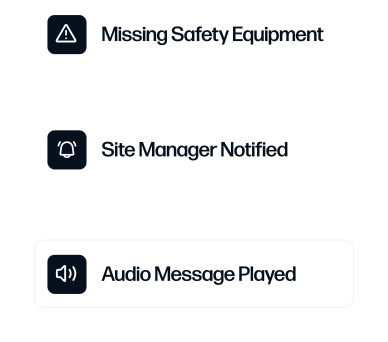
Here the two diverge. In February 2026 Verkada moved AI-Powered Deterrence into public beta, a capability that detects behavior such as loitering and triggers a sequence of escalating, AI-generated audio warnings that incorporate scene context, for example describing a person's clothing or location. Third-party cameras can trigger the warning sequence, though Verkada notes that some deterrence capabilities depend on Verkada cameras and audio hardware such as the BZ11 Horn Speaker or a Verkada Intercom. That hardware dependency is worth pricing into any deployment that leans on active response.
Avigilon does not publicly specify a distinct real-time deterrence product in the pages reviewed. Its documented strength sits earlier in the timeline, in analytics and investigation, so a team whose priority is stopping activity in the moment rather than reconstructing it afterward should confirm what active response, if any, Avigilon can deliver on its shortlisted platform.
Key terms
- ONVIF Profile S: a camera standard that lets a platform connect and stream video from cameras made by different vendors, not only its own.
- Command Connector: Verkada's appliance that brings compatible third-party ONVIF and RTSP cameras into the Verkada Command platform.
- Avigilon Control Center (ACC): Avigilon's on-premise video management software, delivered within the Avigilon Unity platform.
- Camera-agnostic: software that runs on the IP cameras a business already owns, with no rip-and-replace project required.
- AI coworker: an agent that reads context, acts the moment an event is detected, and hands a team case-ready evidence, rather than a camera that only records.
Unified platform and access control
Both vendors sell more than cameras, which matters if you want to retire disconnected point tools. Verkada runs one cloud platform that spans cameras, access control, alarms, environmental sensors, and intercoms, all in Command. For a lean team, that breadth on a single interface reduces the number of consoles on the wall.
Avigilon unifies video and access control under one brand as well, with its access line sitting alongside Unity and Alta. The practical question for a buyer is scope and consistency: Verkada's breadth lives natively in one cloud console, while Avigilon's unification spans an on-premise and a cloud product line, so confirm how access and video come together on the specific deployment path you choose.
Openness, integrations, and ecosystem
Avigilon leans into openness. It positions itself as an open platform with an App Marketplace and a broad integration ecosystem, which appeals to security directors who run access control, alarms, and other systems alongside video and want to connect them. Verkada exposes published integrations and API access through Command, oriented around its own unified stack rather than a marketplace model. Neither approach is wrong; the right one depends on how much you value a large third-party ecosystem versus a tightly integrated first-party platform.
Deployment, sales, and pricing
Verkada typically sells directly and through resellers, with a cloud setup that many teams can stand up without a heavy integration project. Avigilon is sold and deployed through the security integrator channel, which brings hands-on expertise and an existing relationship for many enterprises, along with a quote cycle and a dependency on that partner. Neither vendor publishes list pricing, so both require a vendor or integrator quote to budget accurately, and exact deployment timelines are not publicly specified for either.
The verdict by buyer scenario
Because the platforms are strong in different places, the honest answer to "which is better" is "better for whom." Use the scenarios below to place your own environment.
- Choose Verkada if you want a cloud-native, single-vendor platform with minimal on-site infrastructure, value a unified console across cameras, access, alarms, and sensors, and want built-in escalating deterrence, accepting that its most advanced deterrence features favor Verkada cameras and audio hardware.
- Choose Avigilon if you need on-premise deployment for data-residency or bandwidth reasons, want the option to run on-premise and cloud across a mixed portfolio, prioritize mature self-learning analytics and AI search, and already have a trusted Motorola Solutions integrator relationship.
- Look wider if your real problem is standardizing AI across cameras from several makers that you already own, or if real-time action on existing hardware matters more than which brand's cameras you buy next. That is the gap a software-led, camera-agnostic platform is built to close.
The most useful question in a Verkada vs Avigilon evaluation is not about camera resolution, it is about your operating model. Ask each vendor to show, on your own footage, how the platform detects context, how fast it surfaces the right clip, and what it can do in the moment an event happens. That single test tells you more about day-to-day value than any spec sheet.
A third option: Spot AI
Many teams that start with a Verkada vs Avigilon shortlist are really trying to solve a broader problem: getting modern AI to work across a fleet of cameras from several makers, without a rip-and-replace project. That is where it helps to add a software-led option honestly, so you can judge all three on the same criteria. Spot AI is a camera-agnostic video AI platform that works with any ONVIF IP camera a business already owns, including Verkada, Avigilon, Pelco, Axis, and Hanwha hardware, so existing cameras become supported inputs rather than sunk cost.
Architecturally, Spot AI runs a hybrid edge-to-cloud model on its Intelligent Video Recorder (IVR): full-resolution video stays on-site and only metadata crosses the network, which keeps bandwidth low, deployments fast, and video PCI-clean. Instead of standardizing on one camera brand, a team standardizes on one software layer across the fleet. For security specifically, the AI Security Guard detects intent in context, deters in seconds with lights, sirens, and natural-conversation AI Talk Down, and documents time-stamped, case-ready evidence in one connected system. More than 15 pre-trained Video AI Agents cover common security jobs, and Iris lets a team build a new custom detection in plain language rather than filing a request. It is NDAA-compliant, follows SOC 2 practices, and does not use biometric identification.
The clearest proof is what happens at multi-site organizations running mixed or inconsistent camera coverage. Tidewater Fleet Supply, a heavy-duty truck-parts distributor, unified 3 distribution centers and 14 retail locations from Florida to Virginia onto one cloud dashboard, replacing inconsistent legacy coverage and turning footage searches that once took hours into fast investigations. In a different setting, Storage Asset Management runs roughly 50 virtually managed self-storage facilities on Spot AI; at one previously targeted site, a 1 AM intruder detection led to an in-progress arrest and zero subsequent break-ins. Both customers kept the cameras they already had and standardized the intelligence on top.
For the direct comparisons, see Spot AI vs Verkada and Spot AI vs Avigilon. If you are still building your shortlist, our roundups of Verkada alternatives for 2026 and Avigilon alternatives for 2026 map the wider field, and our guide to the best video management software of 2026 and our overview of enterprise video security solutions frame the broader decision.
Whichever way you lean, run a short proof of value on your highest-risk site using the cameras already installed there. Ask each platform to show context-aware detection, fast AI search, and one real-time response on your own footage. Because a camera-agnostic option works with what you own, comparing all three on the same site is the fairest test you can run.
The Agentic AI is incredible technology and I love the unified dashboard.
Regional Sales Director (Mid-Market), Lisa S.
Verkada and Avigilon are both strong platforms, and for many teams one of them is the right answer. If your evaluation is really about standardizing AI across the cameras you already own, it is worth seeing the software-led approach next to them before you commit. When you are ready, you can compare Spot AI side by side with either platform or book a demo, with no rip-and-replace required.
Frequently asked questions
Is Verkada or Avigilon better for enterprise video security?
Neither is universally better; it depends on your environment. Verkada is the stronger fit for cloud-native simplicity, a single unified platform, and built-in escalating deterrence. Avigilon is the stronger fit for deployment flexibility across on-premise and cloud, mature self-learning analytics, and teams with an established Motorola Solutions integrator relationship.
Do Verkada and Avigilon work with third-party cameras?
Yes, both do for connectivity. Verkada connects compatible third-party ONVIF Profile S and RTSP cameras through Command Connector, and has extended several analytics features to them. Avigilon is ONVIF conformant and supports third-party ONVIF Profile S cameras such as Axis, Hanwha, Pelco, and Vivotek. Confirm with each vendor whether a specific advanced feature needs its own cameras.
What is the difference between Avigilon Unity and Avigilon Alta?
Avigilon Unity is the on-premise platform built around Avigilon Control Center, keeping recording and analytics on local servers. Avigilon Alta is the cloud-native platform with a serverless architecture and end-to-end encryption, and it can bridge existing cameras through Cloud Connectors. They are two distinct products, so a multi-site buyer chooses a path per site.
Does Verkada or Avigilon offer real-time deterrence?
Verkada launched AI-Powered Deterrence in public beta in February 2026, using escalating AI-generated audio warnings that incorporate scene context, though some capabilities require Verkada cameras and audio hardware. Avigilon does not publicly specify a distinct real-time deterrence product on the pages reviewed, so confirm active-response options directly if that is a priority.
How much do Verkada and Avigilon cost?
Neither vendor publishes list pricing, so both are quote-based. Verkada is typically sold directly or through resellers, while Avigilon is sold and deployed through the security integrator channel. Budget for the platform plus any required cameras, audio hardware, and, on the Avigilon Unity path, on-premise servers and storage.
About the author
Joshua Foster is an IT Systems Engineer at Spot AI, where he focuses on designing and securing scalable enterprise networks, managing cloud-integrated infrastructure, and automating system workflows to enhance operational efficiency. He is passionate about cross-functional collaboration and takes pride in delivering robust technical solutions that empower both the Spot AI team and its customers.






.png)
.png)
.png)
.svg)