




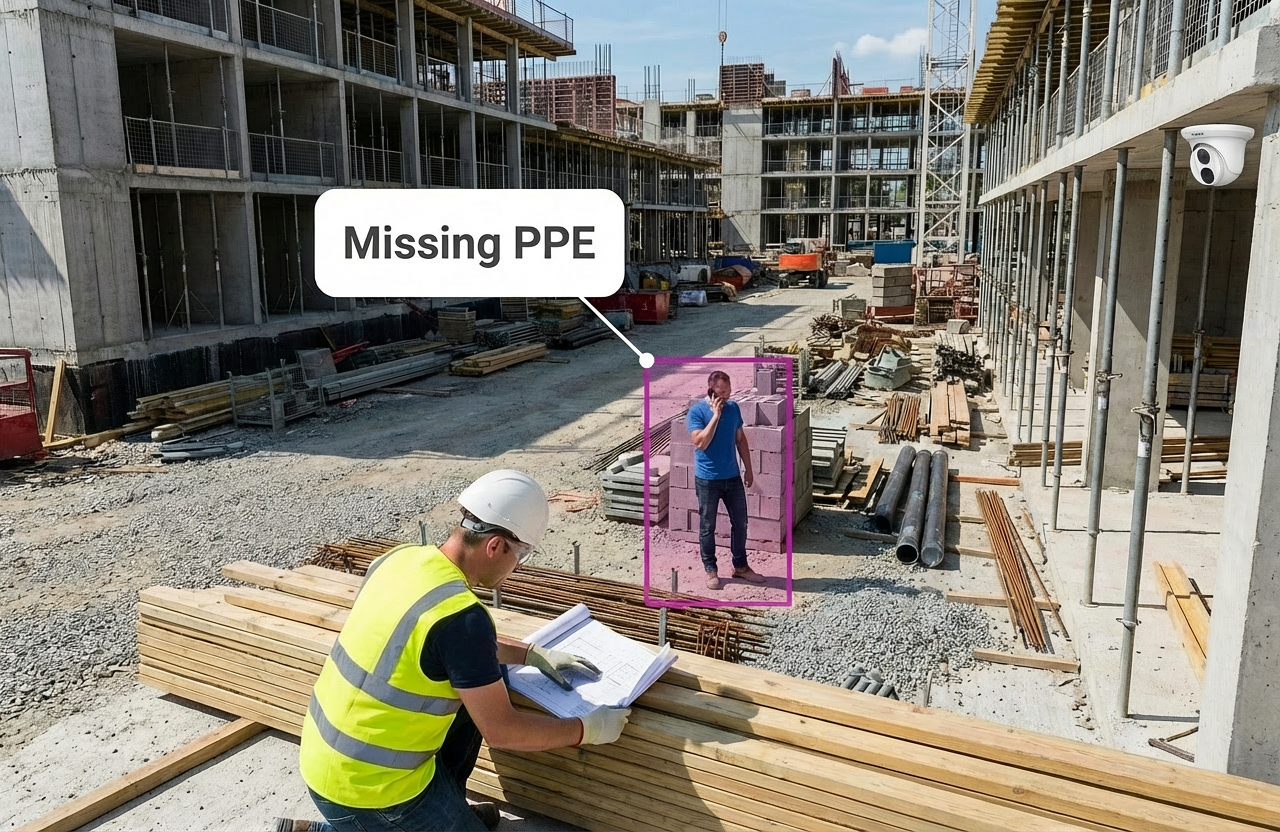


On modern construction sites, supervisors face a complex reality. Despite rigorous safety protocols and constant vigilance, incident rates remain stubbornly high. Traditional camera systems, intended to provide an extra set of eyes, often exacerbate the problem. They generate a constant stream of motion-based alerts for everything from passing clouds to routine crew movements, creating a pattern where important alerts are overlooked. When teams are overwhelmed by noise, they start to miss the signals that truly matter, and critical issues are more likely to be missed.
This is the core roadblock: how can you leverage video to improve safety and operational outcomes when the technology itself creates more distractions than solutions? The answer lies in shifting from simple motion detection to intelligent, context-aware video AI that can distinguish between routine activity and genuine risks, turning noisy data into a clear signal for action.
The high cost of alert fatigue on construction sites
For site leadership, managing a sprawling, dynamic construction environment is a constant balancing act. The pressure to maintain schedule and budget is immense, but not at the expense of worker safety. Traditional monitoring systems fail to support this balance, making day-to-day operations harder.
Reactive security that only documents failure: traditional camera systems are passive observers. They record incidents like theft, vandalism, or safety violations, but they don't help you intervene. This forces teams into a reactive posture, discovering problems only after the damage is done, leading to project delays and insurance claims for incidents that could have been addressed before they escalated.
Excessive false alarms from motion detection: conventional security systems cannot differentiate between a subcontractor arriving for their shift and an unauthorized intruder after hours. This inability to understand context generates a high volume of false alerts. Supervisors waste valuable time investigating non-issues, desensitizing them to the notification system and increasing the likelihood that a real alert will be missed. Studies in similar high-stakes environments show that professionals can miss up to 47% of critical alerts when overwhelmed by false positives (Source: Forgepoint Capital).
Time-consuming manual footage review: when an incident does occur—whether a safety issue, a quality issue, or a dispute between trades—finding the relevant video evidence is a major roadblock. Manually scrubbing through hours of footage from multiple cameras takes supervisors away from active site management, delaying incident response and resolution.
Inability to monitor compliance in real time: manual site walks are essential but provide only a snapshot in time. A supervisor can't be everywhere at once, meaning personal protective equipment (PPE) violations, unsafe behaviors, and restricted area breaches can easily go undetected between inspections. Supervisors spend a significant portion of their time on PPE checks, yet gaps in coverage persist.
These obstacles directly impact key project metrics, from safety KPIs like Total Recordable Incident Rate (TRIR) to operational ones like schedule adherence and rework percentage, which can account for 5-10% of total project costs (Source: SafetyCulture).
How video AI separates signal from noise
AI-powered video analytics moves beyond simple motion detection by using computer vision to interpret what’s happening in video feeds. The technology is built on deep learning algorithms trained on vast datasets of construction-specific scenarios. This allows the system to identify specific objects (people, vehicles, forklifts), attributes (wearing a hard hat), and behaviors (loitering, entering a no-go zone).
The breakthrough is the ability to understand context and minimize false alerts. Advanced platforms achieve this through several key methods:
High-quality training data: effective AI models are trained on thousands of images from diverse construction environments, capturing different lighting, weather conditions, and camera angles. This enables the model to generalize and perform reliably in the unpredictable conditions of a real job site.
Intelligent thresholding: instead of triggering an alert for every potential detection, the system calculates a confidence score. An alert is only generated when the AI is highly certain that a rule has been violated, filtering out ambiguous events that would otherwise create noise.
Contextual analysis: sophisticated systems analyze video over time, not just frame by frame. This allows the AI to distinguish between a worker briefly removing a hard hat to wipe their brow and someone working continuously without protection. By understanding temporal context, the system avoids flagging temporary, non-hazardous actions.
Edge computing: processing video data on an intelligent device at the job site—known as edge computing—enables real-time analysis without the delays of sending footage to the cloud. This means alerts for critical events, like a person entering a high-hazard zone, are delivered quickly, allowing for faster intervention.
When implemented correctly, these techniques allow video AI platforms to achieve high precision (a low rate of false alerts) and high recall (a low rate of missed events). For example, modern PPE detection systems can achieve a strong balance of both accuracy and reliability.
From fewer false alerts to better project outcomes
By filtering out noise and delivering only relevant, context-rich alerts, video AI empowers site leaders to shift from a reactive to a more forward-looking approach. This has a direct and measurable impact on safety, quality, and efficiency.
Improve safety with earlier hazard detection
Instead of investigating accidents after they happen, video AI helps you identify and mitigate risks before they lead to injury.
Mitigate falls and struck-by incidents: AI can automatically detect when a worker is at height without proper fall protection or enters a "no-go zone" around operating heavy equipment. With real-time alerts, supervisors can intervene to mitigate risk. Sites using this type of AI monitoring have reported fewer accidents in targeted areas.
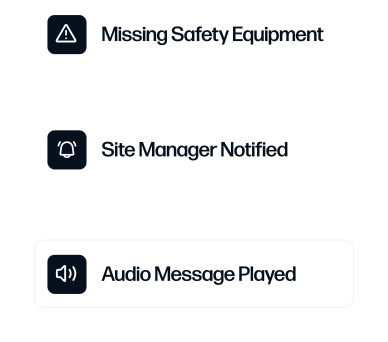
Automate PPE monitoring: an AI teammate can continuously and consistently monitor for missing hard hats, vests, or other required PPE. This augments manual inspections and helps lift compliance rates, directly reducing risk. Spot AI’s Missing PPE detection provides an automated way to help ensure workers are properly equipped for their task.
Accelerate incident investigations: when an event does occur, smart search capabilities allow you to find what you’re looking for in seconds. Instead of manually reviewing hours of footage, you can search for "person without hard hat" or "vehicle in restricted area" and get time-stamped video evidence quickly.
Enhance quality assurance and compliance
Video AI provides an objective, continuous record of work as it happens, helping to minimize rework and streamline documentation.
Monitor quality in real time: AI can be trained to spot deviations from project specifications, such as improper rebar placement or finishing issues in concrete work. Detecting these issues as they happen allows for timely correction, avoiding the considerable costs associated with rework, which can be 5-10% of a project's total cost (Source: SafetyCulture).
Automate compliance documentation: AI-powered systems create a verified, time-stamped visual record of site conditions. This simplifies audit preparation for OSHA inspections and provides objective evidence to resolve disputes with subcontractors or owners. Companies with mature AI monitoring programs have seen OSHA citation rates fall.
Prove subcontractor accountability: with objective video evidence of safety violations or quality issues, you can move past finger-pointing and review objective footage with trade partners to enforce contractual standards effectively.
Capability | Traditional Monitoring | Spot AI Video AI Platform |
|---|---|---|
Alert type | Basic motion detection | Context-aware AI detections (person, vehicle, PPE, etc.) |
False alerts | High volume, leading to alert fatigue | Reduced, due to intelligent filtering and confidence scoring |
Footage review | Manual, time-consuming scrubbing | Fast smart search by keyword or event |
Safety monitoring | Reactive; records incidents after they occur | Proactive; real-time alerts for hazards and violations |
Deployment | Complex, often requires new proprietary hardware | Plug-and-play with most IP cameras, typically up and running quickly |
Accessibility | Limited to on-site security monitors | Unified cloud dashboard, accessible from any device |
Drive operational efficiency and reduce costs
By providing a new layer of operational data, video AI helps improve workflows and reduce avoidable costs.
Optimize equipment and crew workflows: identify bottlenecks in real time, such as idle equipment or crews waiting on preceding trades. Video AI can verify when changeover prerequisites are met, enabling smoother transitions and reducing downtime. This can accelerate project schedules by 1.5-4.5% (Source: Spot AI).
Monitor progress automatically: compare actual work progress against project schedules without relying solely on manual reports. Real-time variance detection allows project managers to make forward-looking adjustments to keep timelines on track.
Control material and equipment costs: use features like Vehicle/Forklift Absent detection to get alerts when valuable equipment is moved from designated areas after hours. Monitor material storage areas to reduce waste and deter theft, protecting project profitability.
Transition to a smarter, safer job site
Moving from a conventional monitoring system plagued by false alerts to an intelligent video AI platform is a strategic upgrade that can deliver measurable operational improvements. By providing supervisors with timely, accurate information, you empower them to focus their expertise where it matters most—mitigating incidents, ensuring quality, and keeping the project moving forward. The result is a safer work environment, a more efficient operation, and a stronger bottom line.
Curious how video AI can help your team cut through noise and focus on what matters? See Spot AI in action or explore a customer story to learn how an intelligent video platform supports safer, more efficient job sites.
Frequently asked questions
How can AI improve safety on construction sites?
AI improves safety by proactively detecting hazards in real time. It can monitor for missing PPE, unauthorized entry into dangerous zones, and unsafe behaviors. By sending real-time alerts to supervisors, AI enables faster intervention to mitigate risk, shifting safety management from reactive to forward-looking.
What are the benefits of using video analytics in construction?
The primary benefits include improved safety outcomes, enhanced quality assurance, and greater operational efficiency. Video analytics can help minimize accidents and costly rework by catching defects early, provide objective documentation for compliance and disputes, and offer insights to improve workflows and resource utilization.
How can false alerts be minimized in construction monitoring?
False alerts are minimized by using advanced video AI that understands context. This is achieved through models trained on construction-specific data, intelligent confidence scoring to filter out low-certainty events, and analyzing video over time to distinguish between brief, harmless actions and genuine violations.
What technologies are available for construction compliance monitoring?
AI-powered video analytics is a key technology for compliance. It automates the monitoring of PPE usage, adherence to restricted zone protocols, and other OSHA-mandated safety practices. The system generates time-stamped video evidence, creating a reliable audit trail for regulatory inspections.
How does AI enhance construction quality assurance?
AI enhances quality assurance by providing continuous, automated monitoring of work as it is performed. It can be trained to identify deviations from design specifications in real time, such as incorrect rebar placement or surface defects in concrete. This allows crews to make timely corrections and avoid expensive rework later in the project.
What is the best video AI monitoring system for workplace safety?
The best systems combine high accuracy with ease of use. Look for context-aware AI trained on industry-specific data to minimize false alerts. Key features include real-time, actionable notifications, compatibility with your existing IP cameras to avoid costly hardware replacement, and a unified platform with smart search capabilities that help you find critical footage in seconds.
What is the best video analytics for detecting trespass after hours on construction sites?
The most effective analytics use AI to understand context. Instead of simple motion detection, these systems allow you to create rules that trigger alerts only when a person is detected in a specific zone during non-operational hours. This ability to differentiate people from animals or weather significantly reduces false alarms and enables a rapid security response when it matters.
About the author
Sud Bhatija is COO and Co-founder at Spot AI, where he scales operations and GTM strategy to deliver video AI that helps operations, safety, and security teams boost productivity and reduce incidents across industries.






.png)
.png)
.png)