






Overall Equipment Effectiveness (OEE) represents the single most critical metric for manufacturers seeking to understand and optimize production efficiency. By combining availability, performance, and quality into one unified percentage score, OEE exposes hidden production losses that traditional metrics often mask. However, the true power of OEE emerges when paired with advanced technologies like video AI platforms that provide real-time visibility into production processes.
For continuous improvement leaders, the hurdle isn't just calculating the score—it is understanding the why behind the numbers. A machine might report downtime, but without visual context, knowing whether that downtime was caused by a material jam, operator absence, or an undocumented changeover remains a guessing game. This data blindness forces leaders to rely on manual Gemba walks and reactive firefighting rather than strategic optimization.
This guide explores how leveraging data from your video AI system helps teams use OEE as a more timely, practical tool for improving operations.
Understanding the basics
Before analyzing how video AI enhances measurement, it is helpful to define the core components of OEE and the common friction points in tracking them.
Overall Equipment Effectiveness (OEE)
OEE is a widely used metric for measuring manufacturing productivity. It pinpoints the percentage of manufacturing time that is truly productive. An OEE score of 100% means you are manufacturing only good parts, as fast as possible, with no stop time.
The three OEE factors
Availability: measures production loss due to downtime (e.g., equipment failures, material shortages, changeovers).
Performance: measures production loss due to slow cycles or micro-stops (e.g., idling, reduced speed).
Quality: measures production loss due to defects (e.g., scrap, rework).
The six big losses
To improve OEE, manufacturers must address the "Six Big Losses" that align with these factors:
Breakdowns (Availability)
Setup and adjustments (Availability)
Small stops (Performance)
Reduced speed (Performance)
Startup rejects (Quality)
Production rejects (Quality)
Why traditional OEE tracking falls short
Many organizations begin their OEE journey with manual data entry or basic sensor data. While better than nothing, these methods often leave continuous improvement teams struggling with "data blindness"—a core frustration where the root cause of inefficiency remains invisible.
The limits of manual data collection
Spreadsheet-based methods rely on operators to record downtime events and cycle times. This approach introduces notable risks:
Inaccuracy: operators focused on production targets often underreport minor stoppages or misclassify downtime causes (Source: CAI Software).
Latency: by the time data is consolidated for weekly reports, the opportunity to address specific operational issues has passed.
Missing context: a tick sheet might say "Setup," but it won't reveal that the operator spent 15 minutes searching for tools—a hidden waste that video AI could easily detect.
The gap in sensor-only data
Automated setups connected to PLCs provide accurate timestamps for when a machine stops, but they lack the qualitative context of why it stopped. A sensor reports a "stop," but it cannot differentiate between a jam, an operator break, or a shift handover delay.
Improving availability with video AI
Availability losses are often the most obvious because they halt production completely. However, diagnosing the root cause of these stops requires visibility that sensors alone cannot provide.
Lowering setup and changeover time (SMED)
Setup and adjustment losses often represent the second-largest source of availability loss. Video analysis is a powerful tool for implementing Single-Minute Exchange of Dies (SMED) methodologies.
Visualize the process: by reviewing video footage of changeovers, teams can distinguish "internal" activities (which stop the machine) that can be converted to "external" activities (performed while the machine is running).
Identify wasted motion: Video AI reveals inefficiencies such as operators walking to retrieve tools or waiting for approvals. Analysis shows that a significant portion of changeover time can represent wasted motion or waiting.
Standardize procedures: using video to benchmark the "gold standard" changeover enables teams to train operators on the most efficient method, lessening variability between shifts.
Addressing unplanned downtime
When equipment fails, every minute counts. Video AI helps lower Mean Time to Repair (MTTR) by providing real-time context to maintenance teams.
Pain Point | How video AI assists |
|---|---|
Unknown downtime cause | Cameras provide visual evidence of what happened right before the failure (e.g., material jam, operator error). |
Ghost stoppages | Unattended Workstation templates detect if downtime is due to operator absence rather than machine failure. |
Resource bottlenecks | Crowding detection shows if maintenance teams are waiting on parts or approvals at the line. |
Optimizing performance through visual review
Performance losses are notoriously difficult to track because they often consist of micro-stops—short interruptions—or reduced operating speeds. These minor inefficiencies can accumulate to represent a large source of lost capacity in many facilities.
Eliminating micro-stops
Manual observation rarely captures micro-stops accurately. An operator might not log a 30-second jam, but if that jam happens 20 times a shift, the loss is substantial.
Automated detection: Video AI platforms can index specific events, letting continuous improvement leads search for anomalies without watching hours of footage.
Root cause validation: by correlating timestamped performance drops with video footage, teams can see if micro-stops are caused by material feed issues, operator hesitation, or minor mechanical catches.
Cycle time evaluation: video review detects inefficient movement patterns and unnecessary waiting times, exposing hidden process waste that impacts ideal cycle time.
Standardizing work across shifts
Variability between operators is a major driver of performance loss. One shift might consistently run 10% slower than another due to differences in technique.
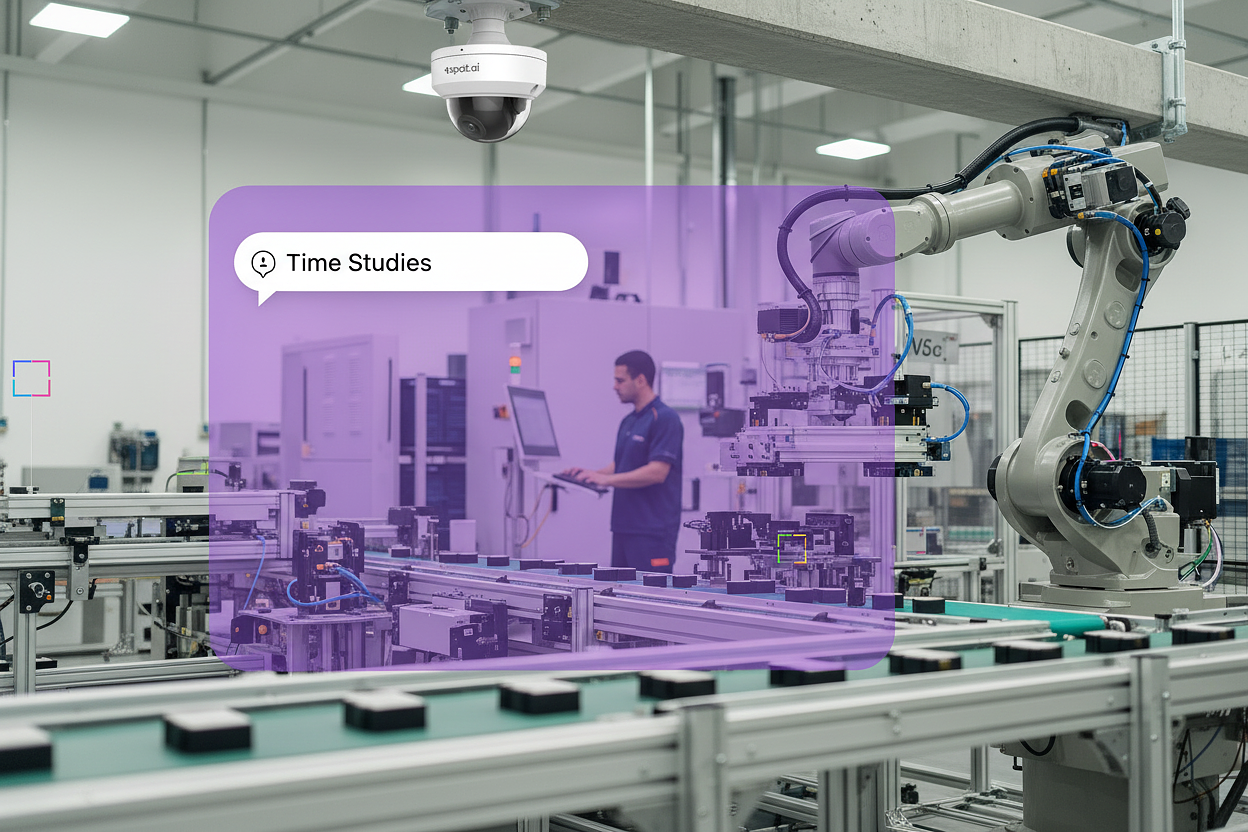
Video AI enables Time Studies without the need for a physical stopwatch and clipboard. By analyzing footage from top-performing operators, leaders can:
Benchmark best practices.
Update Standard Operating Procedures (SOPs) based on visual evidence.
Train underperforming shifts using real-world examples of efficient operation.
Enhancing quality with automated detection
Quality losses are the most expensive OEE factor because they consume production capacity, materials, and labor without generating revenue. Video AI helps shift quality control from purely reactive inspection to earlier-stage detection.
Proactive Quality Control with Video AI
Quality losses often result from process deviations, not just final-product failures. Video AI helps teams shift from reactive inspection to proactive process control by providing visibility into how work is actually performed. By identifying deviations from standard procedures, you can prevent quality failures before they happen.
Process compliance: SOP adherence templates can help highlight deviations from typical workflows. If the expected sequence appears to be missed, the platform can flag the event for review.
Environmental monitoring: visual detection of foreign objects or debris on the line helps guard against contamination or physical defects before they occur.
Minimizing scrap: identifying the root cause of startup rejects allows teams to optimize ramp-up procedures, minimizing the amount of material wasted at the beginning of a shift.
Implementing a video-data OEE strategy
For continuous improvement leads, integrating video data into OEE measurement requires a structured approach. This helps the organization move from reactive firefighting to a more proactive, continuous-improvement approach.
Phase 1: Establish the baseline
Don't try to fix everything at once. Start by defining your "Planned Production Time" and measuring the current state.
Deploy video monitoring: focus on critical bottlenecks. Use Vehicle Absent or Person Enters No-go Zones templates to gather initial data on utilization.
Categorize losses: use video to validate manual downtime codes. Is "Maintenance" actually "Waiting for Material"?
Quantify the gap: determine which of the Six Big Losses is your primary constraint.
Phase 2: Target specific losses
Once the primary loss category is identified, apply targeted video AI capabilities.
If Availability is low: focus on lowering changeover time. Use video to map the current process and identify wasted motion.
If Performance is low: tackle micro-stops. Use historical search to find patterns in short duration stoppages.
If Quality is low: focus on SOP compliance. Ensure operators are performing tasks consistently across all shifts.
Phase 3: Sustain and scale
Sustainability is the hardest part of continuous improvement. Video AI helps maintain gains by automating the audit process.
Automate Gemba walks: replace physical floor walks with Shift Recaps and automated alerts. This enables leaders to monitor multiple lines or sites simultaneously.
Scorecards and coaching: use data to provide objective feedback to teams. SOP adherence tracking creates accountability without bias.
Cross-site standardization: share video clips of "gold standard" processes across different facilities to ensure best practices are replicated enterprise-wide.
Comparing video AI solutions for manufacturing
When selecting a partner to help measure and improve OEE, it is vital to choose a solution that integrates with your existing infrastructure and scales easily.
Feature | Spot AI | Legacy VMS | Traditional Sensors |
|---|---|---|---|
Deployment Speed | Minutes (Quick setup with existing cameras) | Weeks to Months | Varies (High wiring complexity) |
Hardware Compatibility | Camera-agnostic (Works with most IP cameras) | Proprietary lock-in | Requires specific sensor hardware |
Data Accessibility | Cloud dashboard with natural language search | Local server access only | Data silos (often separate from video) |
Intelligence | Pre-trained AI Agents for Ops & Safety | Passive recording | Data only (No visual context) |
Scalability | Unlimited users and locations | License-per-seat limitations | Difficult to scale across sites |
Spot AI helps teams get more value from existing cameras. With capabilities like Unattended Workstation detection and SOP adherence tracking, it addresses common pain points for continuous improvement leads: limited context and the difficulty of verifying compliance at scale.
Real-world impact on efficiency
The integration of video analytics with OEE tracking delivers measurable results. Organizations that implement these technologies systematically can achieve significant efficiency improvements.
Case study: Lowering changeover time
A packaging facility used video analysis to break down their changeover process. They identified that significant time was lost to activities like searching for film rolls and waiting for equipment to heat up. By converting these internal setup tasks into external activities that could be done while the machine was still running, they significantly lowered total changeover time and increased available production capacity.
Case study: eliminating bottlenecks
A cable manufacturer significantly improved OEE by using video to analyze downtime. The footage revealed that events logged as "maintenance" were often caused by workflow issues, such as time spent searching for tools. It also identified frequent micro-stops from product backups on conveyors. Addressing these root causes led to a substantial increase in equipment effectiveness.
Turning OEE Data into Actionable Insights
Measuring and improving OEE is not just about tracking a score; it is about uncovering the hidden capacity within your existing resources. Traditional methods often fail to provide the context needed to solve complex production problems, leaving continuous improvement teams stuck in a cycle of reactive firefighting.
By integrating data from your video AI system, you gain the ability to see the "why" behind the data. From lowering changeover times and eliminating micro-stops to ensuring SOP compliance across multiple sites, video AI acts as a digital force multiplier for your operations team.
It helps your team use existing camera infrastructure to surface operational insights.
See how Spot AI’s video AI platform can help you measure and improve OEE. Request a demo to experience the technology in action.
Frequently asked questions
How can OEE be improved?
OEE is improved by systematically addressing the Six Big Losses: breakdowns, setup/adjustments, small stops, reduced speed, startup rejects, and production rejects. Using video AI to identify the root causes of these losses enables targeted interventions, such as implementing SMED for changeovers or improving maintenance response and scheduling based on observed issues.
What are effective strategies for lowering downtime?
Effective strategies include improving maintenance practices to address breakdowns before they escalate, optimizing changeover processes (SMED), and using real-time monitoring to shorten response times. Video AI assists by validating downtime causes and identifying resource bottlenecks that prolong stoppages.
How do video analytics enhance manufacturing processes?
Video analytics provide visual context to data, allowing teams to see inefficient movement, verify SOP adherence, and detect anomalies that sensors miss. This leads to faster root cause investigation, improved training through visual examples, and the ability to audit processes remotely.
What are the best practices for measuring OEE?
Best practices include establishing clear definitions for planned production time, automating data collection to remove human error, and categorizing downtime events accurately. Integrating video data ensures that the "reason" for downtime is correctly pinpointed and logged.
How can AI be integrated into manufacturing for better efficiency?
AI can be integrated into manufacturing by using computer vision for automated workflow monitoring and process compliance checks. Platforms like Spot AI empower manufacturers to deploy these capabilities using existing camera hardware, making integration fast and scalable.
About the author
Sud Bhatija is COO and Co-founder at Spot AI, where he scales operations and GTM strategy to deliver video AI that helps operations, safety, and security teams boost productivity and reduce incidents across industries.






.png)
.png)
.png)