




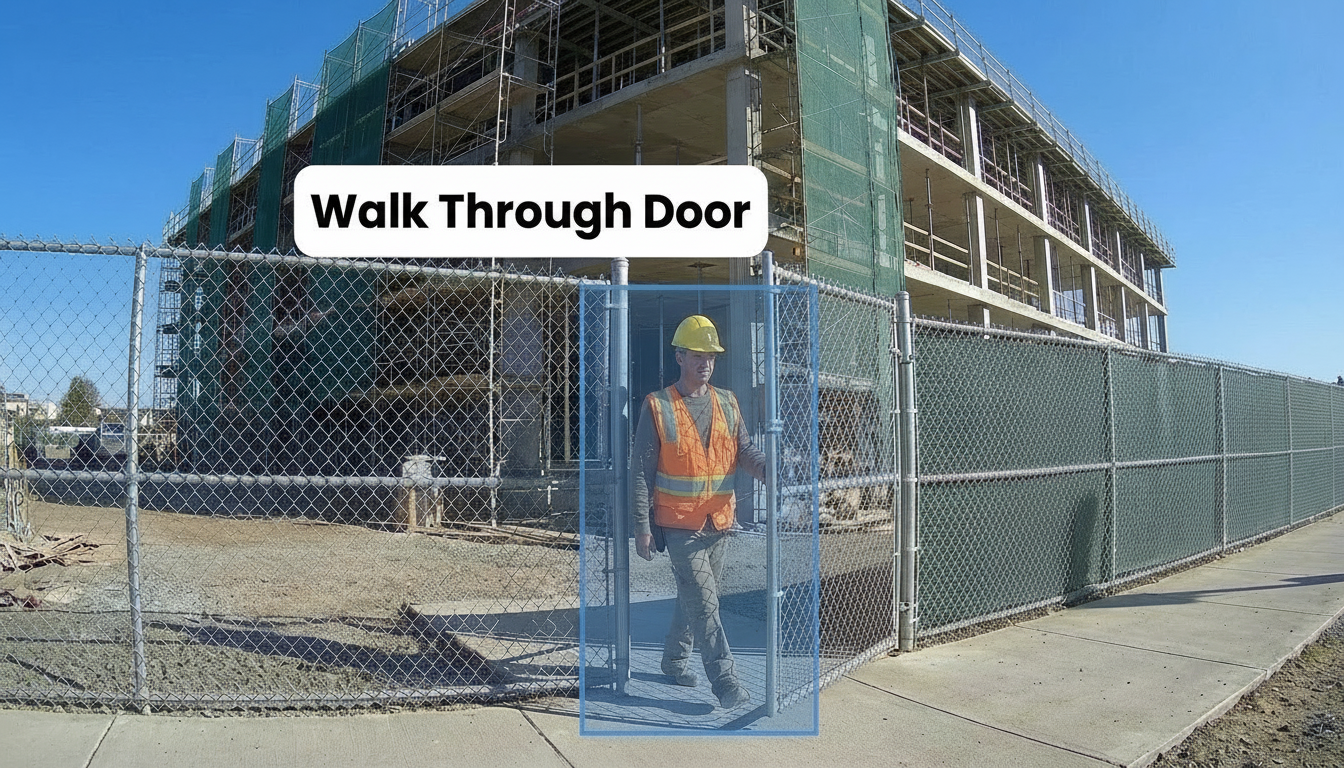


Managing a busy construction site often feels like coordinating a small city. For site and general superintendents, the daily reality involves juggling 10-20 different trades, ensuring material deliveries arrive on time, and maintaining strict safety standards across multi-acre zones. The entry and exit points are the critical pulse of these operations, yet they are often the biggest source of risk.
Traditional methods of monitoring these access points—like manual logbooks, badge swipes, or passive camera systems—often create data silos. They tell you who should be on the jobsite, but they rarely show what is actually happening in real time. Reactive security systems that only record after incidents force site leaders to discover problems after the damage is done. This leads to project delays, insurance claims, and safety incidents that could have been mitigated with forward-looking visibility.
"Walk through door" analytics and video AI help construction leaders manage jobsite access more consistently. By turning standard cameras into intelligent teammates, superintendents can automate entry monitoring, verify subcontractor hours, and detect safety risks the moment they occur.
The high cost of unmonitored access points
The financial and operational risks associated with poor entry monitoring are escalating. Construction projects face difficulties beyond simple theft; organized criminal activity and liability claims are becoming more sophisticated.
Theft and equipment loss
Theft creates rapid financial loss and significant downstream delays. A single stolen piece of heavy equipment, such as a skid steer loader, can cost upward of $50,000 in replacement value (Source: Latium Tech). Beyond the asset cost, stolen tools and materials create project delays that accumulate costs at rates between $10,000 to $50,000+ per day depending on the project scope (Source: Latium Tech).
Unauthorized access liability
Locations lacking effective monitoring become accessible to trespassers, creating safety and legal liability. Intruders may not intend to steal, but their presence can lead to accidents or injuries. If a company fails to establish that proper precautions were taken, they face legal liability if unauthorized individuals are harmed on the property.
Organized crime trends
Recent data indicates that criminal groups are targeting high-value construction materials. Cargo theft across the United States and Canada reached 772 incidents in Q3 2023, with the average stolen shipment value doubling to $336,787 compared to the previous year (Source: Verisk).
How video AI solves the "reactive security" problem
Site managers frequently cite "reactive security systems" as a core frustration. Traditional cameras record footage, but they do not interpret it. This forces leaders to spend hours manually reviewing footage to investigate incidents, taking valuable time away from operational management.
Video AI changes this dynamic by analyzing video feeds in real time. Instead of just recording motion, the system understands behavior.
1. Differentiating between activity and threats
Basic motion detection generates excessive nuisance alarms from wind, shadows, or wildlife. Video AI algorithms distinguish between normal construction activity and genuine security events. This capability allows the system to ignore a plastic tarp flapping in the wind while sending a timely alert if a person enters a restricted zone after hours.
2. Intelligent "walk through door" analytics
This technology specifically monitors entry and exit behaviors. It goes beyond simple counting to identify context.
Tailgating detection: identifies when an unauthorized person follows an authorized worker through a secure door.
Loitering detection: flags individuals lingering near sensitive entry points or high-value material storage areas.
Door propped open: alerts management if a secure exit is left open, compromising site perimeter security.
3. Rapid investigation tools
When a dispute or incident occurs, speed is critical. Smart search capabilities allow superintendents to find relevant footage quickly by searching for specific attributes, such as "person wearing red vest" or "vehicle at North Gate," helping shorten investigation time.
Feature | Legacy Camera Systems | Video AI (Spot AI) |
|---|---|---|
Detection Type | Basic motion detection (high nuisance alarms) | Object and behavior recognition (people, vehicles) |
Searchability | Manual scrubbing (hours) | Keyword/Attribute search (seconds) |
Alerting | None or generic motion | Context-aware alerts (e.g., "Person at Back Gate") |
Accessibility | Local DVR/NVR monitor | Cloud dashboard on any device |
Improving safety compliance at the gate
Ensuring consistent safety protocol adherence is a daily hurdle. With hundreds of workers entering jobsites, manual supervision cannot catch every violation. Video AI acts as a digital coach, helping standardizing safety checks at entry points.
1. Automated PPE detection
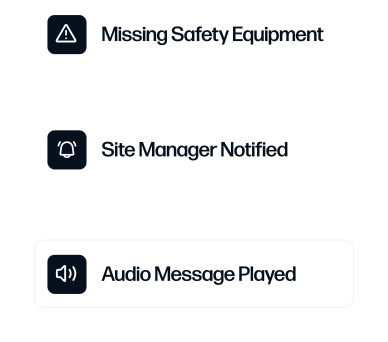
Computer vision systems can monitor Personal Protective Equipment (PPE) compliance as workers walk through site entry points. The technology detects missing hard hats or high-visibility vests and sends timely alerts to safety managers. This allows for real-time coaching rather than waiting for a monthly audit to find gaps.
2. Managing no-go zones
Construction sites are dynamic, with zones changing from safe to hazardous daily. Video AI allows site leaders to draw virtual "no-go zones" around hazardous areas or active demolition areas. If a worker or vehicle enters these restricted zones, the system triggers an alert. This helps reduce the risk of accidents involving heavy machinery and untrained personnel.
Enhancing subcontractor accountability
Site superintendents often struggle to prove subcontractor accountability regarding schedule adherence and site presence. Without objective data, disputes over hours worked or site presence turn into "he-said, she-said" arguments.
Verifiable time and attendance
Integrating video analytics with access control provides a dual-layer verification system. While a badge swipe logs an entry, video analytics helps verify identity, discouraging "buddy punching" where one worker clocks in for another. This data is essential for tracking labor productivity metrics, where labor represents 20-40% of project costs (Source: VertAccount).
Objective dispute resolution
Time-stamped video evidence provides verified timestamped evidence of jobsite conditions and attendance. If a subcontractor claims a delay was caused by jobsite inaccessibility, video data can confirm whether the entry points were blocked or open. This objective data removes friction from accountability discussions.
Comparing site entry monitoring technologies
When selecting a solution for construction site entry monitoring, it is important to balance deployment speed, cost, and capabilities.
1. Spot AI
Spot AI connects to existing IP cameras, making it a camera-agnostic solution that deploys in minutes. It processes video at the edge and provides a unified cloud dashboard.
Best for: rapid deployment, operational visibility, safety coaching, and minimizing nuisance alarms.
Key capability: smart search and real-time alerts for "walk through door" events and safety violations.
2. Biometric access control
Systems using fingerprint or facial recognition offer high security for time and attendance.
Best for: precise payroll integration and discouraging buddy punching.
Consideration: requires specific hardware installation at every gate and does not provide the broader site visibility of video systems.
3. Traditional card access
Standard RFID or badge systems.
Best for: basic access control on long-term stable projects.
Consideration: cards can be shared, lost, or stolen, offering lower security against unauthorized access compared to visual or biometric verification.
Best practices for implementing site entry analytics
To effectively use walk through door analytics, managers should follow a structured implementation plan that aligns with operational workflows.
Conduct a risk assessment: map all entry and exit points, identifying vulnerabilities where unauthorized access or theft is most likely to occur.
Define operational metrics: decide what needs tracking. Is it the count of personnel for safety mustering? Is it the timing of material deliveries? Establishing baselines helps in measuring ROI.
Integrate with project management tools: ensure security data does not live in a silo. Modern video systems should connect with project management platforms to provide a comprehensive view of project activity.
Configure custom alerts: set up specific alerts for "Person Enters No-go Zones" or "Loitering" during off-hours to filter out noise and focus on actionable events.
Standardize shift recaps: use automated reports to review entry/exit trends weekly. This helps identify patterns, such as consistent late arrivals by specific trades, allowing for data-backed discussions.
Turning Entry Points from Vulnerabilities into Operational Insights
For site and general superintendents, the goal is not just to record video but to gain control over the chaotic environment of a construction jobsite. Moving from reactive monitoring to insight-driven walk through door analytics helps turn entry points from vulnerabilities into sources of operational insight.
By leveraging Video AI, construction leaders can standardize safety compliance, verify subcontractor performance, and shorten the time spent on investigations. This technology helps teams do more with the same resources, giving superintendents the visibility they need to keep projects moving.
See how Spot AI’s video AI platform can enhance jobsite visibility and safety. Request a demo to experience our technology in action.
Frequently asked questions
What are the best practices for monitoring construction site access?
Best practices include a multi-layered approach: establishing clear physical boundaries, using video AI for real-time monitoring, and integrating access logs with project management software. Regular audits of entry points and utilizing "no-go zone" alerts for restricted areas are also critical for maintaining safety and security.
How can technology improve security on construction sites?
Technology shifts security from reactive to proactive. AI-powered analytics detect unauthorized access and loitering in real time, allowing for on-the-spot intervention. This lessens the reliance on physical guards and helps teams address incidents quickly to mitigate the likelihood of theft or damage.
What are the compliance requirements for construction site access?
Compliance varies by region but generally includes OSHA requirements for safe ingress/egress, ADA accessibility standards for ramps and exits, and strict documentation for worker attendance (prevailing wage). Video analytics helps verify these conditions are met and documents compliance for audits.
How do entry and exit tracking systems work?
Modern systems combine visual data with access logs. When a person enters, the system logs the time and identity (via badge or biometric). Video AI adds a layer of verification, helping verify the person matches the credential and can check for safety compliance like PPE usage.
What are the benefits of using AI in construction site security?
The primary benefits are fewer nuisance alarms, faster investigations, and improved safety coaching. AI filters out noise (like weather) to alert only on genuine events. It also allows site managers to search video by keywords (e.g., "red truck"), saving hours of manual review time.
About the author
Sud Bhatija is COO and Co-founder at Spot AI, where he scales operations and GTM strategy to deliver video AI that helps operations, safety, and security teams boost productivity and reduce incidents across industries.






.png)
.png)
.png)