




Why switch from Avigilon to Spot AI
You do not replace a working security system on a whim. Teams move off Avigilon, the enterprise video security line from Motorola Solutions, at specific moments: a license renewal, a camera or server refresh, an Avigilon Control Center (ACC) upgrade that has quietly grown into a project, or a run of incidents the cameras recorded but nobody caught in time. The honest reason to switch is not that Avigilon is a bad platform. It is that the architecture, the upgrade cadence, and where the cost lands may no longer match how your sites actually run.
This guide is written for security leaders at that decision point. It sets Avigilon and Spot AI side by side on the things that matter when you already own cameras, then explains what genuinely changes if you move. One number frames the stakes: the median annual wage for a US security guard was $42,470 in May 2025, and round-the-clock coverage multiplies that base once shifts, benefits, and overtime are added (Source: U.S. Bureau of Labor Statistics). A platform that watches every camera continuously changes that math, and a switch is worth evaluating whenever the labor and hardware bills are already in motion.
Key takeaways
- Switching is usually triggered by an event, not a feature gap: a renewal, a hardware or server refresh, a heavy ACC upgrade, or missed incidents.
- Avigilon runs as an on-premises line (Unity, built on ACC) or a separate cloud line (Alta). Spot AI is a single hybrid edge-to-cloud platform, so there are not two architectures to choose between.
- Your Avigilon cameras are ONVIF hardware, and Spot AI is camera-agnostic, so most teams keep the cameras they already own and skip a rip-and-replace.
- Avigilon's most advanced self-learning analytics are tuned for its own cameras and appliances; Spot AI runs its AI Security Guard and active deterrence on the existing cameras with standard speakers.
- Neither vendor publishes list pricing, so a switch decision comes down to architecture fit, upgrade burden, and total cost over a multi-year horizon, not a sticker.
Before the trigger moments, here is the fast side-by-side. This table leads with the dimensions security teams actually weigh, so you can hold any proposal against it. Competitor details reflect Avigilon's own published documentation; where a detail is not documented, it is marked as such.
Dimension | Avigilon (Unity/ACC and Alta) | Spot AI |
|---|---|---|
Architecture | On-premises VMS (Avigilon Unity, built on ACC) with recording servers and storage on site, or a separate cloud-native line (Avigilon Alta) | Single hybrid edge-to-cloud platform; the IVR keeps full-resolution video in the facility and sends only metadata across the network |
Existing cameras | ONVIF third-party cameras are supported; the most advanced self-learning analytics are tuned for Avigilon's own cameras and appliances | Camera-agnostic; runs on any ONVIF IP camera you already own, including Avigilon units, with legacy analog handled through the IVR |
AI and response | Self-learning video analytics such as Appearance Search and unusual activity detection; deterrence capabilities vary by product line | 15+ pre-trained Video AI Agents plus Iris for custom detections; active deterrence with talk-down, strobes, and sirens on existing cameras and standard speakers |
Upgrades and changes | ACC version upgrades plus periodic server and storage refresh; moves, adds, and changes typically route through an integrator | Software updates delivered continuously; add cameras without buying new recording servers |
Deployment speed | Varies by configuration and integrator | Most sites live in days, with no rip-and-replace |
Published list price | Not publicly specified; quote-based through integrators (Unity perpetual licenses, Alta per-camera subscription) | Not publicly specified; per-camera software subscription on the cameras you already own |
Compliance | NDAA 2019 Sec 889 (Avigilon cameras), SOC 2 Type II, ISO 27001, ONVIF conformant, per Avigilon; posture varies by product line | SOC 2, NDAA-compliant, PCI-clean edge architecture |
The trigger moments that make teams look
Very few teams wake up wanting a migration. They reach for one when a specific cost or gap forces the question. These are the four that come up most often.
- A renewal or a big license true-up. A per-channel license renewal, or adding channels as you expand, is a natural checkpoint. It is the moment to ask whether the next multi-year commitment still fits, or whether a per-camera software subscription on your existing cameras would deliver more for the same budget.
- A hardware or server refresh. On-premises recording servers and storage have a service life. When a refresh cycle lands, you are effectively re-buying the infrastructure, which makes it a clean point to compare an architecture that does not put a recording server in every site.
- An ACC upgrade that became a project. Version upgrades, storage planning, and coordinating an integrator for every change add up. When keeping the platform current starts to feel like a standing workload, the operational overhead itself becomes a reason to reassess.
- Incidents the system recorded but nobody caught. Motion-triggered alerting floods teams with noise, so real events get missed in the moment and surface only during an after-the-fact review. When you find yourself scrubbing footage after a loss rather than acting during one, the gap is response, not recording.
That last trigger is worth sitting with. Loss does not wait for a review. The National Retail Federation projects total US retail returns will reach $849.9 billion in 2025, and reports that roughly 9% of all returns are fraudulent, the kind of organized, repeat behavior that after-the-fact recording alone does little to deter (Source: National Retail Federation). Catching it means detecting intent in context and acting while it happens, not filing a clip afterward.
What actually changes when you switch
The biggest misconception about leaving Avigilon is that it means tearing out cameras. It does not. Because Spot AI is camera-agnostic and works over ONVIF, the switch is software-led, and the physical layer you already paid for mostly stays in place.
Your cameras stay
Avigilon cameras are ONVIF hardware, and Spot AI works with any ONVIF IP camera a business already owns, so your Avigilon fleet keeps running. There is no rip-and-replace, and legacy analog cameras connect through the IVR (Intelligent Video Recorder). The result is that the switch reuses your largest hardware investment rather than writing it off.
The recorder and the data model change
Instead of recording servers you size, buy, and refresh, Spot AI uses a hybrid edge-to-cloud design. The IVR keeps full-resolution video in the facility, and only metadata crosses the network, which keeps deployments fast and PCI-clean. You get remote, portfolio-wide access without shipping full video off site, and without maintaining a server room per location.
The cameras start acting, not just recording
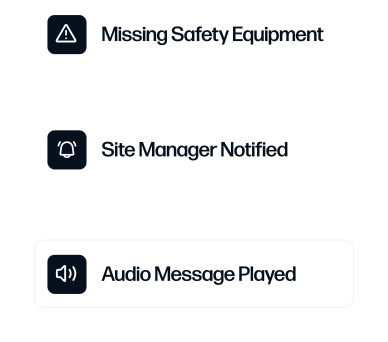
This is the operational shift that matters most. Rather than a system you query after an event, Spot AI turns existing cameras into an AI Security Guard: it detects incidents in context, deters in seconds with talk-down, strobes, or sirens, and documents case-ready evidence automatically. Active deterrence runs on the cameras you already have paired with standard speakers, so real-time response is a software capability, not a hardware upgrade.
Key terms
- ONVIF: an open standard that lets cameras and video software from different makers work together, so your existing cameras are portable between platforms.
- VMS (video management software): the software that records, stores, and lets teams review camera footage across a site or a portfolio.
- Hybrid edge-to-cloud: an architecture that processes and stores full-resolution video on site while using the cloud for access, updates, and coordination.
- IVR (Intelligent Video Recorder): Spot AI's on-site recorder, which keeps full-resolution video in the facility and sends only metadata to the cloud.
The proof teams point to after switching
The pattern that shows up across switchers is consolidation plus speed: many disconnected local systems collapse into one portfolio view, and the time to find and act on an incident drops sharply. Tidewater Fleet Supply replaced an inadequate legacy camera system and unified 3 distribution centers and 14 retail locations onto a single dashboard, reusing existing cameras and avoiding roughly $250 to $500 per camera in upgrade costs across a Florida-to-Virginia footprint. Storage Asset Management runs Spot AI across about 50 virtually-managed facilities; at one previously targeted site, perimeter break-ins stopped entirely, and a 1 a.m. intruder detection led to an in-progress arrest with no repeat incidents afterward. All Star Elite reported investigations running more than 50% faster once every case and clip lived in one database. These are customer-reported outcomes, and results depend on the site.
When you build the switch case, count the labor line, not just the software line. An AI Security Guard that watches every camera continuously can offset guard hours, and customers report saving up to about half of their guard spend, though the figure varies with site risk and staffing model.
"Spot AI has replaced all of our legacy systems and enables us to view and review all of our sites from one central location...It was an easy choice to go with Spot AI."
Daniel A., Systems and Programs Coordinator (Mid-Market)
Answering the four objections that stall a switch
The hesitation is rarely about capability. It is about risk, sunk cost, and disruption. Here is a straight answer to each.
Cost: are we just trading one bill for another
Not quite, because the cost lands differently. Avigilon Unity is a capital purchase (perpetual per-channel licenses plus recording servers and storage), while Alta is a recurring cloud subscription; neither publishes list pricing. Spot AI is a per-camera software subscription that runs on the cameras you already own, so a switch often avoids the two largest capital lines, new cameras and new recording servers. Fold in the labor pressure from rising guard wages, and the multi-year total is what to compare, not the first invoice. For a cost-layer breakdown of the incumbent side, see the Avigilon pricing guide.
Downtime: will we go dark during the cutover
No, because the cameras never stop. A switch is phased: your existing cameras keep recording while Spot AI is brought online alongside them, then coverage moves over site by site. There is no rip-and-replace, and most sites go live in days rather than months, so the transition is measured in configuration time, not construction time.
Retraining: will the team have to relearn everything
The day-to-day gets simpler, not harder. Spot AI is web-based with unlimited user seats, and natural-language video search lets non-technical staff find footage themselves, which removes the bottleneck where every request routes through IT or a single power user. Teams that switch consistently report that self-service search and one consolidated dashboard shorten the learning curve rather than lengthen it.
Existing investment: we just spent money on Avigilon
That investment mostly carries over. Because Avigilon cameras are ONVIF hardware, they keep working under Spot AI, so the cameras, mounts, and cabling you funded are not stranded. The switch modernizes what the system does, detection and real-time response, without discarding the physical layer you already own.
Time the switch to a trigger you already have on the calendar. Pointing a renewal, a server refresh, or a heavy ACC upgrade at a software subscription that reuses your ONVIF cameras is how teams avoid paying twice for the same coverage.
How to run the evaluation
A disciplined comparison beats a gut call. Work through these steps before you commit either way.
- List your trigger. Name the renewal, refresh, or incident pattern driving the question, and put a date on it, because that date is your natural switch window.
- Inventory your cameras and confirm ONVIF support, so you know exactly how much of the existing fleet carries over unchanged.
- Map the architecture you want. Decide whether an on-premises server model or a hybrid edge-to-cloud model fits your network, retention needs, and multi-site footprint.
- Model a multi-year total cost that includes licenses or subscription, server and storage refresh, support, and the guard hours the system could offset.
- Run a pilot on real cameras at one site. Judge detection accuracy, deterrence, and investigation speed on your own footage, not on a spec sheet.
To go deeper on the comparison, start with the full Spot AI vs Avigilon comparison, then review the best Avigilon alternatives in 2026 if you are still building a shortlist. It also helps to read how a modern platform differs from legacy systems in the Spot AI vs traditional VMS breakdown, the best video management software guide for the wider field, the enterprise video security guide for category context, and how video intelligence software works if AI detection is new to your team.
The fastest way to settle the question is to see the difference on your own cameras and sites. Book a demo with Spot AI to watch an AI Security Guard run on the cameras you already own, and to get a switch plan that fits your footprint and your next renewal.
Frequently asked questions
Why do teams switch from Avigilon to Spot AI?
Most switches are triggered by an event rather than a feature complaint: a license renewal, a server or camera refresh, a heavy ACC upgrade, or a run of incidents the cameras recorded but nobody caught in time. At those moments, teams compare Avigilon's on-premises or cloud architecture against a hybrid edge-to-cloud platform that adds real-time detection and deterrence on their existing cameras. The decision usually turns on architecture fit and multi-year cost, not on Avigilon being a poor system.
Can Spot AI use my existing Avigilon cameras?
Yes. Avigilon cameras are ONVIF hardware, and Spot AI is camera-agnostic, so your existing fleet keeps working after a switch. Legacy analog cameras connect through the IVR. That means most teams avoid a rip-and-replace and reuse the camera investment they already made.
Will switching from Avigilon mean downtime or a rip-and-replace?
No. A switch is phased, so your existing cameras keep recording while Spot AI is brought online alongside them, then coverage moves over site by site. Because the change is software-led on cameras you already own, most sites go live in days rather than months.
How is Spot AI different from Avigilon Unity (ACC) and Avigilon Alta?
Avigilon Unity is an on-premises VMS built on ACC, with recording servers and storage on site, and Alta is a separate cloud-native line. Spot AI is a single hybrid edge-to-cloud platform, so full-resolution video stays on site in the IVR while only metadata leaves the network. Spot AI also leads with AI Agents and active deterrence that act on existing cameras in real time.
Is switching from Avigilon worth it if we just renewed or invested in hardware?
Often yes, because the hardware carries over. Your ONVIF cameras keep working under Spot AI, so a recent camera purchase is not stranded, and the switch modernizes detection and response through software. If a server refresh or a major ACC upgrade is still ahead of you, that upcoming cost is usually the stronger trigger to evaluate now.
About the author
Joshua Foster is an IT Systems Engineer at Spot AI, where he focuses on designing and securing scalable enterprise networks, managing cloud-integrated infrastructure, and automating system workflows to enhance operational efficiency. He is passionate about cross-functional collaboration and takes pride in delivering robust technical solutions that empower both the Spot AI team and its customers.






.png)
.png)
.png)
.svg)