






Construction leaders face a paradox. You are tasked with driving innovation and implementing technology that scales, yet you must do so without adding headcount, all while navigating significant labor shortages. For Directors of Innovation and VDC-BIM professionals, the hurdle isn't just finding new tools; it is overcoming "pilot fatigue," fighting too many disconnected tools, and proving ROI to CFOs who view technology as a cost center.
Traditional camera systems offer little help. They are passive recording devices that create data silos—hours of footage that no one has time to watch until after an incident occurs. This reactive approach leaves sites vulnerable to safety risks, theft, and operational inefficiencies.
The shift from reactive recording to anticipatory risk management lies in agentic AI. Unlike basic automation that follows rigid steps, agentic AI systems assist field teams by monitoring configured camera views and sending relevant alerts. They perceive complex site conditions, reason about potential risks, and act by alerting field teams in real-time. By using agentic AI to see, reason, and act on construction site risks, organizations can standardize safety protocols, minimize rework, and deliver projects on schedule.
Key terms to know
Before discussing implementation, it is helpful to clarify the specific technologies driving this shift.
- Agentic AI: an advanced form of artificial intelligence capable of perceiving its environment, reasoning through complex scenarios, and executing multi-step decisions with minimal human intervention (Source: GBQ).
- Computer vision for construction: technology that enables cameras to "see" and interpret visual data, identifying objects like PPE, forklifts, and unauthorized personnel.
- Edge computing: processing data locally on the jobsite (on the "edge") rather than sending it all to the cloud, which is critical for sites with limited connectivity.
- BIM integration: connecting real-time site data with Building Information Modeling (BIM) software to compare as-built conditions against design intent.
Moving beyond "shiny object syndrome" to scalable value
Innovation leaders often struggle with the "pilot-to-production" gap. A technology might demo well but fail in the harsh reality of a construction site due to dust, poor connectivity, or field resistance. Agentic AI addresses these specific friction points by focusing on utility rather than novelty.
Solving the connectivity pain point
Remote sites often lack the bandwidth required for traditional cloud-based video systems. Agentic AI utilizes edge computing to process video data locally. This means the system analyzes risks and operational data on-site, sending only necessary alerts and insights to the cloud. This architecture ensures that AI-driven construction site monitoring continues to function even with intermittent internet connections, a critical requirement for mobile trailers and off-grid projects.
Reducing tool overload through integration
Data silos are a primary frustration for VDC and ConTech teams. Implementing agentic AI for VDC managers does not mean adding another disconnected platform. Leading video AI solutions utilize open APIs to integrate directly with existing tech stacks, such as Procore and Autodesk BIM 360. This allows safety alerts and quality insights to flow directly into the project management workflows teams already use, minimizing login fatigue and administrative load.
How agentic AI sees, reasons, and acts on safety risks
The core value of agentic AI lies in its ability to complement the observation capabilities of a safety superintendent with broad coverage across configured camera areas. This "See, Reason, Act" framework helps teams use video more actively for safety.
1. See: automated hazard detection construction
Human supervisors cannot be everywhere at once. Agentic AI turns every camera into a smart sensor that continuously scans for specific risk indicators.
- Missing PPE: the system detects individuals entering zones without required hard hats or vests, supporting AI-powered PPE detection initiatives.
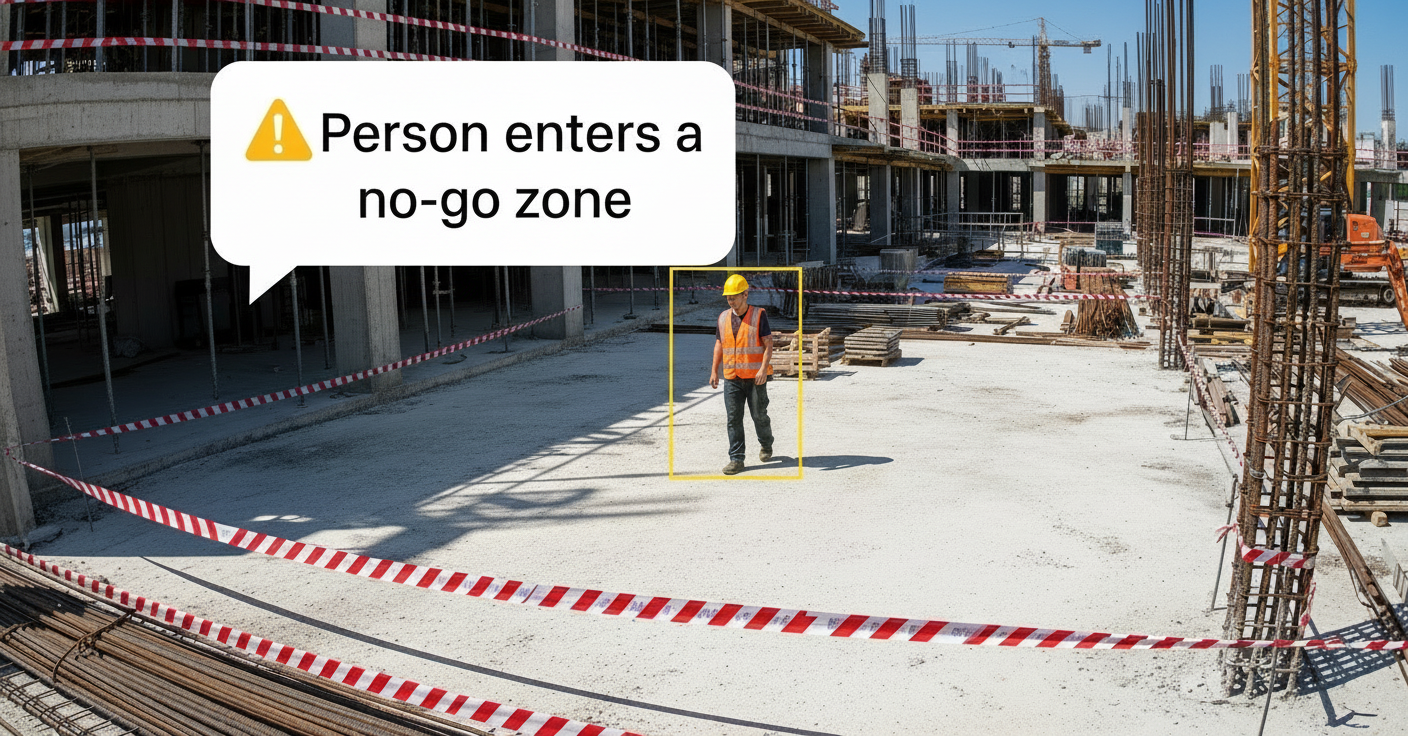
- No-go zones: it identifies workers or equipment entering restricted areas, such as active demolition zones or crane swing radiuses.
- Hazard cues in video: integrations and visual analysis can help flag observable risk conditions in camera views (for example, entry into restricted areas), so teams can respond promptly.
2. Reason: understanding context
Detection alone creates noise. Agentic AI adds a layer of reasoning to differentiate between normal activity and genuine risk.
- Contextual analysis: a person walking near a forklift is a risk; a person in a designated walkway is not. The AI distinguishes these scenarios to minimize false alarms (Source: Spot AI).
- Historical patterns: by analyzing data over time, the system identifies high-risk trends, such as specific times of day when safety violations spike, allowing for targeted construction risk identification AI strategies (Source: Netguru).
3. Act: real-time intervention
The goal is to surface potential hazards promptly so teams can intervene.
- Timely alerts: when a risk is validated, the system sends swift notifications to site supervisors or triggers on-site audio alerts to warn workers without delay.
- Automated coaching: shift recaps and individual scorecards provide objective data for safety coaching, shifting the dynamic from consequence-focused enforcement to collaborative improvement.
| Feature | Benefit for Innovation Leads |
|---|---|
| Edge Processing | Works on sites with poor internet; low bandwidth usage. |
| Open API | Connects with Procore/BIM 360; no data silos. |
| Camera Agnostic | Uses existing hardware; no "rip and replace" required. |
| AI Agents | Automates monitoring; scales safety without adding headcount. |
Improving construction site safety with AI and minimizing liability
Safety incidents have a direct financial impact, with workers' compensation claims averaging $48,500 per claim (Source: Motive). AI in construction site safety can help document safety improvements and streamline investigations; insurance outcomes depend on carrier policies and other factors.
Automating compliance documentation
Regulatory compliance is often a manual, paper-heavy process. Agentic AI automates the documentation of safety protocols.
- Audit trails: the system creates timestamped video evidence of compliance, such as adherence to confined space procedures or trench safety protocols.
- Dispute resolution: searchable video history can significantly speed up investigations, providing objective video context to help resolve liability disputes or workers' compensation claims.
Shifting field culture
Field resistance often stems from the perception of technology as "Big Brother." By focusing on AI for worker safety construction, leaders can reframe the technology.
- Protection, not punishment: emphasize that the system detects hazards (like a forklift blind spot), not just rule-breaking.
- Objective feedback: use data to highlight safe shifts and reward teams with high SOP adherence, fostering a culture of operational excellence.
Enhancing productivity and quality control
Beyond safety, AI for site productivity improvement is a key driver for ROI. With rework costing projects between 4% and 10% of total value, early detection of errors is essential (Source: PlanRadar).
Visual quality assurance
AI for construction quality control integrates with BIM models to compare reality against the plan.
- Progress tracking: drones and fixed cameras capture site conditions, allowing the AI to verify if installation matches the schedule and design specifications.
- Installation Verification: By creating a searchable video log of as-built conditions, the system enables teams to remotely confirm that work matches design intent. This visual documentation helps validate progress, resolve disputes over sequencing, and catch deviations before they become costly rework.
Optimizing workflows
AI for construction workflow automation helps streamline logistics and resource allocation.
- Bottleneck identification: visual analytics reveal traffic congestion at gates or inefficiencies in material staging areas.
- Resource allocation: data on equipment utilization helps managers decide when to rent additional machinery or off-hire underused assets.
Evaluating AI solutions: a comparison
When selecting a partner for AI-driven construction site monitoring, innovation leaders should prioritize deployment speed, flexibility, and total cost of ownership.
| Comparison Criteria | Spot AI | Traditional Camera Systems | Generic AI Analytics |
|---|---|---|---|
| Deployment Speed | Plug-and-play; live in minutes | Weeks of cabling and setup | Requires complex server config |
| Hardware Flexibility | Camera agnostic (works with any IP camera) | Proprietary hardware lock-in | Often requires specific sensors |
| Connectivity | Hybrid Edge/Cloud (works with Starlink/LTE) | Heavy bandwidth requirements | High bandwidth dependency |
| Scalability | Unlimited users; enterprise dashboard | Per-seat licensing models | Difficult to scale across sites |
| AI Capability | Pre-trained AI Agents (Safety, Ops, Security) | Passive recording only | Basic motion detection |
Strategic implementation roadmap
To avoid "pilot purgatory," follow a phased approach to implementing agentic AI across your portfolio.
- Define the pilot scope: select a single site with a cooperative superintendent. Focus on one or two key use cases, such as AI-powered PPE detection or perimeter security.
- Establish baselines: measure current incident rates, investigation times, or rework costs before deployment to establish a clear ROI baseline.
- Engage IT early: utilize SOC-2 ready, pilot-in-a-box solutions that bypass lengthy infrastructure reviews.
- Train the field: position the tool as a "digital teammate" that handles the mundane monitoring, allowing superintendents to focus on high-value work.
- Scale based on data: use the pilot results—such as a decrease in safety violations or faster dispute resolution—to build the business case for fleet-wide adoption.
Building a resilient, adaptable construction site
The construction industry is moving toward a model of intelligent management where decisions are driven by real-time data rather than lagging indicators. Agentic AI provides the mechanism to see, reason, and act on risks that were previously invisible until it was too late.
By integrating these systems, innovation directors can solve the dual obstacle of improving safety and productivity without expanding headcount. The technology offers a practical solution to tool sprawl, connectivity issues, and the need for demonstrable ROI.
See Spot AI in action—request a demo to explore how video AI can help standardize safety and streamline operations on your sites.
Frequently asked questions
How can AI improve safety on construction sites?
AI improves safety by providing continuous, consistent monitoring of job sites. It uses computer vision to detect hazards such as missing PPE, or workers in no-go zones in real-time. This allows for on-the-spot intervention and coaching, shifting safety programs from reactive incident reporting to forward-looking risk mitigation.
What are the best AI tools for risk management in construction?
The most effective AI tools for risk management are those that combine computer vision with agentic reasoning. Look for platforms that offer real-time hazard detection, integration with project management software like Procore, and trend analysis of historical data to highlight higher-risk patterns. Solutions that work on the edge are essential for sites with variable connectivity.
How does AI enhance productivity in construction projects?
AI enhances productivity by automating routine tasks like progress tracking and site documentation. It identifies bottlenecks in workflows, optimizes equipment utilization, and reduces rework by detecting quality defects early. This allows project managers to make data-driven decisions that keep projects on schedule and within budget.
What compliance considerations should be addressed when implementing AI in construction?
When implementing AI, organizations must ensure data governance and privacy standards are met. This includes establishing clear protocols for data retention, ensuring systems are SOC-2 compliant, and maintaining transparency with the workforce about how video data is used. It is also critical to ensure that AI documentation aligns with regulatory requirements for audit trails and incident reporting.
About the author
Sud Bhatija is COO and Co-founder at Spot AI, where he scales operations and GTM strategy to deliver video AI that helps operations, safety, and security teams boost productivity and minimize incidents across industries.

