






Best warehouse security camera systems (2026): a buyer's guide for operations leaders
The best warehouse security camera system in 2026 is the one that turns your existing cameras into AI coworkers: software that detects incidents in context, deters intruders in seconds with talk-down, strobe lights, or horns, and hands you case-ready evidence in minutes instead of hours. Passive recording is no longer enough. CargoNet recorded 3,594 supply chain crime events across the United States and Canada in 2025, essentially flat against the 3,607 events in 2024, which tells you the risk to warehouses and distribution centers is not going away (Source: CargoNet). Meanwhile, IDC projected that by the end of 2024, 30% of enterprises using video security systems would also use video data analytics, a sign that layering AI over the cameras you already own is now the mainstream path, not a rip-and-replace (Source: IDC).
This guide ranks the leading systems for warehouse and manufacturing facilities, compares them on the criteria that matter to a Director of Operations, and shows you how to choose by risk zone, when to upgrade versus replace, and how to justify the spend with KPIs your CFO will recognize.
Key takeaways
- The best warehouse security cameras in 2026 detect in context, deter in real time, and produce verified, timestamped evidence, not just footage to scrub through later.
- AI video software can run on the IP cameras you already own, so most warehouses upgrade their capability without a full hardware swap.
- Loading docks, perimeters, yards, and high-value inventory areas are the priority risk zones that drive camera placement and counts.
- Spot AI's AI Security Guard turns existing cameras into AI coworkers that detect intent, deter intruders, and build case-ready cases across every site.
- Directors of Operations can justify investment with concrete KPIs: incident response time, investigation time, guard efficiency, shrink, and downtime avoided.
What separates the best warehouse security camera systems in 2026
For years, warehouse security meant rows of recorders capturing video that nobody watched until something went wrong. That model has a flaw: by the time you pull the footage, the trailer is gone and the trail is cold. The shift in 2026 is from passive recording to active intelligence.
Security Magazine notes that advances in AI and machine learning-based video analytics are reshaping traditional on-premises camera systems, letting cameras automatically detect and classify intrusions, distinguish legitimate activity from suspicious activity, and support a faster response rather than simple recording (Source: Security Magazine). That is the dividing line. A camera that records is a witness after the fact. An AI coworker reasons about what it sees and acts while there is still time to matter.
The World Economic Forum's Physical AI research explains how decades of computer-vision data now let AI systems watch factory and warehouse operations, including access points and yards, for anomalies in human and vehicle behavior, closing blind spots around loading docks and outdoor storage (Source: World Economic Forum). For a busy operations leader, that closes the most expensive gaps in the building.
When you evaluate any warehouse video security system this year, score it against these operational criteria:
- AI detection in context. Does it tell a forklift from an intruder, and a delivery driver from a fence-jumper, after hours?
- Active deterrence. Can it trigger talk-down, strobe lights, or horns in real time, or does it only notify you?
- Compatibility with existing cameras. Will it run on your current IP and ONVIF cameras, or force a hardware replacement?
- Loading dock and perimeter coverage. Can it watch trailers, gates, yards, and entrances as one connected view?
- Multi-site management. Can one team see every facility from a single dashboard?
- False alarm reduction. Does it filter routine motion so your team is not chasing wind and wildlife?
- Video search and evidence export. Can you find an event in seconds and export a clean, timestamped clip for police, insurers, or HR?
- Storage model and installation complexity. Cloud, on-prem, or hybrid, and how fast does it go live?
- Scalability. Does adding a site mean adding headcount, or just connecting cameras?
Comparison of the leading warehouse security camera systems
Below is how the leading named systems stack up for a warehouse or manufacturing environment. Spot AI is listed first because it is built around the criteria operations leaders weight most: working with existing cameras, active deterrence, and case-ready evidence. Competitor cells reflect only what each vendor publicly specifies. Where a vendor does not publicly state a capability, the cell reads "Not publicly specified" rather than an assumption.
| System | Deployment model | Works with existing cameras | AI / analytics | Notable integrations | Best-fit warehouse profile |
|---|---|---|---|---|---|
| Spot AI | Cloud (hybrid edge-to-cloud) | Yes, camera-agnostic with third-party IP cameras | AI-powered video intelligence that turns existing cameras into active agents to protect people, optimize operations, and drive measurable outcomes | Open APIs and webhooks per brand material | Multi-site warehouses and manufacturing campuses upgrading existing cameras without rip-and-replace |
| Verkada | Cloud | Not publicly specified | Not publicly specified | Not publicly specified | Not publicly specified |
| Genetec Security Center (Omnicast) | Not publicly specified | Not publicly specified | Not publicly specified | Access control, automatic license plate recognition (ALPR), communications | Not publicly specified |
| Eagle Eye Networks | Cloud | Not publicly specified | AI video security with proactive security capabilities | Integration with Brivo access control at multiple levels | Not publicly specified |
| Rhombus | Cloud | Not publicly specified | Not publicly specified | Not publicly specified | Not publicly specified |
| Hanwha Vision | Not publicly specified | Not publicly specified | AI-powered video and visual intelligence for security and retail applications | Not publicly specified | Not publicly specified |
The pattern worth noting: most named systems are cloud-based, but few publicly confirm whether they run on the cameras you already own. That single question, camera compatibility, is what separates a software-led upgrade from a capital-heavy hardware project. Spot AI's video AI platform is camera-agnostic and works with any IP camera, so most sites go live in days rather than months.
How AI security cameras improve warehouse perimeter and loading dock security
Loading docks and perimeters are where warehouses bleed. CargoNet's analysis of holiday-period cargo theft calls out warehouses and distribution centers as a top targeted location category, with thieves exploiting docks and outdoor storage when facilities are unstaffed or running with reduced oversight (Source: CargoNet). The hours that should be quietest are the ones that cost the most.
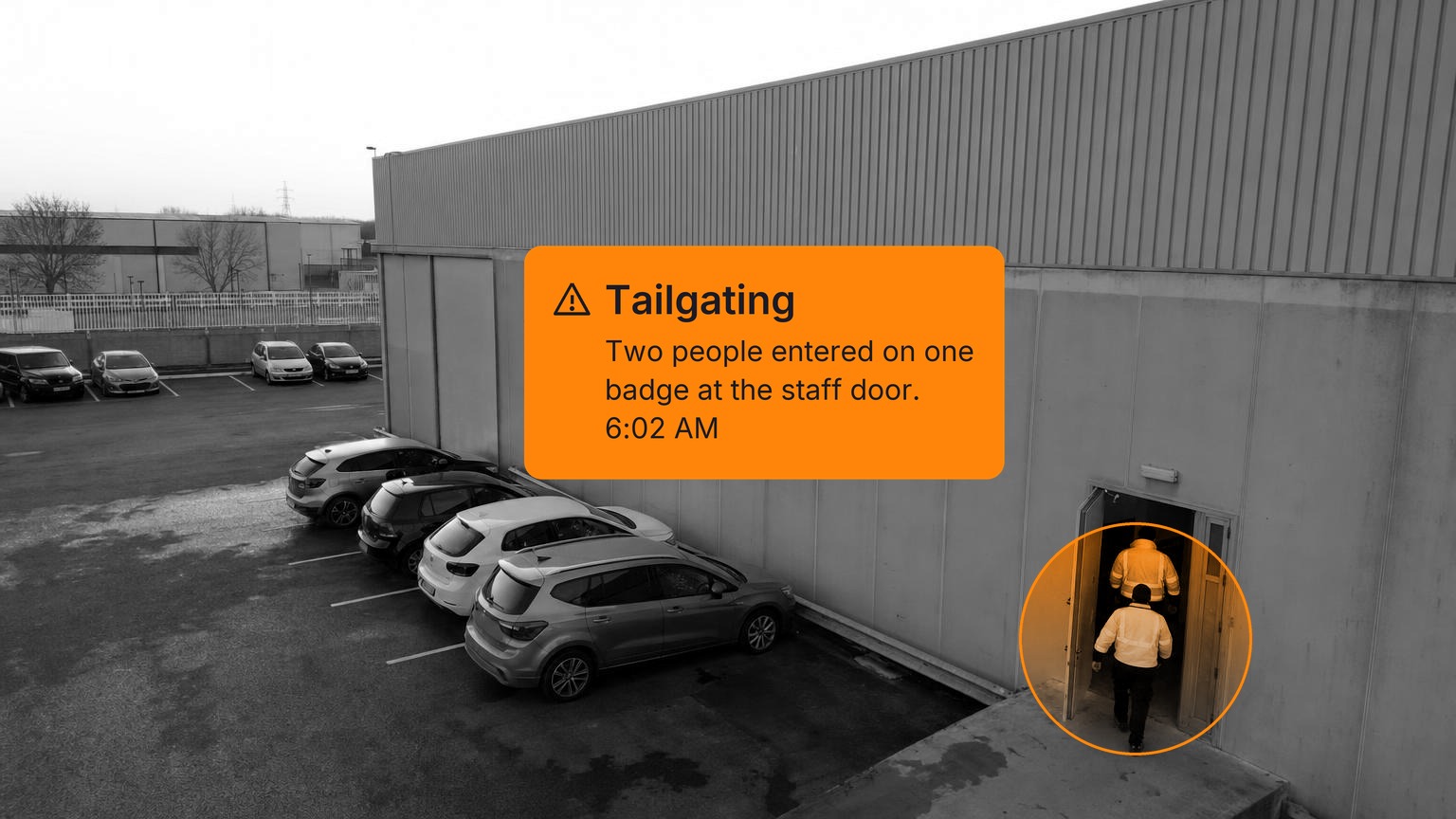
Here is how an AI coworker changes the math at the dock and the fence line. Spot AI's AI Security Guard follows a four-step flow: establish perimeter control, detect and reason in context, deter in real time, then document and resolve. In practice that means a camera at the gate can read a license plate of interest, a yard camera can flag loitering or tailgating, and the system can trigger a strobe light, play an automated talk-down, or notify the right team while the event is still unfolding.
The context piece is what tames false alarms. Legacy pixel-change alarms fire on every shadow, headlight, and stray cat, which trains your team to ignore them. Context-aware detection asks a smarter question: is this a person where a person should not be, at an hour when no one is scheduled? Security leader Jon Weingot, cited by Security Magazine, stresses the value of clearly distinguishing who belongs at a facility from who does not, and points to tools like license plate readers for managing heavy vehicle traffic at industrial perimeters (Source: Security Magazine).
For multi-site operators, this is the difference between watching and seeing. One team can monitor every loading dock and yard across a portfolio from a single dashboard, with remote access from anywhere. No travel, no per-site guard booth, no blind spots between facilities.
Where to place warehouse security cameras by risk zone
OSHA's warehousing guidance identifies open loading dock doors, fall exposures, forklift traffic, and high stacking as common hazards, and stresses that camera strategy should follow a systematic assessment of these documented risks rather than an arbitrary count (Source: OSHA). The right number of cameras is the number that achieves continuous, high-quality coverage of your priority zones. Start with the four that matter most.
Loading docks
Cover every dock door to watch trailer activity, after-hours access, and cargo movement. These are the highest-value, highest-exposure points in the building, especially when trucks are staged overnight. Dock cameras tied to AI detection can flag an open door when no shipment is scheduled.
Perimeter, gates, and yards
Fence lines, employee entrances, vehicle approaches, and laydown yards need coverage that detects intent, not just motion. License plate reading at gates and loitering detection in the yard let you control access before someone reaches the building.
Entrances and access points
Main entrances, side doors, and dock-adjacent entries are where tailgating and unauthorized entry happen. Pairing cameras with access control gives you a record of who entered, when, and whether they were authorized.
High-value inventory and restricted areas
Equipment cages, production-adjacent storage, and high-value SKU zones deserve dedicated coverage for both theft deterrence and incident review. This is also where camera footage doubles as a safety record when something goes wrong near forklift traffic or high stacking.
Should a warehouse upgrade its legacy camera system or replace the whole system
This is the question that decides your budget. The short answer for most facilities in 2026: upgrade the intelligence, keep the cameras.
The World Economic Forum's Physical AI research describes architectures where AI software runs on top of existing camera networks and operational technology sensor networks, delivering advanced analytics and decision support without wholesale hardware replacement, which lowers the barrier to adopting AI for safety, security, and efficiency (Source: World Economic Forum). Security Magazine's video security trend analysis echoes this, noting that businesses increasingly budget for AI-enabled platforms that reduce operating costs and work with existing cameras, cloud connectivity, and hybrid architectures instead of full rip-and-replace (Source: Security Magazine).
Replace hardware only when you genuinely need to: a camera is failing, resolution is too low to read a plate, or a critical zone has no coverage at all. Otherwise, a software-led upgrade gets you AI detection, active deterrence, and case-ready evidence on the cameras already mounted. Spot AI is camera-agnostic and works with Avigilon, Pelco, Axis, Hanwha, and any ONVIF camera, so there is no rip-and-replace and most sites go live in days. Its hybrid edge-to-cloud design keeps full-resolution video in the facility on an Intelligent Video Recorder and sends only metadata across the network, which keeps deployments fast, secure, and PCI-clean.
A clean decision framework looks like this:
- Inventory your cameras. Note resolution, placement, and condition for every feed.
- Map coverage gaps. Compare current views against your priority risk zones (docks, perimeter, entrances, high-value areas).
- Add cameras only where gaps exist. Fill blind spots; do not replace working cameras.
- Layer AI software across all feeds. Apply detection, deterrence, and search to the full fleet, old and new.
- Connect access control and alerts. Tie detections to the actions and people who respond.
Key terms
- AI Security Guard: Spot AI's coworker for perimeter and interior protection that detects intent in context, deters in real time with talk-down, strobe lights, or horns, and delivers case-ready evidence.
- Camera-agnostic / ONVIF: Software that runs on any standards-compliant IP camera regardless of brand, so you avoid a rip-and-replace.
- Case-ready evidence: Verified, timestamped, searchable video organized into a case for police reports, insurance claims, HR reviews, or audits.
- Hybrid edge-to-cloud: An architecture that keeps full-resolution video on-prem and sends only metadata to the cloud, balancing speed, security, and bandwidth.
What AI capabilities matter most in 2026
Not every "AI" label means the same thing. For a manufacturing warehouse, these are the capabilities that separate an AI coworker from a marketing badge.
- Context-aware detection. Distinguishing routine warehouse motion (forklifts, scheduled deliveries, staff) from suspicious activity is what cuts false alarms and rebuilds trust in your alerts.
- Active deterrence. Talk-down, escalating strobe lights, and horns act on an incident in real time instead of leaving you to review it the next morning.
- Fast video search. Finding an event by person, vehicle, or zone in seconds turns an investigation from a half-day into a few minutes.
- Case-ready evidence export. Clean, timestamped clips with permissions and retention policies that hold up for insurers, police, and HR.
- Multi-site visibility. One pane of glass across every facility, so a small team covers a large footprint.
These capabilities matter beyond security, too. McKinsey's early-2024 AI survey found 65% of organizations regularly using generative AI, with the largest revenue uplifts of more than 5% in supply chain and inventory functions, a signal that video AI in the warehouse increasingly ties to measurable business outcomes, not security alone (Source: McKinsey). That dual mandate is real. The U.S. Bureau of Labor Statistics reported 2.5 million injury and illness cases in 2024, down 3.1% from 2023, with transportation and warehousing a meaningful contributor, which is why the same cameras that deter intruders also support safety and incident documentation (Source: U.S. Bureau of Labor Statistics).
That is why Spot AI ships more than one coworker. Alongside AI Security Guard, the AI Safety Manager surfaces PPE gaps, no-go-zone violations, and high-risk events around the clock, and the AI Operations Assistant evaluates every run against your SOPs to standardize the best shift. One camera fleet, three jobs.
A real warehouse deployment: Staccato
Theory is cheap, so here is a real application. Spot AI was deployed across Staccato's 800-acre firearms manufacturing campus, which includes manufacturing, administrative, and experiential training facilities, to move the team from reactive video review to proactive safety and security monitoring.
Spot AI's Video AI Agents integrated with Staccato's existing camera infrastructure to support automated PPE compliance checks, real-time tailgating detection, after-hours security monitoring, and forklift movement tracking. The team uses AI monitoring to detect security breaches and unauthorized access attempts in real time with swift alerts, reducing reliance on manual observation. The full implementation took seven weeks from first conversation to deployment.
"We needed something that could transform our camera system from a passive recording tool into a proactive partner in safety and security."
Mike Tiller, Director of Technology, Staccato
You can read the full Staccato customer story for the deployment details.
How a Director of Operations justifies the investment
The case for AI warehouse security cameras is not abstract; it is a KPI conversation. Frame the business case around metrics your leadership already tracks, and tie each one to what an AI coworker does day to day.
| KPI | What the AI coworker does | Why it matters to operations |
|---|---|---|
| Incident response time | Detects in context and triggers deterrence or alerts in real time | Acts while there is still time to matter, not the morning after |
| Investigation time | Searchable, timestamped video organized into cases | Cuts incident review from hours of scrubbing to minutes |
| Guard efficiency | Filters routine motion to reduce false alarms | Stops wasting guard hours chasing non-events |
| Shrink and unauthorized access | Flags loitering, tailgating, and after-hours entry | Helps reduce the likelihood of loss at docks and high-value zones |
| Downtime avoided | Surfaces safety and process events for faster resolution | Keeps lines running and supports faster claims and audits |
ASIS International's Security Risk Assessment Standard reinforces the logic: effective security controls should be layered, integrated, and aligned with organizational objectives, which in practice means a warehouse camera system needs access control integration, incident workflows, and case-ready evidence that feeds your broader risk management (Source: ASIS International). When your camera system produces verified, timestamped evidence and connects to the systems you already run, the ROI case writes itself.
What do deployment time, total cost, and integrations look like for a warehouse system?
Spot AI deploys as software on the IP cameras a warehouse already runs, with an on-site Intelligent Video Recorder (IVR), so most sites go live in days and the IVR and software are part of one subscription. Once the feature lists look alike, deployment time, total cost, and integrations are where warehouse systems differ most, so put the same questions to every vendor on your shortlist.
| Cost or timeline line | What drives it | Question to ask every vendor |
|---|---|---|
| Cameras | Whether the system runs on the cameras you own or needs its own hardware | Will it run on our current ONVIF and IP cameras, and which zones, if any, need new coverage? |
| Recorder and storage | On-site servers, cloud retention, or a hybrid of both | Where does full-resolution video live, and what happens to recording when the internet link drops? |
| Software and analytics | Per-camera or per-site subscriptions, plus any add-on licenses for advanced analytics | Which detections are in the base subscription, and which cost extra? |
| Installation and setup | Professional services, cabling, and calibration time before the first useful alert | How many days from signed order to the first live alert at our busiest dock? |
| Integrations | Access control, yard management, and the alerting tools your team already uses | Which systems can an alert trigger, and is there an open API or webhook? |
| Support and updates | Software updates, camera health monitoring, and who answers when something breaks | Are software updates and support part of the subscription? |
Deployment models trade upfront cost against recurring cost. Cloud and hybrid systems usually lower the upfront spend and make adding a site simpler, while fully on-premises systems carry a higher initial investment in servers and storage but fewer recurring fees. Spot AI uses the hybrid model: the IVR keeps full-resolution video in the building and sends only metadata across the network, so cloud search and the multi-site dashboard depend on a stable connection while the footage itself stays on site.
Spot AI's typical path to value runs from a custom demo on your existing video, through a technical feasibility check and a business case, to a proof of value (commonly about three months) and a full rollout plan. Integrations decide how much of the response runs on its own: when Spot AI detects an event at a dock door or gate, it can notify the right people by email, text, Slack, or Teams, lock down doors through access control, and trigger yard management or ERP workflows through open APIs and webhooks. For dock-specific workflows, see our loading dock security guide.
Choosing a warehouse camera system is more than a security decision: it is an investment in safety, throughput, and margin, and the fastest way to judge one is on your own footage. Book a demo to see how Spot AI reduces security events and surfaces safety risks on the cameras you already own, and we will map the rollout to your docks, yards, and shifts.
Choosing the right warehouse security camera system for your facility
The best security camera system for a warehouse is not the one with the most cameras or the highest megapixel count. It is the one that turns the cameras you own into AI coworkers that detect in context, deter in seconds, and produce case-ready evidence across every site. For multi-site operators and large industrial facilities, the deciding factors are camera compatibility, deployment speed, and whether one team can manage everything from a single dashboard.
Spot AI is purpose-built for high-risk commercial environments like manufacturing and warehousing. It is camera-agnostic, NDAA-compliant, and SOC 2, with most sites live in days rather than months. To see how your existing cameras would perform as AI coworkers, book a demo and bring a few of your toughest dock, yard, and perimeter feeds.
Frequently asked questions
What are the best warehouse security camera systems for businesses in 2026?
The best systems in 2026 use AI to detect incidents in context, deter intruders in real time, and produce case-ready evidence, rather than passively recording. Leading named options include Spot AI, Verkada, Genetec Security Center, Eagle Eye Networks, Rhombus, and Hanwha Vision. Spot AI stands out for warehouses because it is camera-agnostic and turns existing cameras into AI coworkers, so most sites go live in days without a rip-and-replace.
How do AI security cameras improve warehouse perimeter and loading dock security?
AI cameras detect and classify activity in context, distinguishing a delivery driver from a fence-jumper and a forklift from an intruder, then deter in real time with talk-down, strobe lights, or horns. CargoNet identifies warehouses and distribution centers as top targets for cargo theft, especially when facilities are unstaffed, so real-time detection at docks and gates closes the most exposed gaps (Source: CargoNet).
Should a warehouse upgrade its legacy camera system or replace the entire camera system?
For most facilities in 2026, the better move is to upgrade the intelligence and keep the cameras. The World Economic Forum's Physical AI research describes AI software running on top of existing camera systems without wholesale hardware replacement (Source: World Economic Forum). Replace hardware only where a camera is failing, resolution is too low, or a critical zone has no coverage.
What features matter most in a commercial security camera system for a manufacturing warehouse?
Prioritize context-aware AI detection, active deterrence, false-alarm reduction, fast video search, case-ready evidence export, and multi-site management. ASIS International recommends layered, integrated controls aligned with organizational objectives, which means access control integration and incident workflows matter as much as the cameras themselves (Source: ASIS International).
How many security cameras does a warehouse need for docks, yards, entrances, and high-value areas?
There is no fixed number; coverage should follow a hazard assessment. OSHA's warehousing guidance points to open dock doors, forklift traffic, and high stacking as priority zones, and the goal is continuous, high-quality coverage of those areas rather than an arbitrary count (Source: OSHA). Map every dock door, gate, entrance, and high-value zone, then place cameras to close blind spots.
About the author
Sud Bhatija is Co-founder at Spot AI, where he scales operations and GTM strategy to deliver video AI that helps operations, safety, and security teams boost productivity and reduce incidents across industries.

