




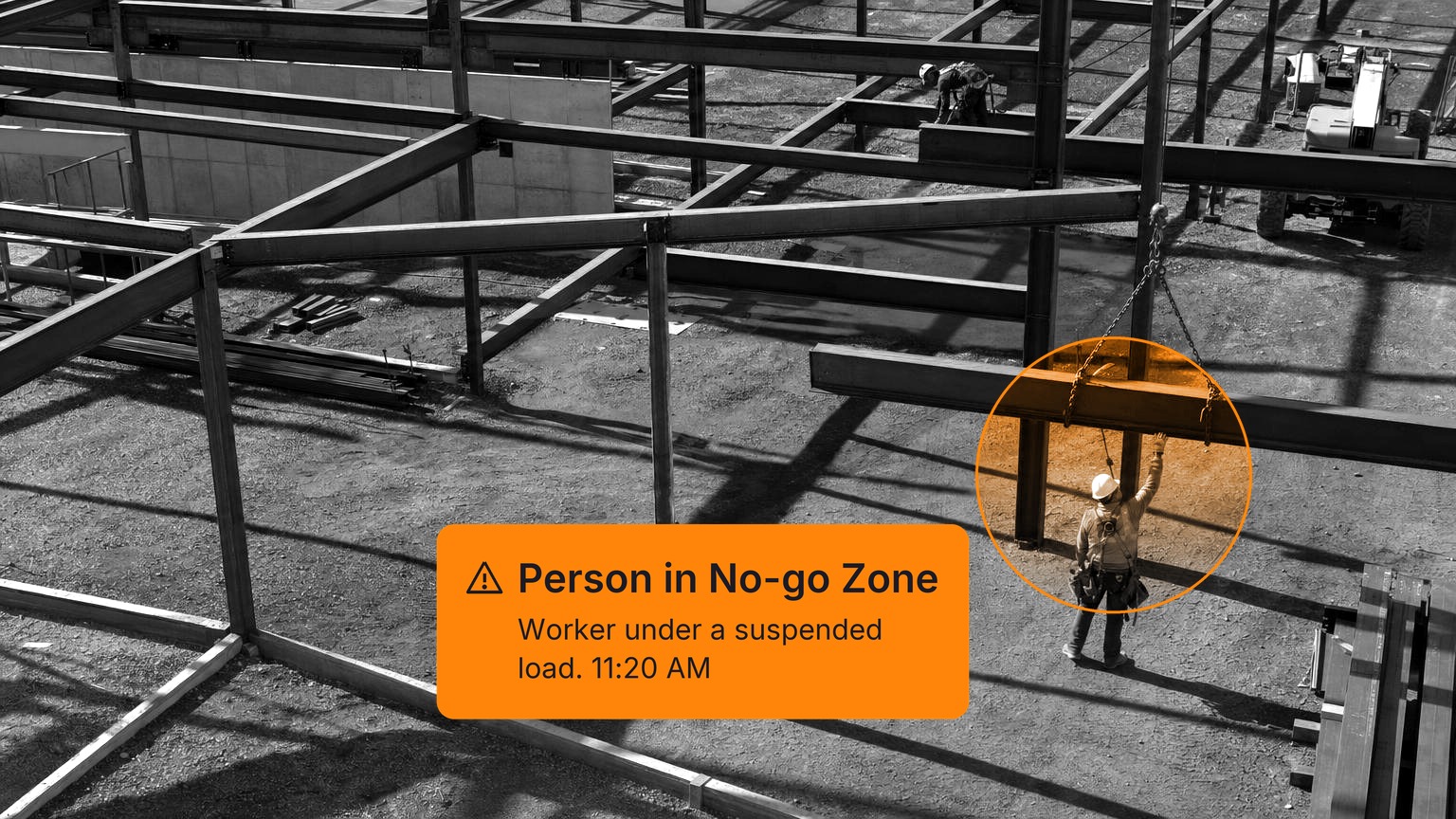


Video AI tools for construction sites: 2026 comparison guide for project executives
Construction and extraction occupations recorded 1,055 fatal work injuries in 2023, about 20 percent of all US workplace deaths, with falls, slips, and trips alone accounting for 39.2 percent (421) of construction fatalities. (Source: U.S. Bureau of Labor Statistics) At the same time, preventable loss on jobsites now reaches well beyond theft into damage, rework, schedule slippage, and material waste, pushing video AI deployments to evolve from perimeter-only security toward full operational visibility. This guide compares seven leading video AI tools for construction sites in 2026, with evaluation criteria built for the project executive who tracks incident frequency, guard spend, insurance exposure, and schedule variance across a multi-project portfolio.
Key takeaways
- Video AI platforms now cover security, safety, and operations in a single deployment, replacing the need for siloed point solutions on each jobsite.
- Camera-agnostic, hybrid edge-to-cloud architectures avoid rip-and-replace costs and keep full-resolution footage on-prem while sending only metadata across the network.
- Context-aware detections paired with active deterrence (AI Talkdown, lights, sirens) can reduce after-hours trespass and theft likelihood before damage occurs.
- Construction firms that integrate digital technologies report fewer safety incidents and better quality and timeliness, and AI is now among the fastest-growing tools on the jobsite. (Source: Deloitte)
- Deployment speed matters: some platforms go live in days, while others require weeks of site-specific training data and custom calibration.
Key terms
- Video AI Agents: Software agents that run on camera feeds to detect, classify, and respond to specific events (unauthorized access, PPE gaps, equipment movement) without manual monitoring.
- Hybrid edge-to-cloud architecture: A design that processes video locally at the jobsite edge for speed and stores full-resolution footage on-prem, while sending lightweight metadata to the cloud for dashboards, search, and cross-site reporting.
- Camera-agnostic platform: A system that works with any ONVIF-compliant IP camera (Axis, Avigilon, Hanwha, Pelco, and others), so existing hardware stays in place and new cameras can be mixed in without vendor lock-in.
- Context-aware detections: Alerts that consider scene context (time of day, zone, object type, behavior pattern) rather than firing on simple motion, which reduces false alarms and surfaces the events that actually require a response.
Why project executives are re-evaluating jobsite camera systems in 2026
Traditional camera setups record footage that someone reviews after an incident has already caused damage, delay, or injury. For a project executive managing five, ten, or twenty active sites, that reactive model creates three compounding problems: guard costs that scale linearly with site count, investigation hours that pull superintendents off schedule-critical work, and insurance claims that lack the timestamped evidence adjusters need to close quickly.
The risk picture is well documented. Roughly 65 percent of construction fatal injuries between 2011 and 2021 came from the Focus Four hazards (falls, struck-by, caught-in/between, and electrocution), the same categories OSHA organizes its construction safety training around. (Source: CDC) Video AI changes the equation by turning existing cameras into AI coworkers that detect in context, deter in seconds, and produce case-ready evidence, aligning detection models with the hazards regulators care about most. (Source: OSHA)
Deloitte reinforces this shift, advising that technology architecture choices should balance cloud, edge, and on-premises resources so today's investments do not become tomorrow's constraints, a principle that applies directly to construction sites where bandwidth is limited, projects span years, and connectivity can be intermittent. (Source: Deloitte)
OSHA anchors construction safety training on the Focus Four, and falls remain the single largest killer, driving 39.2 percent of construction deaths in 2023. (Source: U.S. Bureau of Labor Statistics) A project executive can point video AI detection at those exact categories, using always-on oversight to justify the investment as compliance-forward rather than purely operational.
Five criteria for comparing video AI tools for construction sites
Before evaluating individual platforms, establish the criteria that matter most to a multi-project portfolio. The following five dimensions separate tools that deliver ROI from those that create new overhead.
- Deployment speed and hardware flexibility. Can the platform connect to cameras already on your jobsite, or does it require proprietary hardware? Sites that go live in days protect margin faster than those requiring weeks of calibration.
- Real-time deterrence, not just detection. Alerts are only valuable if someone acts on them. Platforms with built-in deterrence (AI Talkdown, audible warnings, light activation) reduce the gap between detection and response from minutes to seconds.
- Cross-site visibility without adding headcount. A project executive needs a single dashboard that surfaces incidents, trends, and evidence across every active site. The platform should scale horizontally without requiring a dedicated operator per location.
- Evidence quality for claims and disputes. Timestamped, searchable video that can be shared with insurers, attorneys, or OSHA inspectors in minutes (not hours) directly reduces claim costs and dispute resolution timelines.
- Integration and interoperability. Deloitte emphasizes that today's technology investments should not become tomorrow's legacy constraints, so the platform should connect to project management, safety reporting, and incident resolution workflows without extensive custom development. (Source: Deloitte)
At-a-glance comparison: seven video AI tools for construction sites in 2026
The table below summarizes each platform across the criteria that project executives track most closely. Spot AI is listed first because its combination of deployment speed, camera flexibility, and active deterrence aligns with the multi-site construction use case.
Platform |
Best for |
Deployment speed |
Camera compatibility |
Active deterrence |
Storage architecture |
Key limitation |
|---|---|---|---|---|---|---|
Spot AI |
Multi-site security, safety, and operations |
Days (most sites live in under a week) |
Any ONVIF IP camera |
Yes (AI Talkdown, lights, sirens) |
Hybrid edge-to-cloud |
Broad platform, not construction-only |
Superb AI |
Budget retrofits |
About 14 days |
Existing CCTV |
No |
Cloud plus edge |
Predefined risk models only |
Hubble |
Workflow automation and compliance |
Varies by site complexity |
Compatible cameras |
No |
Cloud or hybrid |
Requires site-specific training data |
Smartvid.io |
BIM-centric risk identification |
Varies (Autodesk ecosystem) |
High-quality video required |
No |
Cloud |
Struggles in low-light conditions |
viAct |
High-risk environments |
Rapid (plug-and-play modules) |
Compatible cameras |
No |
Edge |
Limited third-party integrations |
Buildots |
Progress tracking and scheduling |
Varies (requires 360-degree cameras) |
360-degree cameras required |
No |
Cloud |
Not safety or security focused |
Procore |
Holistic project management |
Cloud-native |
Varies |
No |
Cloud |
Overly broad for pure safety needs |
For teams weighing where footage and analytics should live, our companion guide to cloud VMS platforms for construction sites breaks down the storage and management layer in more depth.
What project executives get from an AI Security Guard deployment
The comparison above is about capabilities. The table below translates those capabilities into the outcomes a project executive is measured on, mapping the recurring jobsite challenge to how an AI Security Guard responds and the result that shows up on a portfolio scorecard.
Jobsite challenge |
How the AI Security Guard responds |
Executive outcome |
|---|---|---|
After-hours trespass and copper or equipment theft |
Context-aware detection escalates through AI Talkdown, lights, and sirens in seconds, before a guard would receive a call |
Fewer break-ins and lower guard spend across remote sites |
Focus Four safety exposure (falls, struck-by, caught-in, electrocution) |
Video AI Agents flag zone violations, PPE gaps, and unsafe proximity as they happen |
Documented, proactive safety program that supports OSHA compliance |
Slow, labor-intensive incident investigation |
AI search pulls timestamped, shareable clips in minutes instead of hours |
Faster claims, fewer disputes, superintendents kept on schedule |
No unified view across a multi-project portfolio |
One cloud dashboard covers every active site with no per-seat limit |
Portfolio-wide visibility without adding headcount |
Deep dive: Spot AI as the AI Security Guard for construction sites
Spot AI turns the cameras a construction site already owns into AI coworkers that act in real time. The platform's AI Security Guard handles perimeter and interior protection through a three-step workflow: detect in context, deter in seconds, and deliver case-ready evidence.
How it works on a jobsite
The Intelligent Video Recorder (IVR) connects to any ONVIF-compliant IP camera (Axis, Avigilon, Hanwha, Pelco, or others) without rip-and-replace. Full-resolution video stays on-prem at the jobsite, and only metadata travels to the cloud. This hybrid edge-to-cloud architecture is critical for construction, where bandwidth is often limited and Starlink backhaul may be the only reliable connection on a remote site.
Pre-trained Video AI Agents run context-aware detections for unauthorized access, after-hours trespass, vehicle break-ins, and fire. When an agent detects a threat, the system can escalate through AI Talkdown (natural-conversation deterrence with three levels of escalation), audible alarms, or light activation, all before a human guard would even receive a phone call. For custom scenarios unique to a specific project, Iris lets teams build new detections in minutes using natural language. If you are still mapping where cameras miss, our guide to construction site security blind spots shows the gaps context-aware detection is built to close.
Remote visibility across a multi-project portfolio
A project executive overseeing ten active sites can view live feeds, review flagged incidents, and pull timestamped evidence from a single cloud-native dashboard. There is no per-seat licensing restriction, so superintendents, safety managers, and insurance partners can all access the system without adding cost. Spot AI supports pole-mounted, wall-mounted, and trailer-mounted camera units, covering everything from a downtown high-rise to a rural infrastructure project.
The remote-site pattern that defines construction, unstaffed perimeters, after-hours vulnerability, and high-value metal on the ground, shows up across other industries too. A top-five North American EV charging network deployed Spot AI to deter copper theft autonomously at unmanned sites and reported cutting incidents by 80 percent with no human monitoring in the loop, a customer-reported result that mirrors what construction portfolios need from an always-on deterrent.
"We've reduced incidents by 80% without any kind of human monitoring."
Jeremy N., Sr. Manager of Operations & Maintenance
The parallels to a jobsite are direct: unstaffed or lightly staffed perimeters, after-hours vulnerability, copper and metal theft, and the need for remote accountability across multiple locations without a guard at every gate.
Compliance and trust posture
Spot AI is NDAA-compliant and follows SOC 2 practices, which matters for project executives working on government-adjacent or federally funded projects. Security researchers note that the convergence of AI and emerging threats will create new classes of cyberattacks targeting connected systems, including camera networks. (Source: Security Magazine) Spot AI's zero-trust architecture and on-prem video retention address this concern by keeping sensitive footage off the public internet.
Deep dive: other video AI platforms for construction
Superb AI
Superb AI retrofits existing CCTV systems with hazard detection powered by computer vision. The platform delivers alerts for PPE gaps, proximity risks, and environmental hazards. Typical deployment takes about 14 days, including assessment, integration, testing, and training. It appeals to small and midsize contractors who want affordable hazard detection without replacing current cameras. The primary limitation is that detection models are predefined, making the system less adaptable to unique or evolving jobsite hazards.
Hubble
Hubble is a safety workflow automation platform that converts video AI alerts into assignable tasks with audit trails. Its computer vision models are tailored for construction, detecting missing barricades, unsafe behaviors, and zone violations. Deep connectivity with project management tools like Procore ensures that alerts feed directly into compliance documentation. Hubble is best suited for large contractors with rigorous reporting requirements, though it requires extensive site-specific training data for optimal accuracy, which can lengthen setup on unique projects.
Smartvid.io
Smartvid.io's "Vinnie" AI analyzes site photos and videos for risk identification, hazard tagging, and trend analysis. The platform integrates deeply with Autodesk BIM 360, making it a natural fit for design-build firms already in the Autodesk ecosystem. Performance depends on high-quality image and video input and can degrade in low-visibility conditions, which limits its reliability on dusty or poorly lit jobsites.
viAct
viAct offers modular video AI for PPE detection, confined space monitoring, and environmental tracking. Edge computing delivers low-latency alerts, and the plug-and-play deployment model allows rapid setup on compatible sites. The trade-off is limited third-party integration, which can be a drawback for firms with complex technology stacks spanning multiple project management and safety platforms.
Buildots
Buildots uses computer vision and 360-degree site imagery to track construction progress against BIM schedules, flagging discrepancies and delays automatically. It is purpose-built for progress tracking rather than safety or security, so it fills a different role in the video AI stack. The requirement for 360-degree cameras adds upfront hardware cost and limits compatibility with existing camera infrastructure.
Procore
Procore is an end-to-end construction management suite that includes AI-powered analytics for safety, productivity, and compliance. Its "Copilot" feature enables natural language queries across project data. For enterprise firms seeking a single platform for financial, safety, and design operations, Procore offers broad coverage. The breadth of the platform can be a disadvantage for teams that need specialized, deep video AI capabilities for security or safety without the overhead of a full project management migration.
How to evaluate video AI for your jobsite portfolio
BLS data shows substantial variation in construction injury and fatality rates across different states and project types. (Source: U.S. Bureau of Labor Statistics) A platform that works for a commercial general contractor in Texas may need different detection configurations than one deployed on a highway infrastructure project in the Pacific Northwest. The following evaluation steps help project executives match platform capabilities to portfolio-specific risk.
- Audit your existing camera inventory. Count cameras, note manufacturers, and confirm ONVIF compliance. A camera-agnostic platform like Spot AI can connect to this existing infrastructure, while some alternatives require proprietary hardware or specific camera models.
- Map your top three risk categories. Use your OSHA 300 logs and insurance claim history to identify whether your portfolio's primary exposure is after-hours trespass, Focus Four hazards, material theft, or schedule-impacting rework. Prioritize platforms whose detection models address those categories out of the box.
- Quantify your current guard spend. Calculate the fully loaded cost of on-site security guards across all active projects. Platforms with active deterrence (AI Talkdown, automated escalation) can reduce or restructure guard hours without leaving sites unprotected.
- Test deployment speed on a pilot site. Request a pilot that goes live in under a week. If a vendor cannot meet that timeline, the deployment friction will multiply across a ten-site rollout.
- Verify cybersecurity and compliance posture. Confirm NDAA compliance, SOC 2 practices, and on-prem video retention policies so that full-resolution footage never leaves the jobsite and connected cameras do not become an open attack surface.
When running a pilot evaluation, focus on these three proof points to build a compelling business case for portfolio-wide rollout:
- Measure time-to-live: platforms that deploy in days rather than weeks reduce unprotected exposure and demonstrate operational readiness.
- Track false-alarm rates during the pilot to confirm that context-aware detections actually reduce noise compared to legacy motion-based systems.
- Document at least one evidence-pull scenario end-to-end, from incident detection to shareable, timestamped footage, to validate claims-readiness for your insurance partners.
Turn your jobsite cameras into AI coworkers
The cameras on your construction sites are already capturing thousands of hours of footage. The question is whether that footage sits on a hard drive until someone needs it for a claim, or whether it works for you in real time, deterring trespassers, surfacing hazards, and producing the evidence your insurers and attorneys need in minutes instead of hours. Spot AI's AI Security Guard connects to your existing cameras, goes live in days, and scales across every project in your portfolio without adding headcount.
Book a demo to see how Spot AI turns passive footage into an AI coworker that detects, deters, and documents across your jobsites.
Frequently asked questions
What is video AI for construction sites?
Video AI uses computer vision and machine learning to analyze live or recorded camera feeds, automatically detecting unauthorized access, safety hazards, equipment movement, and operational bottlenecks. Instead of requiring a person to watch every feed, Video AI Agents surface the events that matter and can trigger active responses like audible warnings or law enforcement notifications.
Can I use my existing jobsite cameras with a video AI platform?
Many platforms, including Spot AI, are camera-agnostic and work with any ONVIF-compliant IP camera (Axis, Avigilon, Hanwha, Pelco, and others). This avoids rip-and-replace costs and allows most sites to go live in under a week. Some alternatives require proprietary cameras or specific models, so confirm compatibility before committing.
How does video AI reduce after-hours theft risk on construction sites?
Context-aware detections identify unauthorized individuals or vehicles during off-hours based on time, zone, and behavior, not just motion. Platforms with active deterrence can then escalate through AI Talkdown, audible alarms, or light activation within seconds of detection, reducing the window between intrusion and response. Timestamped video evidence then supports police reports and insurance claims.
Is video AI compliant with OSHA and other construction safety regulations?
Video AI platforms support regulatory compliance by automating safety documentation, providing audit trails, and enabling rapid incident reporting. Because OSHA organizes construction safety around the Focus Four hazards, detection models aimed at falls, struck-by, caught-in, and electrocution risks map directly to what inspectors look for. (Source: OSHA) Confirm with your vendor that their solution meets your specific jurisdictional and project requirements.
What should I look for in a video AI platform's cybersecurity posture?
Prioritize platforms that offer NDAA-compliant hardware, SOC 2 practices, zero-trust network architecture, and on-prem video retention so that full-resolution footage never leaves the jobsite. Security researchers warn that connected camera networks are an expanding attack surface, making cybersecurity a core evaluation criterion rather than an afterthought. (Source: Security Magazine)
About the author
Sud Bhatija is COO and Co-founder at Spot AI, where he scales operations and GTM strategy to deliver video AI that helps operations, safety, and security teams boost productivity and reduce incidents across industries.

