






Cloud VMS for construction sites: the 2026 buyer's guide
Construction sites are among the toughest places to keep eyes on, and the stakes keep climbing. Construction and extraction occupations recorded 1,032 fatal work injuries in 2024, and falls, slips, and trips were the leading cause (Source: U.S. Bureau of Labor Statistics). At the same time, copper wire, lumber, power tools, and heavy equipment are prime targets on active jobsites, and metal theft escalates as resale prices climb (Source: Security Magazine).
A cloud video management system (VMS) turns the cameras already on a site into a live, searchable safety and security layer, so project teams can deter incidents, resolve them faster, and hold the schedule. This guide compares the leading cloud VMS and video AI options for construction in 2026 and shows where each one fits.
Key takeaways
- A cloud VMS centralizes jobsite video, so teams watch every site remotely, search footage in seconds, and share case-ready evidence.
- Camera-agnostic platforms work with the cameras a site already owns over ONVIF, which avoids rip-and-replace and shortens deployment.
- Spot AI runs its AI Security Guard on existing cameras to detect intent in context, deter in seconds with lights, sirens, and talk-downs, and document resolved cases.
- Remote and temporary sites need solar and cellular options, and satellite back-haul such as Starlink keeps off-grid areas connected.
- Match the platform to the work: fixed multi-phase builds, laydown yards, and short-duration jobs each favor different form factors and retention.
What a cloud VMS does on a construction site
A VMS is the software that records, manages, and lets people review video from many cameras in one place. A cloud VMS adds remote access, centralized management across sites, and, increasingly, on-camera or on-site AI that reads what is happening instead of just storing it. For construction, that shift matters because the work is spread out and always moving. US construction spending ran near a seasonally adjusted annual rate of about $2.2 trillion in 2025, spread across sprawling, multi-phase jobsites that are hard to watch from one place (Source: U.S. Census Bureau).
The practical questions for a project team are straightforward. Can the platform reuse the cameras already on the fence line and the trailer? Will it work on a site with spotty connectivity? And can it do more than record, so a superintendent gets an alert while there is still time to act? The comparison below is organized around those questions.
At a glance: cloud VMS platforms for construction sites in 2026
The table summarizes seven options construction teams commonly evaluate, from camera-agnostic video AI to managed remote monitoring services.
Platform |
Best for |
Camera approach |
Architecture |
Notable strengths |
|---|---|---|---|---|
Spot AI |
Fast, camera-agnostic video AI across multi-site and fast-moving builds |
Camera-agnostic, works with existing ONVIF cameras |
Hybrid edge-to-cloud |
Natural-language video search, real-time AI Security Guard alerts and deterrence, live in days |
Videoloft |
Adding cloud recording to legacy cameras |
Existing ONVIF cameras via an on-site adapter |
Hybrid |
Local failover, basic analytics, low upfront cost on existing infrastructure |
Eagle Eye Networks |
Large, compliance-heavy builds needing long retention |
Often paired with new IP cameras |
Cloud |
AI video search, license plate recognition, extended encrypted retention, open API |
Verkada |
Single-vendor hardware and software on permanent sites |
Own cameras, plus third-party ONVIF and RTSP via Command Connector |
Hybrid (edge plus cloud) |
Edge analytics, long hardware warranty, floor-plan mapping |
Genetec Stratocast |
Serverless, rapid deployments on temporary sites |
Cameras connect directly to the cloud |
Cloud-native |
No on-site servers, automatic updates, ties into Genetec Security Center |
TrueLook |
Time-lapse and progress documentation |
Construction-specific jobsite cameras |
Cloud |
Time-lapse, project dashboards, lighter security analytics |
Pro-Vigil |
Outsourced monitoring on remote or off-grid sites |
Managed solar and cellular units |
Cloud, managed service |
Human-monitored response, audio deterrents, turnkey install |
The platforms compared
Spot AI
Spot AI is a camera-agnostic video AI platform that works with the cameras a site already owns over ONVIF, so there is no rip-and-replace and most sites go live in days. Its hybrid edge-to-cloud design keeps full-resolution video on site in the Intelligent Video Recorder (IVR) and sends only metadata across the network, which keeps deployments fast and light on bandwidth. Natural-language search lets a project manager ask for "people near the tower crane after 7pm last Tuesday" and jump straight to the clip.
The camera-agnostic platform runs the AI Security Guard on those same cameras: it detects intent in context, deters in real time with strobes, sirens, and natural-conversation talk-downs, and packages case-ready evidence in organized cases. Open APIs and webhooks connect to Procore, BuilderTrend, building information modeling (BIM), and access control. The software and IVR are part of the subscription, and the platform holds NDAA-compliant and SOC 2 practices. It fits general contractors, developers, and specialty trades that need theft deterrence, safety visibility, and remote oversight across many sites at once.
Videoloft
Videoloft adds cloud recording and basic analytics to an existing camera system through an on-site adapter, with local storage for continuity during outages. It suits sites that want to modernize legacy cameras for perimeter and PPE monitoring without a full replacement, and it typically installs within one to two weeks.
Eagle Eye Networks
Eagle Eye Networks is a cloud VMS with AI video search, license plate recognition, and long encrypted retention, often deployed with new IP cameras. It fits large or compliance-driven builds that need extended evidence retention and an open API for custom workflows, though multi-site rollouts can take longer to stand up.
Verkada
Verkada pairs its own cameras with a cloud platform and solid-state edge storage. Its Command Connector supports third-party ONVIF and RTSP cameras, while the full AI feature set and its newer deterrence tools run on Verkada hardware. It appeals to teams that prefer a single-vendor hardware and software stack on permanent, high-value sites, and it carries a long hardware warranty.
Genetec Stratocast
Genetec Stratocast is a cloud-native VMS with no on-site servers, managed from the same ecosystem as Genetec Security Center. Cameras connect directly to the cloud and update automatically, which makes it a fit for temporary sites and rapid mobilizations that need a serverless deployment.
TrueLook
TrueLook focuses on construction time-lapse, progress documentation, and jobsite webcams, with lighter security analytics than a dedicated video AI platform. It fits owners and general contractors who prioritize visual progress tracking and milestone documentation alongside project dashboards.
Pro-Vigil
Pro-Vigil delivers managed remote video monitoring using solar and cellular units, with human-monitored response and audio deterrents sold as a service. It fits remote or high-risk sites that want an outsourced monitoring team rather than an in-house platform, in exchange for ongoing service fees and less direct control.
Jobsite theft and after-hours security
Theft is the loss most project teams feel first. Copper, wire bundles, lumber, fuel, and tools move fast and resell easily, and most incidents happen after hours when a site sits empty. Traditional recording only helps after the loss, when the trailer is already gone. The shift from passive recording to active video AI is what changes the outcome on a jobsite.
With the AI Security Guard, cameras follow a simple flow: detect intent in context, deter in seconds, then document a resolved case. Construction and construction-adjacent customers report strong results with this approach, framed as customer-reported outcomes rather than guarantees:
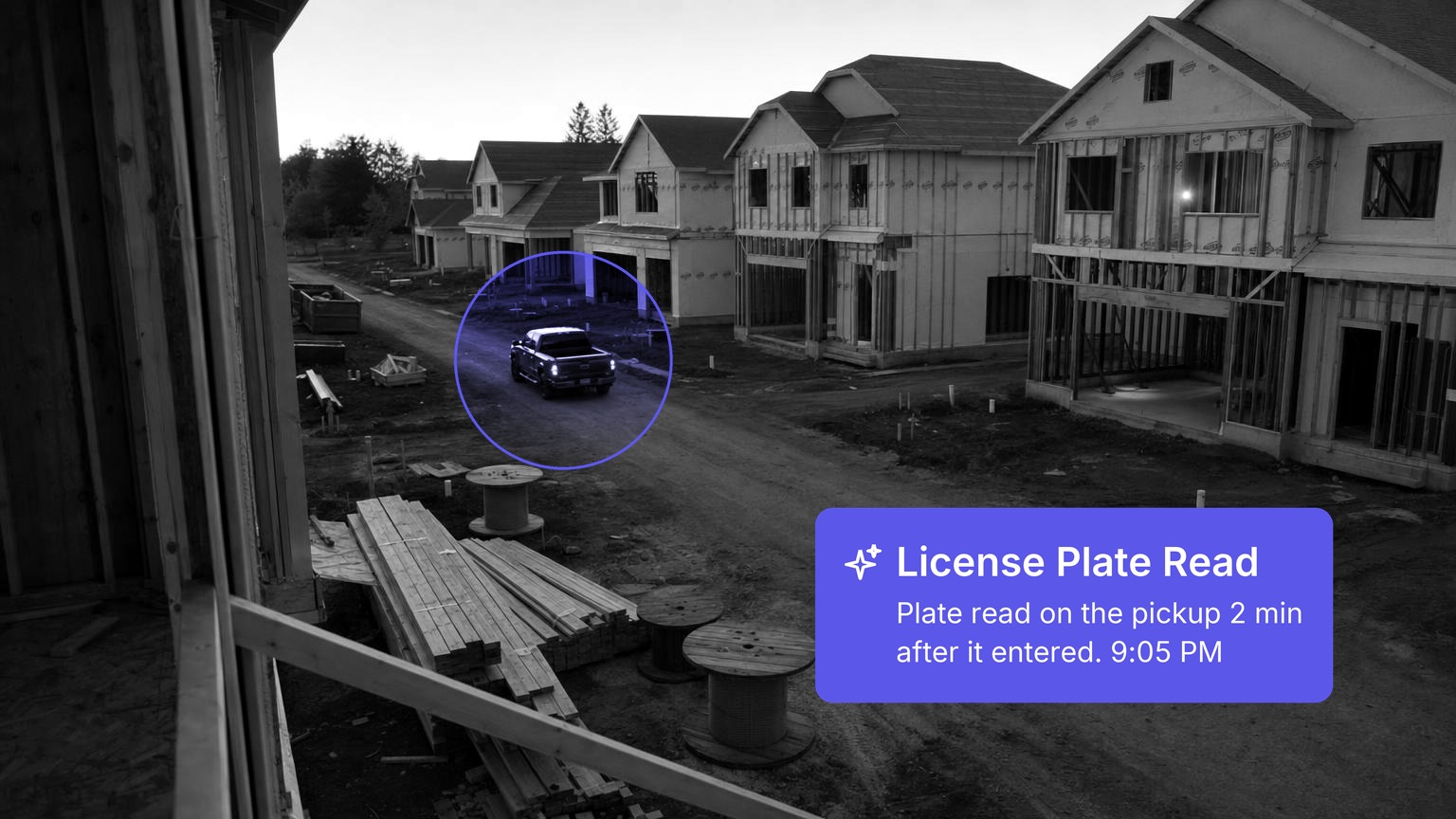
- A top-10 homebuilder captured a serial copper thief and the vehicle plate within about two minutes, which helped law enforcement apprehend a suspect.
- A top-five North American EV charging network cut copper-theft incidents by about 80 percent using autonomous deterrence, with no human monitoring.
- Storage Asset Management stopped perimeter break-ins entirely at a previously targeted facility after adding automated after-hours alerts.
The common thread is speed. When a strobe, siren, or talk-down triggers within seconds of an intruder entering a laydown yard, most walk away before anything is cut or loaded. That is deterrence you can measure, and it is why active video AI reduces incidents rather than simply recording them. For a deeper look at how real-time detection and response works on outdoor perimeters, Spot AI documents the detect, secure, and deter workflow in detail.
Solar, cellular, and off-grid coverage for remote sites
Early-stage and remote jobsites rarely have reliable power or wired internet, so connectivity decides what is even possible. The right mix depends on how permanent the site is and how much bandwidth is available. Common options are:
Connectivity option |
Best for |
Trade-offs |
|---|---|---|
Wired power over Ethernet (PoE) |
Established sites with power and cabling in place |
Most reliable, but trenching and cabling add cost and time |
WiFi |
Trailer offices and areas with an access point nearby |
Flexible placement, but range and interference vary on active sites |
Cellular (LTE or 5G) |
Temporary and moving sites with carrier coverage |
Quick to deploy, but data plans and signal strength matter |
Solar plus cellular |
Perimeter, laydown yards, and early groundwork with no power |
Self-powered and mobile, but coverage per unit is limited by placement |
Satellite back-haul (Starlink) |
Truly off-grid or rural sites beyond cellular range |
Connects almost anywhere, with a higher per-site equipment cost |
Edge-first architecture is what makes these options workable. Because the IVR keeps full-resolution video on site and sends only metadata across the network, a solar and cellular unit does not have to stream raw video to stay useful. Cameras on poles, walls, and security trailers can cover outdoor zones, and Starlink back-haul keeps remote sites online. One building-materials maker running about 1,000 sites put this to work by having Spot AI run on its existing cameras over RTSP and Starlink, with zero cameras replaced.
Safety and OSHA compliance on the jobsite
Security is only half the value. The same video layer supports safety, where the exposure is severe. Fall protection was OSHA's most frequently cited standard in fiscal year 2024, and construction-specific standards such as ladders, scaffolding, and fall protection training also ranked in the agency's top 10 (Source: OSHA). Video AI can flag missing PPE, watch no-go zones around equipment and trenches, and surface possible falls or high-risk events for review, then route an alert to the right person.
Used this way, video AI analytics give safety leaders a set of extra eyes that never look away, so hazards get flagged as they arise instead of surfacing in a Monday-morning investigation. The goal is to reduce incidents and coach safer habits, not to watch workers.
Key terms
- VMS (video management system): the software that records, manages, and lets teams review video from many cameras in one place.
- ONVIF: an open standard that lets cameras and software from different makers work together, which is what makes a platform camera-agnostic.
- Hybrid edge-to-cloud: an architecture that processes video on site and load-balances heavier work to the cloud, so only metadata crosses the network.
- IVR (Intelligent Video Recorder): Spot AI's on-site recorder that keeps full-resolution video in the facility while running edge AI.
Integrations that fit a construction workflow
A jobsite video platform earns its keep when it plugs into the tools a project team already runs. Open APIs and webhooks let a cloud VMS feed events into project management and field tools, so an alert can open a task or attach evidence to a record. Look for connections to Procore and BuilderTrend, BIM workflows, and access control, plus role-based access and audit trails that keep evidence organized and shareable with insurers, subcontractors, and law enforcement.
"[Spot AI] gives us the visibility and real-time insights needed to uphold the highest standards of safety and efficiency… we are redefining how we create safer, more streamlined environments and manage project oversight."
Safety Director, AECOM Hunt
How to choose the right platform for your sites
The best fit depends on the mix of sites you run and how you want to operate them. Work through these steps in order:
- Map your site types. Separate permanent multi-phase builds from short-duration jobs, laydown yards, and remote groundwork, because each favors different cameras and retention.
- Check camera reuse. Confirm whether the platform is camera-agnostic over ONVIF so you can use the cameras already installed and avoid rip-and-replace.
- Solve connectivity. Decide where you need wired, WiFi, cellular, solar, or satellite back-haul before you pick hardware.
- Weigh the AI. Ask whether the platform only detects, or whether it also deters in real time and packages case-ready evidence.
- Confirm integrations. Verify connections to Procore, BuilderTrend, BIM, and access control so alerts land in your existing workflow.
- Set retention and compliance needs. Match evidence retention, NDAA, and SOC 2 requirements to your insurers and owners.
Choosing a cloud VMS for your construction sites is about protecting your people, your assets, and your schedule, not just adding cameras. The strongest options combine camera-agnostic deployment, video AI that acts in the moment, and connectivity that reaches remote ground. If you want to cut losses, support safer sites, and keep projects moving, Spot AI is built to help your field teams without adding load for IT. Explore proof across industries in the Spot AI customer stories, including multi-site theft deterrence. Book a demo at try.spot.ai/contact and see how quickly it goes live on your existing cameras.
Frequently asked questions
What is a cloud VMS for construction sites?
A cloud video management system is software that records, manages, and lets teams review video from many jobsite cameras in one place, with remote access from any device. On construction sites, it centralizes footage across trailers, perimeters, and multiple projects. The most capable options add video AI that detects events, sends real-time alerts, and organizes case-ready evidence.
Can I use my existing jobsite cameras with a cloud VMS?
Often yes. Camera-agnostic platforms such as Spot AI work with the cameras a site already owns over ONVIF, so there is no rip-and-replace. Some vendors run their full analytics only on their own hardware, so confirm ONVIF and RTSP support before you commit.
How do cloud VMS platforms secure remote or off-grid construction sites?
They combine mobile form factors with flexible connectivity. Solar-powered units with cellular data cover sites without power, and satellite back-haul such as Starlink reaches truly off-grid ground. An edge-first design helps here, because keeping full-resolution video on site means a unit sends only lightweight metadata over the network.
How does video AI improve jobsite safety and OSHA compliance?
Video AI can flag missing PPE, watch no-go zones around equipment and trenches, and surface possible falls or high-risk events, then route an alert to the right person. That helps safety leaders catch hazards as they arise rather than after an incident. It supports OSHA-focused programs by documenting conditions and speeding review, with the aim of reducing incidents.
How fast can a cloud VMS go live on an active construction site?
It depends on the platform and the camera approach. Camera-agnostic systems that reuse existing ONVIF cameras can go live in days, since there is no cabling overhaul or long calibration cycle. Deployments that require new proprietary hardware or complex network setup usually take one to three weeks.
About the author
Amrish Kapoor is VP of Engineering at Spot AI, leading platform and product engineering teams that build the scalable edge-cloud and AI infrastructure behind Spot AI’s video AI, powering operations, safety, and security use cases.

