






Recurring safety violations on a construction site are a clear signal of systemic gaps in a safety program. Despite countless hours spent on site walks, training sessions, and incident investigations, the same unsafe behaviors and conditions often reappear, creating a cycle of reactive management. This perpetual firefighting is a significant roadblock to minimizing incident risk over time and pulls focus from forward-looking safety initiatives. For safety leaders, the frustration is immense: spending days reviewing footage after an incident, struggling to maintain consistent standards across multiple sites, and being held liable for subcontractor non-compliance.
Traditional methods of manual observation and periodic inspection simply cannot keep pace with the dynamic nature of a construction site. Violations happen in the moments between walkthroughs, leaving organizations exposed to regulatory penalties, increased insurance premiums, and, most importantly, avoidable worker injuries. This report explores how modern video analytics platforms move beyond passive recording to actively minimize the recurrence of safety violations, using existing cameras to provide AI-powered monitoring that provides the continuous, objective data needed to build a truly proactive safety culture.
The ongoing challenge of recurring safety violations
For safety professionals in the construction industry, the daily reality is a constant battle against recurring risks. Traditional safety management is often a reactive process, where teams respond to incidents after they occur rather than mitigating them. This creates a perpetual cycle of investigation and response that fails to address the root causes of why violations happen in the first place.
The core frustrations are deeply felt across the industry:
- The high demands of manual compliance monitoring: safety leaders spend hours performing site walks to check for personal protective equipment (PPE) compliance and adherence to safety protocols. Yet, they still miss violations that occur between inspections, leading to avoidable incidents and costly Occupational Safety and Health Administration (OSHA) citations.
- Hurdles in multi-site oversight: maintaining consistent safety standards and real-time visibility across multiple, geographically dispersed construction sites is a substantial hurdle. This lack of a unified view increases the risk of undetected violations and regulatory exposure.
- Accountability for subcontractor safety: ensuring dozens of subcontractors—each with varying safety cultures and training levels—comply with site-specific protocols is a major hurdle. The primary contractor is often held liable for these third-party violations.
- The time drain of incident investigations: following an incident, safety managers can spend days sifting through hours of video footage to prepare OSHA reports, understand root causes, and defend against fraudulent claims. This pulls valuable time and resources away from proactive safety work.
These difficulties are compounded by the high stakes of non-compliance. In fiscal year 2023, fall protection was the most frequently cited OSHA standard, with 7,271 recorded violations (Source: OSHA). Each repeat violation not only increases the risk of serious injury but also invites higher penalties, which can exceed $160,000 for a single offense (Source: Fisher Phillips).
How video analytics shifts safety monitoring from reactive to proactive
Video analytics can shift practices from passive video recording to an intelligent, automated system that analyzes visual data to identify specific events, behaviors, and conditions. For construction safety, this technology uses existing cameras to provide proactive monitoring and alerts.
The architecture of these systems is designed for the demanding construction environment. It starts with image capture from existing or new cameras, which can include standard or infrared models to ensure coverage in all conditions. The video streams are then analyzed in real time.
This is where computer vision, a field of artificial intelligence, comes into play. Using machine learning models, the system can identify specific objects, people, and actions. These models are trained on vast datasets to recognize safety-critical events, such as:
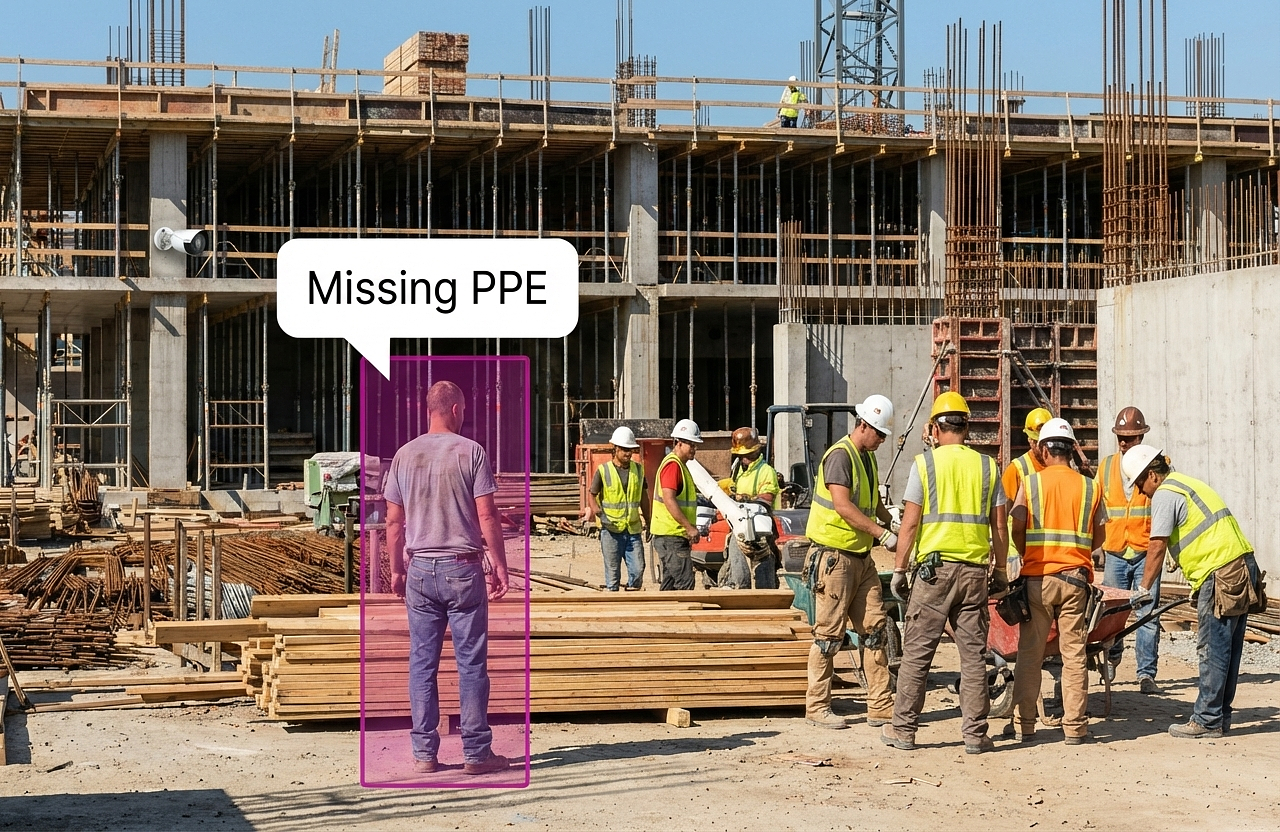
- Missing PPE: detecting if a worker is without a hard hat, safety vest, or other required gear.
- Hazardous zone entry: identifying when a person or vehicle enters a restricted or dangerous area, like an active excavation or the swing radius of a crane.
- Unsafe behaviors: recognizing actions like running, which can be a proxy for unsafe behavior that often precedes falls or other incidents.
When the system detects a potential violation, it sends a real-time alert to supervisors, so they can respond quickly on-site. This transforms safety management from a reactive, after-the-fact process to a proactive one.
A modern approach to breaking the cycle of recurring violations
A unified video AI platform offers a direct solution to the core frustrations of safety leaders by providing the tools to move from reactive enforcement to proactive risk mitigation. By integrating with existing camera systems, these platforms deliver advanced analytics without requiring a complete hardware overhaul.
| Capability | Traditional Safety Monitoring | Spot AI Video Analytics |
|---|---|---|
| Coverage | Intermittent; relies on manual site walks | Continuous; 24/7 automated monitoring of key areas |
| Detection | Reactive; violations found after they occur | Proactive; real-time alerts as violations happen |
| Data | Subjective; relies on manual notes and memory | Objective; time-stamped video evidence for detected events |
| Oversight | Siloed; difficult to manage multiple sites consistently | Centralized; unified dashboard for all sites, accessible anywhere |
| Investigation | Manual; hours or days spent reviewing footage | Automated; search for events in seconds with natural language |
1. Automate compliance monitoring to ease manual workloads
Instead of relying solely on periodic site walks, video analytics automates the process of checking for compliance. For example, Spot AI’s Missing PPE detection can be configured to monitor entry points to high-hazard zones. If a worker attempts to enter an area without a hard hat, the system can send an on-the-spot alert to a supervisor. This allows for coaching and helps minimize the worker’s exposure to risk. Contractors using this type of automated monitoring see a sharp decrease in PPE violations as workers quickly learn that non-compliance is detected quickly.
2. Shift from reactive responses to proactive interventions
The ultimate goal is to identify hazards before they lead to incidents. Video analytics makes this possible by detecting leading indicators of risk. Spot AI’s AI Agents can be configured to monitor for:
- Person enters no-go zones: keep unauthorized personnel out of dangerous areas like demolition zones or spaces with active heavy machinery.
- Vehicle enters no-go zones: enforce strict vehicle routing to minimize the risk of struck-by incidents, one of the leading causes of construction fatalities.
By getting ahead of these events, safety teams can intervene earlier to address the issue, fundamentally breaking the cycle of reactive management.
3. Gain unified visibility and consistent oversight across all projects
Managing safety across multiple job sites is a logistical hurdle. A cloud-based video AI platform provides a single dashboard for real-time visibility into covered locations. From one interface, a safety director can monitor multiple projects, receive prioritized alerts from all sites, and deploy resources where they are needed most. This centralized approach ensures that safety standards are applied consistently, regardless of the project manager or physical location, reducing the risk of violations slipping through the cracks.
4. Drive subcontractor accountability with objective evidence
Holding subcontractors accountable for safety compliance is simplified with video analytics. When a violation occurs, the system automatically creates a time-stamped video record of the event. This objective evidence can help resolve disputes more quickly and provides clear documentation for safety discussions, training reinforcement, or contractual enforcement. Whether it’s a subcontractor’s employee entering a restricted area or failing to wear proper PPE, the video clip provides verified, time-stamped video evidence, making it easier to enforce safety protocols consistently across all trades on site.
5. Accelerate incident investigations from days to minutes
When an incident does occur, the investigation process is significantly streamlined. Instead of manually scrubbing through hours of footage from multiple cameras, safety managers can use intelligent search. With a platform like Spot AI, a simple search query like "show me all people without hard hats in Zone B yesterday" quickly brings up the relevant video clips. This capability can significantly accelerate investigation time, freeing up safety professionals to focus on what matters most: averting the next incident.
From data to decisions: measuring the impact of video analytics
The success of a video analytics program is measured by improvements in both leading and lagging safety indicators.
- Leading indicators: these are proactive measures that show your safety program is working. With video analytics, you can track metrics like PPE compliance rates, the number of high-risk events detected, and the frequency of hazard-zone violations. An initial spike in detected violations is common and is a positive sign of increased visibility, not a failing program.
- Lagging indicators: these are the traditional reactive metrics, such as Total Recordable Incident Rate (TRIR) and Lost-Time Injury Frequency Rate (LTIFR). Over time, as proactive interventions take root, organizations typically see a marked improvement in these lagging indicators. For example, some policyholders have cut their number of claims by 50% or more after adopting wearable tech and monitoring systems (Source: Missouri Employers Mutual).
The return on investment (ROI) extends beyond safety metrics. It includes direct cost savings from fewer incidents, reduced workers' compensation claims, and avoided OSHA fines. Indirect benefits include potentially lower insurance premiums, improved bid competitiveness, and less time spent on costly investigations.
Build a proactive safety program with video AI
Moving from a reactive safety posture to a proactive one is essential for breaking the cycle of recurring violations. Video AI provides the continuous monitoring, real-time alerts, and objective data needed to identify risks early, intervene effectively, and drive lasting behavioral change. By augmenting your team with AI-powered insights, you can create a safer, more compliant, and more efficient construction environment.
Want to see Spot AI in action? Book a demo to explore how video AI can help you minimize recurring safety violations and strengthen your safety program using your existing cameras.
Frequently asked questions
How can technology help minimize safety violations?
Technology like AI-powered video analytics helps minimize safety violations by providing continuous, automated monitoring of job sites. It can detect issues like missing PPE or entry into hazardous zones in real-time, sending alerts to supervisors who can respond quickly on-site. This moves safety management from a reactive to a proactive model.
What are the best practices for using video analytics in safety?
Best practices include starting with clear objectives, focusing on high-risk areas first, and using a phased implementation approach. It is also critical to ensure transparent communication with the workforce to build trust, establish clear governance for data access and response protocols, and continuously review system performance to optimize accuracy and minimize alert fatigue.
How do AI-driven solutions improve workplace safety?
AI-driven solutions analyze video feeds to identify unsafe conditions and behaviors that the human eye might miss. They can detect and surface patterns about where violations are occurring more often, enabling targeted interventions. This data-driven approach helps organizations address the root causes of incidents rather than just the symptoms, leading to a more sustainable safety culture.
What are the compliance requirements for construction safety?
Construction safety is heavily regulated by OSHA under standard 29 CFR 1926. Key requirements cover fall protection, hazard communication, scaffolding, electrical safety, and PPE. Video analytics helps document compliance with these standards by creating an objective, time-stamped record of site activities, which is invaluable during audits or investigations.
How can organizations curb recurring safety incidents?
Curbing recurring incidents requires understanding their root causes. Video analytics provides the data to identify patterns—do violations happen at a certain time of day, with a specific crew, or under particular conditions? By analyzing this long-term data, organizations can implement systemic changes to training, procedures, or the work environment that address the underlying issues and break the cycle of recurrence.
What should you look for in a video AI monitoring system for safety?
A top-tier system should use your existing cameras to provide proactive monitoring and alerts. Look for the ability to deliver real-time, configurable alerts for issues like missing PPE or no-go zone entry. It must provide a unified dashboard for visibility across all your sites and integrate with your current camera hardware to manage costs. Finally, an intelligent search function is critical, allowing you to find specific incident footage faster to accelerate investigations and reporting.
About the author
Tomas Rencoret leads the Growth Marketing team at Spot AI, where he helps safety and operations teams use video AI to minimize safety and security incidents and improve productivity.

