




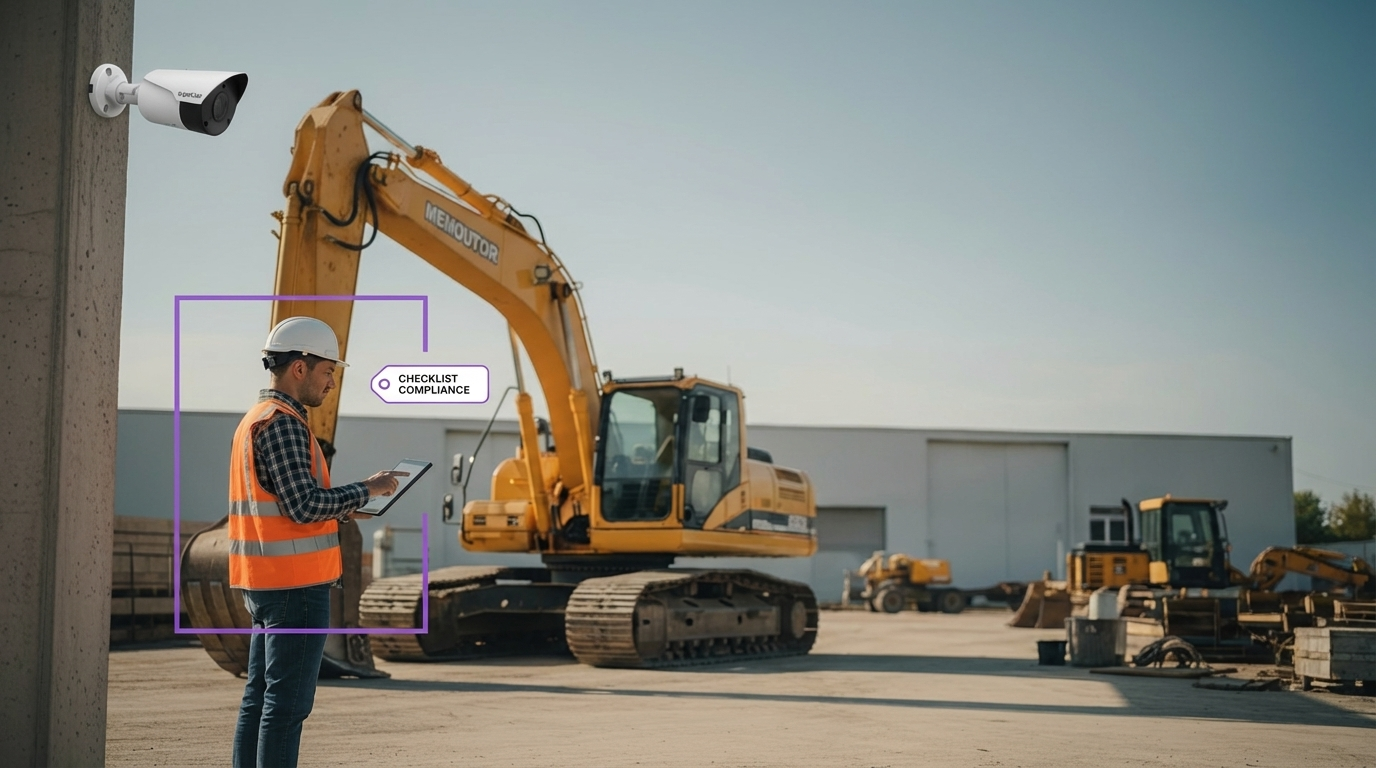


Every production supervisor knows the feeling: You are responsible for the output and safety of four different lines, but you can only physically stand in front of one at a time. While you are troubleshooting a bottleneck on Line A, a changeover on Line C is drifting ten minutes over schedule, and you have a sinking suspicion that the night shift skipped the required equipment calibration steps because the logs were filled out in perfect, identical handwriting at the end of the shift.
This is the reality of checklist process compliance in modern manufacturing. You are tasked with enforcing strict Standard Operating Procedures (SOPs), ensuring GMP compliance, and hitting aggressive throughput targets, often with tools that haven't evolved much since the 1990s.
Paper checklists and manual data entry leave significant blind spots, and by the time you find a missing signature or a quality defect, the issue may already have affected output.
Video AI can help change this dynamic. By analyzing feeds from existing cameras, manufacturers can assist with manufacturing checklist compliance, helping teams follow critical steps even when a supervisor isn't watching. This guide explores how to move from reactive reviews to proactive process compliance using video analytics.
Key terms to know
Video AI: a technology that uses computer vision to analyze video feeds in real-time, detecting specific behaviors, objects, or anomalies without human intervention.
Standard Operating Procedures (SOPs): detailed, written instructions to achieve uniformity of the performance of a specific function.
Good Manufacturing Practice (GMP): a system for ensuring that products are consistently produced and controlled according to quality standards.
First Pass Yield (FPY): the percentage of products that are manufactured correctly the first time without rework.
Spot AI: a video AI platform that connects to any camera to provide real-time insights for operations, safety, and security.
The operational reality: why manual checklists fail
For a production supervisor, the gap between what is written in an SOP and what happens on the factory floor is often the source of daily stress. Compliance frameworks operate on three levels: regulatory requirements (like FDA or OSHA), internal SOPs, and customer specifications.
However, relying on manual verification creates substantial operational risks.
The cost of human error and blind spots
Human factors research shows that manual data entry generates error rates of 1 to 3 percent, with verification failures occurring in 2 to 5 percent of documents despite review procedures (Source: Lean Learning Collective). In a high-volume facility, these small percentages can create significant risks and costs.
The core frustrations for supervisors often include:
Blind spots during off-shifts: you cannot monitor 2nd and 3rd shifts effectively, leading to anxiety about safety violations or skipped steps happening in the dark.
Reactive incident response: traditional camera systems are passive. You only review footage after an incident, which means you are investigating a problem rather than preventing it.
Excessive administrative load: supervisors spend hours reviewing footage for investigations or gathering data for audits instead of coaching their teams.
Inconsistent SOP adherence: workers may cut corners when unsupervised, creating variability in product quality.
The documentation silo
When auditors arrive, the "documentation silo" creates major challenges. Records are scattered across paper logs, spreadsheets, and disconnected software. An organization with over 100 employees can incur annual costs of $430,000 to $850,000 due to errors and productivity losses associated with manual document processing (Source: Lean Learning Collective).
How video AI transforms process compliance
Video AI for process compliance provides continuous monitoring support. While it doesn’t tire or get distracted, it can help document critical actions with objective, time-stamped evidence.
Unlike traditional systems that just record footage, an AI camera for process verification understands what it sees. It can distinguish between a worker properly wearing PPE and one who isn't, or identify when a forklift enters a restricted zone.
Mapping pain points to Spot AI solutions
Supervisor pain point | Spot AI solution | Operational outcome |
|---|---|---|
Blind spots during off-shifts | Real-time alerts for operational anomalies and safety violations sent directly to mobile devices. | Real-time awareness of issues on 2nd/3rd shifts without being physically present. |
Reactive incident response | Early detection of hazards like "Person Enters No-go Zones" or "Forklift in Pedestrian Area." | Ability to intervene via two-way audio or dispatch team leads quickly. |
Excessive admin load | Smart search functionality that finds specific events in seconds, not hours. | Shortens investigation time and frees supervisors for floor management. |
Inconsistent SOP adherence | Automated monitoring for behaviors like "Unattended Workstation" or "Running." | Consistent product quality and data-driven coaching based on visual evidence. |
Lack of data for root cause | Video-verified reporting that categorizes all detected events. | Clear evidence to identify if a defect was caused by equipment failure or procedure deviation. |
A practical guide to implementation
Implementing checklist process compliance with video AI does not require ripping out your existing infrastructure. Modern platforms like Spot AI are camera-agnostic and can be deployed in days.
Phase 1: assessment and baseline establishment
Before turning on the AI, you must identify where your compliance risks are highest.
Identify critical control points: look for procedures where failure leads to scrap, rework, or safety incidents.
Review audit findings: analyze past regulatory observations to find patterns in compliance failures.
Establish baseline metrics: record current First Pass Yield (FPY) and SOP adherence rates. For example, manual transcription typically has an error rate of 1-3% (Source: Lean Learning Collective).
Phase 2: pilot with high-impact procedures
Start with one or two workflows to evaluate impact. Select the areas that cause the most headaches.
Safety compliance: deploy video AI for worker safety compliance by tracking "Missing PPE" (vests, hard hats) or "Forklift Enters No-go Zones."
Changeover optimization: monitor the "Changeover" process to ensure steps are followed sequentially and efficiently, aiming to meet SMED targets.
Configure alerts: set up the system to notify supervisors only for confirmed deviations to avoid alert fatigue.
Phase 3: process integration and workflow
Video AI should not be a standalone tool; it must integrate with your daily rhythm.
Automate documentation: use the system to generate a visual audit trail. Instead of a signature on a clipboard, you have a time-stamped video clip of the procedure being executed.
Shift handovers: use the dashboard to review process compliance KPIs for production supervisors during shift changes. Show the incoming lead exactly where issues occurred.
Coaching, not punishment: use the footage to train staff. Show an operator the difference between a compliant procedure and a deviation.
Phase 4: scaling to facility-wide monitoring
Once the pilot proves successful, expand to other lines.
Standardize across shifts: ensure the night shift follows the same manufacturing checklist compliance standards as the day shift.
Tiered alerts: configure critical safety alerts to trigger real-time notifications, while efficiency metrics (e.g., "Unattended Workstation") populate a daily report.
Real-world impact: case studies in compliance
The shift from manual to automated process compliance can deliver measurable improvements.
1. pharmaceutical manufacturer: reducing documentation time
A mid-size pharmaceutical company struggled with inconsistent compliance documentation across nine operational contexts (three lines, three shifts). Supervisors spent over 25% of their time on paperwork (Source: Lean Learning Collective).
Result: After implementing video AI for critical process verification, documentation time decreased by approximately 40%, and documentation completeness improved significantly (Source: Lean Learning Collective).
2. electronics manufacturer: improving First Pass Yield
An electronics manufacturer faced a First Pass Yield of 91%, meaning 9% of assemblies required rework.
Result: By using AI video analytics for factories to verify assembly steps in real-time, FPY improved to 96.2%. Rework time decreased by 35% as defects were caught without delay (Source: Roboflow).
3. food manufacturing: ensuring sanitation compliance
A food production facility faced recurring audit findings regarding cleanliness, despite logs showing procedures were complete.
Result: Video monitoring revealed cleaning steps were abbreviated during high-volume runs. After addressing this with data-backed scheduling changes, cleaning procedure adherence increased to over 97% (Source: Spot AI).
Comparing video AI solutions for manufacturing
When selecting a partner for improving checklist compliance with AI, look for deployment speed and ease of use.
Feature | Spot AI | Legacy monitoring systems | Generic AI analytics |
|---|---|---|---|
Deployment Speed | Plug-and-play (minutes) | Weeks to months | Varies, often complex |
Hardware Flexibility | Works with existing cameras | Requires proprietary hardware | Often requires specific cameras |
Scalability | Supports many users and locations | Limited by local NVR storage | Per-camera licensing costs |
Search Capability | Fast, intuitive smart search | Manual scrubbing (hours) | Limited metadata search |
Network Impact | Hybrid Cloud (Low Bandwidth) | High bandwidth usage | High bandwidth usage |
Gain Control Over Your Production Floor
For the production supervisor, the goal is not to work harder but to have better visibility. Checklist process compliance is no longer about chasing signatures or hoping the night shift followed protocol. It is about leveraging video AI for process compliance to create a transparent, efficient, and safe production environment.
By automating the verification of SOPs and safety protocols, you can minimize administrative work and gain the insights needed to improve day-to-day operations. The technology helps your cameras provide actionable, insight-driven visibility on the floor.
Want to see how video AI can help standardize shifts and streamline compliance? Request a Spot AI demo to experience the platform in action.
Frequently asked questions
What are the best practices for ensuring compliance in manufacturing?
The best practices involve moving from reactive verification to proactive monitoring. This includes digitizing SOPs, utilizing video analytics for checklist adherence, and establishing a culture where data is used for coaching rather than punishment.
How can AI improve compliance processes?
AI improves compliance by providing ongoing, consistent monitoring. It helps reduce the "pencil-whipping" of paper logs and provides real-time alerts for process non-compliance, helping teams correct issues quickly rather than discovering them during an audit.
What are the common hurdles in manufacturing compliance?
Common hurdles include human error in data entry (1-3% error rates), lack of visibility into off-shift operations, inconsistent training across teams, and the immense time cost of manual documentation (Source: Lean Learning Collective).
How do video analytics enhance checklist adherence?
Video analytics enhance adherence by verifying that physical actions match the checklist requirements. For example, if a checklist requires a "visual inspection of the die," video AI can verify that the operator was present at the station for the required duration.
What technologies are available for compliance tracking?
Beyond manual logs, technologies include Manufacturing Execution Systems (MES), Quality Management Systems (QMS), and now, Video AI platforms like Spot AI that visually verify the data entering these systems.
About the author
Sud Bhatija is COO and Co-founder at Spot AI, where he scales operations and GTM strategy to deliver video AI that helps operations, safety, and security teams boost productivity and reduce incidents across industries.






.png)
.png)
.png)