






Standard Operating Procedures (SOPs) are the operational backbone of any successful construction project. They define how work gets done, upholding safety compliance, quality consistency, and schedule adherence. Yet, for Construction Project Managers overseeing multiple multi-acre sites and diverse subcontractor teams, verifying these procedures are actually followed is an ongoing roadblock.
You cannot be at twenty sites at once. When you are not on-site, are safety protocols being followed? Is the sequencing of trades correct? Are quality checks happening before walls are closed up? The inability to physically monitor every subcontractor leads to rework, safety incidents, and disputes that erode profit margins.
Video AI technology has emerged as a practical solution to this visibility gap. By using existing cameras with AI to assist monitoring, construction leaders can automate the detection of SOP deviations and gain the objective evidence needed to hold subcontractors accountable.
Key terms to know
Before discussing implementation, it is helpful to clarify how specific terms apply to the construction environment.
- Standard Operating Procedures (SOPs): Detailed, step-by-step instructions that define how specific tasks—such as concrete curing, scaffolding setup, or PPE usage—must be performed to maintain consistency and safety.
- Video AI: A technology that uses computer vision algorithms to analyze video feeds in real time, detecting specific behaviors or conditions (like a worker entering a no-go zone) without human intervention.
- Computer Vision: The specific capability that allows a computer to "see" and interpret visual data, distinguishing between a person, a forklift, or a material delivery.
- Rework: Work that must be redone due to non-compliance with plans or quality standards, often caused by failure to follow SOPs.
The high cost of SOP non-compliance
For project managers, SOP adherence is not just about paperwork; it is about protecting the project's bottom line and schedule. Non-compliance has direct, measurable impacts on the KPIs that define project success.
Financial impact of rework
Rework accounts for 5% to 10% of total project costs on average. However, companies that enforce consistent quality assurance processes—essentially, strict SOP adherence—can keep rework costs under 5%, whereas those without standardized procedures often see much higher costs (Source: PlanRadar). When a subcontractor skips a waterproofing step or fails to follow concrete pouring protocols, the cost is not just the material; it is the schedule delay and the ripple effect on subsequent trades.
Safety and liability risks
Safety SOPs establish the guardrails that guard against accidents. A single failure to follow fall protection procedures or equipment operation protocols can lead to OSHA violations, which carry penalties of over $14,500 per instance (Source: BLR). Beyond fines, incidents drive up your Experience Modification Rate (EMR), increasing insurance premiums and potentially disqualifying your firm from bidding on future projects (Source: OHS).
Dispute resolution and charge-backs
One of the core frustrations for project managers is inadequate evidence for charge-backs. When damage occurs or materials go missing, disputes often devolve into "he-said, she-said" arguments. Without objective proof that a specific subcontractor deviated from the agreed-upon SOPs, managers struggle to recover costs, directly impacting the Cost Performance Index (CPI).
Roadblocks to maintaining subcontractor adherence
Managing subcontractor performance across dispersed sites creates specific operational hurdles that traditional monitoring cannot overcome.
1. Lack of real-time visibility
Project managers waste hours driving between job sites for inspections. This sporadic physical presence means that compliance is often only verified during the brief window a manager is on-site. Subcontractors may follow procedures strictly while being observed, only to revert to non-compliant practices once the manager leaves.
2. Inconsistent enforcement
Different subcontractors bring different operational cultures to the jobsite. Managing the complex choreography of electrical, plumbing, and framing crews requires ensuring that all parties adhere to the same master SOPs. Manual supervision is subject to human error and fatigue; a safety deviation noted by one superintendent might be overlooked by another, leading to mixed messages and inconsistent enforcement.
3. Documentation gaps
When OSHA inspectors or owner representatives request proof of compliance, scrambling to find daily logs or photos is inefficient. Traditional documentation is often fragmented and incomplete. If a defect claim arises years later, the lack of timestamped evidence proving that SOPs were followed can leave the general contractor liable.
How video AI transforms SOP monitoring
Video AI helps teams shift from reviewing incidents after the fact to monitoring configured conditions as they occur. Instead of reviewing footage only after an incident, video AI agents monitor for defined events and can send alerts when deviations are detected.
Mapping project manager pain points to Spot AI solutions
| Pain Point | Spot AI Capability | Operational Outcome |
|---|---|---|
| Lack of real-time visibility | Cloud-based dashboard with remote access | Monitor 20+ sites from a single office; zoom in to verify progress without driving. |
| Manual safety observation | Automated PPE and No-Go Zone detection | Receive alerts for safety violations in near real time; can help lower TRIR and insurance risk depending on configuration and site practices. |
| Inadequate dispute evidence | Timestamped, searchable video clips | Quickly export proof of damage or non-compliance for charge-backs. |
| Reactive security | AI agents for perimeter and intrusion detection | Detect unauthorized access or loitering in real time, deterring theft. |
| Blind spots in tracking | Intelligent Video Recorder with easy search | Locate equipment or verify material delivery in seconds, not hours. |
Automating detection of violations
Video AI systems use pre-trained models to identify specific scenarios. For example, the system can be configured to identify if a worker enters a hazardous "no-go zone" around active heavy machinery. If a deviation occurs, the system logs the event and sends an alert, allowing the site superintendent to intervene promptly when notified.
Creating an objective audit trail
Every detected event is timestamped and indexed. This creates a verified record of site activities. If a subcontractor claims they followed the material handling SOP, you can pull the specific video clip in seconds to verify. This capability helps ground discussions in documented facts, supporting clearer resolution and protecting working relationships and margins.
Top use cases for monitoring subcontractor SOPs
Implementing video AI allows you to target specific areas of non-compliance that threaten project success.
1. Safety protocol enforcement
Safety is the most direct application for video AI.
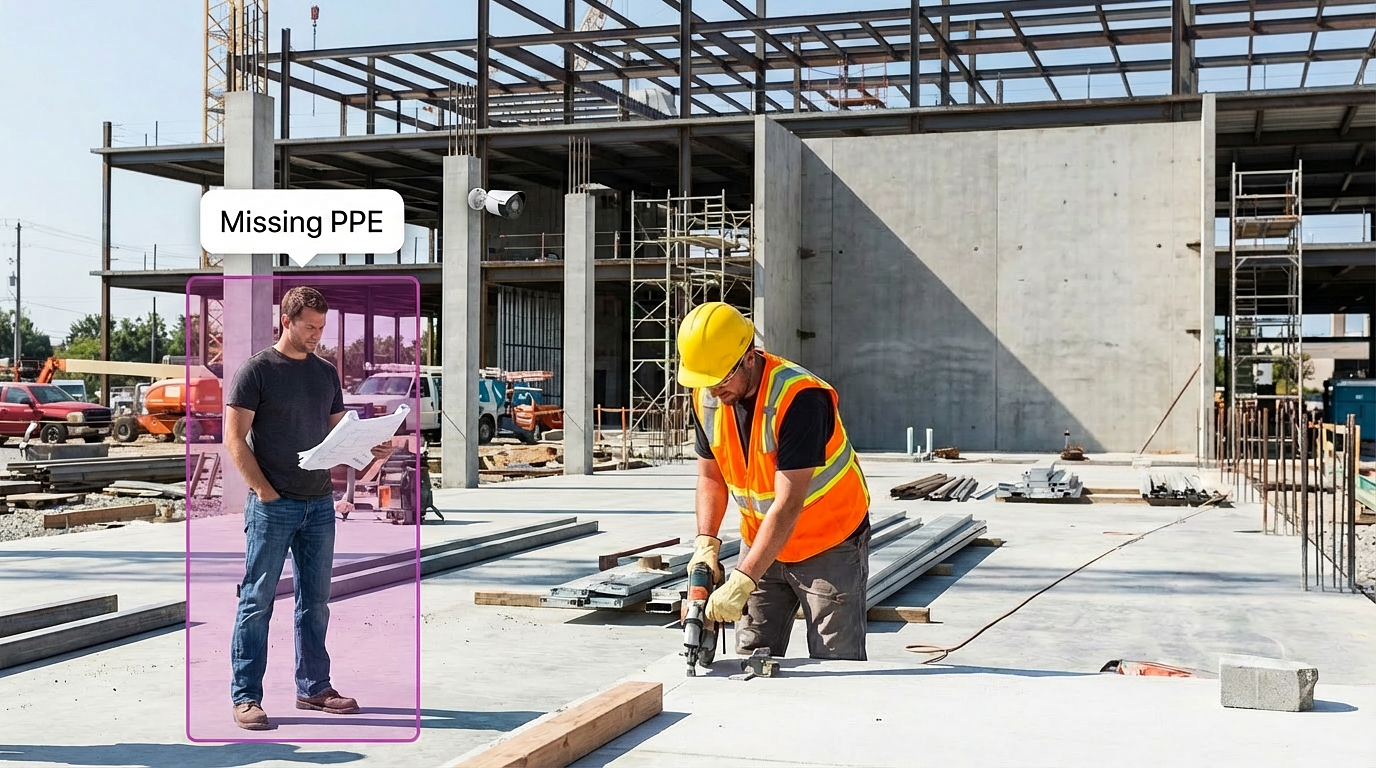
- PPE Compliance: Automatically identify when workers in specific zones are not wearing required hard hats or high-visibility vests. This ensures consistent adherence to safety standards without requiring constant manual checks.
- No-Go Zones: Define virtual perimeters around open excavations, crane swing radiuses, or electrical hazards. If a subcontractor's crew member crosses into these dangerous areas, an alert is triggered, mitigating potential accidents.
- Fall Protection: Observe elevated work areas to verify that workers are present only when appropriate safeguards are visible, helping to mitigate one of the industry's leading causes of injury.
2. Quality and sequencing verification
Video AI supports quality assurance by providing visual verification of work progress.
- Visualizing Progress: Verify that work is proceeding according to the schedule. You can visually confirm if the framing is complete before the electrical sub begins, maintaining the correct sequencing of trades.
- Idle Time Reduction: Identify equipment or crews that are standing idle. This data helps you optimize resource allocation and identify bottlenecks where one subcontractor is holding up another.
3. Site logistics and access control
Managing the flow of materials and people is critical for site efficiency.
- Delivery Verification: Use video evidence to verify that materials were delivered to the correct laydown area and handled according to SOPs, guarding against damage and loss.
- Unauthorized Access: Spot if subcontractors are accessing the site outside of approved hours, which can lead to unsupervised work and increased liability.
Comparison of video analytics solutions
When selecting a tool to track SOP adherence, it is essential to choose a platform that fits the dynamic nature of construction.
| Feature | Spot AI | Traditional Monitoring Systems | Legacy Enterprise VMS |
|---|---|---|---|
| Deployment Speed | Quick to set up; typically live quickly | Slow; requires complex cabling | Weeks to months |
| Hardware Flexibility | Works with most ONVIF-compliant IP cameras | Proprietary cameras only | Often requires specific hardware |
| Remote Access | Cloud-native dashboard (mobile/web) | Limited or requires VPN | Complex remote configuration |
| AI Capabilities | Built-in AI Agents (PPE, Zones) | None or basic motion only | Expensive add-on licenses |
| Searchability | Google-like search for events | Manual scrubbing (rewind/fast-forward) | Varies by vendor |
Spot AI is well-suited for construction environments because it can use many existing cameras. You can deploy the Intelligent Video Recorder to connect site cameras and begin collecting usable video data quickly.
Best practices for implementation
Deploying video AI is as much about change management as it is about technology. To drive success and subcontractor buy-in, follow these steps.
1. Phased rollout strategy
Do not attempt to oversee every SOP on every site right away. Start with a pilot program on 1-2 high-risk sites. Focus on critical procedures, such as PPE compliance in high-traffic zones or perimeter security. This allows you to refine your alert thresholds and demonstrate value before expanding.
2. Transparent communication
Address the "Big Brother" concern head-on. Explain to subcontractors that the goal is safety and objective dispute resolution, not to monitor individuals. When subcontractors understand that video evidence can also exonerate them from false claims, they are more likely to accept the technology.
3. Integration with project workflows
Video AI should not be a siloed tool. Integrate alerts with your existing project management workflows. If a major safety deviation is detected, it should trigger a specific response protocol, such as a conversation between the site superintendent and the subcontractor's foreman.
4. Data-driven coaching
Use the data for improvement, not just for enforcement. If the system detects a trend of non-compliance with a specific subcontractor, use the video clips as coaching tools during toolbox talks. Showing a team exactly where a procedure broke down is far more effective than abstract verbal warnings.
Measuring success: KPIs for SOP adherence
To justify the investment and track progress, you should track specific Key Performance Indicators (KPIs) related to SOP adherence.
- Safety Incident Rate (TRIR): Track the decrease in recordable incidents after implementing automated hazard detection (Source: OHS).
- Rework Rate: Measure the percentage of work requiring correction. Effective SOP monitoring should drive this number down, protecting your project margins (Source: PlanRadar).
- SOP Adherence Rate: Calculate the percentage of observed activities that comply with procedures. This can be derived from the ratio of completed work phases to detected deviations.
- Dispute Resolution Time: Track how quickly charge-backs and claims are resolved when video evidence is available. Shortening this time improves cash flow and eases the administrative load.
Standardizing Execution with Video AI
For Construction Project Managers, the ability to enforce SOPs across multiple sites is the difference between a profitable project and a chaotic one. Traditional methods of manual supervision are no longer sufficient for the speed and complexity of modern construction.
Video AI offers a proven path to standardized execution. By providing timely visibility, automated safety alerts, and verified documentation, Spot AI helps ensure subcontractor accountability and confirm that work follows specified procedures. This technology helps your cameras function as proactive monitoring tools for project delivery, helping you maintain schedule, budget, and safety standards across your entire portfolio.
Want to see Spot AI in action? Request a demo to explore how video AI can help you monitor subcontractor SOP adherence.
Frequently asked questions
How does video AI differentiate between normal work and an SOP deviation?
Video AI uses machine learning models trained on thousands of images to recognize specific objects (like hard hats) and behaviors (like entering a zone). It distinguishes patterns, allowing you to set specific rules—such as "alert if a person is in Zone A without a vest"—to filter out normal activity and focus on non-compliance.
Can video AI work with the cameras I already have on site?
Yes. Solutions like Spot AI are camera-agnostic, meaning they can connect to your existing IP cameras, mobile trailers, or outdoor units. This allows you to upgrade your intelligence without the capital expense of replacing hardware.
Will this technology replace site superintendents?
No. Video AI supports your superintendents by handling repetitive monitoring for deviations, allowing field leaders to focus on higher-value tasks like coordination, problem-solving, and mentoring.
How does this help with subcontractor disputes?
Video AI provides an objective, timestamped record of site activity. If a subcontractor disputes a damage claim or a safety deviation, you can retrieve the relevant footage quickly. This evidence reduces subjective disagreements and can speed up resolution.
Is the video data secure?
Enterprise-grade video AI platforms prioritize security. Spot AI, for example, uses secure cloud dashboards with two-factor authentication and encrypted data transmission, keeping your project data private and accessible only to authorized personnel.
About the author
Sud Bhatija
COO and Co-founder
Sud Bhatija is COO and Co-founder at Spot AI, where he scales operations and GTM strategy to deliver video AI that helps operations, safety, and security teams boost productivity and reduce incidents across industries.

