




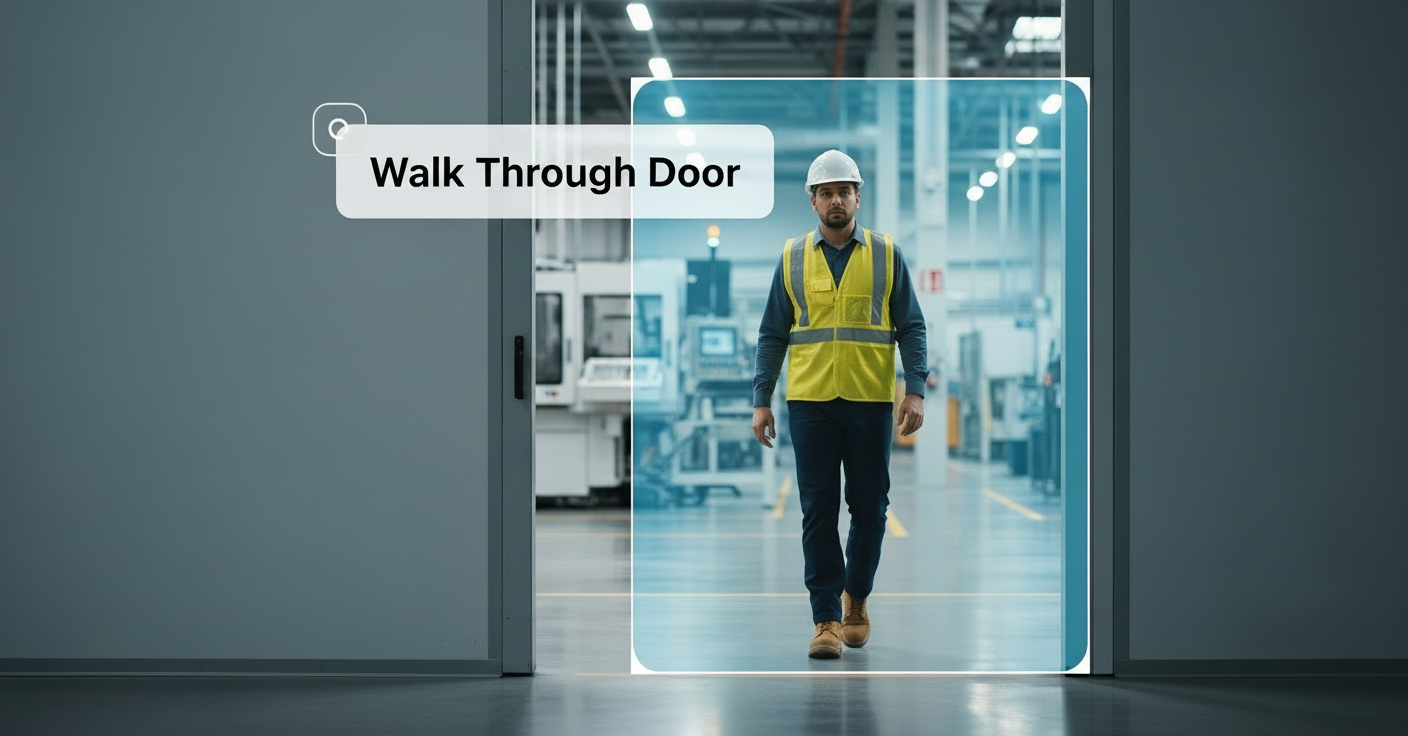


Managing a production floor requires coordinating many moving parts, and critical moments can be hard to see in real time.
For production supervisors, the shift changeover is that vulnerable window where momentum is either maintained or lost. You face a constant battle against blind spots during off-shifts, reactive incident responses, and the administrative overhead of manual headcount verification.
When the outgoing shift lingers and the incoming crew is late, changeover times balloon, and Overall Equipment Effectiveness (OEE) takes a direct hit. Traditionally, tracking who enters and exits the facility required standing at the door with a clipboard or scrubbing through hours of video footage after an incident occurred.
Today, "walk through door" analytics helps you get more value from existing cameras. By using video AI to monitor shift changes and entries automatically, manufacturers can standardize handovers, ensure compliance, and recover lost production time without adding to the supervisor’s workload.
Key terms to know
Walk through door analytics: A computer vision capability that detects and counts individuals passing through a specific threshold, providing real-time data on occupancy and flow without requiring manual counting.
Edge AI: Processing video data locally on the device (the "edge") rather than sending it to the cloud, enabling low-latency real-time alerts—useful for on-the-spot production decisions.
SMED (Single-Minute Exchange of Die): A lean manufacturing method for minimizing waste in a manufacturing process, which can be applied to optimizing shift changeovers.
OEE (Overall Equipment Effectiveness): A widely used metric for measuring manufacturing productivity, calculated by multiplying Availability, Performance, and Quality.
Solving production supervisor pain points with entry analytics
The role of a production supervisor is shifting from floor monitoring to strategic coordination.
However, core frustrations remain: blind spots during off-shifts, inconsistent SOP adherence, and the pressure to improve throughput while maintaining safety. Video AI directly addresses these pain points by turning entry points into sources of operational intelligence.
1. Gaining visibility during off-shifts
You cannot physically monitor every entrance during the second and third shifts. This lack of visibility creates anxiety about unauthorized access, late arrivals, or safety violations happening when leadership is not present.
The Solution: "Walk Through Door" and "Person Enters No-go Zones" analytics provide around-the-clock visibility within covered camera views. Instead of reviewing footage the next day, supervisors receive real-time notifications if unexpected entry occurs or if staffing levels at the start of a shift do not match the schedule. This helps supervisors stay aware during off-hours, providing timely alerts about unexpected entries or staffing levels.
2. Easing the administrative load
Investigating a time-card dispute or a reported unauthorized entry traditionally takes hours of manual video review. This administrative strain pulls you away from coaching your team and optimizing production.
The Solution: Intelligent video recorders index entry events. Supervisors can search for "person entering North Gate" between 6:00 AM and 6:15 AM and get results in seconds. This capability dramatically reduces investigation time, freeing up hours of valuable management time every week.
3. Improving shift handover communication
Inconsistent handovers are a major source of production errors. If the incoming team arrives late or the outgoing team leaves early, critical information about machine status or quality issues falls through the cracks.
The Solution: By integrating entry analytics with production planning, you can visualize shift overlap. If the system detects that the incoming shift has not arrived 10 minutes before the start time, you get an alert. This allows you to hold the outgoing shift for a proper handover, ensuring operational continuity.
How walk through door analytics optimizes manufacturing
Implementing door entry monitoring in manufacturing is not just about security; it is about operational efficiency. By treating entry points as data sources, facilities can drive measurable improvements in uptime and labor utilization.
1. Operational continuity and OEE impact
Unplanned downtime costs manufacturers up to $260,000 per hour in high-volume facilities (Source: Kavi Global). A significant portion of this downtime originates from poor coordination at facility entry points. When key operators arrive late, lines cannot start.
Video analytics provide real-time visibility into arrival patterns. If a bottleneck at the entry turnstiles delays the workforce by 10 minutes, that is 10 minutes of lost production across the entire line. By identifying and resolving these entry bottlenecks, facilities can reclaim lost capacity and protect OEE.
2. Automated shift changeover detection
Video AI trained on manufacturing patterns can recognize the "signature" of a shift change—the clustering of personnel at entry and exit points. This allows for the automation of shift change tracking.
Timestamp verification: Automatically log exactly when the shift transition began and ended, providing a baseline for improvement.
Duration analysis: Track whether shift changes are taking 20 minutes or 40 minutes. Facilities using this data often shorten changeover duration by 20-30% within 90 days (Source: CenterForLean).
Anomaly detection: Flag unusual patterns, such as a shift change taking 50% longer than average, prompting rapid supervisory intervention.
3. Safety and regulatory compliance
Evolving OSHA standards emphasize the need for verifiable workforce safety and presence records. Entry monitoring systems generate the audit trails necessary to document compliance.
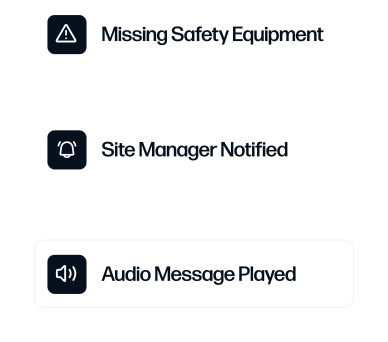
If an incident occurs, you need to know exactly who was in the facility. Automated entry logging creates a verified, timestamped record of presence. Furthermore, by integrating "Missing PPE" detection at entry points, you can help check for required safety gear at entry and alert or prompt intervention to reduce violations (Source: National Law Review).
Best practices for implementing entry monitoring
Deploying analytics for monitoring employee entry and exit requires a strategic approach to maximize value without disrupting operations.
1. Apply SMED principles to shift changes
Just as you optimize machine changeovers, use entry data to optimize human changeovers.
Measure: Use video analytics to establish a baseline duration for shift changes.
Analyze: Identify internal activities (that require the line to stop) versus external activities (that can happen while running).
Streamline: Use entry data to stagger arrival times or open additional entry points to ease congestion.
Impact: Facilities applying SMED to shift changes have demonstrated significant improvements in changeover downtime.
2. Integrate with workforce management
Connect your door entry monitoring in manufacturing with your existing time and attendance systems.
Verify attendance: Cross-reference door entry timestamps with clock-in data to identify "buddy punching" or time theft.
Real-time decisions: If the system detects high absenteeism at the start of a shift, supervisors can quickly call in backup staff or adjust production schedules before the line stops.
Ghost employee detection: Identify employees who clock in but do not enter the production zone, a behavior that is tough to manage with manual supervision.
3. Establish real-time alert protocols
To move from reactive to anticipatory, configure alerts that matter to production supervisors. Avoid alert fatigue by focusing on exceptions.
Alert Type | Trigger Condition | Operational Action |
|---|---|---|
Late Arrival | < 90% of shift present 5 mins before start | Activate backup call list; adjust line speed. |
Unauthorized Entry | Person enters restricted zone off-shift | Prompt security/supervisor dispatch. |
Extended Changeover | Shift transition exceeds 30 mins | Supervisor investigates floor bottlenecks. |
Missing PPE | Person enters floor without vest/helmet | Automated audio reminder or supervisor intervention. |
Comparing video analytics solutions
When selecting a solution for factory entry analytics, it is crucial to choose a platform that integrates with your existing infrastructure and provides actionable operational insights, not just security footage.
Feature | Spot AI | Traditional Video Systems | Standard Access Control |
|---|---|---|---|
Deployment Speed | Minutes (Plug & Play) | Weeks (Cable runs, servers) | Days to Weeks |
Hardware Compatibility | Works with any IP camera | Proprietary cameras often required | Requires specific readers/locks |
Intelligence | AI Agents for Operations & Safety | Passive recording only | Binary (Open/Close) data only |
Search Capability | Google-like search (e.g., "red shirt") | Manual scrubbing (Fast Forward/Rewind) | Log-based text search only |
User Limit | Unlimited users | Per-seat licensing fees | Limited admin seats |
Cloud Accessibility | Hybrid Cloud (Low bandwidth) | Heavy bandwidth requirements | Often local-network only |
Spot AI stands out by offering a camera-agnostic platform that deploys in minutes. It processes data at the edge to minimize latency for critical alerts—essential for real-time shift change monitoring—while providing a cloud dashboard that gives supervisors visibility across all sites from their phone.
Quantifiable ROI from entry analytics
Implementing video analytics for entry points can deliver measurable financial returns and may pay for itself quickly, depending on the deployment and context (Source: Memoori).
1. Recovered production time
Shortening shift change duration directly increases available production time.
Scenario: A facility reduces changeover from 35 minutes to 25 minutes across two shifts per day.
Gain: 20 minutes of extra production daily.
Value: At a production value of $2,000/hour, this equals $167,000 in annual recovered revenue.
2. Less unplanned downtime
Real-time alerts allow supervisors to address staffing gaps immediately. Manufacturing facilities implementing real-time notification systems can reduce shift-related downtime by 25% (Source: MyShyft).
Value: Even at a conservative downtime cost of $50,000/hour, avoiding just 5 hours of downtime monthly saves $250,000+ annually.
3. Payroll accuracy
Automated entry logging eliminates manual errors and time theft.
Value: For a facility with 500 employees, improving payroll accuracy can yield significant annual savings.
From Reactive to Proactive Shift Management
For production supervisors, the goal is not to watch every employee every second—it is to have a system that watches out for the operation. Using "walk through door" analytics to monitor shift changes and entries provides the visibility needed to standardize processes, ensure safety compliance, and maximize throughput.
By moving beyond passive video monitoring to data-driven operations, you can minimize blind spots that contribute to downtime and stress. You gain the ability to quickly validate shift attendance, optimize changeover timing, and maintain a digital audit trail that helps your facility during OSHA inspections.
Spot AI empowers you to turn your existing cameras into a tool for operational excellence. Instead of reacting to yesterday's problems, you can manage today's shift with real-time data.
Request a demo to see Spot AI’s video AI platform in action and discover how entry analytics can streamline your shift change process.
Frequently asked questions
What are the best practices for monitoring employee entry and exit?
Best practices include using camera-agnostic video AI to automate counting and logging, integrating this data with time-and-attendance systems to verify clock-ins, and using real-time alerts for exceptions (like late arrivals) rather than monitoring feeds continuously. It is also critical to communicate transparency to employees about how the data is used to improve safety and efficiency.
How can analytics improve shift change management?
Analytics improve shift changes by establishing baseline durations, identifying bottlenecks (like congested entry points), and enabling the application of SMED principles to streamline the process. Automated alerts notify supervisors if a shift change is running overtime, allowing for timely intervention to protect OEE.
What technologies are available for door entry monitoring?
Modern technologies include edge-based Video AI (like Spot AI) that works with existing cameras, IoT-enabled smart doors, and integrated access control systems. The most effective solutions combine video verification with data analytics to provide context—showing not just that a door opened, but how many people entered and who they were.
How do compliance requirements affect shift management?
OSHA regulations require rigorous documentation of employee presence and safety. Entry monitoring systems provide an automatic, timestamped audit trail of who was in the facility and when, which is essential for incident investigations and documenting compliance during audits.
What are the benefits of real-time entry alerts?
Real-time alerts allow supervisors to be forward-looking rather than reactive. Benefits include the ability to fill staffing gaps quickly if a shift is short, helping to deter unauthorized access into hazardous zones and enabling fast response, and supporting shift overlaps as scheduled to facilitate proper handovers.
About the author
Sud Bhatija is COO and Co-founder at Spot AI, where he scales operations and GTM strategy to deliver video AI that helps operations, safety, and security teams boost productivity and reduce incidents across industries.






.png)
.png)
.png)