




Managing multiple construction sites often feels like a balancing act where visibility is the first casualty. For project managers and construction leaders, the inability to be everywhere at once creates operational blind spots where equipment disappears, safety protocols slip, and unauthorized access goes unnoticed until it impacts the schedule. The financial toll is heavy, with plant and machinery theft resulting in estimated losses exceeding £800 million annually in the UK alone when accounting for replacement costs and project delays (Source: Plant & Civil Engineer).
To identify suspicious activity, teams are moving beyond night guards and passive recording devices, which only provide evidence after an incident. Instead, they are adopting intelligent, real-time video systems that act as a digital teammate.
By leveraging modern video technology, construction leaders can detect behavioral anomalies, enforce safety zones, and secure perimeters without adding headcount. This guide outlines practical strategies and technologies to identify operational risks early, ensuring projects stay on schedule and budgets remain intact.
Key terms to know
Video AI Agents: Intelligent software that analyzes video feeds in real time to detect specific behaviors, such as loitering or vehicles entering restricted areas, acting as an automated observer.
Computer Vision: A field of artificial intelligence that enables cameras to "see" and interpret visual data, allowing systems to distinguish between a person, a vehicle, and harmless environmental movement like wind-blown tarps.
Geofencing: A virtual perimeter for a real-world geographic area. In construction, this technology triggers alerts when assets move outside a defined zone or when personnel enter a hazardous area.
False Positive Rate: The frequency with which a security system triggers an alert for a non-incident (e.g., a shadow interpreted as a person). Low false positive rates are essential to minimize alert fatigue.
License Plate Recognition (LPR): Technology that reads vehicle registration plates to verify authorized access or flag unknown vehicles entering the job site.
The high cost of operational blind spots
Construction sites are uniquely vulnerable due to their temporary nature, high-value assets, and constant flux of subcontractors and deliveries. The impact of a security breach extends far beyond the replacement cost of a stolen excavator or generator.
Project delays and schedule slippage: When critical equipment is stolen, work stops. Research indicates that less than 10% of stolen plant machinery is recovered without tracking technology, leading to extended downtime while replacements are sourced (Source: Plant & Civil Engineer). For a project manager, this directly impacts the Schedule Performance Index (SPI).
Margin erosion: Indirect costs often dwarf direct losses. These include rental expenses for substitute machinery, administrative costs for investigations, and potential contract penalties for late delivery.
Insurance premiums: Repeated claims can lead to substantial premium hikes or coverage denial. Conversely, demonstrating robust security measures may help lower premiums, though results vary by insurer and site (Source: ComplianceQuest).
Safety liability: Unauthorized access isn't just a theft risk; it's a liability. Trespassers injured on-site can lead to legal action, while undetected safety violations by workers increase the risk of OSHA citations and stop-work orders.
Defining suspicious behavior on the job site
Suspicious conduct on a construction site can range from a stranger climbing a fence at midnight to subtle operational deviations. It includes any behavior or environmental change that deviates from normal operational patterns. Understanding these nuances is critical for configuring video systems to detect genuine operational risks.
Behavioral indicators
Loitering in restricted areas: Workers or unknown individuals lingering near material staging areas or fuel tanks without a clear work-related purpose often signal potential theft or vandalism.
Unusual timing: Movement occurring during off-hours, such as vehicles arriving late at night or personnel moving through the site early in the morning before shift starts, suggests unauthorized access.
Coordinated movement: Multiple individuals arriving together, separating to different areas, and regrouping—particularly near high-value assets—can indicate organized theft planning.
Concealment behaviors: Individuals attempting to obscure their faces, avoiding well-lit paths, or moving rapidly toward blind spots are clear indicators of malicious intent.
Operational and safety anomalies
PPE non-compliance: While often viewed as a safety issue, workers deliberately removing hard hats or vests in specific zones may be attempting to avoid identification or signal a breakdown in site discipline.
Vehicle irregularities: Unknown vehicles circling the perimeter, parking near loading zones without authorization, or idling for extended periods require timely verification.
Asset displacement: Tools or materials appearing in locations different from where they were staged, or evidence of tampering with locks and fences, are precursors to theft.
How video AI transforms site monitoring
Traditional monitoring methods, such as roving guards or passive recording, can leave gaps in coverage. Guards cannot be everywhere, and passive cameras only help you understand what happened after the loss occurs. Video AI helps existing camera infrastructure provide earlier detection.
Automated threat detection
Modern video AI platforms use computer vision to monitor feeds continuously and send alerts for human review. Unlike standard motion detection, which triggers on blowing debris or stray animals, AI distinguishes between people, vehicles, and environmental noise.
Perimeter protection: AI Agents detect people or vehicles crossing virtual tripwires at the site boundary. This allows for real-time alerts when a breach occurs, rather than waiting for a morning site walk to discover a cut fence.
Loitering detection: Systems can be configured to alert management if a person or vehicle remains in a designated no-go zone (like a copper storage area) for longer than a set duration.
Unauthorized access alerts: By integrating with access schedules, the system flags any person or vehicle detected on-site outside of approved working hours.
Improving response times
Speed is critical when a suspicious event is detected. Research indicates that systems combining AI detection with real-time verification can help shorten response times, depending on configuration and workflows (Source: ECAM).
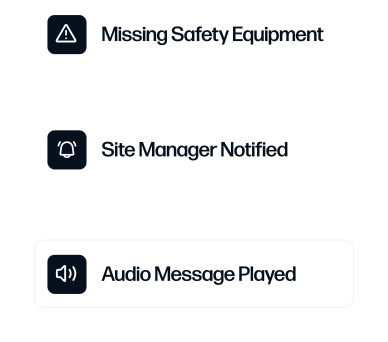
Real-time notifications: Alerts are sent directly to site managers or remote monitoring centers via mobile apps or dashboards, including a video clip of the event.
Visual verification: Managers can view the live feed in real time to verify the incident, eliminating the need to drive to the site for every alarm.
Active deterrence: Some systems integrate with on-site speakers to broadcast audio warnings to intruders, which can deter many attempts before entry is gained.
Strategic placement of video sensors
To effectively identify suspicious behavior, video sensors must be positioned to cover high-risk zones while minimizing new blind spots.
Zone | Monitoring Objective | Recommended AI Capability |
|---|---|---|
Site Perimeter | Detect breaches and loitering vehicles. | Vehicle & Person Detection, Virtual Tripwires |
Entry/Exit Points | Verify authorized access and track deliveries. | License Plate Recognition (LPR), Access Control Integration |
Material Staging | Guard against theft of high-value items (copper, tools). | Loitering Detection, Object Detection |
Hazardous Zones | Ensure safety compliance and mitigate injury. | No-Go Zone Alerts, PPE Detection |
Remote Areas | Monitor areas without power/internet. | Mobile Solar Trailers with Edge AI |
Comparing construction monitoring solutions
When selecting a solution to identify suspicious events, project managers must weigh deployment speed, flexibility, and intelligence.
Feature | Spot AI | Traditional Camera Systems | Guard Services |
|---|---|---|---|
Deployment Speed | Minutes (Plug-and-Play with existing cameras) | Weeks (Complex wiring and setup) | Days/Weeks (Staffing and scheduling) |
Intelligence | AI Agents (Detects loitering, PPE, vehicles) | Passive (Recording only, no alerts) | Human (Subject to fatigue and gaps) |
Remote Visibility | Cloud Dashboard (Access from anywhere) | Limited (Often requires on-site NVR access) | None (Relies on phone reports) |
Scalability | Many sites (centralized view) | Complex (Fragmented systems) | Expensive (Linear cost increase) |
Searchability | Fast search (Find events quickly) | Manual (Hours of scrubbing footage) | N/A (Relies on written logs) |
Best practices for securing the job site
Implementing technology is only one part of the equation. To truly reduce risk, construction managers should integrate video AI into broader operational protocols.
Establish clear perimeters: Use anti-climb fencing and ensure gates are locked during off-hours. Physical barriers slow down intruders, giving AI systems time to detect and alert.
Implement digital incident reporting: Move away from paper logs. Use digital tools to document suspicious incidents, complete with timestamped video evidence. This creates an audit trail that strengthens insurance claims and legal defense.
Coordinate with subcontractors: Ensure all trades are aware of monitoring protocols. Use video data to resolve disputes regarding material delivery or damage objectively, rather than relying on "he-said, she-said" arguments.
Optimize lighting: Good lighting acts as a deterrent and can improve the accuracy of video sensors. Ensure high-value areas are well-lit to reduce shadows where intruders could hide.
Regular risk assessments: Construction sites are dynamic; as the building rises, lines of sight change. Regularly review camera angles and AI alert configurations to ensure new blind spots haven't emerged.
Integrating safety and security
The same video platform used to identify suspicious behavior can also support safety outcomes. This dual-purpose approach can improve ROI and support a culture of consistent operations.
Automated PPE checks: Instead of manual spot checks, use AI to detect workers missing hard hats or high-visibility vests. This allows for targeted coaching rather than blanket discipline.
No-go zone enforcement: Configure alerts for when personnel enter dangerous areas, such as active demolition zones or crane swing radiuses. This helps mitigate the risk of accidents.
Dispute resolution: Timestamped video evidence protects the firm from false liability claims, whether from workers' compensation fraud or third-party accidents on the site perimeter.
Secure Your Sites and Schedule with Video AI
Identifying suspicious events on construction sites is a critical component of modern project management. It protects profit margins, ensures schedule adherence, and keeps the workforce safe. By moving from reactive observation to early detection with Video AI, construction leaders gain the visibility they need to manage dispersed sites effectively.
Spot AI's Video AI platform transforms existing cameras into proactive teammates. With automated loitering detection, real-time alerts, and fast video search, construction teams can cut investigation time from hours to minutes and deter incidents before they escalate.
Want to see how video AI can help you secure your construction site? Request a Spot AI demo and experience the platform in action.
Frequently asked questions
What are the best practices for securing a construction site?
Effective security combines physical barriers with intelligent technology. Key practices include installing anti-climb fencing, ensuring adequate lighting, implementing strict access control for vehicles and personnel, and deploying AI-powered video systems that can detect and alert on suspicious behavior in real time. Regular risk assessments are also vital as the site layout evolves.
How can technology improve construction site safety?
Technology improves safety by providing continuous monitoring to support human supervision. Video AI can automatically detect missing PPE (like hard hats and vests), alert managers when workers enter hazardous "no-go" zones, and identify unsafe behaviors like running or unauthorized equipment use. This data allows for timely coaching and helps minimize the risk of accidents and OSHA violations.
What are the common security risks in construction?
The most prevalent risks include theft of high-value equipment (excavators, generators) and materials (copper, lumber), vandalism that causes project delays, and unauthorized access by trespassers which creates liability issues. Organized crime rings targeting construction plant machinery are also a growing concern due to the low recovery rate of stolen assets.
How do I report a suspicious incident on a construction site?
Suspicious incidents should be reported using digital incident reporting tools that integrate with your project management software. These reports should include timestamped video evidence, descriptions of the individuals or vehicles involved, and location details. Real-time alerts from video systems can also be configured to notify site managers and law enforcement promptly.
What technologies are available for construction site monitoring?
Available technologies include AI-powered video systems (like Spot AI) that work with existing cameras, mobile solar-powered camera trailers for remote areas, license plate recognition (LPR) for access control, and environmental sensors that monitor noise, dust, and vibration. These systems often integrate into a single cloud dashboard for centralized visibility.
About the author
Sud Bhatija is COO and Co-founder at Spot AI, where he scales operations and GTM strategy to deliver video AI that helps operations, safety, and security teams boost productivity and reduce incidents across industries.






.png)
.png)
.png)