




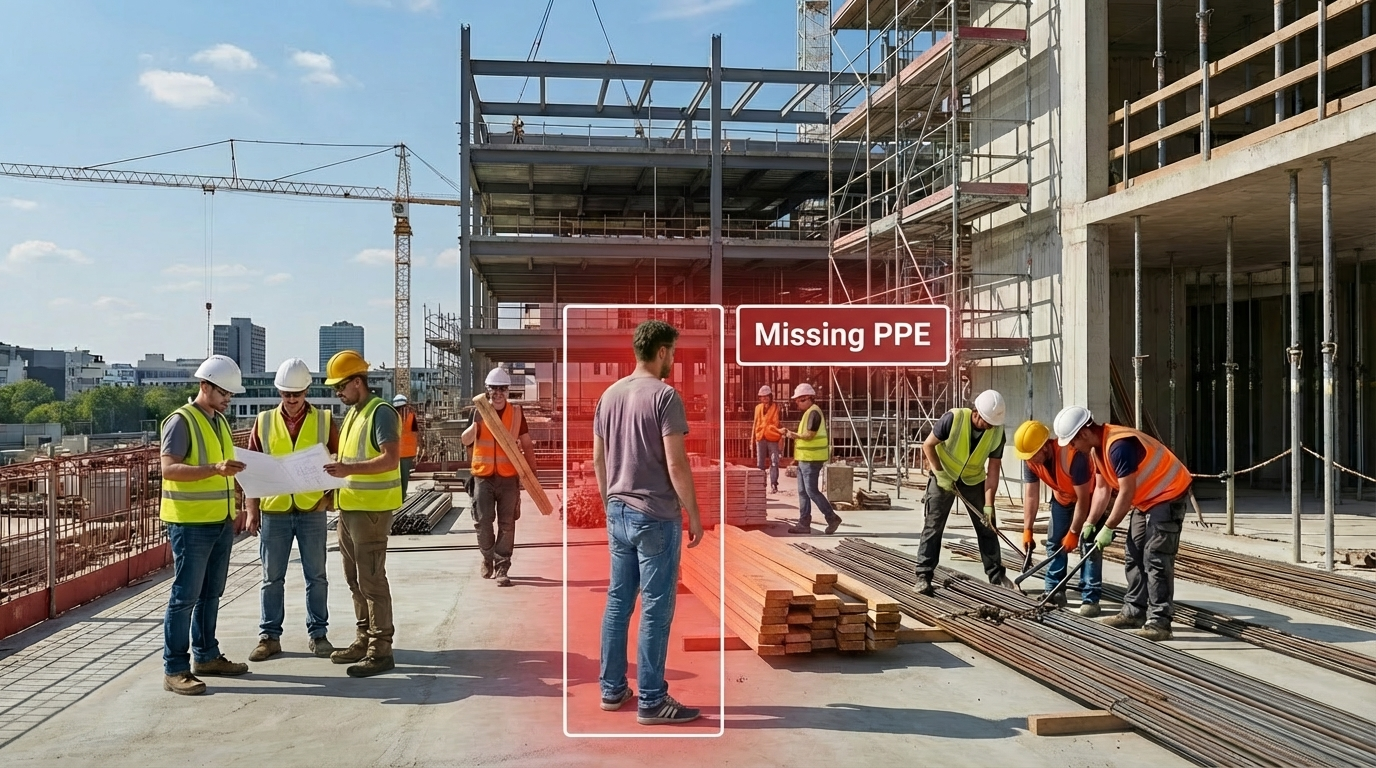


Managing safety across a bustling construction site often feels like trying to be in ten places at once. You walk the site, clipboard in hand, and adherence looks perfect. Yet, the moment you turn the corner, the hard hat comes off, or a vendor cuts a corner to speed up a task. For Safety Directors responsible for Total Recordable Incident Rate (TRIR) and Experience Modification Rate (EMR), this visibility gap is not just frustrating—it is a financial and operational liability.
Traditional methods of observation—periodic site walks and manual checklists—leave massive blind spots. With 10 to 15 different trade partners operating simultaneously, ensuring consistent safety standards across trades requires more than human vigilance alone.
This article explores how PPE tracking by subcontractor using video AI transforms safety management from a reactive, manual task into an insight-driven, data-driven strategy. By turning existing cameras into intelligent teammates, safety leaders can automate adherence checks, enforce accountability, and protect their workforce without adding headcount.
Understanding the basics
Before discussing the application of this technology, it is helpful to define the core concepts that drive automated safety oversight.
- Video AI (Computer Vision): A technology that allows camera systems to "see" and interpret visual data in real-time, detecting objects like hard hats, vests, and specific behaviors.
- PPE Compliance Rate: A metric tracking the percentage of workers correctly wearing required Personal Protective Equipment compared to the total number of workers observed.
- Subcontractor Scorecarding: The process of using data to benchmark safety performance by specific trade or vendor, enabling objective comparisons and accountability.
- TRIR (Total Recordable Incident Rate): A standard calculation used by OSHA to measure the number of safety incidents per 100 full-time workers.
The operational reality of managing subcontractor safety
For the modern Safety Director, the primary hurdle is not knowing what safety looks like, but ensuring it happens consistently across a transient workforce. The pain points outlined below reflect the daily operational reality on complex job sites.
1. The manual compliance monitoring workload
Safety professionals spend hours conducting site walks to check for PPE adherence. Despite this effort, violations occurring between inspections often go undetected until an incident occurs. This manual approach leaves sites vulnerable to avoidable accidents and OSHA citations.
Spot AI Solution: Spot AI addresses this by deploying Missing PPE detection capabilities. The system automatically identifies workers without required safety equipment—such as vests or hard hats—in real-time. Instead of hoping to catch a violation during a walk, safety leaders receive swift alerts, allowing them to maintain continuous compliance oversight across all sites without physically being there. This capability has been shown to reduce manual inspection workloads by 60-80% (Source: Spot AI).
2. Subcontractor safety accountability
Ensuring consistent safety compliance among dozens of subcontractors is a persistent struggle. Different trades often bring varying safety cultures and training levels. When a violation occurs, it often devolves into a "he said/she said" dispute, making it difficult to enforce contract terms or hold specific vendors liable.
Spot AI Solution: Video AI provides objective, timestamped evidence of every detection. Features like Person Enters No-go Zones and Hazard Zone detection automatically track and document compliance. If a specific vendor repeatedly violates safety protocols, you have the video data to back up corrective actions, retraining requirements, or contract enforcement. This shifts the dynamic from subjective arguments to fact-based performance reviews.
3. Reactive safety management
Most safety programs rely on lagging indicators—responding to incidents after they happen. This reactive cycle makes it nearly impossible to achieve zero-incident goals.
Spot AI Solution: By utilizing Possible Fall detection and Forklift Near Miss analytics, Spot AI transforms safety management into an anticipatory discipline. The system identifies hazardous behaviors—like running in a warehouse or entering a restricted zone—before they escalate into reportable injuries. This allows safety teams to intervene on leading indicators, effectively reducing risk before an accident occurs.
Why tracking PPE by trade matters
Not all PPE violations carry the same risk profile. A painter missing a high-visibility vest presents a different hazard than a roofer missing a fall protection harness. To effectively track PPE adherence by trade and subcontractor, safety systems must distinguish between these contexts.
Differentiating risk profiles
Generic observation creates noise. Effective video AI for PPE compliance allows you to focus on the specific risks associated with different trades.
- Roofing and Steel Erection: The primary risk here is falls. Monitoring must focus on the presence of harnesses and adherence to tie-off protocols in elevated zones. Fall protection violations accounted for 5,914 OSHA citations in fiscal year 2025, making this a critical area for targeted oversight (Source: Tyndale USA).
- Electrical and HVAC: These trades often work in restricted areas or near energized equipment. Adherence tracking here focuses on ensuring only authorized personnel enter these zones and that they are wearing arc-rated gear if visible.
- General Labor and Site Logistics: High-visibility vests and hard hats are the baseline. Real-time PPE detection ensures that as materials move and traffic patterns change, ground personnel remain visible to equipment operators.
The impact of labor shortages on supervision
The construction industry is currently facing a paradox: over 80% of companies reported difficulty hiring supervisors and project managers in 2024 (Source: ENR). This means sites are operating with limited supervisory oversight exactly when safety risks are highest. Automated PPE adherence tracking acts as a force multiplier, allowing a single Safety Director to effectively oversee multiple sites and trades despite staffing constraints.
| Feature | Manual Inspection | Video AI Oversight |
|---|---|---|
| Coverage | Intermittent (only when supervisor is present) | Continuous (24/7 observation) |
| Detection Rate | Low (misses violations between walks) | High, with strong detection accuracy |
| Evidence | Subjective / Written notes | Objective / Timestamped video |
| Reaction Time | Delayed (hours or days) | Real-time (seconds to minutes) |
| Data Depth | Anecdotal | Trend-based analytics by trade/zone |
How video AI detects non-adherence
Understanding the technology behind automated PPE adherence checks helps in evaluating its fit for your operations. It does not require a complete overhaul of your infrastructure.
Computer vision and object detection
Modern video AI uses deep learning models, such as YOLO (You Only Look Once), to process video streams in real-time. These models are trained on vast datasets of construction imagery to recognize specific objects.
- Recognition: The system identifies a "person."
- Classification: It analyzes specific attributes of that person—is a hard hat present? Is a safety vest visible?
- Contextualization: It determines if the person is in a zone where that PPE is mandatory.
- Alerting: If a violation is detected (e.g., "Person in Hazard Zone without Hard Hat"), the system triggers an alert.
Research indicates that modern systems achieve a high mean Average Precision (mAP) for PPE detection, meaning they reliably identify adherence status in the vast majority of instances.
Hardware flexibility
One of the biggest misconceptions is that you need special "AI cameras." Solutions like Spot AI are camera-agnostic. They plug into your existing monitoring infrastructure, whether it is an on-premise NVR or a mobile trailer system. This allows you to upgrade your site's intelligence without the capital expense of ripping and replacing hardware.
Operationalizing subcontractor accountability
Data is only useful if it drives action. To truly improve subcontractor safety with AI, you must integrate the insights into your daily management workflows.
1. Objective performance scorecards
Move away from generic safety memos and towards data-backed reviews. By aggregating violation data, you can generate adherence scores for each subcontractor.
- Benchmarking: Compare trades against each other. If the electricians have a 98% adherence rate and the framers are at 85%, you know exactly where to focus your resources.
- Trend Analysis: Identify if a specific vendor’s performance degrades towards the end of a shift or on specific days. This allows for targeted interventions, such as scheduling toolbox talks right when fatigue typically sets in.
2. Automating the evidence trail
When an incident occurs or a fine is levied, documentation is your first line of defense. Video AI automatically curates this evidence.
- Dispute Resolution: If a subcontractor claims they were compliant during an incident, timestamped video provides the definitive truth.
- Insurance Documentation: Insurers increasingly recognize automated observation as a risk mitigation factor. Documenting systematic hazard identification can lead to premium reductions of up to 12% (Source: AlignSure).
3. From policing to coaching
The goal of PPE tracking by subcontractor is to standardize safety culture through coaching, not to punish non-adherence.
- Positive Reinforcement: Use video clips to highlight crews doing the right thing. Show a clip of a team properly tying off or respecting a no-go zone during a safety meeting.
- Targeted Training: Instead of generic training for everyone, assign specific modules to workers or trades based on their actual violation patterns. If a specific crew struggles with vest adherence, focus your coaching there.
Implementation best practices for construction sites
Deploying video analytics for worker safety requires a strategic approach to ensure buy-in and operational success.
- Map your high-hazard zones: Do not try to observe every square inch with equal intensity. Prioritize areas with fall hazards, heavy equipment traffic, and chemical storage. Configure Person Enters No-go Zones alerts specifically for these high-risk areas.
- Establish clear alert protocols: Define who receives alerts and when. A missing vest might go to a site supervisor, while a vehicle entering a pedestrian-only zone or a person entering a high-voltage zone should escalate rapidly to the Safety Director.
- Communicate with trade partners early: Include PPE adherence tracking requirements in your contracts. Make it clear that video AI is being used to protect their workers and ensure fair enforcement of safety rules. Transparency builds trust.
- Start with a pilot: Roll out the technology on a single site or with a specific trade first. This allows you to tune the sensitivity of the AI to your specific environment—accounting for lighting, dust, and site layout—before expanding.
- Integrate with existing workflows: Ensure that the data from the video system feeds into your existing project management or safety software. This prevents data silos and ensures that safety insights are part of the broader project view.
Comparison: Spot AI vs. traditional video systems
When evaluating subcontractor safety management tools, it is important to understand how modern Video AI differs from legacy systems.
| Feature | Spot AI | Legacy CCTV / VMS |
|---|---|---|
| Deployment Speed | Plug-and-play with existing cameras; live in minutes | Weeks of installation; requires proprietary hardware |
| Intelligence | Pre-trained AI agents for safety (PPE, Falls, Zones) | Passive recording; requires manual review |
| Searchability | "Google-like" search for specific events or attributes | Scrubbing through hours of footage manually |
| Scalability | Unlimited users and sites on a unified cloud dashboard | Difficult to network multiple sites; expensive bandwidth |
| Cost Model | Predictable software license; low upfront hardware cost | High upfront capital expenditure for servers/cameras |
Spot AI stands out by offering a unified video AI platform that connects any camera—existing or new—to a secure dashboard. It empowers Safety Directors to standardize shifts, track SOP adherence, and mitigate risk without the complexity of traditional enterprise systems.
Conclusion
The construction industry is moving toward a future where safety is continuous, data-driven, and transparent. Tracking PPE adherence by trade and subcontractor with video AI is no longer just a technological novelty; it is a necessary evolution for managing risk in a complex, labor-constrained environment.
By automating detection and providing objective visibility into subcontractor performance, Safety Directors can shift their focus from chasing violations to building a resilient safety culture. The result is not just better compliance scores, but a tangible reduction in incidents, lower insurance costs, and a safer environment for every worker on site.
See how Spot AI’s video AI platform can help you standardize safety and streamline site operations. Request a demo to experience the technology in action.
Frequently asked questions
How can technology improve PPE compliance?
Technology improves adherence by providing continuous, unbiased observation that humans cannot achieve alone. Video AI systems detect violations in real-time, allowing for timely correction before habits form. Furthermore, the data collected allows for targeted training and systemic improvements, moving safety from a reactive to a forward-looking discipline.
What are the best practices for monitoring subcontractor safety?
Best practices include establishing clear contractual safety requirements, using data-driven scorecards to track performance, and providing regular, objective feedback. Utilizing tools that offer real-time PPE detection ensures that observation is consistent across all trades, regardless of when a supervisor is physically present.
How does AI enhance safety management in construction?
AI enhances safety by automating the detection of hazards such as missing PPE, unauthorized entry into dangerous zones, and potential fall risks. It processes video data to identify patterns—such as specific times of day or locations where violations spike—enabling Safety Directors to implement precise interventions that mitigate overall risk.
What tools are available for real-time PPE detection?
Tools range from fixed camera networks with edge AI processing to mobile camera trailers for remote sites. Solutions like Spot AI offer a platform that integrates with these various hardware types to provide a centralized view of PPE adherence, Hazard Zone detection, and safety performance across the entire project portfolio.
How can compliance be enforced among subcontractors?
Enforcement is best achieved through transparency and accountability. By using timestamped video evidence to document violations, General Contractors can enforce contract terms objectively. Additionally, implementing performance-based incentives—where subcontractors with high compliance scores receive preferential treatment or bonuses—can motivate adherence to safety protocols more effectively than penalties alone.
About the author
Tomas Rencoret
Senior Growth Manager
Tomas Rencoret leads the Growth Marketing team at Spot AI, where he helps safety and operations teams use video AI to cut safety and security incidents as well as boost productivity.

