




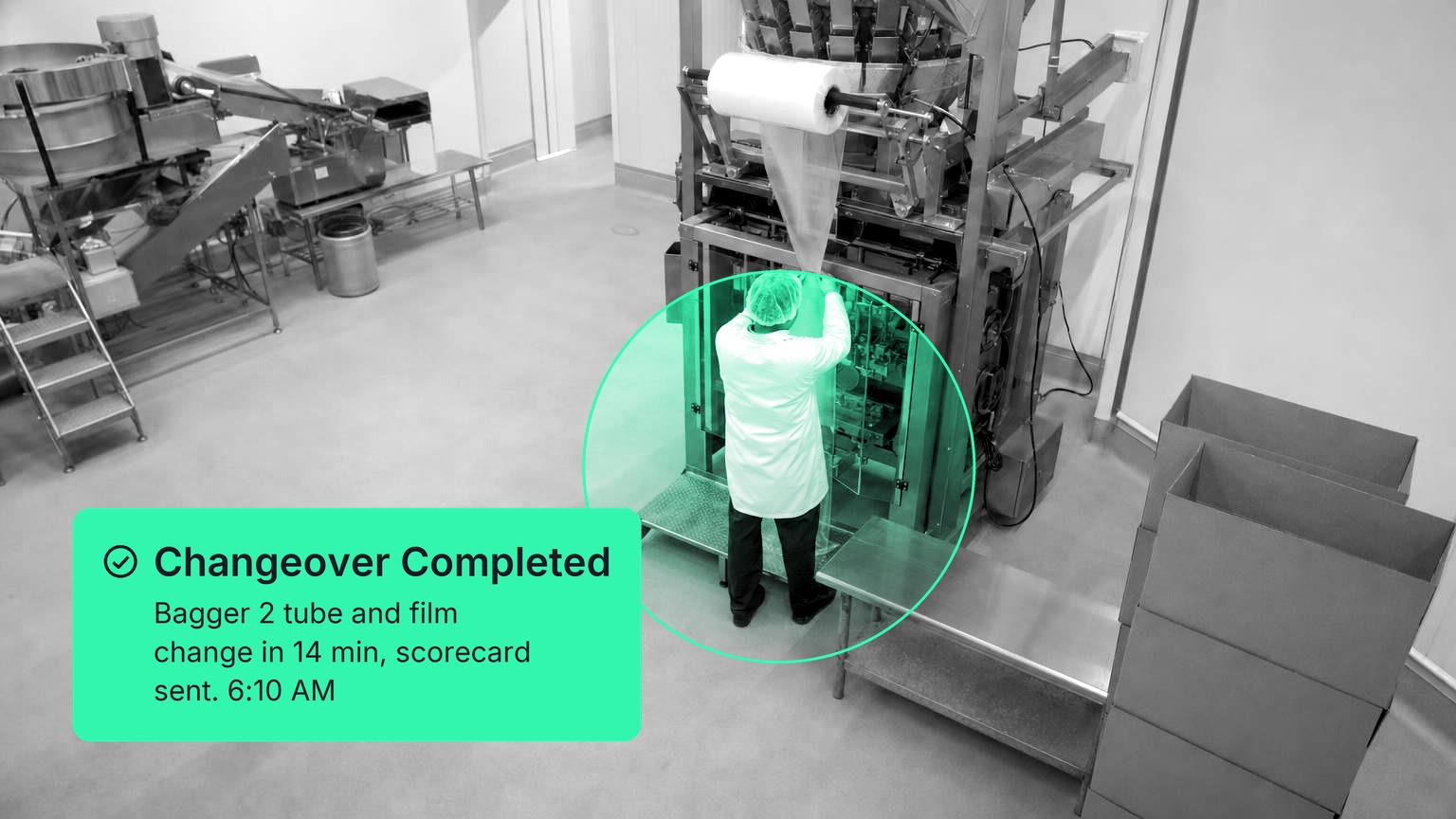


Operator scorecards for changeover coaching: who sees them, when, and what the crew does next
An operator scorecard earns its place when it turns each changeover into one specific coaching point while the crew still remembers the run. Spot AI's AI Operations Assistant gives operators a scorecard with video of what went well and what to adjust after each run, on the cameras a plant already has. The routine around the scorecard decides whether it helps: Kluger and DeNisi's 1996 meta-analysis found that about one third of feedback interventions decreased performance (Source: Frontiers in Psychology), so this guide covers who sees the scorecard, when, and what the crew does next.
Key takeaways
- After each run, Spot AI gives the crew phase times against standard, any step skipped or done out of order, and a scorecard with video.
- Review the run while the crew remembers why a phase ran long, then check the agreed adjustment on the next comparable changeover.
- A working routine has four rhythms: after each run, each shift, a crew check-in every week or two, and a monthly review of the standard.
- Tie the check-in to positive incentives for hitting goals, and agree the uses of the video with HR and the union before go-live.
- Never put individual rankings on a wall; compare each crew with its own baseline and recognize improvement.
What does an operator scorecard show after each changeover?
Spot AI's operator scorecard comes after each run with video of what went well and what to adjust, and the AI Operations Assistant produces two more results from the same run. Read together, they give the crew three things:
- Phase times against standard: Spot AI scores each changeover by phase, so the crew sees that the exchange ran on target and the first-off sign-off ran long, not only that the total was over.
- Steps: Spot AI checks the run step by step and flags any step that was skipped, done wrong or done out of order.
- Scorecard clips: the scorecard's video of what went well and what to adjust, so the conversation starts from the same picture.
The phases come from SMED and are explained in our phase-by-phase SMED guide. For the analytics side of the scorecard, including the metric set a buyer should expect, see the buyer's guide to reducing changeover time with video analytics.
When should crews review changeover feedback?
Spot AI delivers the scorecard after each run, and the practical case for that timing is strong. The crew still remembers why the clamp stuck or the checker was late, the next changeover of the same family is often on the same shift, and one point at a time is something a crew can act on.
The research is supportive rather than decisive. A 2023 systematic review of 20 studies on corrective feedback found that half favored immediate feedback, seven found no difference and three favored delayed feedback (Source: Frontiers in Psychology). These language-learning studies do not establish the best timing for manufacturing coaching. Review the run while it is fresh, then test whether the agreed adjustment helps on the next comparable changeover.
How does a supervisor review a whole shift?
Spot AI's supervisor shift review gives a stage-by-stage summary, a task timeline and key-moment clips for a whole shift. A routine for the end of the shift:
- Open the changeover that ran furthest over standard and find the phase that cost the time.
- Open the best changeover of the shift and note what that crew did differently.
- Check every flagged step and decide whether it is a coaching point or a process gap, such as a missing tool.
- Leave one coaching point per crew, and put the rest in the handover.
The review feeds the shift report; see what a production shift report should show about lost changeover time.
What does the coaching routine look like, run by run and week by week?
Spot AI supplies the evidence at each level, from the operator scorecard to weekly reports by line, shift and crew; the routine is the plant's. Four rhythms cover it:
Rhythm | Who | What they look at | What happens next |
|---|---|---|---|
After each run | Operator and changeover lead, at the machine | Spot AI's operator scorecard for that run | Pick one adjustment, then check it on the next comparable changeover, with the quality check passed |
Each shift | Supervisor | Spot AI's supervisor shift review | One coaching point per crew; process gaps go into the handover |
Every week or two | Crew and supervisor | The crew's trend against its own goal | Recognize improvement, tie positive incentives to the goal, set the next goal |
Monthly | CI lead and plant manager | Spot AI's weekly reports and leadership trend dashboards | Update the standard once a better method is validated, and tell every crew |
At the machine, start with the clip, not the verdict. Ask the operator what they see happening in it, then agree the one change for the next run and how you will know it worked. One loop, from miss to verified fix:
Worked example (illustrative) | What happens |
|---|---|
The miss | Line 4, color change, crew B: the first-off phase ran 4 minutes over its target; every step was done in order |
The operator's explanation | At the machine, the operator watches the clip and says the first-part checker arrived late |
Coaching point or process gap | Process gap: the checker is not scheduled for changeovers, so there is nothing to coach the crew on |
Action and owner | The shift supervisor books the checker at the start of each color change on line 4 |
Check on the next comparable run | Next color change on line 4: first-off on target, first-part check passed, no extra startup scrap |
What goes to the check-in | The on-target clip; the crew is recognized for flagging the wait |
Scorecards matter most for newer operators. Across U.S. industries in January 2026, workers aged 55 to 64 had a median 9.6 years with their current employer, more than three times the 3.0 years of workers aged 25 to 34 (Source: BLS). As veterans retire, more changeovers fall to newer operators, who learn by watching their own run next to the standard. When the standard itself lives in a veteran's head, start with turning veteran know-how into the standard.
How do you run the check-in without it feeling like Big Brother?
Spot AI's answer to "it sounds like Big Brother" is what it has learned from deployments: weekly or biweekly check-ins that tie positive incentives to hitting goals are a positive way of using the tool. Census Bureau research also found that structured management practices for monitoring, targets and incentives are tightly linked to better performance in manufacturing plants (Source: Census Bureau). Six rules keep the check-in on the right side:
- Agree in writing with HR and, where there is one, the union what the video is used for and who can see it, before go-live.
- Agree the measures and targets with operators before launch: define each phase's start and stop, compare the same changeover family, and record equipment or staffing constraints before setting the crew's baseline. Your most experienced operators know what good looks like; bring them in first.
- Show each crew its own scorecards and trend first; supervisors see more, and the rest of the plant sees only crew-level results.
- Set goals against that baseline, so a crew on an older press is not measured against a newer one, and never trade a quality check for a faster phase.
- Show a clip of something done well at every check-in, not only the misses.
- Make the incentive about what the crew can influence, such as phase time or steps in order, never about catching someone out.
"We're not spying on anyone, but we can't be out there watching 24 hours a day. Spot AI helps us spot the processes that need to change."
Kevin McDaniel, Director of Safety and Asset Protection, Unique Industries
For the rollout conversation with operators, HR and the union, see answering the workforce question before rollout.
What should you not do with operator scorecards?
Spot AI's scorecards are meant for coaching, and they can still be misused. The mistakes are predictable:
- Rankings on a wall. Avoid public individual rankings and keep the discussion on the observed step and the crew's next adjustment; feedback research warns that attention directed toward self-esteem can interfere with feedback acceptance.
- Clips as evidence for discipline. Once a clip is used against someone, crews stop trusting the scorecard.
- Blaming the operator for a process gap. A step skipped because the tool was missing is a staging problem, not a training problem.
- Comparing different changeovers. A color change and a die change are not the same job; compare crews on the same changeover family, as in our guide to benchmarking changeover variance across plants.
- Changing the standard quietly. If the target moves, every crew hears why.
Decide before go-live which problems are process gaps and which are coaching points: a skipped step caused by a missing tool sends someone to fix the cart, not to talk to the crew.
A sample scorecard layout for coaching
The layout below is a coaching sheet a plant can build from Spot AI's results for each run (phase scores, the step check and the scorecard clips):
Section | What it shows | Who uses it, and how |
|---|---|---|
Run header | Line, changeover family, crew, total time against standard | Everyone: the context in one line |
Phase times | Each phase against its target | Changeover lead: finds the phase to work on |
Steps | Steps skipped, done wrong or out of order | Supervisor: coaching point or process gap |
Clips | One clip of what went well, one of what to adjust | Operator: sees the difference, not a description of it |
Next-run focus | One adjustment for the next changeover of this family | Crew: the only action item |
Trend | The crew's recent runs of this family against its goal | Check-in: recognition and the next goal |
Keep one action item per scorecard. A crew that fixes one phase a week is ahead of a crew handed a list it never finishes.
See how Spot AI approaches operator coaching: the AI Operations Assistant gives operators a scorecard with video after each run and gives supervisors a review of the whole shift, on the cameras your plant already has.
Frequently asked questions
What is an operator scorecard in manufacturing?
An operator scorecard summarizes a run against agreed measures and points to one coaching action, and Spot AI's version comes after each changeover with video of what went well and what to adjust. Read with the same run's phase scores and step check (any step skipped, done wrong or done out of order), it gives the crew one thing to change on the next run.
What is AI-assisted changeover coaching?
Spot AI's AI Operations Assistant scores each changeover by phase, checks every run step by step and gives operators a scorecard with video after each run; supervisors and changeover leads then coach from that evidence instead of from memory. The AI measures and points to the clip; the coaching itself stays a conversation between people.
How do you surface coaching opportunities by site and shift?
Spot AI's weekly reports summarize performance by line, shift and crew, and its leadership trend dashboards compare plants side by side, so the shifts and sites that need coaching stand out. Inside a shift, the supervisor shift review shows the key-moment clips that point to the coaching point.
How often should operators get changeover feedback?
Spot AI delivers the operator scorecard after each run, which sets the first rhythm: one point at the machine before the next changeover. Add a supervisor review each shift and a crew check-in every week or two, where trends and recognition belong.
How do you introduce scorecards without making crews feel watched?
Spot AI has learned that weekly or biweekly check-ins tying positive incentives to hitting goals are a positive way to use the tool. Agree in writing with HR and, where there is one, the union what the video is used for before go-live, show each crew its own data first, and never rank individuals in public.
About the author
Dunchadhn Lyons, Director of AI Engineering
Dunchadhn Lyons leads Spot AI's AI Engineering team, building real-time video AI for operations, safety, and security, turning video data into alerts, insights, and workflows that cut incidents and boost productivity.