




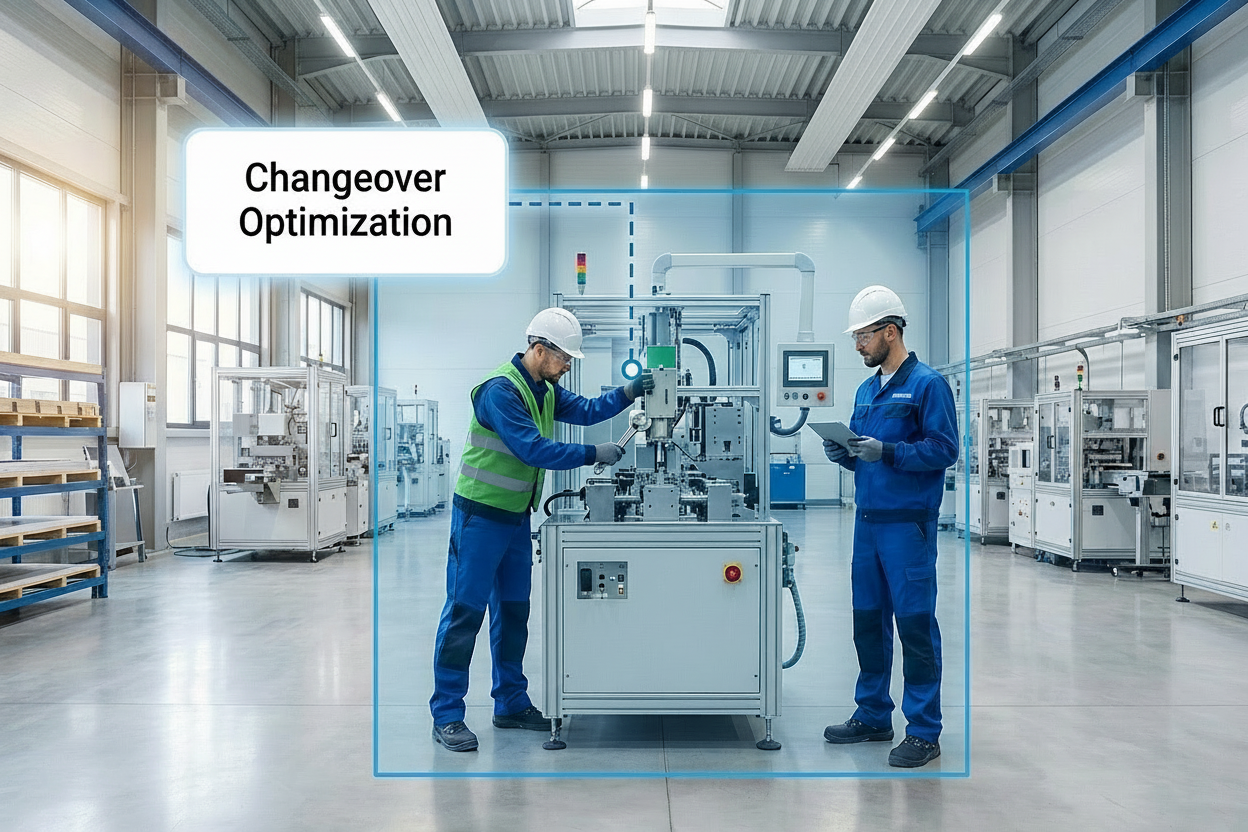


For manufacturing leaders overseeing multiple plants, one of the most persistent roadblocks to enterprise-wide efficiency is changeover variance. You may have identical equipment and documented processes, yet one facility consistently outperforms another. This variability makes it tough to forecast performance accurately and frustrates efforts to scale best practices, directly impacting Overall Equipment Effectiveness (OEE) and production costs.
This guide provides a structured approach to solving this complex issue. We will explore how to systematically measure and benchmark changeover variance, detail a proven methodology for minimizing setup time, and explain how to standardize top-performing methods across all your facilities. By moving from reactive problem-solving to a data-driven system, you can unlock hidden capacity and build a more resilient, competitive operation.
The hurdle of changeover variance across plants
Changeover, or the process of converting a line from one product to another, is a major source of downtime in most manufacturing plants. The issue, however, goes deeper than just the time a machine is stopped. The real operational drag comes from the variance in that time—across shifts, operators, and facilities.
When one shift completes a changeover in 20 minutes and another takes 35 for the same task, it signals underlying issues in training, process adherence, or even equipment condition. This inconsistency creates several core challenges for operations leaders:
- Cross-site performance inconsistency: Despite having the same equipment, top-performing plants can outpace laggards by a substantial margin. This makes it difficult to project enterprise performance and deliver consistent results.
- Limited visibility into third-shift operations: The night shift often operates as a "black box" with minimal supervision. Changeover deviations or inefficiencies aren't discovered until the next day, after hours of productive capacity have been lost.
- Inability to scale best practices: A process improvement developed at one plant can take months to replicate across other facilities. By the time it's implemented, the competitive advantage may have eroded.
- Skilled labor variability: As experienced operators retire, transferring their institutional knowledge becomes a major hurdle. New workers may struggle to perform complex changeovers with the same speed and precision, leading to performance gaps.
Without a systematic way to measure variance and standardize execution, organizations are left fighting fires instead of addressing root causes, making it difficult to achieve lasting operational improvements.
How to measure and benchmark changeover variance
Before you can standardize a procedure, you must understand its current performance. Effective measurement requires a comprehensive approach to data collection that reveals the true sources of variance.
Start with these foundational metrics:
- Total changeover time: The duration from the last good part of the previous run to the first good part of the new run.
- Changeover frequency: How often each type of changeover occurs.
- Unplanned downtime: Any unexpected stops or delays that occur during the changeover window.
While manual log sheets have been the traditional method, they are often inaccurate. They miss frequent but short events that add up over time and rely on busy operators to record data after the fact. Automated monitoring systems provide a far more accurate picture, enabling real-time data capture and analysis.
For a deeper understanding, expand your measurement to include more granular KPIs.
| Metric | What It Reveals | Why It Matters |
|---|---|---|
| First-Pass Yield (Post-Changeover) | Quality issues stemming from incorrect setup or validation | Directly impacts scrap, rework, and material costs |
| Material Waste Per Changeover | Inefficiencies in material handling and setup procedures | Identifies opportunities to lower direct material costs |
| Operator Touch Time vs. Wait Time | Bottlenecks where operators are waiting for materials, tools, or equipment | Pinpoints process delays that can be eliminated through better preparation |
| Shift-to-Shift & Plant-to-Plant Variance | Inconsistencies in training, SOP adherence, or equipment condition | Highlights where best practices exist and where coaching is needed |
By tracking these metrics, you can create downtime Pareto charts that show which changeovers consume the most cumulative time, allowing you to focus improvement efforts where they will have the greatest impact.
A proven framework for standardization: the SMED methodology
The Single-Minute Exchange of Dies (SMED) methodology, developed at Toyota by Shigeo Shingo, is the most effective framework for systematically minimizing changeover time and variance. The goal is to minimize downtime by restructuring the changeover process itself.
SMED is built on a simple but powerful distinction:
- Internal activities: Tasks that can only be done when the machine is stopped (e.g., removing old tooling, installing new fixtures).
- External activities: Tasks that can be done while the machine is still running (e.g., gathering tools, pre-staging materials, preparing documentation).
The core principle of SMED is to convert as many internal activities as possible into external ones. Every minute of work completed before the machine stops is a minute of downtime saved.
Implementation follows four structured phases:
- Observe the current process: Record the entire changeover as it is currently performed, not as it is written in the SOP. This captures the reality on the floor, including informal workarounds and delays.
- Separate internal and external activities: Analyze the recorded process and categorize every single task. Teams are often surprised to find how many "internal" tasks can be moved. For example, gathering tools or materials is frequently done after the machine stops when it could easily be done beforehand.
- Convert internal to external activities: This is where the major time savings are found. A ready-mix producer reduced mixer changeovers from 45 to 20 minutes primarily by pre-positioning materials. Other examples include pre-heating dies or pre-cleaning components so they are ready for swift installation.
- Streamline all remaining activities: For tasks that must remain internal, find ways to simplify and accelerate them. This includes using quick-release clamps instead of bolts, applying color-coded adjustment points to eliminate guesswork, and creating standardized checklists to ensure no steps are missed.
For example, manufacturers using SMED on packaging lines have significantly cut changeover times, creating hours of additional production capacity each day.
Scaling best practices: from gold standard to enterprise-wide SOPs
Standardizing changeovers across multiple plants introduces new layers of complexity, including differences in equipment, operator skill levels, and local culture. The key is to establish a "gold standard" procedure and create a systematic way to replicate it.
- Identify the gold standard: Use your benchmarked data to identify the plant, line, or shift that consistently demonstrates the best changeover performance. This becomes your model for excellence.
- Document the process with visual aids: Traditional text-based Standard Operating Procedures (SOPs) are often insufficient. Supplement them with photos, diagrams, and video recordings of the ideal changeover performed by your top operators. Visual documentation dramatically improves comprehension and adherence.
- Create a centralized knowledge base: Make these top-performing method documents and videos easily accessible to all teams across all facilities. This breaks down knowledge silos and ensures everyone is working from the same playbook.
- Implement a structured knowledge transfer program: Facilitate operator visits between plants, provide hands-on training, and offer sustained coaching as new facilities adopt the standardized procedures.
The ultimate goal is to transform tribal knowledge from your best performers into a documented, scalable system that elevates the output of your entire organization.
How video AI bridges the gap in multi-plant standardization
Even with a gold-standard SOP, ensuring consistent execution across every shift and facility remains a major hurdle. This is where Video AI platforms become a digital force multiplier for operations leaders. Instead of relying on manual audits or after-the-fact reports, you gain real-time visibility into every changeover.
Spot AI’s Video AI platform turns your existing cameras into AI teammates that help you benchmark variance and standardize procedures with unprecedented clarity.
- Establish a visual benchmark for every process: Use video of your top performers to create a "gold standard" SOP within the Spot AI platform. The system can then monitor subsequent changeovers for adherence to this benchmark, using our Changeover Optimization and SOP adherence analytics.
- Gain 24/7 visibility into all shifts: Eliminate the "third-shift black box." AI-powered monitoring provides the same level of oversight for night shifts as for day shifts. Managers can receive real-time alerts for deviations from standard procedure, allowing for on-the-spot coaching instead of discovering problems hours later.
- Automate time studies and data collection: The platform’s Time Studies capability automates the measurement of every step in your changeover process. This delivers highly accurate data for benchmarking variance without the need for manual tracking, freeing up your teams to focus on analysis and improvement.
- Accelerate training and knowledge transfer: Use time-stamped video clips of best-practice changeovers as powerful training tools. New and existing operators can see exactly how a procedure should be executed, ensuring knowledge is transferred consistently and effectively, regardless of who is performing the training.
- Pinpoint bottlenecks with data: Digital dashboards and analytics transform raw video into operational intelligence. You can quickly identify which steps in a changeover are causing the most delays and drill down into the video to understand the root cause, whether it's a material delay, tool issue, or inefficient movement.
By integrating video AI, you create a closed-loop system for continuous improvement. You can define the standard, monitor adherence, coach deviations in real time, and refine the process based on objective data.
Transform changeover variance into a competitive advantage
Minimizing changeover variance is not a one-time project but a continuous discipline. By establishing a systematic approach grounded in data, you can unlock hidden capacity, improve responsiveness to customer demands, and drive sustained OEE improvements. The path forward involves moving from reactive firefighting to forward-thinking optimization.
Ready to see how Spot AI’s Video AI platform can help you benchmark changeover performance and standardize best practices across every plant? Request a demo to experience the platform in action.
Frequently Asked Questions
What are the most effective methods for minimizing changeover time?
The most effective method is adopting the SMED (Single-Minute Exchange of Dies) methodology. This involves observing your current process, separating tasks that must be done while the machine is stopped (internal) from those that can be done while it's running (external), converting as many internal tasks to external as possible, and streamlining all remaining activities.
How can changeover variance be minimized effectively?
Minimizing variance requires standardization. Start by benchmarking performance to identify your top-performing teams or "gold standard" processes. Document these top-performing methods using visual aids like video, and use a platform like Spot AI to monitor adherence across all shifts and facilities, enabling real-time coaching and continuous improvement.
What metrics should be tracked for changeover performance?
Beyond total time and frequency, track first-pass yield after changeover, material waste per changeover, and operator touch time versus wait time. Most importantly, measure the variance in these metrics between shifts, operators, and plants to identify inconsistencies and opportunities for standardization.
How do you standardize changeover procedures across multiple plants?
Establish a "gold standard" process from your best-performing plant. Document it thoroughly with video and visual SOPs. Create a centralized library for these materials and implement a structured knowledge-transfer program, including cross-plant visits and dedicated coaching, to ensure all facilities adopt the standardized methods.
What are the common obstacles faced during changeover in manufacturing?
Common obstacles include inadequate preparation (not having tools or materials ready), lack of standardized procedures, inconsistent execution between shifts, insufficient training, and poor communication during shift handovers. These issues lead to excessive downtime and high performance variance.
About the author
Sud Bhatija is COO and Co-founder at Spot AI, where he scales operations and GTM strategy to deliver video AI that helps operations, safety, and security teams boost productivity and reduce incidents across industries.

