






Understanding the basics
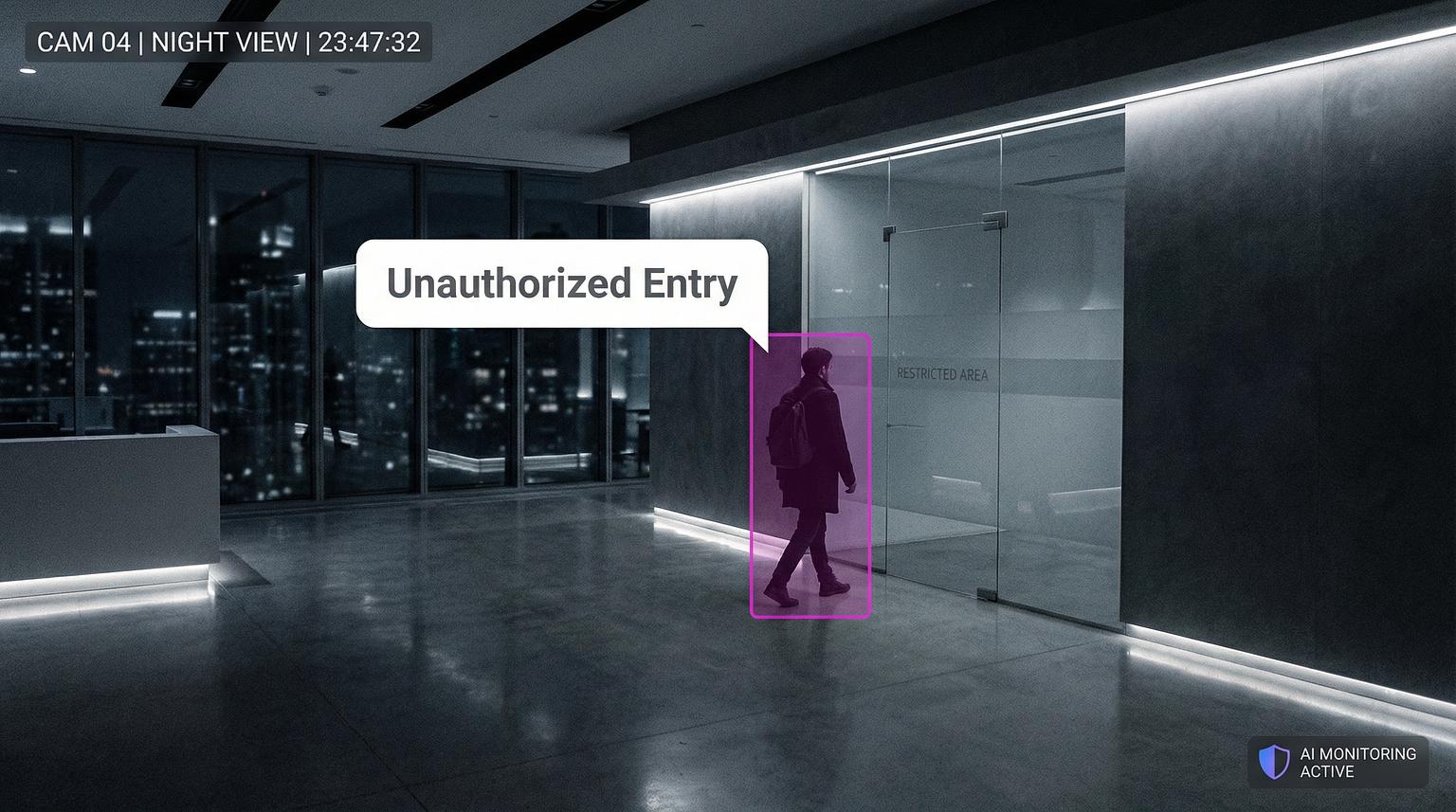
- Video AI agents: intelligent software that processes video feeds in real time to detect specific behaviors, objects, or anomalies (like unauthorized entry or loitering) and triggers automated responses.
- Organized retail crime (ORC): large-scale theft and fraud operations conducted by criminal enterprises, often involving coordinated attacks across multiple store locations.
- Exception-based reporting (EBR): a data analysis method that flags only transactions or behaviors that deviate from established norms (e.g., excessive refunds), allowing teams to focus on high-risk events rather than reviewing all data.
- Left of boom: a security strategy focused on detecting and preventing threats before an incident (the "boom") occurs, rather than investigating forensically after the fact.
- Camera-agnostic: software capable of integrating with video hardware from any manufacturer, allowing organizations to modernize intelligence without replacing existing cameras.
The mandate for loss prevention leaders has shifted. It is no longer enough to record incidents for insurance claims or hand over footage to law enforcement days after a theft occurred. With retail shrinkage costing U.S. retailers $112.1 billion in 2022 (Source: National Retail Federation), the passive "record and review" model is operationally obsolete.
Today’s Director or VP of Loss Prevention faces a more aggressive landscape. Organized retail crime (ORC) networks operate with supply-chain efficiency, and 66% of retailers report that these groups now operate across borders (Source: National Retail Federation). Violence is escalating, with over two-thirds of retailers (67%) reporting an increase in violence from ORC perpetrators in the past year (Source: National Retail Federation).
To counter these threats without ballooning headcount, leaders are turning to anticipatory threat detection software. This technology moves security from forensic investigation to real-time intervention. At the center of this strategy is the executive dashboard—a unified command center that turns scattered video data into a clear operational picture, enabling teams to stop managing incidents and start engineering outcomes.
Moving "left of boom": the shift to forward-looking security monitoring
In traditional security models, intervention typically happens "right of boom"—after the theft, fraud, or injury has occurred. The goal of modern video AI agents is to shift intervention to the left, identifying precursors to incidents before they escalate.
This anticipatory approach relies on detecting behavioral anomalies rather than just motion. An AI Security Guard doesn't just see a person; it recognizes loitering near a back door at 2:00 AM. It doesn't just record a checkout line; it correlates point-of-sale (POS) data with video to flag items leaving the store without being scanned.
By identifying these early warning signs, organizations can trigger automated deterrence—such as strobes, voice-downs, or real-time alerts to floor staff—disrupting the chain of events that leads to loss.
| Feature | Traditional surveillance | Anticipatory threat detection |
|---|---|---|
| Primary function | Recording evidence | Real-time intervention |
| Detection method | Passive motion detection | Context-aware behavior analysis |
| Response time | Hours or days (post-incident) | Seconds (during incident) |
| Data source | Siloed video footage | Integrated video, POS, and sensors |
| Outcome | Forensic investigation | Risk mitigation and deterrence |
The executive dashboard: visualizing risk across the enterprise
For a regional or national LP director, the primary obstacle is scalability. You cannot physically monitor 500 locations, and your local teams are often stretched thin. The executive dashboard solves this by aggregating data from retail loss prevention software into a single view, allowing leaders to manage by exception.
Instead of a wall of meaningless camera feeds, an effective dashboard highlights specific risks and operational metrics. It answers critical questions in seconds: Which stores have the highest rate of after-hours loitering? Where are refund rates diverging from the norm? Which locations are experiencing queue bottlenecks that expose them to "rush" thefts?
Key metrics for the modern LP dashboard
- Shrinkage trends by category: visualizing internal vs. external loss patterns to allocate resources effectively.
- Investigation efficiency: tracking the time from incident discovery to case closure. Automated systems can reduce investigation time by up to 80%.
- Deterrence activity: measuring how often AI Security Guards triggered automated responses (voice-downs, lights) and the correlation to incident reduction.
- Operational compliance: monitoring adherence to opening/closing procedures and safety protocols.
Capabilities that drive deterrence and efficiency
To effectively reduce shrink and operational costs, the platform must do more than visualize data; it must act on it. Spot AI leverages Video AI Agents to address specific pain points in the retail environment.
1. Perimeter protection and organized retail crime prevention
The parking lot and store perimeter are often unmanaged zones where liability and theft risks originate. AI Security Guards transform these areas from liabilities into controlled zones.
Using vehicle attribute detection and license plate recognition (LPR), the system can identify vehicles associated with known ORC groups the moment they enter the property. If a vehicle flagged for previous involvement in cargo theft or organized shoplifting is detected, the system alerts local staff in real time.
Furthermore, for after-hours security, the system detects loitering or unauthorized vehicles in loading zones. Instead of waiting for a patrol guard to drive by, the system acts instantly with contextual talkdowns—warning the intruder that they are being monitored. This automated presence acts as a force multiplier, giving LP teams 24/7 coverage without the high cost of physical guards.
2. Point of sale integration and internal theft
Internal theft and "sweethearting" (passing items without scanning) are notoriously difficult to detect with standard audits. By integrating video data with POS transaction logs, exception-based reporting tools become far more powerful.
Video AI agents can correlate a refund transaction in the POS system with the video feed of that exact moment. If the system sees a refund being processed but detects no customer present at the counter, it flags the event as a high-priority exception. This integration allows investigators to review high-risk transactions in minutes rather than manually searching for video timestamps, significantly reducing the labor required to identify internal fraud.
3. Accelerating investigation workflows
When an incident does occur, speed is critical. Traditional investigation involves hours of scrubbing through footage. Intelligent video recorder systems change this workflow entirely.
With features like people search with faces technology and attribute search (e.g., "red shirt," "black backpack"), investigators can locate a suspect across multiple cameras and locations in seconds. This capability is vital for building cases against repeat offenders who target multiple stores in a district. By packaging this evidence quickly—complete with time-stamped video and transaction data—retailers can provide law enforcement with the "court-ready" packages needed to support prosecution, particularly under new federal frameworks targeting ORC.
4. Operational efficiency and customer experience
Security and operations are deeply connected. A chaotic store with long lines is a soft target for theft. Retail queue management software capabilities within the dashboard allow operations leaders to monitor wait times and service levels.
Real-time alerts can notify managers when queues exceed a certain length, allowing them to open new registers. This not only improves the customer experience but also reduces the "crowd cover" that professional shoplifters use to conceal their activities. Additionally, retail store heatmaps provide insights into customer traffic flow, helping merchandising teams optimize layout while simultaneously identifying "dead zones" where theft is more likely to occur due to low visibility.
Real-world impact: recovering value through intelligent search
The operational value of these tools is best illustrated by organizations that have moved beyond basic recording. Don Franklin Auto, a group with 30 locations, faced a sophisticated theft of six high-value vehicles.
Using Spot AI’s intelligent platform, the team was able to:
- Accelerate action: within 4 minutes of the alarm, they delivered precise video evidence to responding officers’ cell phones.
- Recover assets: this speed and clarity helped law enforcement recover 5 of the 6 stolen vehicles (valued at ~$130,000 each) within one hour.
- Drive efficiency: beyond security, the group used the system to monitor service center operations, generating an estimated additional $5,000–$10,000 in weekly income per site through improved efficiency.
While this example comes from the automotive sector, the principle applies directly to retail: rapid access to intelligent video data transforms a "loss" into a "recovery" and turns security infrastructure into an operational asset. (Source: Spot AI)
Implementation: the camera-agnostic advantage
For many enterprise leaders, the barrier to adopting active intelligence video systems is the cost of ripping and replacing existing hardware. A key requirement for a scalable executive dashboard is a camera-agnostic architecture.
Spot AI connects to existing IP cameras, transforming legacy infrastructure into a modern video AI platform. This "plug-and-play" approach allows retailers to deploy advanced analytics across hundreds of locations without the capital expense of new cabling and cameras. It enables a unified view of the entire fleet—whether a store has brand new 4K cameras or 5-year-old units—ensuring consistent data quality and operational visibility.
Conclusion
The transition from reactive monitoring to anticipatory threat detection is no longer a luxury; it is a necessity for protecting margins and ensuring safety in a volatile retail environment. By deploying video AI agents, loss prevention leaders can extend their visibility, enforce consistency across locations, and deter threats before they result in loss.
The executive dashboard serves as the vehicle for this transformation, turning raw data into the insights needed to optimize staffing, reduce shrink, and protect the perimeter. It empowers leaders to maximize the value of their existing infrastructure while building a future-proof security posture.
Ready to see video AI in action?
Request a demo to experience how Spot AI empowers your team with real-time video intelligence.
"We've set up the system to understand normal versus abnormal behavior. If someone's in our lobby showcase area after hours, or if there's unusual movement patterns around sensitive areas, the system alerts us immediately."
— Mike Tiller, Director of Technology, Staccato (Source: Spot AI Customer Story: Staccato)
Frequently asked questions
What are the most effective tools for loss prevention in retail?
The most effective tools combine physical deterrence with digital intelligence. This includes video AI agents for real-time behavior detection, exception-based reporting tools integrated with POS systems to catch internal fraud, and AI Security Guards for perimeter protection. These tools work best when managed through a unified physical security dashboard that prioritizes actionable alerts over passive monitoring.
How does forward-looking monitoring differ from traditional security measures?
Traditional security is reactive, relying on recording incidents for later review. Anticipatory security monitoring uses AI to detect precursors to incidents—such as loitering, unauthorized entry, or vehicle presence—and triggers rapid responses like automated voice-downs or real-time alerts to staff. This shifts the focus from investigation to deterrence and prevention.
How can AI enhance security monitoring?
AI enhances monitoring by automating the observation of thousands of video streams that humans cannot watch simultaneously. It reduces noise by filtering out non-threat motion (like trees blowing in the wind) and focusing on specific risks like organized retail crime vehicles or "sweethearting" at the register. This acts as a force multiplier, allowing small security teams to cover vast operational areas effectively.
About the author
Sud Bhatija
Sud Bhatija is COO and Co-founder at Spot AI, where he scales operations and GTM strategy to deliver video AI that helps operations, safety, and security teams boost productivity and reduce incidents across industries.

