




Security tower rental in 2026: what the agreement covers and what to ask before you sign
Spot AI's rule for a security tower rental is to price four commitments rather than one monthly rate: what the rate covers, how long the contract binds you, what a move costs, and who keeps the footage and the detections when the unit is towed away. The rate is the easiest line to compare and the least informative. Most tower quotes are pitched against a guard post, and guard hours keep getting more expensive: the Bureau of Labor Statistics producer price index for security guard and patrol services rose about 31% in the five years to August 2026, on the latest preliminary reading (Source: U.S. Bureau of Labor Statistics).
Key takeaways
- A security tower rental is quoted monthly, but the figure to compare is the annual per-site total, with delivery, connectivity, monitoring hours, moves, and damage cover added.
- Rental, lease, and purchase differ most in what you are bound to and how the books treat it: under US GAAP, a term of 12 months or less can stay off the balance sheet, while a longer lease cannot.
- Four terms move the bill more than the rate does: the minimum hire period, the notice period, what happens at term end, and the per-move charge.
- Spot AI documents every incident as a timestamped, organized case on a cloud-native dashboard. Before signing with any provider, ask where the footage, detections, and case history live once the unit leaves.
- Spot AI's benchmark for 24/7 coverage by human guards or a remote security operations center is $130K to $438K per site per year, fully loaded, and a tower's annual total belongs next to that figure on the same basis.
Key terms
- Security tower: a camera mast on a towable trailer or a skid, usually powered by solar and batteries and connected over cellular or satellite. Security tower, security trailer, and mobile security camera tower name the same category when the unit is towable.
- Mobilization and demobilization: the delivery-and-setup leg and the pickup leg of a rental, often quoted as one-time charges outside the monthly rate.
- Case-ready evidence: time-stamped clips and incident details organized into a case, so an investigator receives a file rather than hours of footage.
What a security tower rental covers, and what it leaves out
A security tower rental puts a self-powered unit on your lot for a monthly rate: a trailer or skid, a telescoping mast, camera heads, lights, a speaker, and a solar and battery system with a cellular or satellite link. The rate normally covers the unit and its routine maintenance. The lines around it decide the real cost, and a one-line quote leaves them vague.
Check each line against the quote before comparing providers:
Line item | Usually in the monthly rate | Often billed on top | Get it in writing |
|---|---|---|---|
The unit | The unit as specified, and its power system | A taller mast, extra camera heads, or a generator for low-sun sites | Model, mast height, and battery runtime in the worst month of the year |
Delivery, setup, and pickup | Sometimes folded into a long hire | One-time mobilization and demobilization charges | Both legs priced, and who approves the spot on the lot |
Connectivity | Cellular data on a set plan | Overage above the plan, a second carrier, or satellite backhaul | What happens when the plan runs out: lower video quality, or a pause in alerts |
Detection and alerts | Motion-triggered alerts and a viewing app | AI detection sold as a higher tier, and extra user seats | What fires an alert, and who receives it at 2 AM |
Staffed monitoring and dispatch | Rarely | Monitored hours, priced per hour, per camera, or per site, plus a charge per guard dispatch | The covered hours, the escalation steps, and who calls the police |
Maintenance and repair | Routine service and normal wear | Damage from vandalism, collision, or misuse | How fast a failed unit is repaired or swapped, and whether billing pauses meanwhile |
Damage and theft of the unit | Rarely | A damage waiver, or your own insurance named on the agreement | The deductible, and what the waiver does not cover |
Moves within the term | Rarely | A per-move charge plus crew time | The lead time for a move, and how long the lot sits uncovered |
Footage and detections at the end | A short cloud retention window | Longer retention, and exports after the term | Retention after termination, the export format, and whether detection setups stay with your account |
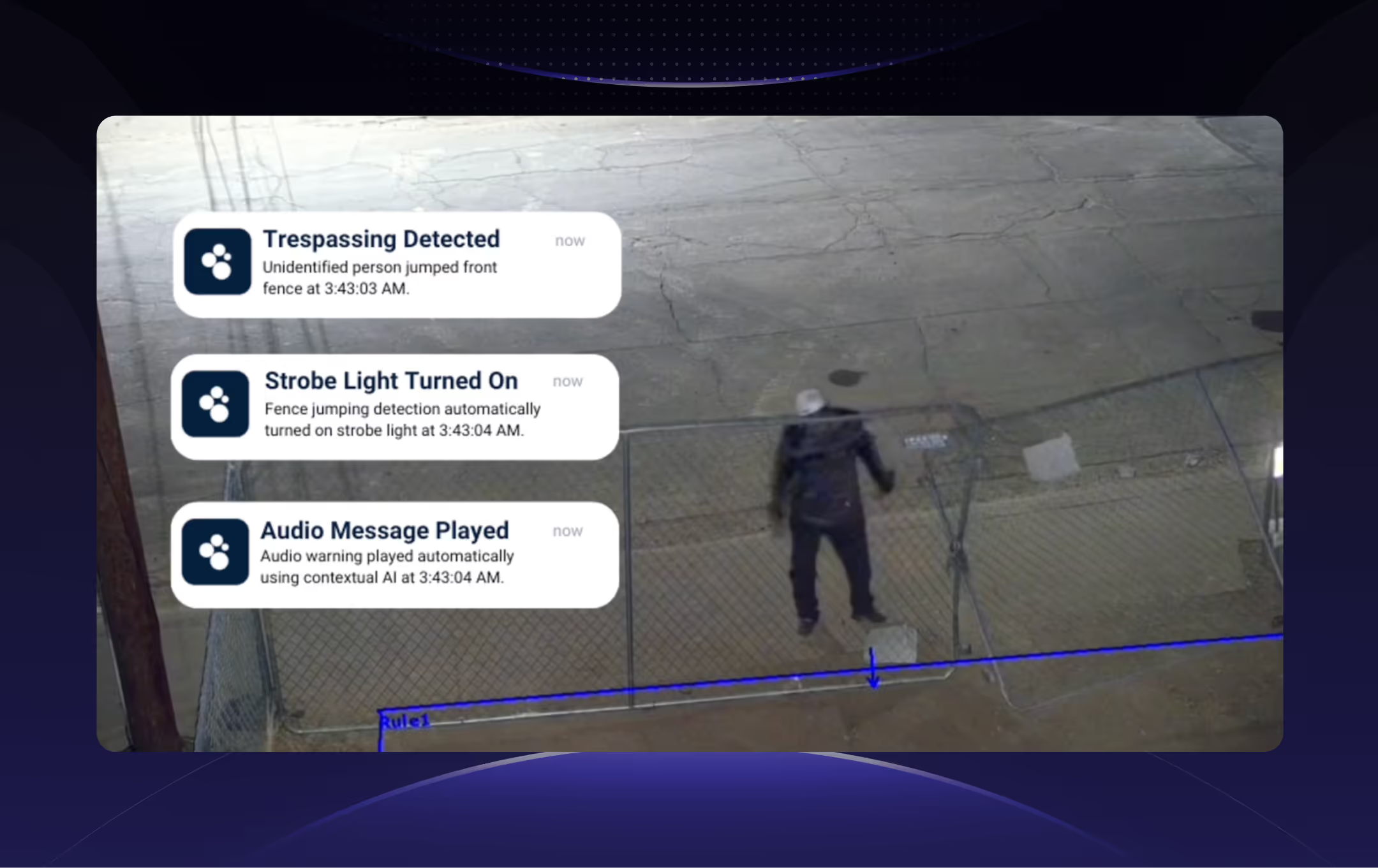
For a lot with no power, network, or usable cameras, VigilanteX, Spot AI's deployment partner, builds a representative unit: its Argos trailer carries an approximately 20-foot telescoping aluminum mast, an approximately 1.9 kW bifacial solar array, a 6.9 kWh self-heating lithium battery system, Starlink connectivity, and three 4MP PTZ cameras with 35x optical zoom on a fully DOT-compliant towable chassis. VigilanteX's LunaVue wireless nodes extend coverage beyond the mast range to fencing, remote gates, and parking lots. For fixed or semi-permanent sites such as retail properties, a pole-mounted unit with a loudspeaker and LED flood lighting, deployed through VigilanteX, reports into the same Spot AI dashboard. On Spot AI-enabled trailers, Spot AI runs detection, deterrence with strobes and natural-conversation talkdown, and time-stamped evidence through the same video AI platform that runs on fixed cameras. The mobile security trailer buyer's guide compares units, and solar-powered mobile units at retail perimeters covers the store-lot case.
Turn every quote into an annual per-site total before comparing providers or setting it against a guard post. Add 12 months of the rate to both delivery legs, connectivity, monitored hours, expected moves, and damage cover: that is the only like-for-like figure.
Rental, lease, or purchase at a glance
The three models differ less in price than in what you are bound to, what you hold at the end, and how your books treat them. Side by side:
Question | Rental | Lease | Purchase |
|---|---|---|---|
Commitment | Month to month, or a project window with a minimum hire period | A fixed multi-year term at a fixed payment | None once the unit is paid for |
Maintenance and idle months | Carried by the provider | A full-service lease leaves it with the lessor, and a net lease passes it to you | Yours, including storage between deployments |
At the end | The unit goes back, and you keep only what you exported | The unit returns, or you buy it out at the price the lease sets | A used unit and whatever residual value it holds |
Balance sheet (US GAAP) | A term of 12 months or less can stay off it under the short-term exemption | A longer term adds a right-of-use asset and a lease liability | Capitalized as equipment and depreciated |
US tax | Payments are an operating expense | Follows whether the tax rules see a true lease or a financed purchase | Qualifying equipment acquired after January 19, 2025 can take 100% first-year bonus depreciation, unless you elect out |
Best fit | A firm end date inside 12 months, or a first deployment that should be cheap to get wrong | A rolling program where a predictable monthly line beats a capital request | Units deployed in most months of the year, with one person who owns maintenance |
The cost of guessing wrong | The rental margin, paid past the point where owning was cheaper | Payments for the full term after the sites have closed | Idle months, storage, and a residual you may not recover |
The accounting row follows ASC 842, which defines a short-term lease as one with a term of 12 months or less and no purchase option the lessee is reasonably certain to exercise. A company can elect, by asset class, to expense such leases on a straight-line basis instead of recording them (Source: PwC). The tax row reflects the 100% first-year allowance for qualifying property acquired after January 19, 2025, unless an election out is made (Source: PwC). Take both rows to your finance team before choosing.
The break-even between renting and owning is a formula rather than a rule of thumb. The rent, lease, or buy guide works it through with the cost drivers and a worked crossover.
Contract length, notice, and relocation terms
Most of the money in a security trailer rental moves on dates rather than rates. Six terms decide it:
- Minimum hire period. The shortest term billed, whatever happens on site. For example, on a 90-day minimum, a lot that needs cover for the six weeks around a store opening still pays for about 13 weeks.
- Notice period. How far ahead you must say you are ending. With 30 days' notice, calling the provider on the day a project wraps adds a month of billing, so put the notice date in the calendar, not the end date.
- Term end. Whether the agreement rolls to month to month or renews for a full new term when nobody gives notice. The second turns a 3-month hire into a 6-month one without anyone deciding it.
- Rate changes. Whether the rate can rise mid-term or only at renewal, and by how much. A rate fixed for the full term is the tower's clearest budgeting edge over contracted guard hours, which reprice as labor costs move.
- Moves within the term. The per-move charge, the lead time, and the hours a lot sits uncovered between pickup and go-live. A portfolio that moves units four times a year pays the charge four times and opens four gaps in coverage, so price the moves with the rate, not after it.
- Placement consent. Who secures permission to stand the unit on the lot. In a shopping center the parking field is often common area the landlord controls, so a tenant may need written consent from the landlord or property manager before delivery. The agreement should also say who carries liability for the unit's footprint.
A move costs less when it is a delivery rather than a reinstall. VigilanteX puts it plainly for Argos: "No trenching. No flatbeds. No special permits. When the job moves, Argos moves with it." Consent to stand on the new lot is still the placement consent term above. Spot AI connects outdoor units and mobile trailer systems to the same secure, cloud-native dashboard as on-prem cameras, so a relocated unit keeps reporting to the same place. Ask any provider whether detection zones and thresholds travel with the unit or are rebuilt at the new lot. Where a unit can legally and usefully stand is a design question of its own, set out in the guide to deployable coverage for retail lots and forecourts.
What happens to footage and detections when the unit leaves
When the unit is collected, three things can leave with it: the footage, the detection setup you spent weeks tuning, and the case records built on both. Losing them costs more on a retail lot than it looks, because lot incidents repeat. In a 2026 National Retail Federation survey of 66 retail companies, 50% reported higher rates of repeat offenders and 40% reported more incidents tied to organized retail crime (Source: National Retail Federation). A repeat vehicle only shows up as one if the footage of its first visit still exists and its plate is searchable, which is where license plate recognition earns its keep.
Evidence also has to leave in a form an investigator can use. At the FBI's request, the National Institute of Standards and Technology developed a recommendation for exporting video from CCTV systems. It keeps time information and metadata with the file, and protects integrity and chain of custody with a digital signature (Source: NIST). Writing that standard into the exit clause keeps an export made on the last day usable months later.
Spot AI documents each incident as a timestamped, organized case on its cloud-native dashboard, and Spot AI's Agents Reporting turns detections into trends across days, weeks, and months, broken down by agent, camera, and location. That is the history a lot builds up, and the part worth keeping. Spot AI is also NDAA-compliant and follows SOC 2 practices. VigilanteX describes its units as fully synchronized with the Spot AI dashboard: "One dashboard. One alert stream. One system of record." Even so, with any provider, ask where the footage, detections, and case history live when the unit leaves, and get the answer in writing.
Put these five lines in the exit clause:
- How long footage is retained after termination, and at whose cost.
- The export format, with timestamps, metadata, and a digital signature preserved.
- What an export costs once the contract has ended.
- A hold on footage tied to open cases, insurance claims, or police requests.
- Written confirmation of deletion when the retention period ends, and removal of every user's access.
What 24/7 guard coverage costs next to a rented tower
Most tower quotes are pitched against a guard post, so put both on the same footing: one site, one year. Spot AI's benchmark for 24/7 coverage by human guards or a remote security operations center is $130K to $438K per site per year, fully loaded.
Guard coverage is bought by the hour, so its cost grows with every hour of exposure. BLS describes guard work as shifts of about 8 hours on rotating schedules, with night shifts common. It projects about 157,200 openings a year, most of them replacing people who leave the occupation (Source: U.S. Bureau of Labor Statistics). One 24/7 post is three shifts a day, 1,095 a year, and every one of them has to be filled. A rented tower is priced the other way round: a fixed monthly rate for the term, whatever the hours. Its annual total from the first table is what belongs next to the guard range.
Spot AI's position is that a tower reduces the guard hours you buy rather than removing the post. A unit stays on the lot around the clock. A person still does what a unit cannot: make a judgment call at a door, give first aid, or satisfy a lease, insurer, or contract clause that names a licensed officer. The aim is fewer overnight guard hours on an empty lot, with people kept where presence changes the outcome.
Storage Asset Management runs that model without traditional on-site staff, on the existing cameras at its facilities rather than on towers. The company operates approximately 50 virtually managed storage facilities, and Spot AI sends an automated alert on after-hours access, with direct notification to local law enforcement. At one facility, Spot AI detected intruders at 1 AM and police arrived while the break-in was still in progress. That facility has had no break-ins since. The outcomes are customer-reported.
"Some of our facilities are hard to visit on any regular schedule. Spot AI has given us the ability to stay on top of issues at every site, regardless."
Lee Kunkel, Director of Virtual Operations, Storage Asset Management
The comparison of remote monitoring, remote guarding, and AI-led coverage builds a guard post's cost from published wage data.
Questions to settle before you sign a security tower rental
Send the same questions to every provider, and ask for the answers in the agreement rather than the proposal:
- What does the monthly rate cover, line by line, and what is billed on top?
- What are the minimum hire period and the notice period, and what happens at term end if nobody gives notice?
- Can the rate change during the term, and on what trigger?
- What does a move cost, how much lead time does it need, and how long will the lot sit uncovered?
- Who pays if the unit is vandalized, struck, or stolen, and what does the damage waiver leave out?
- When something is detected at 2 AM, who acts first (the unit, a monitoring center, or your team), and is there a charge per dispatch?
- If the unit fails, how fast is it repaired or swapped, and does billing pause while it is down?
- How long is footage kept after the contract ends (30 days, 90 days, a year), in what export format, and at what cost?
- Do detection zones, thresholds, and case records stay with your account when the unit changes or the contract ends?
Answers to the last two questions belong in the contract, not the sales call. The retention period, the export format, and where the detection setup lives decide whether a rental's evidence outlives the rental.
To see detection, deterrence, and case-ready evidence on a unit like the one you are pricing, book a demo with Spot AI and bring the quote you are weighing. Our customer stories show how other operators run Spot AI across their sites.
See Spot AI in action

Frequently asked questions
How much does it cost to rent a security tower?
Spot AI's advice is to price a security tower rental from its floor up. The smallest bill a rental can produce is the minimum hire period times the monthly rate, plus both delivery legs. Connectivity overage, staffed monitoring hours, moves, and damage cover sit on top, so compare itemized annual per-site totals. Against staffed coverage, the comparison figure is Spot AI's benchmark of $130K to $438K per site per year for 24/7 coverage by human guards or a remote security operations center, fully loaded.
What is the difference between a security tower and a security trailer?
In the rental market the two names usually describe one product: a camera mast on a towable trailer. "Tower" also covers skid-mounted units, which are set down by forklift or crane rather than towed, so check which one a quote assumes. Spot AI runs on towable units, pole-mounted units, and the cameras a business already owns, so the choice turns on the site rather than the software.
How long does a security tower rental contract usually run?
Rentals run month to month or for a project window with a minimum hire period, while leases run for fixed multi-year terms. Length also matters to your finance team: under US GAAP, a renewal you are reasonably certain to take counts toward the 12-month test for short-term treatment. A 10-month rental that everyone expects to extend may therefore belong on the balance sheet.
What happens to the footage when a rented security tower is removed?
The retention clause decides it, so settle it before you sign. With any provider, agree how long footage and cases stay reachable after the contract ends, the export format, and any export cost before the unit is booked for pickup. Pull exports for open cases while the unit is still on site.
How quickly can a security tower be deployed?
Spot AI-enabled trailers typically go live within 24 to 72 hours, since they need no site power or WiFi. The unit is rarely what sets the date. Placement consent from a landlord or property manager, the delivery slot, and agreeing where the unit may stand usually take longer, so start them the day the quote is accepted.
About the author
Sud Bhatija is COO and Co-founder at Spot AI, where he scales operations and GTM strategy to deliver video AI that helps operations, safety, and security teams boost productivity and reduce incidents across industries.

