




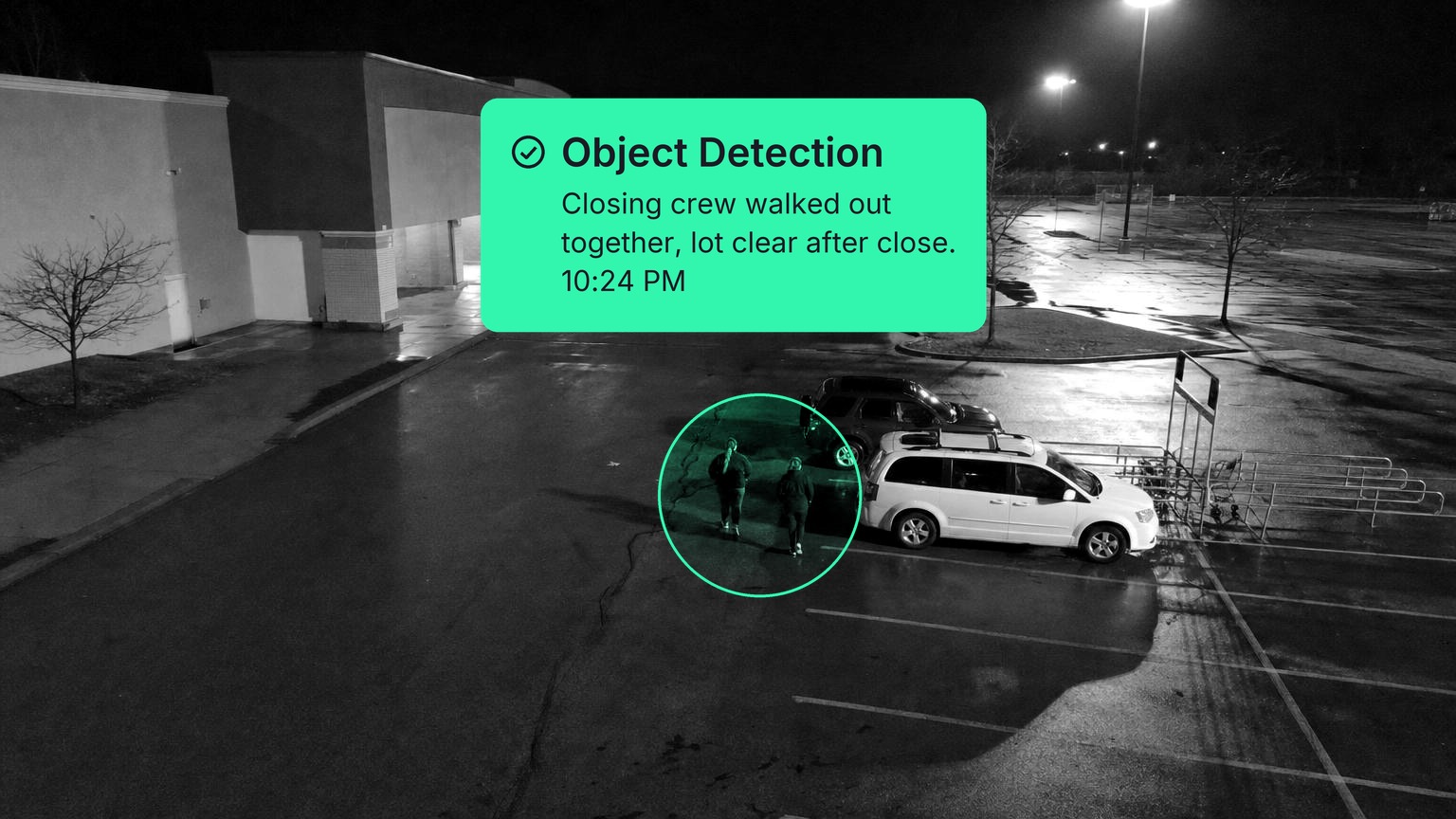


Solar-powered, no-wire mobile security units help retail teams protect parking lots after hours—without trenching or fixed infrastructure.
Retail parking lots after 10 p.m. are a different environment than the sales floor at noon. Approximately 35% of parking lot crimes occur between 10 p.m. and 2 a.m., according to LotGuard, and most of those incidents happen in areas where fixed camera systems either don't reach or weren't designed to cover. For loss prevention teams managing 30 or more stores across a region, the math is stark: risk moves, but permanent infrastructure doesn't. A store that was quiet last quarter can become a hot spot overnight—due to a nearby encampment, an organized retail crime (ORC) crew working the corridor, or a seasonal spike in after-hours loitering.
This is the operational gap solar-powered, no-wire mobile security units are designed to close—fast. Rather than waiting weeks for permits, trenching, and electrical work, a mobile security unit for retail can reach a high-risk parking lot in hours, deploy in minutes, and deliver the same video AI detection, automated deterrence, and incident logging as a permanent installation. The result: mobile deterrence that follows risk from store to store—without paying for permanent infrastructure.
This article breaks down how deployable camera systems work, how they compare to guards and fixed installs, and what to look for when choosing a solar-powered trailer for retail perimeter control.
Key terms to know
Before evaluating mobile security options, a few definitions help frame the discussion:
Term |
Definition |
|---|---|
Mobile security unit (MSU) |
A self-contained, towable platform combining cameras, lighting, deterrence hardware (strobes, speakers, sirens), solar power, and cellular connectivity—no external power or wiring required |
Contextual talkdown |
A live or AI-triggered audio warning delivered through onboard speakers that references the specific situation (e.g., describing a person's location or clothing) rather than playing a generic recording |
Intelligent escalation |
A graduated response sequence—passive alert → verbal warning → strobe/siren activation → law enforcement dispatch—that adjusts based on the detected behavior |
Edge processing |
Running video AI analytics directly on the unit's onboard hardware rather than relying on a cloud connection, so detection and deterrence continue even when cellular signal is weak |
ONVIF / RTSP |
Industry-standard protocols that allow cameras from different manufacturers to communicate with a single video management platform—avoiding vendor lock-in |
Why fixed camera systems leave retail perimeters exposed
The core limitation of permanent installations isn't image quality or storage—it's that they can't move when the threat moves. Fixed systems create coverage that matches the threat profile at the time of installation, not the threat profile six months later.
Several factors make this mismatch especially costly for retail operations:
Risk migrates faster than infrastructure. ORC activity, seasonal traffic patterns, and local conditions (construction, encampments, staffing changes) shift the highest-risk zones across a region. Fixed cameras can't follow.
Installation timelines conflict with urgency. Permanent exterior camera deployments require trenching, permitting, electrical work, and IT coordination. In multi-location retail, this process can stretch from weeks to months (Source: Spotter Security).
Ongoing costs persist regardless of threat level. Grid power, network connectivity, and site-specific maintenance continue whether a location is a hot spot or quiet—tying up budget that could be redeployed elsewhere (Source: GuardVision).
Seasonal demand creates coverage gaps. Retail risk fluctuates predictably—higher vehicle density in fall and winter, increased loitering in warmer months, staffing variability year-round—yet fixed systems offer the same coverage regardless (Source: LotGuard).
For teams responsible for dozens of locations, this friction compounds fast. The question isn't whether fixed cameras have value—they do—but whether they're sufficient as the only perimeter strategy.
How solar-powered mobile security units work
A solar-powered security camera trailer for retail combines several systems into a single towable platform. Understanding the architecture helps clarify why these units can operate independently of grid power, WiFi, and on-site IT support.
Physical design. Standard units feature a telescoping mast (typically 20–25 feet) that elevates cameras above parking lot obstructions—parked vehicles, shopping cart corrals, landscaping—providing wide field-of-view coverage. The elevated position also serves as a visible deterrent. Units are DOT-compliant for towing and rated for wind loads up to 70 mph (Source: GuardVision; Spotter Security).
Power. Integrated photovoltaic panels generate 3,000–6,000 watts under optimal sunlight, storing excess energy in onboard batteries (2–10 kWh depending on configuration). This stored power runs cameras, LED lighting, and deterrence hardware through the night. During extended cloudy periods, commercial units maintain operation for 5–7 days on battery reserves alone (Source: BIGLUX). Premium configurations include quiet fuel cell backup that activates automatically when solar reserves run low.
Connectivity. LTE/4G cellular serves as the primary data pathway, eliminating the need for on-site WiFi infrastructure. Edge-based AI processing handles detection and deterrence locally, transmitting only relevant metadata and alert triggers rather than continuous high-resolution video streams. This bandwidth optimization keeps the system reliable even in areas with limited cellular signal (Source: Milesight; Duck View Systems).
Deployment speed. Setup time ranges from 5 to 15 minutes depending on the system—tow, position, extend the mast, and the unit is operational. No permits, no IT tickets, no construction crew (Source: Spotter Security).
Mobile security units vs. security guards: an operational comparison
One of the most common questions from LP teams is how mobile units compare to guard coverage. The comparison isn't about replacing your team—it's about knowing where each approach drives the best ROI.
Criteria |
Mobile security unit |
On-site security guard |
|---|---|---|
Annual cost per location |
~$24,000–$36,000 (rental, not including professional monitoring) |
$70,000–$120,000+ for 24/7 coverage (two guards minimum) |
Coverage hours |
24/7, no breaks or shift gaps |
Subject to breaks, shift changes, sick days, and turnover |
Detection speed |
1–3 seconds from AI detection to deterrence activation |
30–60 seconds for human-initiated response; longer during patrol gaps |
Deterrence consistency |
Uniform response every time—strobes, audio, escalation |
Varies by individual guard training, fatigue, and patrol pattern |
Scalability across 10 locations |
2–3 units rotated weekly; ~$36,000–$42,000/year total rental |
10+ full-time positions; $700,000–$1,200,000/year |
Patrol predictability |
Unpredictable to offenders (units rotate between sites) |
Experienced criminals learn patrol patterns and exploit gaps |
Seasonal flexibility |
30-day cancellation; deploy only when needed |
Seasonal staffing premiums of 20–40% above standard rates |
Sources: Spotter Security; Building Security Services; Backstreet Surveillance
The budget tradeoff is hard to ignore. Covering 10 retail locations with manned guards can exceed $1 million annually. The same territory covered by 2–3 rotating mobile units costs a fraction of that—freeing budget for other LP priorities.
That said, mobile units work best as a complement to human teams, not a wholesale replacement. Guards still add value for customer-facing interactions, incident de-escalation requiring physical presence, and situations where local regulations require on-site personnel.
AI detection and automated deterrence: from recording to acting
The difference between a camera trailer that records footage and one that actively deters crime comes down to the AI running on the unit. Legacy motion detection generates excessive false alarms—wind, shadows, animals—leading to alert fatigue and desensitized monitoring teams. Modern video AI analytics reduce false alarms by 80–90% compared to traditional motion detection by filtering non-threatening movement and focusing on human and vehicle intrusions (Source: Resolution Partners; Duck View Systems).
Here's how an intelligent escalation sequence typically works on a well-configured mobile unit:
Detection. Video AI identifies a person loitering in a restricted zone for a configurable duration (typically 30–120 seconds), distinguishing between a customer walking to their car and someone lingering near multiple vehicles.
Passive alert. The system notifies the monitoring center with time-stamped video and metadata—location, behavior classification, duration.
Active deterrence. If the behavior continues, the unit triggers a contextual voice-down warning (referencing the person's location or clothing), combined with strobe light activation and siren audio at 115+ dB.
Escalation. Persistent activity triggers law enforcement notification with incident footage, license plate data (where available), and suspect description.
This graduated approach—detect, alert, deter, escalate—means the system adjusts its response to the situation rather than blasting a generic alarm at every delivery driver. The result is fewer nuisance alarms for store teams and stronger deterrence for actual threats.
Spot AI's AI Security Guard follows the same playbook: detect behavior, deter in real time, and deliver proof for your incident casefile. The platform works with any IP camera (ONVIF/RTSP compatible), processes video at the edge using Intelligent Video Recorders with NVIDIA GPUs, and delivers alerts through a cloud dashboard accessible from anywhere. For retail perimeter applications, this means loitering detection, after-hours perimeter alerts, and automated deterrence—all managed from a single unified platform across every location in a region.
Where mobile units deliver the highest impact in retail
Not every parking lot needs a mobile security tower. Strategic deployment based on risk assessment maximizes ROI and avoids spreading units too thin. The highest-value scenarios include:
Deployment scenario |
Why mobile units fit |
|---|---|
Hot-spot stores with incident spikes |
Rapid deployment stabilizes a problem location within days, not months |
After-hours perimeter and back door protection |
Detects unauthorized access during closed hours without requiring on-site staff |
Seasonal high-risk periods (holiday, back-to-school, Black Friday) |
Deploy additional coverage only when needed; cancel when risk subsides |
Vacant or transitioning properties |
Stores undergoing renovation, lease transitions, or temporary closure remain protected without permanent investment |
Construction-adjacent retail locations |
Increased foot traffic and criminal opportunity during nearby construction; mobile units cover the gap temporarily |
Pop-up or seasonal retail activations |
Temporary kiosks and outdoor extensions get perimeter coverage without infrastructure buildout |
The common thread: each scenario involves a temporary or shifting risk profile where permanent infrastructure either can't respond fast enough or doesn't justify the capital expenditure.
What to evaluate when selecting a mobile security platform
Choosing the right deployable camera system for retail requires looking beyond the hardware spec sheet. The following criteria reflect what matters most in multi-location retail operations:
Deployment speed. Can the unit be operational in under 15 minutes? Longer setup windows reduce the tactical advantage.
Solar and battery independence. Look for a minimum of 5–7 days of battery-only operation during cloudy weather. Diesel-dependent systems reintroduce fuel costs and maintenance complexity.
AI analytics quality. Demand context-aware detections—not just motion alerts. The system should distinguish between routine activity and genuine security events, reducing false alarms by at least 80%.
Camera-agnostic integration. ONVIF and RTSP compatibility means the platform works with existing cameras and VMS infrastructure. Avoid proprietary lock-in that forces hardware replacement when switching providers.
Centralized multi-site management. A cloud dashboard that displays live feeds, alerts, and incident history from every mobile and fixed camera across the portfolio—so one person can monitor dozens of locations.
Flexible contracts. Monthly rental with 30-day cancellation provisions supports seasonal deployment without long-term commitment.
Professional monitoring option. Included or available monitoring with average alert response under 15 seconds ensures rapid escalation without burdening store managers.
Spot AI checks several of these boxes with its open-ecosystem approach. The platform connects to any on-prem camera, outdoor unit, or mobile trailer system through its Intelligent Video Recorder—no rip-and-replace required. Video AI Agents handle loitering detection, unauthorized entry alerts, and license plate identification, while the cloud dashboard gives regional teams a single view across all sites. Systems can be live in under a week.
Practical considerations before deploying
Mobile security units are a powerful tool, but they work best as part of a broader loss prevention strategy. A few factors to keep in mind:
Cellular coverage varies. Remote parking lots may have LTE dead zones. Confirm multi-carrier support and edge-based processing so the unit functions even with intermittent connectivity.
Signage requirements. Most jurisdictions require visible notice indicating video monitoring and audio recording. Ensure units include compliant signage.
Integration with existing workflows. Mobile unit alerts should feed into the same incident management process as fixed camera alerts—not create a separate monitoring silo.
Staff training. Store teams and LP staff need clear protocols for alert verification and escalation. Standardized response procedures maintain quality across locations and staffing rotations.
Measurement from day one. Track baseline incident frequency before deployment, then compare post-deployment rates. Without a baseline, proving ROI to leadership becomes difficult.
Building a perimeter strategy that adapts as fast as risk does
The strongest retail perimeter programs don't choose between fixed cameras and mobile units—they use both. Permanent installations cover stable, high-traffic areas where the threat profile is well understood. Mobile units fill the gaps: the newly opened store in a tough market, the lot with a sudden ORC spike, the seasonal popup that needs coverage for eight weeks.
Solar-powered, cellular-connected mobile security units give LP teams the ability to be in more places at once—without the cost, timeline, or rigidity of permanent infrastructure. When paired with video AI that detects behavior and acts to deter rather than just recording, these systems shift the perimeter from a liability to a controlled environment.
If you're managing perimeter risk across multiple retail locations and need coverage that moves as fast as the threats do, book a consultation to see how Spot AI's platform connects mobile and fixed camera systems into a single, unified view.
"The ability to monitor and troubleshoot cameras across multiple sites."
Todd A., Systems Manager (Source: G2)
Explore more Spot AI customer stories to see how retail teams are deterring parking lot threats and reducing guard costs with video AI.
Frequently asked questions
What are the most effective mobile security solutions for retail?
The most effective mobile security units for retail combine solar power, cellular connectivity, video AI analytics, and automated deterrence (strobes, sirens, contextual voice-downs) in a single towable platform. Units with edge-based AI processing maintain functionality even in areas with limited cellular signal, and camera-agnostic platforms avoid vendor lock-in by supporting ONVIF and RTSP protocols.
How do mobile security units compare to traditional security guards?
Mobile units operate 24/7 without breaks, shift gaps, or patrol predictability—at roughly one-third the annual cost of equivalent manned coverage. AI-triggered deterrence activates within 1–3 seconds of detection, compared to 30–60 seconds for human-initiated responses. Guards still add value for customer-facing interactions and physical de-escalation, so the strongest programs combine both approaches.
What is the cost of implementing a mobile security system?
Commercial mobile security unit rentals typically range from $1,500–$3,500 per month depending on features and monitoring inclusion. For a 10-location retail portfolio, 2–3 rotating units can cover the territory for approximately $36,000–$42,000 annually in rental costs—compared to $700,000–$1,200,000 for equivalent manned guard coverage across the same locations.
How can I deter theft in retail parking lots?
Effective parking lot deterrence combines visible presence (elevated camera masts, active lighting), AI-powered loitering detection, and automated escalation (contextual voice warnings, strobe activation, law enforcement dispatch). Rotating mobile units between locations on a weekly or monthly basis adds unpredictability that experienced offenders cannot easily exploit.
What are the benefits of solar-powered security solutions?
Solar-powered mobile units eliminate diesel fuel costs (typically $800–$1,200 per month for generator-dependent systems), reduce maintenance requirements by more than 70% compared to fuel-powered alternatives, and operate continuously for 5–7 days on battery reserves during cloudy weather. They also support corporate sustainability commitments and ESG reporting requirements increasingly common in retail real estate.
About the author
Sud Bhatija is COO and Co-founder at Spot AI, where he scales operations and GTM strategy to deliver video AI that helps operations, safety, and security teams boost productivity and reduce incidents across industries.