




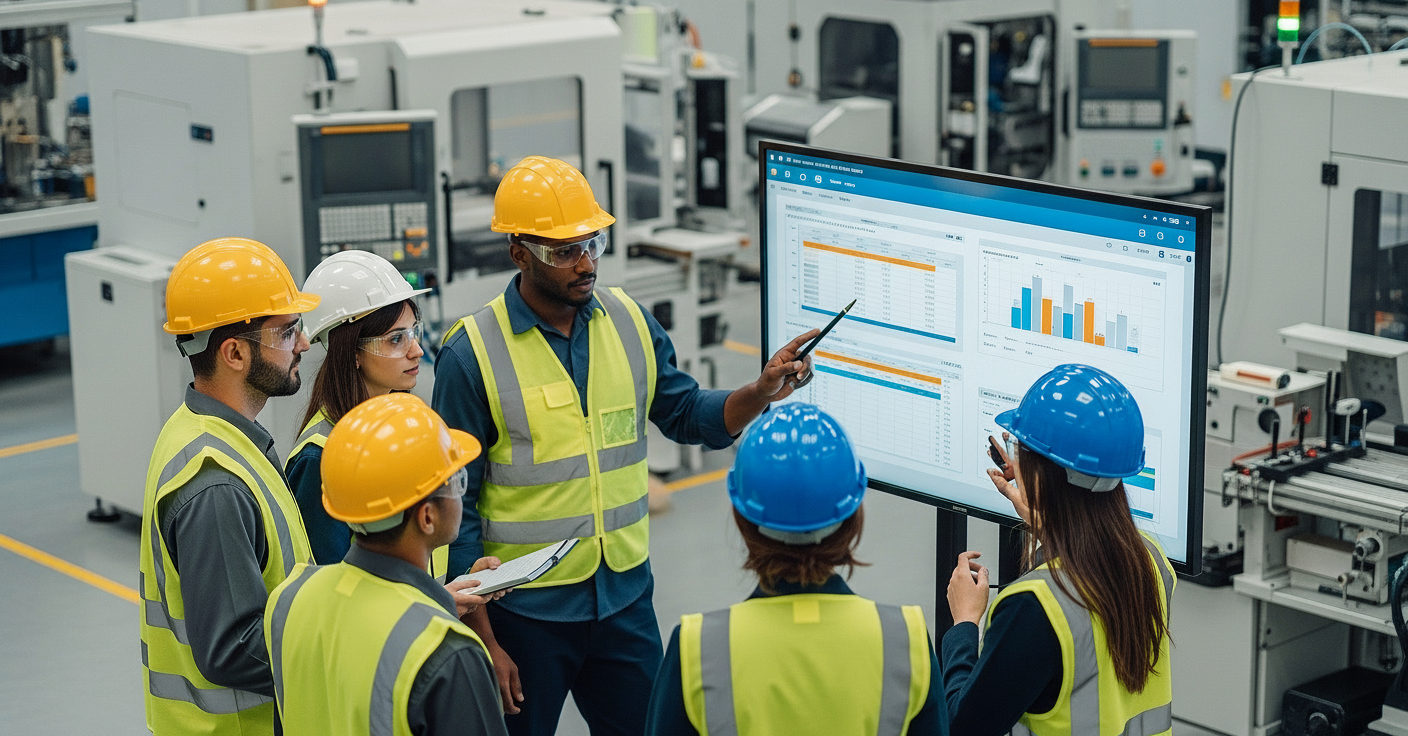


Manufacturing facilities constantly face equipment failures, quality deviations, and persistent bottlenecks. Traditional improvement methods, while valuable, are often reactive and struggle to keep pace with the complexity of modern production. This leads to slow improvement cycles and a culture of firefighting, where teams are exhausted by solving the same issues repeatedly. A transformative shift is underway, powered by agentic artificial intelligence—systems that can be taught to perceive, reason, and act on production data to solve your most unique blockers.
Instead of just flagging problems, these AI teammates learn the 'why' behind them, enabling your organization to move from reactive fixes to forward-looking, continuous optimization. This guide explores how you can use agentic AI to teach your operational systems to identify root causes and resolve production challenges before they escalate.
The persistent roadblocks to operational excellence
For professionals driving innovation and continuous improvement, the daily reality is often a series of recurring obstacles that hinder progress. The goal is to build resilient, efficient processes, but several core frustrations stand in the way:
- A reactive problem-solving culture: Teams are frequently caught in a cycle of firefighting—addressing equipment failures, quality defects, and safety issues only after they occur. This reactive stance hinders a forward-looking approach, as valuable time is spent on on-the-spot damage control rather than systemic improvement. The data that could offer anticipatory insights often remains buried in hours of video footage.
- Time-consuming manual observation: Traditional Gemba walks and physical process observations are fundamental to improvement, but they are incredibly time intensive. These manual walks provide only a snapshot in time, often missing the intermittent or nuanced events that lead to major blockers. Critical process variations that happen between observations go undetected.
- Inability to verify SOPs at scale: Ensuring consistent adherence to standard operating procedures (SOPs) across all shifts and locations is a major hurdle. Without automated monitoring, it's difficult to know if teams are following best practices, leading to process variability, quality inconsistencies, and safety risks.
- Slow improvement cycles: Validating improvements and performing root cause analysis can take weeks or even months. This is largely due to a lack of easily accessible, objective evidence. Teams struggle to find historical video of a specific process variation, equipment behavior, or safety event, slowing down the entire Plan-Do-Check-Act (PDCA) cycle.
- Hidden process waste: Minor inefficiencies, such as unnecessary motion, material handling delays, and brief periods of waiting, are often invisible during periodic observations. However, these small moments of waste accumulate over time, leading to substantial losses in productivity and throughput.
Understanding the basics of agentic AI
To understand how to teach a system, it's important to first define the technology. Agentic AI describes autonomous systems capable of perceiving their environment, analyzing complex patterns, making reasoned decisions, and taking action with minimal human oversight. This sets it apart from other forms of AI.
| AI Type | Description | Manufacturing Example |
|---|---|---|
| Traditional Automation | Follows rigid, pre-programmed rules. | A robot arm that welds a part in the exact same spot every time. It cannot adapt if the part is misaligned. |
| Basic Machine Learning | Analyzes data to identify patterns and make predictions. | A model that identifies patterns in sensor data to flag potential equipment failures, but requires a human to schedule maintenance. |
| Agentic AI | Perceives, reasons, and acts autonomously in a continuous feedback loop. | An AI teammate that observes a subtle change in cycle time, correlates it to bearing wear, and autonomously schedules maintenance during the next planned changeover to avoid disruption. |
In manufacturing, agentic AI acts as a comprehension engine. It doesn't just generate probable outcomes; it reasons about why events happen. It connects disparate data points to your process knowledge, delivering precise insights you can act on.
A framework for teaching your system: observe, analyze, prescribe
Teaching a manufacturing system to solve unique production blockers is an educational process. The system must learn what "normal" looks like, how to diagnose deviations, and what corrective actions to recommend. This can be achieved through a practical, three-step framework:
1. Observe: Create comprehensive visibility
The first step is to teach the system to see what is actually happening across your operations, continuously and objectively. This goes beyond simple data monitoring; it involves recognizing patterns across multiple sources to build a holistic view of your production environment.
Traditional Gemba walks are limited, but an AI teammate can monitor 24/7. With video AI, your existing cameras become smart sensors that reliably capture events and variations. This automated observation surfaces the hidden waste and process deviations that manual walks miss. For example, Spot AI uses templates like Time Studies and Unattended Workstation to automatically measure process durations and identify idle time, turning raw footage into a structured log of operational activity without requiring anyone to watch a screen.
2. Analyze: Uncover the "why" behind blockers
Once the system can observe, the next step is to teach it how to analyze that information to understand root causes. This is where you can break free from slow, evidence-starved improvement cycles.
When a quality defect or bottleneck appears, AI-driven analysis can correlate it with specific production conditions. It might find that a scrap rate increase is not tied to a single cause but to a combination of factors, like a specific material batch being run on a certain line during a specific shift.
This analytical power transforms video from a passive recording into an active database for problem-solving. With Spot AI, you can use natural language to search hours of footage in seconds for events like "a forklift entering a no-go zone" or "a person running near the conveyor belt." This gives you swift access to the visual evidence needed to validate hypotheses and accelerate root cause analysis from weeks to minutes.
3. Prescribe: Translate analysis into solutions
The final step is teaching the system to recommend optimized solutions based on its analysis. After identifying the root cause of a production blocker, the system can propose specific, data-backed recommendations.
For instance, after analyzing dozens of changeover videos, the system can help identify the sequence of actions from your top-performing shift. This "gold standard" SOP, now documented with video, can be used to train all other shifts, standardizing best practices and reducing variability. A high-mix packaging facility used this approach to reduce average changeover times by 14% in just eight weeks (Source: Spot AI). The prescription isn't just a suggestion; it's a validated best practice derived from your own operations.
Putting AI-driven learning into practice
Applying the Observe-Analyze-Prescribe framework with an AI teammate can solve some of the most persistent production blockers.
Eliminate production bottlenecks
Bottlenecks are often subtle and can shift depending on production conditions. AI-driven analysis makes them visible.
- Identify the constraint: Video AI can monitor production flows in real time, measuring cycle times and identifying where queues form. This pinpoints the exact process step that is limiting overall throughput.
- Optimize changeover time: Changeovers are a common source of lost capacity. By using video analytics to observe every step, you can identify wasted motion and non-standard procedures. Documenting the most efficient methods with video helps create a standardized process that every shift can follow, increasing equipment availability and production flexibility.
- Improve material flow: Templates like Forklift Absent or Vehicle Absent can identify when a workstation is starved of materials or when finished goods are not being cleared, revealing hidden material handling delays that disrupt production.
Enhance quality assurance and minimize defects
AI-powered visual inspection and root cause analysis help shift quality control from reactive detection to proactive mitigation.
- Automate defect detection: AI-driven visual inspection can identify microscopic scratches, misalignments, or color variations that are difficult for the human eye to see, operating with consistency across every shift. An electronics plant that deployed AI to find micro-cracks in solder joints reduced rework by 22% and scrap by 18% (Source: quality-line.com).
- Find the root cause of quality issues: When defects occur, an AI system can correlate them to production data without delay. It might discover that a specific defect only appears when a certain material lot is used with specific equipment parameters. This allows your team to address the true cause instead of just adding more inspection steps.
- Ensure process compliance: With templates like Checklist process compliance, you can teach the system to verify that operators are following critical quality procedures in the correct sequence, reducing errors and improving First Pass Yield (FPY).
Standardize SOPs and improve workplace safety
Inconsistent SOP adherence is a primary source of both safety risks and process variability. An AI teammate can act as a digital coach to assist teams.
- Monitor SOP adherence automatically: Instead of wondering if procedures are being followed, you can get alerts for deviations. For example, an alert for Forklift Enters No-go Zone helps enforce traffic management plans and guard against collisions.
- Coach safer practices in real time: Real-time alerts for events like Missing PPE or Running allow supervisors to intervene and provide on-the-spot coaching to reduce incidents. This builds a forward-thinking safety culture.
- Create a library of best practices: By recording and analyzing your top-performing teams, you can build a video-based library of "gold standard SOPs." This becomes an invaluable resource for training new employees and standardizing excellence across the entire organization.
Move from firefighting to forward-looking optimization
By teaching your systems to solve unique production blockers, you empower your teams to focus on strategic improvement rather than tactical firefighting. Agentic AI provides the continuous observation and deep analysis needed to uncover root causes, validate solutions, and standardize best practices across your facilities. It turns your existing cameras into AI teammates that help you build a more efficient, consistent, and resilient operation.
Curious how video AI can help your team solve production challenges? Book a demo to see Spot AI in action and explore how our platform delivers real-time insights for manufacturing operations.
Frequently Asked Questions
How can AI improve manufacturing processes?
AI can improve manufacturing processes by automating root cause analysis, optimizing production schedules, enabling proactive maintenance to minimize downtime, and enhancing quality control through automated visual inspection. It transforms raw operational data into actionable insights for continuous improvement.
What are the best AI tools for manufacturing?
The best AI tools are those that integrate with existing infrastructure and solve specific business problems. Platforms offering video AI analytics, predictive maintenance models, and AI-driven scheduling are highly effective. Camera-agnostic systems like Spot AI are particularly valuable as they work with existing cameras, reducing implementation costs.
How does AI help in minimizing production downtime?
AI minimizes downtime primarily through proactive maintenance. By analyzing data from equipment sensors and video, AI models can identify patterns that signal potential failures, allowing teams to schedule maintenance strategically. This helps guard against unexpected breakdowns that halt production. One automotive parts manufacturer cut unplanned downtime by 67% using this approach (Source: standardbots.com).
What are the challenges of implementing AI in manufacturing?
Common challenges include poor data quality, difficulty integrating with legacy systems (IT/OT convergence), a shortage of skilled personnel, and cultural resistance from employees. Starting with a clear pilot project and choosing platforms designed for ease of use can help mitigate these hurdles.
How can AI enhance quality assurance in manufacturing?
AI enhances quality assurance by automating visual inspection with greater speed and consistency than human inspectors. It can detect microscopic defects and correlate defect patterns with production data to identify root causes, helping teams move from detection to mitigation and improve First Pass Yield.
How can video AI analytics help identify the 8 wastes of Lean?
Video AI helps visualize the 8 wastes of Lean (DOWNTIME) that are often missed by manual observation. It can automatically flag defects through visual analysis, identify waiting with alerts for unattended workstations, and analyze motion and transportation by mapping inefficient travel paths. By monitoring production flows, it also helps spot overproduction and inventory buildups, turning your existing cameras into powerful tools for minimizing waste.
About the author
Dunchadhn Lyons leads Spot AI’s AI Engineering team, building real-time video AI for operations, safety, and security—turning video data into alerts, insights, and workflows that cut incidents and boost productivity.

