






For safety leaders in construction, the goal is a zero-incident job site. Yet the reality is often a perpetual cycle of reactive safety management—investigating accidents after they happen. Despite decades of regulations, the construction industry continues to face fatality rates that have remained largely unchanged over the past 15 years (Source: American Society of Safety Professionals). Falls, for instance, still account for 39.2% of all industry fatalities, a number that has seen little improvement (Source: OSHA). This indicates that traditional methods like manual site walks and paper-based reporting have reached their operational limits.
The path forward requires a fundamental shift from reacting to past incidents to anticipating future risks. This guide explores how trend-based video AI provides the forward-looking insights needed to move beyond reactive measures. By turning your existing cameras into AI teammates, you can identify hazardous patterns and respond quickly when risks emerge, building a forward-looking safety program.
The operational limits of reactive safety management
Traditional safety management depends on supervisors conducting periodic walkthroughs and documenting violations they happen to observe. This approach is inherently flawed, creating significant operational roadblocks for safety leaders.
- Inconsistent and incomplete monitoring: Site supervisors cannot be everywhere at once, creating blind spots where unsafe conditions and behaviors persist unobserved between inspections. Workers may also modify their behavior when they know an inspection is underway, creating a false sense of compliance.
- The strain of manual compliance: Spending hours walking multiple sites to check for personal protective equipment (PPE) and protocol adherence is a massive time drain. Even with diligent effort, violations are missed, leading to incidents that could have been mitigated and costly OSHA citations.
- Delayed, backward-looking data: By the time an incident is investigated and the findings are documented, weeks may have passed. This lag time creates significant barriers to addressing systemic risks in the moment. You are always looking in the rearview mirror, trying to address what has already happened.
- Difficulty managing multiple sites and teams: For leaders overseeing multiple projects, maintaining consistent safety standards is a major hurdle. Ensuring dozens of subcontractors with varying safety cultures adhere to protocols is a constant struggle, yet the liability remains with you.
These limitations keep safety programs in a reactive state, making it extremely difficult to get ahead of risk and improve key metrics like Total Recordable Incident Rate (TRIR) and Experience Modification Rate (EMR).
How video AI delivers forward-looking safety insights
Video AI helps you use your existing camera infrastructure to surface safety-relevant observations and trends. It uses computer vision to analyze video feeds and flag objects, people, and behaviors that signal elevated risk. This creates a continuous stream of data that helps you move from relying on lagging indicators (like incident reports) to leveraging leading indicators (like unsafe behaviors and high-risk interactions).
Here is how video AI works to generate these forward-looking insights:
- Continuous, automated observation: AI-powered video analytics can monitor multiple camera feeds simultaneously to maintain consistent attention across a large job site.
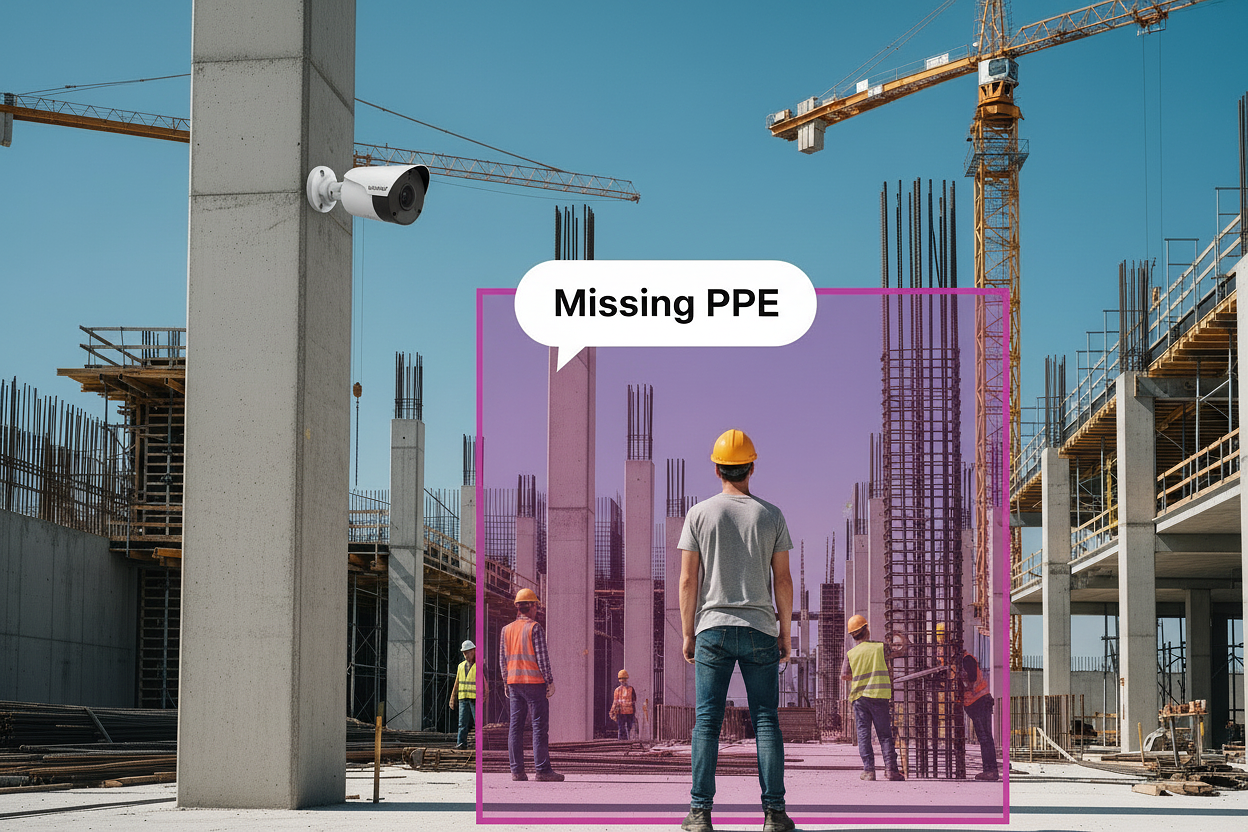
- Real-time detection and alerts: Instead of discovering a safety violation during a scheduled walk-through, video AI identifies it the moment it happens. The system can detect missing PPE, unauthorized entry into hazard zones, or unsafe behaviors and send a timely alert to the appropriate supervisor for on-the-spot intervention.
- Trend analysis and pattern recognition: By aggregating thousands of observations over time, video AI uncovers hidden risk patterns. It can reveal that high-risk interactions are clustering in a specific location, that PPE violations spike during certain shifts, or that a particular team is struggling with a safety protocol. These trends are the foundation of forward-looking insights.
From reactive alerts to insight-driven safety trends with video AI
A modern video AI platform doesn't just send alerts; it provides the tools to analyze trends and build a more resilient safety program. By addressing the core frustrations of construction safety leaders, it enables a strategic shift from firefighting to forward-thinking risk mitigation.
Move from manual walks to continuous compliance monitoring
The manual effort of walking sites to check for compliance is one of the biggest drains on a safety professional's time. Video AI automates this process.
Spot AI’s platform uses AI Video Agents that work with your existing cameras to monitor for compliance around the clock. For example, the Missing PPE agent can automatically identify a worker entering a designated zone without a hard hat or high-visibility vest and send a real-time alert. This allows you to:
- Maintain consistent oversight across all your sites from a single dashboard, without adding more staff.
- Document non-compliance with time-stamped video records, which are useful for training and holding all teams, including subcontractors, accountable.
- Lower your exposure to OSHA-recordable risks. With falls and PPE issues being top OSHA citations, continuous monitoring helps you address these risks systematically and lower your exposure to fines (Source: OSHA).
Shift from incident response to data-informed hazard mitigation
Reactive safety programs investigate accidents after the damage is done. A forward-looking program uses data to identify and mitigate hazards before they lead to an incident.
Spot AI enables this shift by detecting leading indicators of risk. AI agents like Person Enters No-go Zone and Vehicle Enters No-go Zone can alert you the moment a worker or piece of equipment crosses into a restricted area, such as an active trench or a zone with overhead work. By analyzing trends in these alerts, you can identify high-risk areas or behaviors and implement targeted controls to lower the likelihood of serious injury.
Cut investigation time with faster search
When an incident does happen, the investigation process can pull you away from forward-thinking initiatives for days. Sifting through hours of footage to find the root cause is inefficient.
An intelligent video AI platform transforms this process. With Spot AI, you can use natural language search to find specific footage in seconds. A query like "show me all people in the loading zone without hard hats yesterday" quickly surfaces the relevant clips. This not only accelerates investigations but also makes it easier to analyze trends in unsafe behaviors and strengthen your safety protocols.
Choosing a video AI platform for forward-looking safety
Not all video AI solutions are created equal. When selecting a platform to support your proactive safety goals, it's critical to look beyond simple alerts and consider how the system supports trend analysis, integration, and scalability. A platform designed for enterprise use will offer capabilities that point solutions for simple monitoring do not.
| Capability | Spot AI | Traditional Point Solutions |
|---|---|---|
| Hardware Compatibility | Camera-agnostic; works with your existing IP cameras, reducing initial cost. | Often requires proprietary cameras, leading to expensive "rip-and-replace" projects. |
| Deployment Speed | Simple installation can get your system running quickly, depending on your environment. | Can involve complex on-premise server setups and lengthy integration projects. |
| Scalability | A unified cloud dashboard can scale to many sites and large numbers of users. | Often limited by on-premise hardware capacity and per-seat licensing costs. |
| Data Accessibility | Intelligent search and trend analysis tools make it easy to find insights. | Data is often siloed, requiring manual effort to review footage and identify patterns. |
| Alert Management | AI-powered filtering minimizes nuisance alarms, so your team can focus on real issues. | Prone to a high volume of nuisance alerts from irrelevant motion, leading to alert fatigue. |
Build a data-driven safety program that looks forward
The construction industry faces important choices about how to improve safety.
Continuing with reactive safety measures often leads to the same results: incidents that could have been mitigated, rising insurance costs, and a culture of compliance rather than commitment. The shift to a forward-looking safety program is not only possible but essential for protecting your people and your business.
Trend-based video AI supports this shift. By delivering continuous, data-driven insights from your job sites, it empowers you to see and solve problems before they escalate. You can finally move beyond the endless cycle of incident response and start building a safety culture based on foresight and proactive risk management.
If you want to see how video AI can help you reach your safety goals, book a demo to experience Spot AI in action.
Frequently asked questions
How can AI improve safety in construction?
AI improves construction safety by automating the monitoring of job sites for hazards. It uses computer vision to analyze video from existing cameras to detect unsafe behaviors, missing personal protective equipment (PPE), and unauthorized entry into hazardous zones. This provides real-time alerts for on-the-spot intervention and collects data to identify risk trends over time, enabling anticipatory safety management.
How can trend analysis support safety management?
Trend analysis in safety management uses historical data from incidents, unsafe acts, and observed behaviors to highlight recurring risks. When conditions resemble known risk patterns, the system can alert safety personnel so they can address issues promptly.
What tools are available for real-time safety monitoring?
Tools for real-time safety monitoring include video AI platforms, wearable sensors for workers, and integrated safety management software. Video AI systems like Spot AI connect to existing cameras to provide 24/7 monitoring for safety violations and hazards, sending timely alerts to supervisors via mobile devices and centralized dashboards.
How can data insights drive safety improvements?
Data insights drive safety improvements by revealing the root causes and hidden trends behind incidents. By analyzing data from video AI, incident reports, and inspections, safety leaders can identify which locations, tasks, or times of day are most hazardous. These insights allow for targeted interventions, such as focused training, process redesigns, or enhanced supervision, that address specific risks rather than relying on generic safety measures.
About the author
Sud Bhatija is COO and Co-founder at Spot AI, where he scales operations and GTM strategy to deliver video AI that helps operations, safety, and security teams boost productivity and reduce incidents across industries.

