






Manufacturing leaders managing multiple sites often face a persistent visibility gap. While one facility might operate at 85% Overall Equipment Effectiveness (OEE), another facility with identical equipment might struggle to reach 65%, creating a performance differential that can cost millions annually. For a VP of Operations, identifying the root cause of this variance usually involves travel, delayed reports, and reactive firefighting.
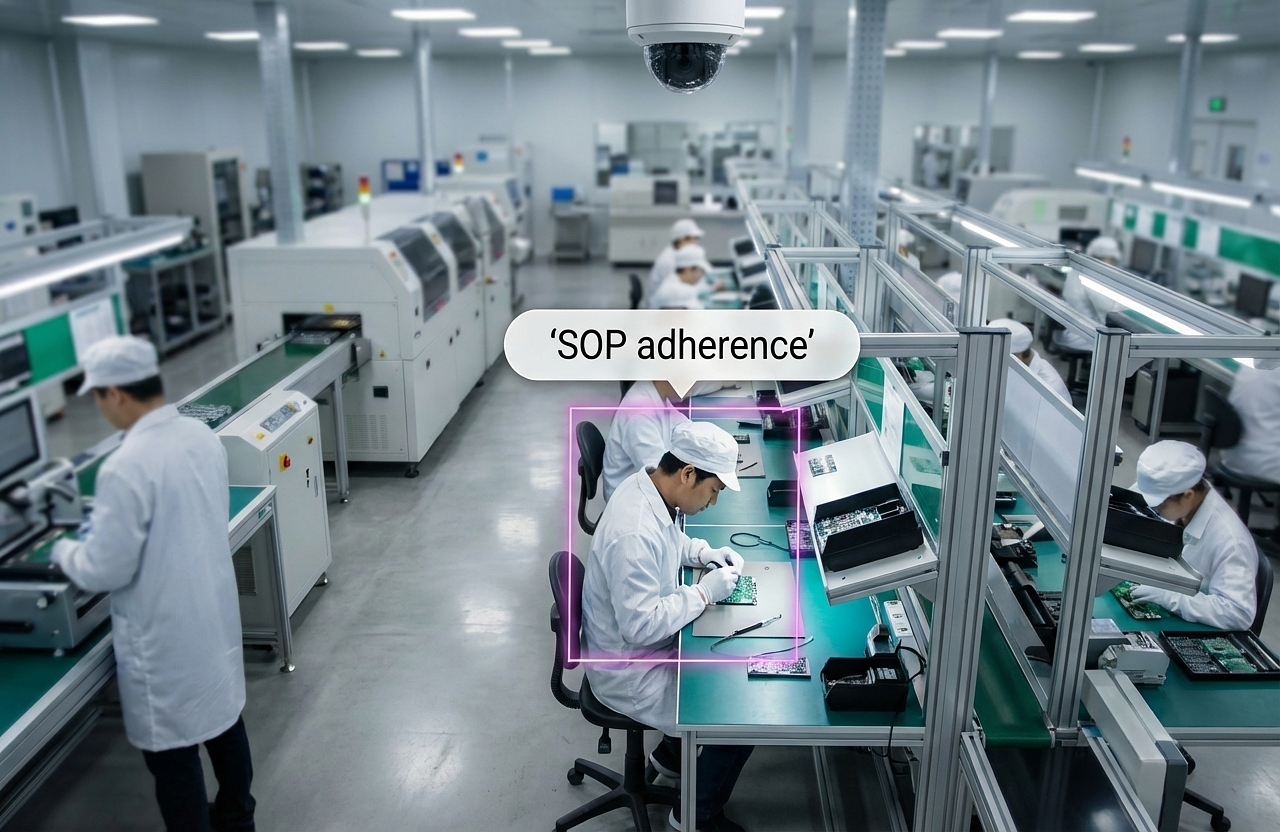
Traditional methods of process auditing—clipboards, spreadsheets, and sporadic site visits—fail to capture the reality of 24/7 operations. They provide only a snapshot in time, leaving vast blind spots during night shifts or weekends. A unified video AI platform helps teams use existing cameras to monitor standard operating procedure (SOP) adherence, safety compliance, and operational efficiency across shifts.
This article explores how manufacturing leaders can leverage video AI to standardize operations across distributed facilities, mitigate compliance risks, and drive measurable improvements in throughput and quality.
Key terms to know
- Unified video AI platform: A centralized software system aggregating video feeds from multiple locations into a single dashboard, using AI to analyze footage for events, behaviors, or anomalies.
- Computer vision: A field of AI enabling computers to derive information from images and video, allowing the system to "see" and understand manufacturing processes.
- Edge computing: Processes data near the source (on the factory floor) for real-time decisions and lower bandwidth usage.
- SOP adherence: The degree to which personnel follow documented Standard Operating Procedures, crucial for quality and safety.
- AI-powered visual inspection: The use of AI to search and analyze video streams for operational events or anomalies using natural language, without needing extensive pre-labeled training data.
The operational hurdle of multi-site visibility
Performance variability and blind spots
Operations leaders struggle to see what happens when not physically present. Performance variability often stems from inconsistent procedural execution, not just the equipment itself. Limited supervision during night shifts leads to inconsistent SOP adherence and safety practices that go undetected until incidents occur.
The complexities of compliance documentation
Preparing for regulatory inspections (OSHA, FDA, EPA) consumes management time. Teams may spend hours reviewing footage for incidents or compliance, pulling managers away from productive work. A single investigation can consume dozens of hours of review time.
Fragmented data systems
Safety metrics, project management data, and security footage often live in separate systems. This fragmentation impedes unified insights. A unified video AI platform helps bridge these gaps, integrating visual data with operational metrics in one place.
How video AI transforms process auditing
Video AI shifts auditing from a manual, reactive task to a more automated workflow. By leveraging computer vision and machine learning, manufacturers can expand auditing coverage across shifts, not just sampled periods.
1. Real-time production monitoring
Video AI systems integrate with Manufacturing Execution Systems (MES) to provide visual context:
- Visualize downtime: Quickly retrieve footage for MES-reported events (e.g., line stops).
- Monitor utilization: AI tracks forklifts/operators, calculating true utilization rates.
- Identify bottlenecks: By analyzing movement patterns, the system identifies congestion points or slow process steps.
2. AI-powered compliance verification
- PPE detection: Detects missing hard hats, vests, or eyewear; flags events for review.
- No-go zone enforcement: Monitors hazardous areas, alerting to unauthorized entry.
- Audit trail generation: Creates time-stamped video evidence, simplifying compliance and supporting insurance discussions.
3. Standardizing SOPs and changeovers
- Benchmark best practices: Captures efficient processes as visual SOPs for training.
- Flag process deviations: Highlights potential deviations for supervisor review.
- Continuous improvement: A central team analyzes footage to roll out improvements across sites.
Enhancing quality control with visual inspection
Video AI enhances quality assurance by providing visual evidence of process deviations, helping teams identify root causes of quality issues to minimize rework and customer churn.
AI-powered visual inspection
- Rapid deployment: Deploy inspection on new lines without needing extensive, pre-labeled training data.
- Contextual understanding: Investigate process anomalies using natural language prompts to quickly find relevant video evidence.
- Fewer false positives: Provides high-fidelity visual evidence, allowing teams to quickly distinguish between normal operations and true process deviations.
Automated optical inspection (AOI)
- Component verification: Provides visual documentation of assembly steps to help teams confirm processes were followed correctly.
- Dimensional checks: Allows teams to review video of production processes to investigate the root cause of out-of-spec products.
- Traceability: Creates a visual audit trail of production runs, linking video to specific batches or times for easier quality investigations.
Condition monitoring with video context
Video can provide visual context alongside maintenance and sensor data to help teams assess issues sooner.
Visual anomaly detection
- Possible leak indicators: Users can search for events like fluid leaks or spills to quickly find relevant video for review.
- Visual wear indicators: Teams can set up alerts or search for visual indicators like smoke or sparks to investigate potential equipment issues.
- Sensor integration: Video bookmarks footage when sensors trigger alerts for remote verification.
Lowering maintenance costs
Using video context alongside maintenance data can help teams lower costs and minimize downtime. Moving to condition-based maintenance can support better decisions and minimize unnecessary work.
Comparing video analytics solutions
| Feature | Spot AI | Traditional NVR/DVR | Legacy enterprise VMS |
|---|---|---|---|
| Deployment speed | Minutes (Plug-and-Play) | Days/Weeks | Months |
| Hardware compatibility | Camera agnostic | Proprietary lock-in | Often requires specific hardware |
| Multi-site scalability | Unlimited sites | Difficult | Expensive server licenses |
| AI capabilities | Built-in AI agents | None/Basic | Expensive add-ons |
| User access | Unlimited users | Limited | Per-user fees |
| Search capability | Google-like search | Manual scrubbing | Complex queries |
Why this matters for the VP of Operations: Spot AI’s architecture can accelerate time-to-value by connecting to existing cameras, helping address coverage gaps cost-effectively. Learn more about video analytics in manufacturing.
Implementation best practices for multi-site success
1. Phased rollout strategy
- Pilot: Start with one or two high-priority sites or use cases.
- High-impact use cases: Begin with PPE detection or perimeter security.
- Expand: Scale after validating the pilot.
2. Data governance and integration
- Connect to daily tools: Use open APIs to push alerts into platforms like Procore, Slack, or Teams.
- Standardize metrics: Define violation/incident criteria across sites.
- Secure data: Ensure SOC 2 compliance and privacy features.
3. Change management and culture
- Position as a tool: Emphasize safety and productivity, not surveillance.
- Share wins: Highlight safety improvements or production bonuses.
- Involve frontline: Engage operators in defining safety rules.
Business outcomes and ROI
- Lower cost of poor quality (COPQ): Standardized changeovers, lower scrap and rework.
- Labor efficiency: Automated auditing frees up management time that would otherwise be spent on manual reviews.
- Insurance outcomes: Forward-looking safety monitoring and audit trails may help insurers better understand your risk; any premium changes depend on your carrier.
- Increased capacity: Improving OEE by a few points can unlock millions in production capacity.
Standardize Operations and Drive Growth with Video AI
Operational excellence starts with visibility. A unified video AI platform helps minimize multi-site blind spots, turning video into actionable intelligence for safety, quality, and growth. Automating parts of process auditing and SOP monitoring enables more consistent, scalable operations.
See Spot AI in action—request a demo and discover how a unified video AI platform can streamline your multi-site operations.
Frequently asked questions
How can AI improve manufacturing processes?
AI automates detection of inefficiencies and hazards, provides real-time utilization data, identifies bottlenecks, and helps teams monitor SOP adherence for higher throughput and more consistent quality.
What are the benefits of video analytics in manufacturing?
Video analytics supports around-the-clock monitoring, saves manual audit time, improves safety, enhances quality control, and can document risk mitigation for insurance discussions.
How do I implement AI for process auditing?
Connect a camera-agnostic AI platform to your existing video infrastructure, define key audit criteria, and roll out in a phased approach starting with a pilot site.
What technologies are best for remote manufacturing audits?
Cloud-native video AI platforms with intelligent search, automated summaries, and low-bandwidth streaming are best for managing multiple sites remotely.
How can video AI enhance workplace safety?
Video AI detects potential hazards and sends real-time alerts, enabling a swift response when issues are observed.
About the author
Sud Bhatija is COO and Co-founder at Spot AI, where he scales operations and GTM strategy to deliver video AI that helps operations, safety, and security teams boost productivity and reduce incidents across industries.

