







Verkada vs Solink vs Spot AI: which video security platform should you choose in 2026?
If you lead loss prevention or security for a multi-location retailer, you are almost certainly weighing Verkada, Solink, and Spot AI against each other, and against the cost of doing nothing. The stakes are real: U.S. retailers lost about $90 billion to inventory shrink in 2025, and organized retail crime groups were involved in thefts at 67% of retailers surveyed (Source: National Retail Federation). The short version: Verkada is a cloud-managed platform strongest on its own camera and audio hardware, Solink is a cloud video plus point-of-sale (POS) exception-reporting platform built for transaction-anchored investigation, and Spot AI is an AI-agent-first, camera-agnostic platform whose AI Security Guard detects in context, deters in the moment, and hands you case-ready evidence.
Key takeaways
- Verkada is a cloud-managed platform that supports third-party ONVIF and RTSP cameras through its Command Connector, while its fullest AI and hardware-based deterrence favor its own cameras and audio hardware.
- Solink is built around video plus POS exception reporting, which makes it a natural fit for register-fraud investigation in QSR, convenience, and small-format retail.
- Spot AI is camera-agnostic and edge-first: it works with the cameras you already own, keeps full-resolution video in the facility, and sends only metadata across the network.
- The real fault line is act versus record. Spot AI's AI Talk Down deters autonomously in the moment; Solink anchors to transactions and investigation; Verkada's live deterrence is strongest on its own hardware.
- Choose on architecture, camera reuse, and how you want to respond, not on brand recognition alone.
Verkada vs Solink vs Spot AI at a glance
Buyer criterion | Verkada | Solink | Spot AI |
|---|---|---|---|
Best known for | Cloud-managed cameras and physical security on one platform | Video paired with POS exception reporting for retail shrink | AI coworkers that detect, deter, and document in real time |
Architecture and where video lives | Cloud-managed through Verkada Command | Cloud video management; video managed in Solink's cloud | Hybrid edge-to-cloud; full-resolution video stays on the IVR in the facility, only metadata crosses the network |
Camera compatibility | Own cameras plus third-party ONVIF and RTSP via Command Connector (third-party channels run reduced analytics) | Works with existing and older cameras | Camera-agnostic; any IP or ONVIF camera you already own, legacy analog via the IVR |
AI and real-time deterrence | AI-Powered Deterrence and trajectory analysis; escalating warnings on third-party channels since May 2026, fullest on Verkada hardware | AI Agents for monitoring, connecting signals, and investigation; autonomous active deterrence not publicly specified | 15+ Video AI Agents plus AI Talk Down: context-aware, auto-escalating deterrence with no operator required |
POS and exception reporting | Not publicly specified as a native product | Core strength: voids, refunds, no-sales, and overrides become reviewable cases with video attached | POS refund-fraud and no-customer-transaction integration live; POS-to-video correlation |
Compliance and data residency | SOC 2 stated by vendor; cloud-managed data path | Bandwidth management and health monitoring; SOC 2 and NDAA specifics not publicly specified in reviewed pages | NDAA-compliant and SOC 2 practices; edge-first residency keeps video in the facility (PCI-clean) |
Best fit | Teams standardizing on a single-vendor camera and hardware ecosystem | QSR, convenience, and franchise operators focused on register fraud | Multi-location teams that want to reuse cameras and act on incidents in real time, indoors and out |
The rest of this guide walks each criterion in turn. Competitor details come only from what Verkada and Solink publicly document; where a vendor does not document something, we say so rather than guess.
Architecture and where your video lives
Architecture is the criterion buyers underweight and later regret. It decides your bandwidth bill, your compliance scope, and whether footage is reachable when the internet is not.
Verkada is cloud-managed through Verkada Command, with cameras and appliances administered from the cloud. Solink is a cloud video management system that works with existing cameras and manages video in Solink's cloud. Both approaches put your video path largely off-site.
Spot AI takes a hybrid edge-to-cloud approach. Full-resolution video stays inside the facility on the Intelligent Video Recorder (IVR), and only metadata crosses the network. For a retailer, that means a lighter bandwidth footprint, a smaller compliance surface for card-data environments, and footage that remains accessible on-site. It is the difference between renting a warehouse across town for your video and keeping it in the back office where you can always reach it.
Camera compatibility and reuse
Nobody wants to rip out working cameras to buy a platform. This is where an outdated reputation can cost you money.
Verkada sells its own cameras, and its Command Connector is an ONVIF Profile S conformant client that can also ingest RTSP feeds, so third-party cameras are supported. It is not accurate to call Verkada a proprietary-only system. The nuance that matters for budgeting: third-party channels run with reduced analytics, and Verkada's fullest AI and hardware-based deterrence favor its own gen-2 or newer cameras and audio hardware.
Solink is designed to work with existing and older cameras, which is part of why it lands well with operators who do not want a hardware refresh.
Spot AI is camera-agnostic by design and works with any IP or ONVIF camera across roughly 100 brands, with legacy analog supported through the IVR. There is no rip-and-replace, and most sites go live in days on the cameras a business already owns.
AI, agents, and real-time deterrence
Every vendor here uses the word AI. The question that separates them is whether the system acts, or only records and reports.
Verkada offers AI-Powered Deterrence and trajectory analysis such as line-crossing, loitering, and occupancy trends. Since May 2026, escalating AI-generated warnings can run on third-party cameras connected through Command Connector, though the fullest deterrence experience is tied to Verkada's own cameras and audio hardware like a horn speaker or intercom.
Solink describes AI Agents that help monitor high-volume activity, connect signals across time and locations, and assist with investigation and analysis. Its center of gravity is surfacing and reviewing what happened; autonomous, real-time active deterrence is not publicly specified as a product capability.
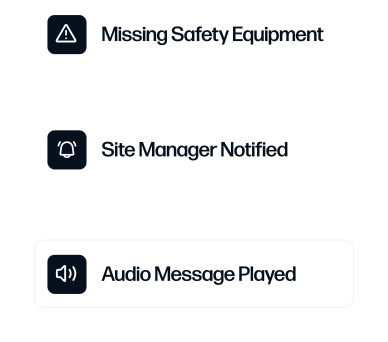
Spot AI ships 15+ pre-trained Video AI Agents plus AI Talk Down, a three-level, context-aware deterrence that calls a person out by clothing and behavior and escalates on its own, with no operator in the loop. The incident-based platform uses merge windows and AIResolved to clear noise so teams see real incidents, not alarm floods. This is the AI Security Guard pattern: detect intent in context, deter in seconds, and document the case. You can also build custom detections in minutes with Iris using plain language.
POS and exception reporting for retail shrink
For retail loss prevention, the till is where a large share of shrink hides, so POS integration is not a nice-to-have.
Solink is the specialist here. It integrates video and POS to turn voids, refunds, no-sales, and overrides into prioritized, reviewable cases with the right video context attached, and it connects to 300+ business tools including POS and access control. If register-fraud investigation is your primary job, this is Solink's home turf.
Verkada does not publicly specify a native POS exception-reporting product; its strengths sit in cameras, access control, and environmental sensors within its own ecosystem.
Spot AI brings POS to the loss-prevention agents: POS refund-fraud and no-customer-transaction integration are live, with POS-to-video correlation that ties a suspicious transaction to the clip. The difference from a reporting-first tool is that Spot AI can also act at the moment of the event rather than only queue it for later review.
Compliance and data residency
IT and security leaders live with the compliance answer long after the demo ends.
Verkada states SOC 2 practices and runs a cloud-managed data path. Solink documents bandwidth management, 24/7 support, and proactive health monitoring; SOC 2 and NDAA specifics were not publicly specified in the pages reviewed, so confirm them directly for your procurement file.
Spot AI follows NDAA-compliant and SOC 2 practices, and its edge-first architecture keeps full-resolution video in the facility, which narrows the data-residency and card-data scope you have to defend. Open APIs, webhooks, and a live Model Context Protocol (MCP) endpoint let approved systems query Spot AI data with read-only permissions.
Integrations, scale, and the guard math
Most teams are not buying a camera; they are buying fewer blind spots without more headcount. That is worth framing against the cost of guards, where the labor math keeps getting harder. The median annual wage for a security guard was $38,370 in May 2024, and employment is projected to show little or no change from 2024 to 2034 with about 162,300 openings a year driven mostly by turnover (Source: U.S. Bureau of Labor Statistics). A platform that acts on its own can extend coverage without adding a post.
On integrations, Solink leans on its 300+ business-tool connections, Verkada on its own access, alarm, and sensor ecosystem, and Spot AI on open APIs plus 15+ agents that span indoor and outdoor in one view. For a lean team covering many stores, the practical question is how much the platform resolves on its own before a human has to look.
Key terms
- Exception-based reporting: flagging unusual POS events, such as voids or refunds, and attaching video so a reviewer can confirm what happened.
- Edge-first architecture: processing and storing full-resolution video on-site, sending only metadata to the cloud, to cut bandwidth and narrow compliance scope.
- Active deterrence: an automated response, such as a spoken warning or strobe, triggered in the moment to stop an incident rather than record it.
- ONVIF and RTSP: open standards that let a platform connect to cameras from many manufacturers instead of one.
Which to choose, by scenario
- Register fraud is your top job (QSR, convenience, franchise): Solink's transaction-anchored exception reporting is purpose-built for this. Compare it against Spot AI if you also want in-the-moment deterrence, and see Solink alternatives for 2026 and Spot AI vs Solink.
- You are standardizing on one hardware vendor: Verkada's single-ecosystem model fits, provided you budget for its cameras and audio hardware to unlock the fullest AI. Weigh the cost in Verkada pricing for 2026 and browse Verkada alternatives for 2026.
- You want to keep your cameras and have the system act in real time: Spot AI's camera-agnostic, edge-first AI Security Guard is the strongest fit across indoor and outdoor, single-site and multi-site. See the head-to-head in Spot AI vs Verkada and, if you are leaving an incumbent, why teams switch from Verkada to Spot AI.
- You are still scoping the category: start with the neutral landscape in the best video management software for 2026 and the pricing view in Solink pricing for 2026.
Proof: what real-time response looks like
The clearest way to see the act-versus-record difference is in the field. Don Franklin Family of Dealerships deployed Spot AI across 30 locations and reported more than $1 million in total savings, including recovering 5 of 6 stolen $130,000 vehicles within a single hour, worth $650,000 or more, and a 60% increase in camera utilization as the system shifted from passive recording to an analytical tool (customer-reported).
When you compare these platforms, separate two jobs that vendors blur together: surfacing what happened and acting while it happens. Solink is strong at the first through POS exception reporting, and Spot AI is built to do both, with AI Talk Down responding in the moment.
Before you decide, confirm three things for each finalist: whether it runs on the cameras you already own, where full-resolution video is stored, and whether it can respond on its own or only alert. Those three answers will settle most shortlists.
"Within four minutes of the alarm going off, Spot AI gave us video footage of the incident on the responding officers' phones. We had five recoveries within the hour."
Josh Bowlin, IT Director, Don Franklin Family of Dealerships
Spot AI supports more than 1,100 customers across the United States and ingests over 3 billion minutes of video every month, more than twice the video uploaded to YouTube. If you want to see how the AI Security Guard would run on your existing cameras, across your highest-risk stores and lots, the fastest next step is a working demo. Book a demo and bring the two or three sites you worry about most.
Frequently asked questions
What is the difference between Verkada, Solink, and Spot AI?
Verkada is a cloud-managed physical security platform strongest on its own cameras and audio hardware. Solink is a cloud video platform built around POS exception reporting for retail shrink. Spot AI is an AI-agent-first, camera-agnostic platform whose AI Security Guard detects in context, deters in the moment with AI Talk Down, and documents case-ready evidence.
Is Solink or Verkada better for retail loss prevention?
It depends on the job. Solink is purpose-built for register-fraud investigation through video plus POS exception reporting, which fits QSR, convenience, and franchise operators. Verkada suits teams standardizing on a single camera and hardware ecosystem. If you want real-time deterrence on your existing cameras, Spot AI is worth adding to the shortlist.
Can Verkada, Solink, and Spot AI use the cameras I already own?
Yes, with nuances. Verkada supports third-party ONVIF and RTSP cameras through its Command Connector, though those channels run reduced analytics. Solink works with existing and older cameras. Spot AI is camera-agnostic across roughly 100 IP and ONVIF brands, with legacy analog handled by the IVR, so most sites go live in days without a hardware refresh.
Which platform deters incidents in real time instead of just recording them?
Spot AI is designed to act, using AI Talk Down to issue context-aware, escalating warnings autonomously. Verkada offers AI-Powered Deterrence that is fullest on its own cameras and audio hardware. Solink centers on surfacing and investigating events rather than autonomous real-time deterrence, which is not publicly specified as a product capability.
How do these platforms handle where video is stored and compliance?
Verkada is cloud-managed and states SOC 2 practices. Solink manages video in its cloud and documents bandwidth management and health monitoring, with SOC 2 and NDAA specifics not publicly specified in the pages reviewed. Spot AI follows NDAA-compliant and SOC 2 practices and keeps full-resolution video on-site through its edge-first IVR, which narrows data-residency and card-data scope.
About the author
Joshua Foster is an IT Systems Engineer at Spot AI, where he focuses on designing and securing scalable enterprise networks, managing cloud-integrated infrastructure, and automating system workflows to enhance operational efficiency. He is passionate about cross-functional collaboration and takes pride in delivering robust technical solutions that empower both the Spot AI team and its customers.






.png)
.png)
.png)
.svg)