






Manufacturing leaders today face a paradox: they have more data than ever, yet they still struggle with visibility into the physical realities of their production floors. While MES and SCADA systems track machine logic, they miss the human and physical context—the "why" behind a micro-stop, the manual deviation from an SOP, or the unreported safety event that happened between shift walks.
For VPs of Operations and Project Executives, this visibility gap creates a reactive cycle. You often discover safety violations, theft, or damage days or weeks after they occur, eroding trust with stakeholders and insurers. Your teams spend hours or days reviewing footage to investigate incidents, pulling project managers and superintendents away from high-value work. Perhaps most frustrating is the inability to maintain real-time visibility across multiple active sites simultaneously, creating anxiety about blind spots when you are not physically present.
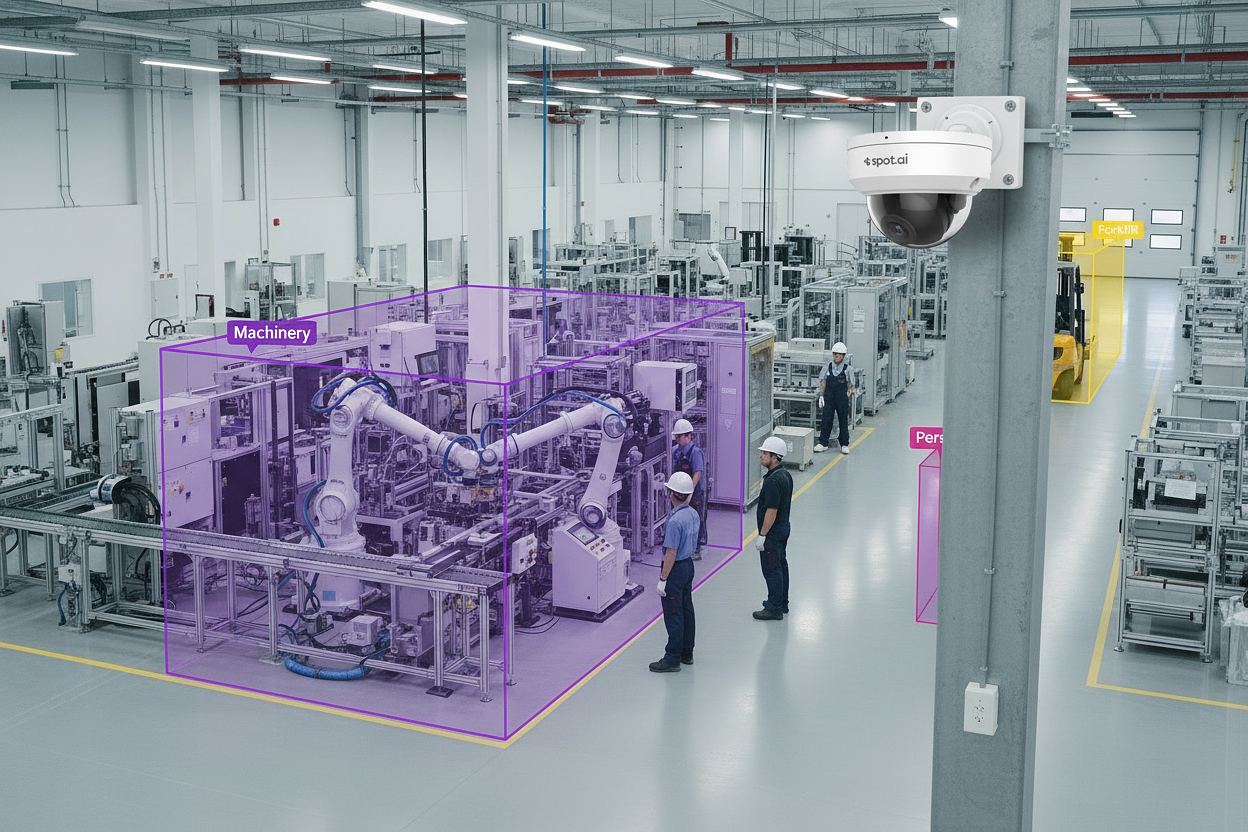
Video AI agents for the physical world bridge this gap. By turning standard security cameras into intelligent sensors, these systems analyze video to trigger configurable alerts. They help turn video from a passive record into a practical tool for day-to-day operations, quality, and safety workflows.
Understanding the basics
Before examining specific applications, it is helpful to define the core technologies driving this shift.
- Video AI agents: intelligent software systems that analyze video feeds in real-time to detect specific objects, behaviors, or anomalies. Unlike passive recording, these agents act as teammates that alert staff to issues like missing PPE, unauthorized access, or production bottlenecks.
- Computer vision: a field of artificial intelligence that enables computers to interpret and understand the visual world. In manufacturing, this technology allows cameras to monitor processes, track assets, and analyze workflows with high consistency.
- Edge AI: a decentralized computing structure where data processing happens near the source (the camera or local appliance) rather than in a distant cloud server. This ensures low latency, meaning alerts happen in milliseconds—critical for safety and fast-moving production lines.
- Automated visual inspection: the use of computer vision to inspect products for defects such as scratches, misalignments, or color variations automatically, often inspecting 100% of goods rather than a statistical sample.
The cost of reactive operations
The traditional approach to manufacturing oversight relies heavily on manual checks, statistical sampling, and retroactive video review. This reactive stance leaves substantial value on the table and exposes organizations to unnecessary risk.
Quality control and defect detection gaps
Relying on manual inspection or sample-based testing creates expensive blind spots. Electronic and automotive manufacturers currently rely on statistical sampling of 2-5% of production, meaning 95-98% of products ship uninspected (Source: Glean). This approach allows defects to escape into the market, leading to costly consequences. A single product recall can cost manufacturers $600 million, with the medical device market alone incurring approximately $5 billion annually in recall expenses (Source: QualityDigest).
Equipment downtime and maintenance inefficiency
Unplanned downtime directly impacts production schedules, customer commitments, and profitability.
Many organizations operate on reactive maintenance models, fixing equipment only after failure, which leads to significantly higher total cost of ownership (Source: Webee Case Study). Conversely, traditional preventive maintenance schedules often waste resources by performing maintenance on equipment that does not yet require intervention.
Safety and compliance risks
Safety incidents carry both human and financial costs. Warehouse workers experience injury rates of 4.8 cases per full-time equivalent, more than twice the national average. Traditional safety monitoring relies on periodic inspections and supervisor observations, which miss safety lapses between checks and can only respond reactively after exposure has occurred. This "blind spot" approach makes it difficult to prove forward-looking risk management to insurance carriers, leading to premiums rising 10-20% annually despite investments in safety programs (Source: OHS Online).
How video AI agents solve critical operational pain points
Video AI platforms like Spot AI address these core frustrations by integrating with your existing infrastructure to provide real-time intelligence. By mapping specific operational pain points to AI capabilities, leaders can move from reactive firefighting to faster, more informed responses.
| Operational challenge | Video AI solution | Impact on operations |
|---|---|---|
| Reactive incident response: finding out about safety violations or damage days late. | Real-time AI alerts: real-time notifications for PPE violations, unauthorized access, or hazards. | Intervene rapidly to mitigate risk rather than documenting losses later. |
| Manual investigation time drain: spending hours reviewing footage. | Intelligent video search: search for "forklift," "red vest," or "person" across hours of video in seconds. | Cuts investigation time from hours to minutes, freeing up PMs and superintendents. |
| Multi-site blind spots: inability to see 10-20 sites simultaneously. | Unified cloud dashboard: view and manage cameras across sites from one place. | Monitor fleet-wide operations remotely; identify which sites need attention in moments. |
| Disconnected data: safety and ops data live in different silos. | Open API integration: connect video data with MES, ERP, and project management tools. | Combine video and operations data so teams reference the same information for decisions. |
Strengthening quality control with process monitoring
Video AI agents improve quality not by inspecting the final product, but by monitoring the human and mechanical processes that create it. By deploying AI agents to monitor production lines, manufacturers can ensure that Standard Operating Procedures (SOPs) are followed correctly, leading to more consistent outcomes and fewer deviations that result in defects.
1. Ensure SOP adherence
Quality outcomes depend on consistent execution. Video AI agents can monitor production lines to verify that critical steps in a process are completed correctly and in the right sequence. For example, an AI agent can confirm that a specific two-hand assembly technique is used or that a cleaning procedure is performed between batches. This provides a layer of automated process verification that manual supervision alone cannot match.
2. Accelerate root cause analysis
When a quality issue is discovered downstream, the most time-consuming task is often finding out when, where, and why it happened. Instead of spending hours manually reviewing footage, teams can use intelligent search to instantly find video of the specific production run, workstation, or operator associated with the defect. This allows quality managers to pinpoint the root cause in minutes, whether it was a deviation from an SOP, an equipment malfunction, or an environmental factor.
3. Provide data for training and improvement
Video evidence is a powerful tool for coaching and continuous improvement. Supervisors can use clips of both correct and incorrect procedures as "game film" to train employees on best practices. By analyzing trends in process deviations across shifts or teams, leaders can identify systemic training gaps or opportunities to make SOPs clearer and easier to follow. This proactive approach helps prevent future quality issues, reducing scrap and rework over time.
Optimizing maintenance and cutting downtime
Video AI agents support a shift from purely reactive maintenance by providing visual context and faster verification. Manufacturers can use video to monitor equipment appearance and activity in real time.
- Condition-based monitoring: use video to flag visible anomalies and deviations from typical operation so teams can investigate sooner.
- Visual verification of telemetry: when a SCADA system reports a fault, video AI allows operators to verify the physical condition of the machine without delay. This validates whether a sensor glitch or a real mechanical failure caused the alert, speeding up triage.
- Mitigate unplanned downtime risk: using video to quickly verify faults and spot issues earlier can help teams shorten diagnosis and coordinate maintenance more efficiently.
Enhancing operational efficiency and throughput
Beyond quality and maintenance, video AI agents act as productivity coaches, helping teams identify hidden inefficiencies that manual observations miss.
1. Cycle time and micro-stop analysis
For example, a three-second micro-stop occurring 100 times per shift represents five minutes of lost production that rarely appears in downtime logs. Video AI continuously monitors production flow, identifying bottlenecks and micro-stops that can erode OEE. This data allows continuous improvement leaders to pinpoint the likely root causes of speed losses.
2. Changeover time optimization
Changeover times represent a major source of lost capacity. Video AI supports SMED (Single-Minute Exchange of Dies) initiatives by providing visual confirmation of task completion and resource positioning. Teams can verify that external changeover activities are complete before stopping the machine and ensure that parallel tasks occur simultaneously rather than sequentially.
3. SOP adherence and training
Standardizing shifts is critical for scaling operations. Video AI can help review routine tasks and safe techniques aligned to Standard Operating Procedures (SOPs). Instead of disciplinary monitoring, this data serves as a "game film" for coaching. Supervisors can use video clips to train staff on best practices, supporting more consistent performance across shifts.
Strengthening safety compliance and mitigating risk
For the VP of Operations, safety is not just about compliance; it is about protecting the workforce and managing insurance costs. Video AI helps move safety from periodic checks to continuous monitoring support.
- Automated PPE detection: AI systems automatically monitor whether workers wear required protective equipment, such as hard hats, vests, and harnesses. This is critical for OSHA compliance and contractor accountability, especially in environments with high turnover or subcontracted labor.
- Hazard detection and zone control: AI agents can detect when people or vehicles enter restricted "no-go" zones. For example, detecting a person entering a forklift lane or an unauthorized area near active machinery can trigger a real-time alert, enabling quicker intervention.
- Compliance documentation support: video-based monitoring helps generate audit trails and documentation to support regulatory compliance. Teams can produce the reports they need to show proactive risk management in conversations with insurance carriers.
- Environmental monitoring: systems can be configured to flag visible cues of overheating risks or smoke-like conditions in video; available integrations vary by platform.
ROI and implementation considerations
Implementing video AI is a strategic investment that requires a clear view of returns. Manufacturing companies implementing proactive analytics report a 15-20% cut in maintenance costs and a 10-15% increase in equipment availability (Source: Glean).
Realizing value
Most AI manufacturing implementations require 12-24 months to achieve satisfactory ROI, which is longer than some traditional tech cycles but offers higher long-term value (Source: Deloitte). However, specific use cases like quality inspection can deliver 200-300% ROI through cutting defects and faster inspection cycles (Source: AleaIT Solutions).
Integration is key
Many manufacturers view data fragmentation as a key obstacle to implementing AI. To succeed, video AI must not be a silo. Modern platforms like Spot AI offer open APIs that allow video data to flow into Procore, Autodesk, MES, and ERP systems, creating a unified operational picture.
Comparing video AI solutions for manufacturing
When selecting a partner to modernize your physical operations, it is essential to look for flexibility, speed of deployment, and enterprise scalability.
| Feature | Spot AI | Legacy camera systems | Traditional AI analytics |
|---|---|---|---|
| Deployment speed | Fast: plug-and-play hardware goes live in minutes. | Slow: requires complex cabling and server setup. | Medium: often requires lengthy calibration periods. |
| Hardware compatibility | Universal: works with any IP camera (existing or new). | Restricted: often locks you into proprietary cameras. | Varied: may require specific expensive camera models. |
| Scalability | Scalable: cloud-native architecture supports large deployments, including thousands of sites (subject to plan and design). | Limited: DVR/NVRs have strict channel limits per device. | Complex: server costs balloon as you add more streams. |
| User access | Broad access: role-based access for operations, safety, and security teams without per-user limits on many plans. | Restricted: usually limited to security teams only. | Per-seat pricing: often charges extra for additional users. |
| Search capability | Google-like: search by keyword, object, or behavior in moments. | Manual: scrubbing through timelines manually. | Structured: rigid query builders that can be hard to use. |
Making the shift to proactive operations
The transition to AI agents for the physical world is changing how manufacturers use video. It helps teams move beyond lagging indicators toward real-time visibility and faster control actions. By leveraging video AI, manufacturers can surface hidden capacity, cut defects, and support a safer environment for their workforce.
For VPs of Operations, the value lies in scalability and control. You gain the ability to standardize processes across multiple sites, free up your project managers from manual tasks, and provide verified timestamped evidence of compliance to insurers and stakeholders. The technology is no longer a futuristic concept; it is a practical tool for those ready to modernize their approach to operations.
Curious how video AI agents work in real manufacturing environments? Request a demo to see Spot AI in action and discover how your existing cameras can deliver real-time operational insights.
Frequently asked questions
How can AI improve manufacturing processes?
AI improves manufacturing processes by providing real-time visibility into operations. It automates the detection of bottlenecks, tracks cycle times, and identifies micro-stops that manual observation misses. This data allows operational leaders to optimize workflows, balance lines, and improve Overall Equipment Effectiveness (OEE) based on accurate, continuous measurement rather than periodic time studies.
What are the benefits of using AI for quality control?
AI supports quality control by helping teams ensure processes are followed correctly. For example, video AI can monitor workflows to verify that workers adhere to Standard Operating Procedures (SOPs), which is critical for consistent product quality. If a quality issue arises, teams can use intelligent video search to quickly find footage of the event, investigate the root cause, and use the visual evidence for training and process improvement.
How does proactive maintenance cut downtime?
Maintenance teams can use AI to analyze video for early visible signs of equipment issues, such as unusual movement. By identifying issues sooner, manufacturers can schedule maintenance during planned windows, helping to mitigate unplanned downtime.
What technologies are involved in automated visual inspection?
Specialized automated visual inspection (AVI) systems use high-resolution cameras and deep learning models (like Convolutional Neural Networks) trained to spot specific product defects such as scratches or misalignments. In contrast, a broader video AI platform uses computer vision to monitor the overall process and environment. This technology focuses on tracking workflows, ensuring SOP compliance, and monitoring for operational anomalies to provide context that complements dedicated quality inspection tools.
How can AI ensure compliance in manufacturing?
AI supports compliance by continuously monitoring the production environment for potential safety and regulatory issues. It can detect PPE lapses, unauthorized entry into hazardous zones, and provide video context for SOP-related reviews. Systems like Spot AI help create audit trails and on-demand compliance reports to simplify documentation for OSHA or FDA inspections.
About the author
Sud Bhatija is COO and Co-founder at Spot AI, where he scales operations and GTM strategy to deliver video AI that helps operations, safety, and security teams boost productivity and mitigate incidents across industries.

