




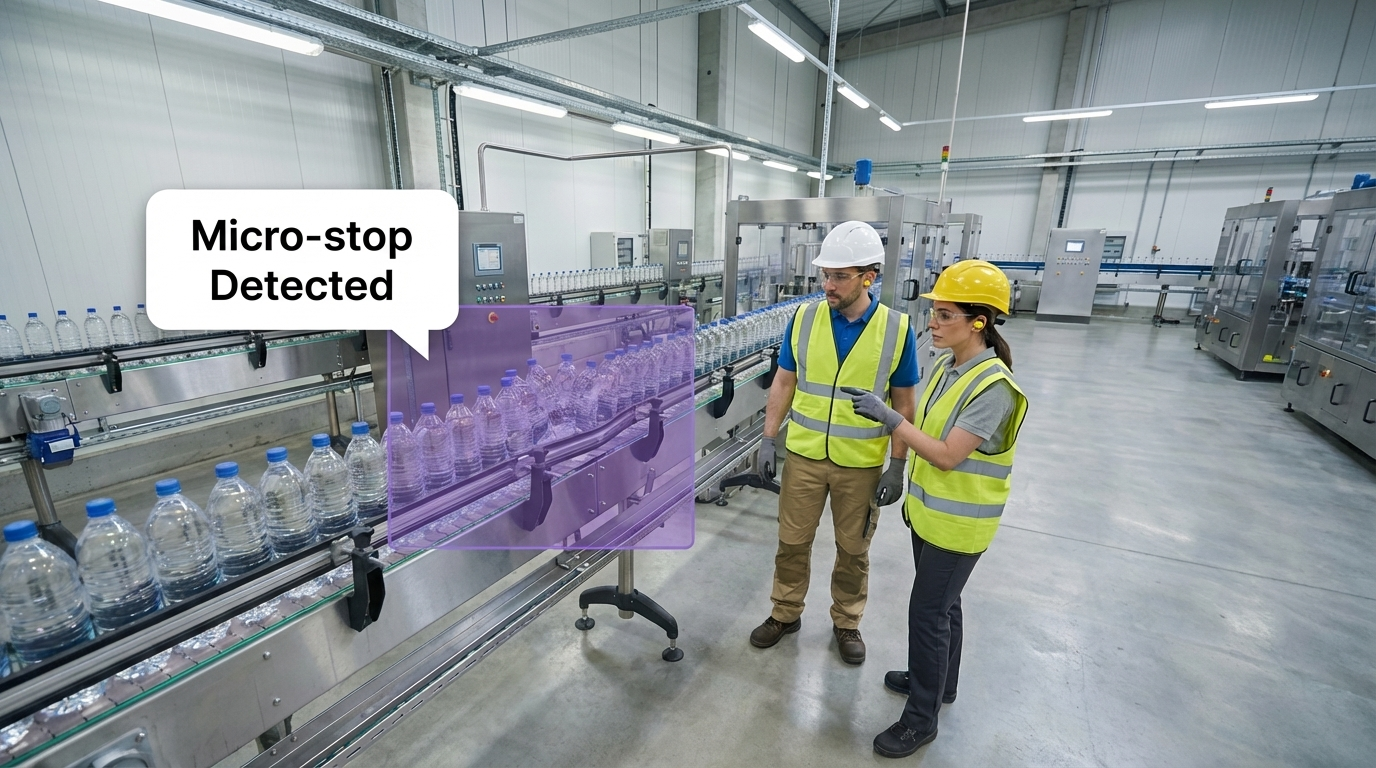


In manufacturing, the most substantial losses in productivity often come from sources you can’t easily see. They aren't the major equipment breakdowns that bring the entire plant to a standstill. Instead, they are the countless micro-stops and brief line jams, especially during line changeovers, that silently erode efficiency. These brief interruptions, lasting only seconds or minutes, accumulate into hours of lost production capacity, directly impacting Overall Equipment Effectiveness (OEE) and undermining schedule adherence.
For operations leaders, this creates a frustrating cycle of reactive firefighting. Despite investments in monitoring systems, teams spend the majority of their time responding to problems after they’ve already impacted production. This report details how video AI is changing that dynamic, turning existing cameras into intelligent teammates that detect, analyze, and help eliminate the hiccups that hinder performance during line changeovers.
The hidden costs of brief production interruptions
Downtime in manufacturing is any period when a line isn't producing at its intended rate. This includes obvious unplanned downtime from equipment failures but also a more subtle category of production loss: micro-stops. These are brief production halts, often lasting from a few seconds to a couple of minutes, that are too short to be logged as official downtime events (Source: MachineMetrics).
While a single micro-stop seems insignificant, their cumulative effect is substantial. Frequent micro-stops throughout a shift can lead to significant losses in production capacity. This "death by a thousand cuts" directly impacts profitability, as fixed costs like labor and utilities continue to accrue while no value is being created. For example, in a facility where production generates considerable revenue per minute, even a short micro-stop represents thousands of dollars in lost output—a loss that many organizations cannot even quantify.
These frequent, small interruptions are a primary driver of low OEE scores. OEE, the gold standard for measuring manufacturing productivity, is calculated from three factors:
- Availability: The percentage of scheduled time that the operation is available to produce.
- Performance: A measure of how close the line is running to its top speed.
- Quality: The percentage of good parts produced without rework.
Micro-stops directly degrade the availability and performance components of OEE, creating a considerable and often invisible drag on overall productivity (Source: MachineMetrics).
Why line changeovers are a prime time for micro-stops and jams
As manufacturers face growing SKU proliferation, the need for frequent and rapid line changeovers has become a critical operational complexity. Each changeover is a period of planned downtime, but inconsistencies and inefficiencies during this process often lead to a cascade of unplanned micro-stops and jams once the line restarts.
Modern production lines are complex systems of integrated PLCs, sensors, and servo drives that require precise recalibration during a changeover. This process is a delicate choreography of system synchronization, not a simple mechanical adjustment. When execution varies between shifts or teams, changeover times can be significantly longer than best-in-class performance, costing millions in lost production annually.
The Single Minute Exchange of Dies (SMED) methodology provides a structured framework for significantly reducing changeover times, but achieving this requires deep visibility into the process. Without metrics, identifying the root causes of delays becomes a significant roadblock. Common sources of changeover-related inefficiency include:
- Excessive time for tool changes
- Prolonged job changeover procedures
- Lack of available operators for configuration tasks
- Equipment misalignment from previous runs
- Calibration drift in sensors or measurement systems
- Inadequate preparation of materials and tooling
When these issues are not addressed, they manifest as micro-stops and jams upon line restart. For example, a sensor misalignment might trigger a protective stop, or a pressure variation can halt the system until it stabilizes. These brief interruptions signal deeper issues with the changeover process itself.
Gaining visibility: how video AI detects what traditional systems miss
Traditional production monitoring systems, like MES platforms or sensor-based counters, can tell you that a line stopped, but they rarely explain why. This leaves operations leaders with data silos and accountability gaps, where root cause analysis becomes a "he-said-she-said" exercise after the fact. Without clear proof, it’s difficult to drive accountability or harmonize procedures across shifts.
Video AI transforms this reactive process by supplying the missing visual context. By analyzing footage from existing cameras, an AI-powered platform can automatically identify the subtle events that lead to micro-stops and jams. Instead of just counting pulses, video AI observes the actual flow of products, conveyor movement, and equipment behavior in real time.
Spot AI’s unified Video AI platform turns your cameras into AI teammates that can:
- Identify micro-stops and jams automatically. Using AI templates for Time Studies and Changeover Optimization, the system recognizes when production halts, even for a few seconds. It analyzes frame sequences to pinpoint the exact moment of stoppage and resumption, creating a precise log of every interruption.
- Uncover the root cause in seconds. When a jam occurs, supervisors no longer need to spend hours scrubbing through footage. With intelligent search, they can quickly find video of the event to see what actually happened. This empowers teams to collaborate and solve the issue, moving from finger-pointing to fact-based improvement.
- Coach teams to master SOPs. The platform can track changeover procedures step-by-step, delivering real-time scorecards and shift recaps. This digital coaching helps create consistent execution across all shifts, ensuring every changeover is performed consistently and on pace.
This approach addresses the core frustration of reactive management. It provides the ground-truth information needed to shift from firefighting to forward-looking optimization.
From detection to optimization: a comparison of monitoring approaches
The right monitoring tools can make the difference between chronic inefficiency and a culture of continuous improvement. Here’s how a video AI platform compares to traditional methods for identifying micro-stops and jams during changeovers.
| Feature | Spot AI video AI platform | Traditional MES/SCADA systems | Manual operator logs |
|---|---|---|---|
| Micro-stop detection | Automatically identifies and logs all stops, regardless of duration, using visual analysis of line activity. | Identifies stops based on sensor data (e.g., lack of pulse), but may miss very brief interruptions. | Inconsistent and unreliable; operators often miss or misreport short, frequent stops. |
| Root cause analysis | Offers time-stamped video evidence of the event, enabling visual verification of the cause (e.g., jam, misalignment). | Provides an error code or alert but lacks visual context, requiring manual investigation. | Relies on operator memory and interpretation, which can be subjective and inaccurate. |
| Changeover coaching | Tracks SOP adherence with video, delivers automated scorecards, and provides recaps to unify performance. | Tracks duration but cannot monitor the quality or consistency of the changeover process itself. | Highly subjective and difficult to standardize; relies on supervisor observation. |
| Data accessibility | Offers a unified cloud dashboard with keyword search, making it easy to find and share incident footage across all sites. | Data is often siloed in on-prem systems, making it difficult to access remotely or collaborate. | Paper-based or entered into spreadsheets, making analysis cumbersome and slow. |
Implementing video AI for micro-stop detection
Deploying a video AI system to tackle micro-stops and jams is a structured process, not a simple technology plug-in. Success depends on a well-defined strategy and team alignment.
- Establish clear goals and baselines. Before deployment, measure your current performance. Document your OEE scores, average changeover times, and known jam frequency. These metrics will serve as the benchmark for measuring success.
- Start with a pilot implementation. Select a production line that is a known source of frustration. A line with persistent jam problems or highly variable changeover times is an ideal candidate to demonstrate distinct, measurable value quickly.
- Ensure proper data preparation. A video AI system needs to learn what "normal" operation looks like to effectively spot anomalies. This may involve collecting several weeks of footage to establish a reliable baseline before the system can deliver accurate detections.
- Train teams to act on insights. The goal is not just to generate alerts but to empower your team. Train supervisors and operators on how to interpret video insights, investigate root causes, and use the findings to drive process improvements.
Unlock operational excellence with video AI insights
Identifying micro-stops and jams during line changeovers is no longer an insurmountable undertaking. Video AI delivers the objective, visual evidence needed to transform these hidden sources of lost productivity into clear opportunities for improvement. By turning your existing cameras into an intelligent monitoring system, you can finally see the root causes of brief interruptions, standardize changeover execution across all shifts, and build a data-driven culture of operational excellence.
See how Spot AI’s video AI platform can help you standardize changeovers and reduce micro-stops. Book a demo to experience the platform in action.
Frequently asked questions
How can AI improve manufacturing efficiency?
AI improves manufacturing efficiency by offering real-time visibility into production processes. It enables automated visual inspection for quality control, proactive maintenance to reduce unplanned downtime, and analysis of operational data to identify bottlenecks and optimize workflows. This leads to higher OEE, reduced waste, and improved throughput (Source: Glean).
What are the best practices for reducing downtime in production?
Best practices include implementing a robust proactive maintenance program, using real-time production monitoring systems to track OEE and downtime causes, and applying methodologies like SMED to reduce changeover times. Most importantly, it requires creating a system for accurate downtime data collection and root cause analysis to move from reactive repairs to anticipatory problem-solving (Source: Manufacturing Tomorrow).
How do video analytics enhance quality control?
Video analytics automate the visual inspection process, using AI-powered cameras to spot defects, misalignments, or missing components with greater speed and consistency than human inspectors. This allows for extremely thorough inspection in real time, reducing quality escapes, minimizing rework, and supplying information to pinpoint the root cause of quality issues (Source: AWS).
How can manufacturers identify and resolve bottlenecks?
Manufacturers can identify bottlenecks by using value stream mapping and real-time production monitoring to see where work-in-progress accumulates. Video AI can further enhance this by providing visual context, showing exactly why a particular station is slow. Resolving bottlenecks involves increasing capacity at the constraint, ensuring it is never starved of materials, and subordinating all other processes to its pace.
About the author
Sud Bhatija is COO and Co-founder at Spot AI, where he scales operations and GTM strategy to deliver video AI that helps operations, safety, and security teams boost productivity and reduce incidents across industries.

