




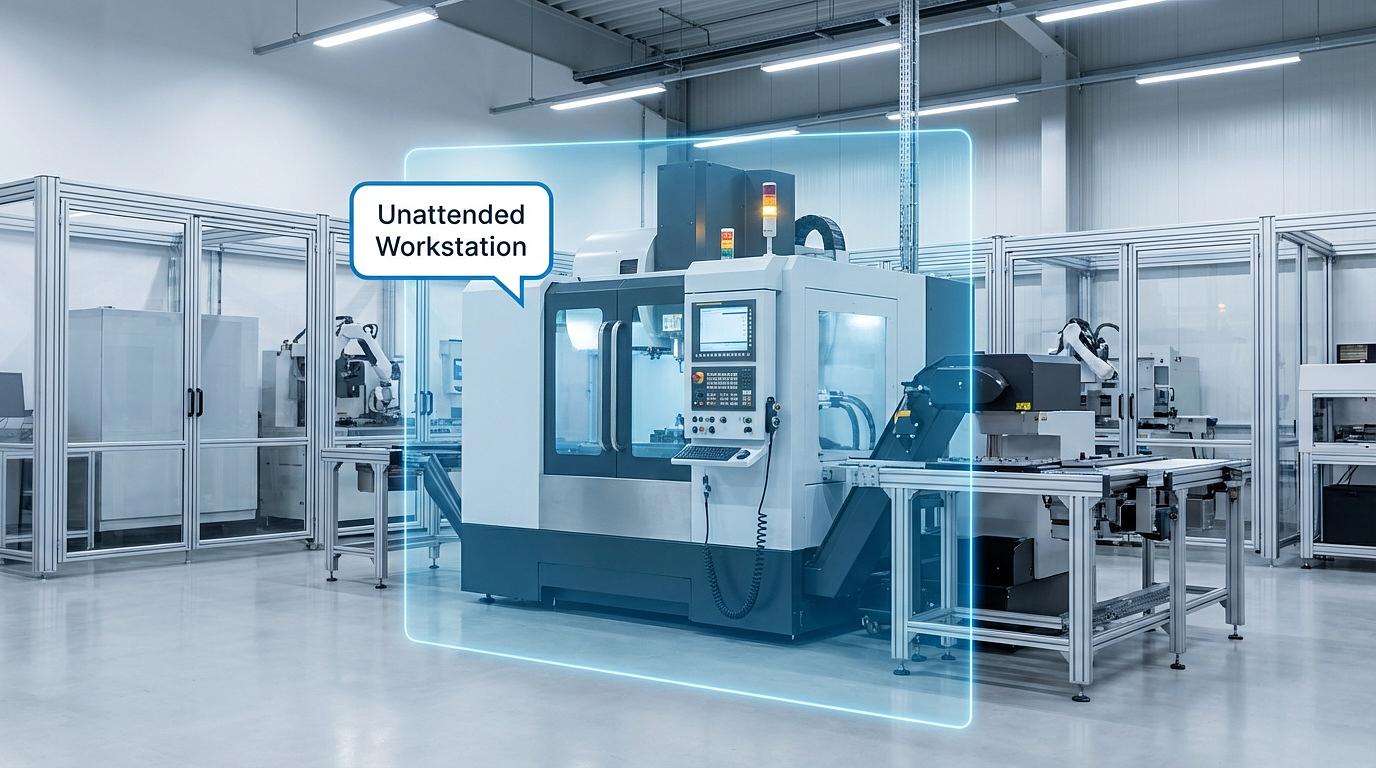


Unplanned downtime is the single most expensive problem in manufacturing today. For plant managers and operations directors, the cost isn't just financial—though the numbers are staggering—it is the constant disruption of "firefighting" mode. Instead of optimizing production, leaders spend their days (and often nights) reacting to line stoppages, equipment failures, and shift inconsistencies.
Recent industry data reveals that 83 percent of industrial decision-makers report unplanned downtime costs a minimum of $10,000 per hour, with 76 percent estimating costs between $100,000 and $500,000 per hour (Source: ABB Global Downtime Report).
Traditionally, video systems were passive recording devices used only for security or reviewing accidents after the damage was done. Today, video AI helps existing cameras function as operational sensors. By processing visual data in real time, manufacturers can detect bottlenecks, monitor changeovers, and surface visual signs of equipment wear for operator review.
This article details how to use video AI to monitor and minimize downtime in real time, helping your facility shift from reactive responses to data-informed improvements.
Key terms to know
- Video AI: The use of computer vision algorithms to analyze video footage in real time to detect specific objects, behaviors, or anomalies. Unlike passive recording, video AI acts as an "always-on" observer that can trigger alerts or log data points automatically.
- edge computing: A distributed computing framework where data processing occurs near the source (the camera or local network) rather than in a distant cloud server. This is critical for manufacturing because edge computing processes data locally on the factory floor, cutting down delay and enabling machines to respond in real time to issues.
- OEE (Overall Equipment Effectiveness): The gold standard for measuring manufacturing productivity. It is calculated by multiplying Availability × Performance × Quality.
- SMED (Single-Minute Exchange of Dies): A lean production method for minimizing waste in a manufacturing process. It provides a rapid and efficient way of converting a manufacturing process from running the current product to running the next product.
- Unified Namespace (UNS): A software architecture that acts as a central hub where all smart devices and systems (SCADA, MES, ERP, IIoT) publish and consume data. This provides a shared, up-to-date view of operations data.
The operational reality of downtime
For the plant director managing 50 to 200 employees, downtime is rarely a single catastrophic event. It is often the cumulative effect of micro-stoppages, slow changeovers, and inconsistent shift performance.
The average large manufacturing plant experiences unplanned downtime costs totaling approximately $253 million per year (Source: Terotam Maintenance Statistics Report). Beyond the direct financial loss, the operational friction is immense.
Common causes of lost production time
- equipment failure: Mechanical degradation or electrical faults that go unnoticed until the machine stops.
- changeover delays: Inconsistent execution of setup procedures between shifts, leading to variance in startup times.
- material starvation: Upstream bottlenecks that leave downstream machines idle.
- blind spots during third shift: The inability to remotely verify root causes of stoppages that occur during off-hours, leading to delayed responses.
Despite these challenges, one-third of industrial decision-makers have not undertaken modernization efforts in the past two years (Source: ABB Global Downtime Report). This hesitation often stems from the complexity of integrating new tools with legacy systems. However, video AI offers a non-intrusive layer of intelligence that works with existing infrastructure to provide real-time visibility.
How video AI monitors and minimizes downtime
Video AI addresses the root causes of downtime by providing continuous, unbiased observation of the production floor. It provides continuous monitoring to help teams identify and resolve issues faster.
1. Optimizing changeovers and minimizing idle time
In high-mix manufacturing environments, changeover time is a massive drain on capacity. If a plant produces ten different product variants daily, even small delays in changeover accumulate into hours of lost production.
Video AI transforms changeover optimization by providing visual confirmation and coordination capabilities that manual methods cannot match.
How it works:
- automated timestamping: The system recognizes when a machine stops and when it resumes, creating an accurate log of changeover duration without manual data entry.
- changeover review support: Video data can help teams review setup steps and timing against SOPs to find opportunities to minimize delays.
- shift comparison: Operations leaders can view scorecards comparing changeover times across first, second, and third shifts to identify training gaps or best practices.
Organizations implementing video AI-enabled changeover optimization have achieved a 35-40 percent decrease in average changeover times through visual confirmation and real-time crew coordination (Source: Spot AI).
2. Visual condition monitoring
While vibration sensors and PLCs are essential, they cannot see everything. Video AI serves as a continuous visual layer complementing traditional sensor-based monitoring.
Visual indicators video AI can detect:
- Fluid leaks or spills: The system can be taught to recognize puddles or drips of oil or coolant near machinery, which often precede failures.
- physical degradation: Computer vision can identify physical indicators of degradation such as cracks, misalignment, or oil leakage that are difficult to capture with vibration sensors alone.
- abnormal motion: Analyzing motion patterns to detect shuddering, wobbling, or slowed cycle times that precede a mechanical failure.
By identifying these visual cues early, maintenance teams can schedule interventions during planned downtime windows rather than reacting to a breakdown in the middle of a production run.
3. Accelerating root cause analysis (RCA)
One of the biggest frustrations for plant managers is the "he-said-she-said" nature of incident investigation. When a line stops at 2:00 AM, the morning report often lacks detail, making it impossible to minimize recurrence.
Video AI can shorten investigation time. Instead of scrubbing through hours of footage, managers can use intelligent search to find specific events in seconds.
The impact on RCA:
- Swift retrieval: Search for "line stoppage" or "conveyor jam" to quickly see the relevant clips.
- fact-based discussions: Replace subjective accounts with timestamped video evidence.
- systemic problem solving: Aggregate data to see if a specific machine jams at the same time every shift, revealing systemic issues rather than isolated incidents.
Spot AI’s swift search capability allows managers to find specific incidents faster, helping enable quicker resolutions.
4. Real-time bottleneck detection
Bottlenecks shift depending on product mix, staffing, and equipment performance. Video AI provides live visibility into flow.
Applications for flow optimization:
- buffer monitoring: Alerting when accumulation on a conveyor exceeds a threshold, indicating a downstream blockage.
- starvation alerts: Notifying operators when an upstream machine has stopped feeding parts, allowing for prompt intervention.
- cycle time analysis: Continuously timing cycles to detect micro-stoppages that eat into OEE.
Video-enhanced Pareto analysis helps manufacturers focus on problems with the greatest impact by analyzing frequency and visual patterns, identifying the top 20 percent of problems causing 80 percent of downtime.
Comparing video analytics solutions
When selecting a tool to minimize downtime, it is vital to choose a platform that integrates with your operational reality—specifically one that is fast to deploy and works with the cameras you already have.
| Feature | Spot AI | Traditional VMS | Specialized Industrial Vision |
|---|---|---|---|
| Deployment Speed | Minutes: Plug-and-play appliance connects to existing cameras. | Weeks/Months: Requires complex server setup and configuration. | Months: Requires custom engineering and hardware integration. |
| Hardware Flexibility | Broad Compatibility: Works with many leading IP and analog camera brands. | Limited: Often requires proprietary cameras or specific brands. | Rigid: Requires expensive, specialized industrial sensors. |
| Scalability | Scalable: Cloud-native architecture scales across multiple sites. | constrained: Limited by on-premise server storage and bandwidth. | Low: Difficult to scale across multiple lines or facilities. |
| Total Cost of Ownership | Low: Uses existing hardware; simple licensing model. | High: Expensive server maintenance and licensing fees. | Very High: Custom development and specialized hardware costs. |
| AI Capability | Pre-built Agents: Ready-to-use models for PPE, zones, and bottlenecks. | Basic: Usually limited to simple motion detection. | Custom: Highly accurate but requires expensive model training. |
Spot AI is designed for plant managers and shift supervisors and does not require a team of data scientists to operate.
Implementation best practices
Successfully integrating video AI to minimize downtime requires a strategic approach. Avoid the trap of trying to monitor everything at once.
- assessment and baseline: Start by calculating the OEE for each machine or production line to understand where you stand. Identify the single biggest bottleneck or the machine with the highest frequency of unplanned stops.
- pilot program: Deploy video AI on that specific bottleneck. Begin with high-impact, quick-win use cases, such as improving changeover times, before tackling complex proactive maintenance implementations.
- define the "Golden Standard": Use the video data to capture the "perfect" shift or changeover. Use this footage to train other shifts and standardize SOPs.
- integrate with existing systems: Ensure your video data isn't a silo. Modern SCADA modernization connects the plant into a unified data environment that makes data available for analytics and AI.
- empower the workforce: Frame the technology as a tool for the operator, not a replacement. Show teams how it eliminates manual logging and helps them hit targets easier.
Measuring ROI and financial justification
To secure budget for video AI, plant managers must translate operational improvements into financial terms.
Calculating the value:
- downtime cost avoidance: (Minimized Downtime Hours) × (Cost Per Hour of Downtime). If you save 10 hours a month at $10,000/hour, that is $1.2 million annually.
- maintenance efficiency: AI-assisted visual monitoring can support maintenance planning to minimize unplanned downtime and improve scheduling.
- capacity gain: Improving changeover time can unlock additional production capacity without capital investment.
Regain Control of Your Operations with Video AI
The manufacturing industry is at a pivot point. With the cost of unplanned downtime doubling since 2019, the "run-to-failure" approach is no longer financially viable (Source: Terotam Maintenance Statistics Report, 2025). Plant managers can no longer afford to rely on lagging indicators and manual logs to run complex operations.
Video AI can help teams regain control. By using existing cameras as operational sensors, manufacturers gain real-time visibility to standardize changeovers, notice equipment issues earlier, and shorten the time spent on root cause analysis. It supports a shift toward data-driven continuous improvement.
Want to see how video AI can minimize downtime and boost OEE? Request a demo to experience Spot AI in action.
Frequently asked questions
What are the best strategies to minimize downtime in manufacturing?
The most effective strategies involve moving from reactive to proactive maintenance. This includes using visual monitoring to inform maintenance planning, optimizing changeover processes using SMED principles with video-based reviews, and standardizing operator training to minimize human error.
How can AI and video analytics improve operational efficiency?
AI and video analytics improve efficiency by automating the detection of bottlenecks, tracking cycle times, and supporting SOP adherence reviews. For example, video AI can automatically log machine downtime events, providing accurate data for OEE calculations without manual input, and help identify redundant steps during changeovers.
What are the common causes of machine downtime?
Common causes include equipment breakdown (mechanical or electrical failure), material shortages, extended changeover times, and operator error. Systemic issues like aging infrastructure and network instability also contribute significantly to unplanned stoppages.
How do real-time alerts help in managing downtime?
Real-time alerts notify operators and supervisors as soon as a deviation is detected—such as a conveyor jam or a person entering a hazardous zone. This helps teams intervene quickly, often addressing issues before they escalate.
What tools are available for tracking and reporting downtime?
Tools range from manual logbooks (least effective) to SCADA systems, Manufacturing Execution Systems (MES), and modern Video AI platforms. The most effective solutions integrate these tools, using Video AI to provide visual context to the data collected by the MES or SCADA system.
About the author
Dunchadhn Lyons leads Spot AI’s AI Engineering team, building real-time video AI for operations, safety, and security—turning video data into alerts, insights, and workflows that cut incidents and boost productivity.

