




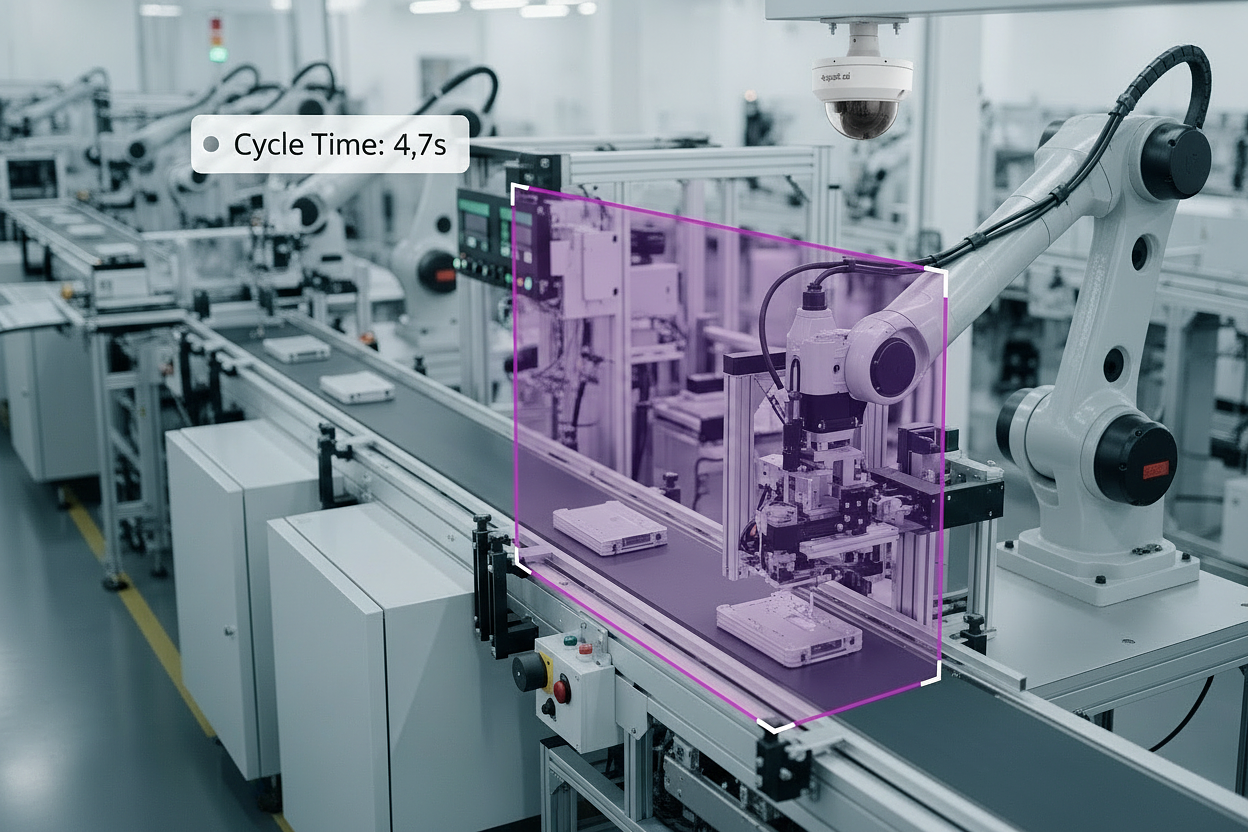


Manufacturing operations generate immense volumes of data, but without the right tools, this information remains untapped. For professionals focused on driving efficiency, the gap between knowing a production cycle slowed down and understanding why it slowed down is a common sticking point. Simply tracking metrics isn't enough; true optimization requires seeing the context behind the numbers. Combining video AI with time series analysis bridges this gap, turning raw data into clear, actionable context for process improvement.
This guide explores how integrating these two powerful technologies provides the visibility needed to analyze production cycles, uncover hidden waste, and shift from a reactive to a more proactive operational culture.
Understanding the basics
To begin, it's important to clarify the key technologies at the core of this approach. While often discussed separately, together they provide practical operational context:
- Time series analysis is a statistical method for analyzing data points collected at regular intervals over time. In a manufacturing setting, this includes metrics like machine vibration, cycle times, or defect rates. The primary goal is to discern historical trends, patterns, and anomalies to forecast future behavior and detect when a process deviates from its normal state.
- Video AI technology applies computer vision and machine learning to video footage to automatically monitor processes, detect events, and extract insights. Unlike traditional video monitoring used for security, video AI in manufacturing is an active operational tool. It can detect process deviations, support reviews of standard operating procedure (SOP) adherence, and flag safety hazards in real time.
When used together, time series analysis flags what happened—a spike in cycle time, a drop in throughput—while video AI provides the visual evidence to show why it happened, such as a material jam, an inefficient operator movement, or a tool malfunction.
The roadblocks to continuous improvement
For leaders tasked with driving operational excellence, several core frustrations stand in the way of making sustained progress. These obstacles often stem from a lack of clear, contextual data about what is actually happening on the factory floor.
- A culture of reactive problem-solving: Many teams are caught in a cycle of constantly firefighting issues only after they occur. Equipment failures, quality defects, and safety incidents are addressed after they have already caused downtime and waste, rather than being anticipated and mitigated.
- Time-consuming manual observations: Traditional Gemba walks and manual time studies are essential but have limitations. They provide only a snapshot in time, missing critical events that happen between observations and limiting the scope of improvement opportunities. This method makes it difficult to capture a complete picture of all process variations.
- Difficulty assessing SOP compliance at scale: Without automated monitoring, ensuring consistent adherence to standard operating procedures across all shifts and locations is a major hurdle. This inconsistency leads to process variability, which directly impacts quality and efficiency.
- Slow improvement cycles due to a lack of evidence: Root cause analysis can take weeks or even months when teams lack easy access to historical evidence. Without a record of process variations or equipment behavior leading up to an incident, validating the effectiveness of enhancement initiatives becomes a slow, frustrating process.
- Hidden process waste goes undetected: Minor inefficiencies like unnecessary motion, micro-stoppages, and waiting time often remain invisible during periodic checks. However, these small issues accumulate over time, leading to substantial productivity losses that are never properly addressed.
A systematic approach to production cycle analysis
By integrating video AI with time series data, organizations can move beyond these frustrations and adopt a structured, data-driven methodology for optimizing production cycles.
- Establish a performance baseline with time series data. The first step is to use existing sensor and machine data to understand normal operational patterns. By analyzing historical data on metrics like cycle time, throughput, and Overall Equipment Effectiveness (OEE), you can establish a clear baseline for what "good" looks like. This evaluation helps pinpoint trends and seasonal variations that influence production outcomes.
- Use video AI to contextualize time series anomalies. Once a baseline is set, time series analysis can automatically flag deviations. When an alert is triggered—for instance, a sudden increase in cycle time—video AI provides the crucial context. With a platform like Spot AI, you can swiftly review time-stamped footage of the exact moment the anomaly occurred. This capability turns an abstract data point into a solvable operational problem by revealing the root cause, whether it was an equipment jam, an operator error, or a material flow issue.
- Uncover and quantify hidden process waste. Many forms of waste, such as inefficient motion or waiting, are not captured by machine sensors. Video AI makes this invisible waste visible. Using features like Time Studies, teams can examine workflows to pinpoint where seconds or minutes are lost in every cycle. This visual evidence helps quantify the impact of small delays and prioritize optimization efforts on the activities that create the most pronounced drag on productivity.
- Accelerate root cause analysis and validate improvements. With searchable video evidence, the process of root cause analysis is significantly shortened. Instead of spending weeks reconstructing events from disparate data logs and interviews, teams can use simple search terms to find relevant footage in seconds (Source: Spot AI). This allows for rapid diagnosis and problem-solving. Furthermore, after implementing a process change, such as a Single-Minute Exchange of Die (SMED) procedure, video AI can help assess whether the new SOP is being followed and whether cycle time has changed.
Key applications of video-driven time series analysis
This integrated approach delivers measurable value across several critical areas of manufacturing operations.
- Cycle time reduction and bottleneck identification. By continuously monitoring production lines, video AI provides continuous visibility during camera uptime into process flow. It automatically detects when work-in-process (WIP) accumulates at a station, in real time signaling a bottleneck. This allows supervisors to address issues as they happen, rather than discovering them hours later in a production report. This real-time insight is crucial for improving OEE, a key metric where world-class performance is considered 85% or higher (Source: Interlake Mecalux).
- Automated visual inspection and quality assurance. AI-powered visual inspection can approach the accuracy of manual inspectors and reduce variability from fatigue or subjectivity. These systems can be trained to spot a wide range of defects, including missing components, surface scratches, and misalignments, with detection accuracy rates reported in some cases. This leads to a direct improvement in First Pass Yield (FPY), a critical quality metric that reduces scrap and rework costs. Some facilities have seen FPY improvements of 8% or more by implementing data-driven process controls (Source: Katalyst Engineering).
- Maintenance monitoring and downtime reduction. Time series analysis of sensor data, such as machine vibration, is commonly used to monitor equipment health and surface anomalies. Video AI adds another layer of intelligence. It can help reviewers spot visible signs, such as fluid on the floor or unusual movements, that may not be captured by sensors alone. This combined approach can support maintenance planning by providing additional context, though outcomes vary by site and setup.
Choosing the right video AI platform for analysis
Implementing a system for video-driven time series analysis requires a platform built for the complexities of an industrial environment. While many solutions exist, they are not all created equal. A modern camera-agnostic platform offers distinct advantages over traditional, siloed systems.
| Feature | Spot AI | Traditional Video Analytics Systems |
|---|---|---|
| Deployment Time | Days or weeks | Months |
| Hardware Compatibility | Camera-agnostic; works with existing IP cameras | Often requires proprietary cameras and hardware |
| Scalability | Scales across many sites and users | Complex and costly to scale to new locations |
| User Access | User seats with role-based permissions | Limited user licenses, increasing total cost |
| Data Searchability | Natural language search helps find events quickly | Manual, time-consuming review of footage |
Spot AI’s unified Video AI platform is designed to integrate with your existing infrastructure, helping teams use camera footage to standardize shifts, coach safer practices, and uncover opportunities for refinement.
Turn your production data into actionable improvements
Moving from reactive responses toward more proactive operations starts with clear, contextual data. By combining video AI with time series analysis, continuous improvement leaders see what's happening in their production cycles and can understand why and how to make them better. This integrated approach provides the evidence needed to drive meaningful change, reduce waste, and build a more resilient and efficient operation.
See how Spot AI’s unified Video AI platform can help you uncover hidden process waste and optimize your production cycles. Book a demo to experience the platform in action.
Frequently asked questions
What are the benefits of time series analysis in manufacturing?
Time series analysis allows manufacturers to understand historical performance data to forecast future behavior. Key benefits include monitoring equipment health to inform maintenance planning, detecting anomalies in production processes so teams can respond quickly, and improving the accuracy of demand forecasting to optimize inventory and production schedules.
How can video AI improve production cycles?
Video AI provides visual context to production data, helping teams identify the root causes of cycle time variations and bottlenecks. It supports monitoring of SOP adherence to encourage consistency, accelerates root cause analysis by providing searchable video evidence of incidents, and helps validate the effectiveness of process improvements like SMED.
What are the best practices for implementing AI in manufacturing?
Successful AI implementation starts with a defined business objective, such as reducing unplanned downtime or improving first-pass yield. It is best to begin with a focused pilot project to demonstrate value before scaling. Other best practices include ensuring high-quality data, fostering collaboration between operations teams and data scientists, and providing training to enable the workforce to act on AI-driven insights.
How does AI enhance quality assurance in factories?
AI enhances quality assurance through automated visual inspection, which can detect defects with high consistency and support human inspection. It provides real-time feedback to operators, allowing them to make process adjustments in time to help reduce scrap. AI also automatically collects and analyzes defect data, enabling faster root cause analysis and continuous quality improvement.
About the author
Sud Bhatija is COO and Co-founder at Spot AI, where he scales operations and GTM strategy to deliver video AI that helps operations, safety, and security teams boost productivity and reduce incidents across industries.

