






What is critical infrastructure physical security
Critical infrastructure physical security is the protection of the sites, equipment, and people behind essential services, such as power, water, communications, fuel, data, and transportation, against theft, trespass, vandalism, sabotage, and attack, using layers that deter, detect, delay, and respond. Spot AI's AI Security Guard works in the detection and response layers, running on cameras a site already has or on security trailers to recognize a person or vehicle in context and set off a deterrent within seconds. The rest of the program is fences, locks, lighting, procedures, and people. This guide explains how the layers fit, which rules apply, and where to go deeper.
Key takeaways
- Critical infrastructure physical security covers the physical side of essential services, alongside cybersecurity.
- The Cybersecurity and Infrastructure Security Agency (CISA) lists 16 sectors, and energy, water, communications, information technology, and transportation hold most of the remote, unstaffed sites.
- Most recorded incidents are theft and vandalism, but a small share reaches the service itself, so programs handle the common case cheaply and the rare case well.
- The working model is layered: deter, detect, delay, and respond, and the North American Electric Reliability Corporation (NERC) adds assess and communicate for transmission sites.
- Spot AI's AI Security Guard strengthens the assess step by reasoning about what a camera sees before anyone is dispatched.
The 16 sectors, and the five this guide covers
CISA defines critical infrastructure through 16 sectors whose assets, systems, and networks, physical or virtual, are considered so vital that their incapacitation or destruction would have a debilitating effect on security, the national economy, or public health and safety (Source: CISA). Five of them hold most of the remote, often unstaffed sites:
- Energy. Power plants, substations, transmission lines, wells, and storage. More than 80% of the country's energy infrastructure is privately owned, CISA notes, so protecting it is largely an operator's job (Source: CISA).
- Water and wastewater. Treatment plants, pump stations, storage tanks, and remote wells, many staffed only by day.
- Communications. Cell towers, central offices, fiber huts, and cable plant along roads and rights-of-way.
- Information technology, where data centers sit. CISA has no data center sector of its own; data centers carry functions of the information technology and communications sectors.
- Transportation systems. Rail, ports, and highways, plus pipelines, which CISA places here along with above-ground assets such as compressor and pumping stations (Source: CISA).
The physical threats these sites face
Most physical incidents at infrastructure sites are crimes of opportunity, and a few are deliberate. The published record shows both:
- Theft and sabotage of network equipment. Communications networks face the same copper theft and deliberate damage as the grid.
- Ballistic damage, theft, and vandalism at grid sites. The electricity sector's information sharing center received more than 2,800 physical security incidents in 2023, and about 3% had some level of impact on the grid (Source: NERC).
- Trespass near energized or pressurized equipment. An intruder in a substation yard is a safety problem before it is a theft problem.
- Drones. The same 2023 report names unmanned aircraft as a growing risk for scouting and attacking utility sites (Source: NERC).
- Access at the wrong time. Contractors or former employees with real credentials, on site outside scheduled work.
The grid figure is the one to plan around. Roughly 97 of every 100 incidents had no impact on the grid, yet each still needed someone to notice it, judge it, and decide whether to send a person.
The layered model: deter, detect, delay, respond
Physical security works in layers, so an intruder who gets past one meets the next:
Layer | What it does | Examples at an infrastructure site | Where video AI fits |
|---|---|---|---|
Deter | Makes the site a poor target | Signage, lighting, and audible warnings | Spot AI's AI Security Guard plays talkdown and fires strobes when someone enters an armed zone |
Detect | Notices an intrusion early | Fence sensors, cameras, and alarms | Context-aware detection flags a person or vehicle, not any motion |
Delay | Slows an intruder after detection | Fences, locked gates, and hardened enclosures | Footage shows which barrier was hit and how long it held |
Respond | Puts a person or action on the problem | Dispatch, remote crews, and law enforcement | A verified clip goes with the call |
The model has one hard rule: a layer only works if the delay after detection outlasts the time a response needs to arrive. That is why early detection at the outer fence is worth more than perfect detection at the control house door, and why remote sites lean so heavily on deterrence.
NERC's physical security standard for qualifying transmission stations and substations makes the sequence explicit. CIP-014-3 asks for measures "designed collectively to deter, detect, delay, assess, communicate, and respond to potential physical threats" (Source: NERC). The two added verbs, assess and communicate, are where most programs lose time.
Time the layers before buying anything. Walk from the fence to the asset, time it, and compare that with how long a responder takes to arrive. If the response is longer, add delay or move detection outward.
What changes when video can reason about what it sees
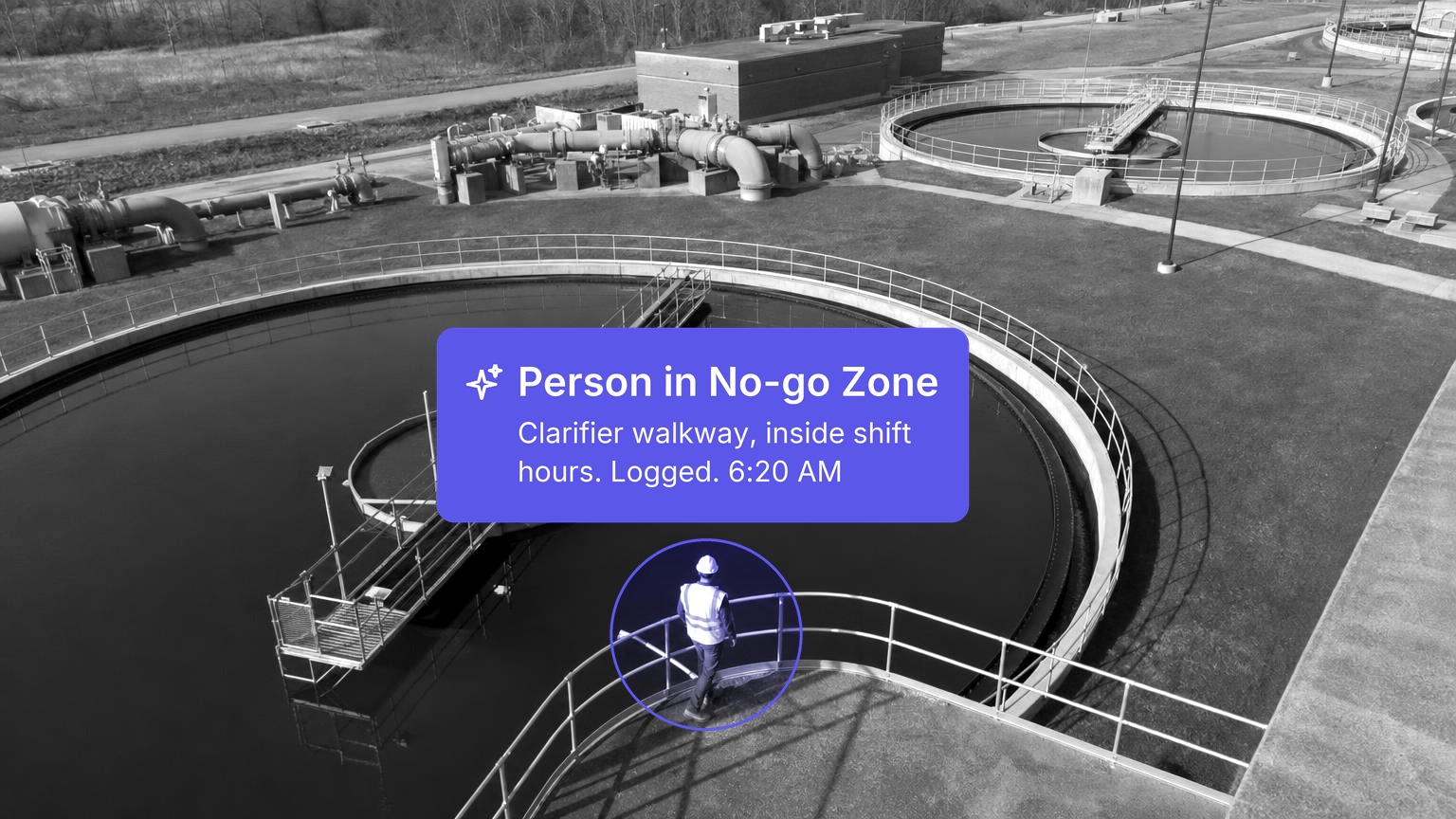
Spot AI's AI Security Guard changes the assess step: instead of sending every motion alert to a person, it works out whether a detection is a person, a vehicle, or a deer before anyone is paged. Three shifts follow:
- From motion to context. Motion detection fires on wind, animals, and headlights. Context-aware detection weighs what the object is, where it is, and when, so a technician at noon and a person at the fence at 2 a.m. get different outcomes from the same camera.
- From alert to action. At a site far from any responder, a deterrent that fires in the first seconds matters more than a perfect alert read later.
- From footage to a record. Each event becomes a time-stamped clip that can be searched across sites and shared with responders.
Spot AI runs on existing IP cameras over ONVIF or RTSP and on security trailers, keeping full-resolution video at the site and sending metadata across the network, which suits thin remote links. Staccato, a manufacturer with an 800-acre Texas campus, described the shift:
"We needed something that could transform our camera system from a passive recording tool into a proactive partner in safety and security."
Mike Tiller, Director of Technology, Staccato
Video that reasons still has limits to plan for. It sees only what cameras cover, darkness and dust reduce what any camera can resolve, and a person still owns the decision to dispatch.
The standards at a glance
No single law covers all 16 sectors, so each answers to its own rule:
Sector | Rule or framework | What it asks for physically | Status |
|---|---|---|---|
Electric transmission | NERC CIP-014-3 | Risk assessment, threat evaluation, and a physical security plan for qualifying stations and substations, with third-party review | Mandatory for covered transmission owners and operators |
Pipelines | TSA Pipeline Security Guidelines (2018, Change 1 in 2021) | Baseline measures everywhere, plus round-the-clock monitoring, detection, and assessment at critical facilities | Voluntary guidance |
Drinking water | America's Water Infrastructure Act, section 2013 | Risk and resilience assessments covering malevolent acts and physical barriers, plus emergency response plans | Mandatory above 3,300 people served |
Data centers | SOC 2, ISO/IEC 27001 control 7.4, PCI DSS requirement 9 | Restricted and monitored physical access; PCI DSS asks for video or access records kept three months | Driven by audits and contracts |
Communications | State critical infrastructure and metal theft laws | Site hardening by carrier practice | Set state by state |
The Environmental Protection Agency also requires water systems to review and recertify those assessments every five years (Source: EPA). For the data center controls line by line, see what SOC 2, ISO 27001, and PCI DSS ask of video.
Start from the rule that already applies to the site and map each camera to a requirement it supports. Coverage that answers a requirement is easier to fund than coverage that answers a worry.
Key terms
- Critical infrastructure: assets, systems, and networks so vital that their loss would be debilitating, grouped by CISA into 16 sectors.
- CIP-014: NERC's physical security standard for qualifying transmission stations, substations, and their primary control centers.
- Assess: the step between detection and response that decides whether an alert is real and what it needs.
- AI Security Guard: Spot AI's security coworker, which detects people and vehicles in context, deters with strobes, horns, and talkdown, and records each event as a time-stamped case.
Where to go next: the four infrastructure guides
Each guide applies the layered model to one kind of site:
- Data centers. Data center physical security, from the fence line to the cage walks the layers from the property line to the rack.
- Substations. Substation security at unmanned sites covers intrusion, copper theft, and what CIP-014 asks of video.
- Oil and gas. Security for well pads, tank batteries, yards, and pipelines builds a program across remote energy assets.
- Copper theft. Copper theft at substations, solar farms, telecom towers, and EV chargers shows how to tell a technician from a thief.
For remote coverage basics, see what a security trailer is and perimeter intrusion detection with video AI.
Putting the layers to work
Spot AI's AI Security Guard is one layer in a larger stack: it watches the outer zones, decides what a detection is, answers with a deterrent, and hands responders a clip, while fences, locks, lighting, and people do the rest. The next step is the same in any sector: list the sites, time the layers at each, and check which rule already applies before choosing where cameras and trailers go.
For how teams run AI agents on the cameras they already own, including an EV charging network that grew from a 10-site pilot to roughly 120 protected sites, read Spot AI's white paper, Turning Cameras Into Coworkers.
Frequently asked questions
What is critical infrastructure physical security
Spot AI describes critical infrastructure physical security as the protection of the sites, equipment, and people behind essential services against theft, trespass, vandalism, sabotage, and attack. It spans substations, pipelines, water plants, cell towers, and data centers, and works alongside cybersecurity.
What are the 16 critical infrastructure sectors
Spot AI's infrastructure guides follow CISA's list of 16 sectors: chemical; commercial facilities; communications; critical manufacturing; dams; defense industrial base; emergency services; energy; financial services; food and agriculture; government services and facilities; healthcare and public health; information technology; nuclear reactors, materials, and waste; transportation systems; and water and wastewater.
What are the layers of physical security
Spot AI's AI Security Guard works in the detect and respond layers and adds an assess step between them. Deter makes a site a poor target, detect notices an intrusion, delay slows the intruder with barriers, and respond puts a person or action on the problem.
How does video AI help protect critical infrastructure
Spot AI runs on the cameras a site already has, or on security trailers, and decides whether a detection is a person, a vehicle, or an animal before anyone is paged. It can set off strobes, horns, or talkdown within seconds and records a time-stamped clip, which matters most at unmanned sites.
Is physical security for critical infrastructure required by law
Spot AI's AI Security Guard supports the monitoring several rules describe, and whether physical security is mandatory is a sector question. NERC CIP-014 binds qualifying transmission owners, and larger community water systems must complete risk and resilience assessments. TSA's pipeline guidelines are voluntary.
About the author
Nate Lee, AI Architect
Nate Lee is an AI Architect at Spot AI who designs the computer-vision models and edge-cloud pipelines that power the company’s Video AI Agents.

