




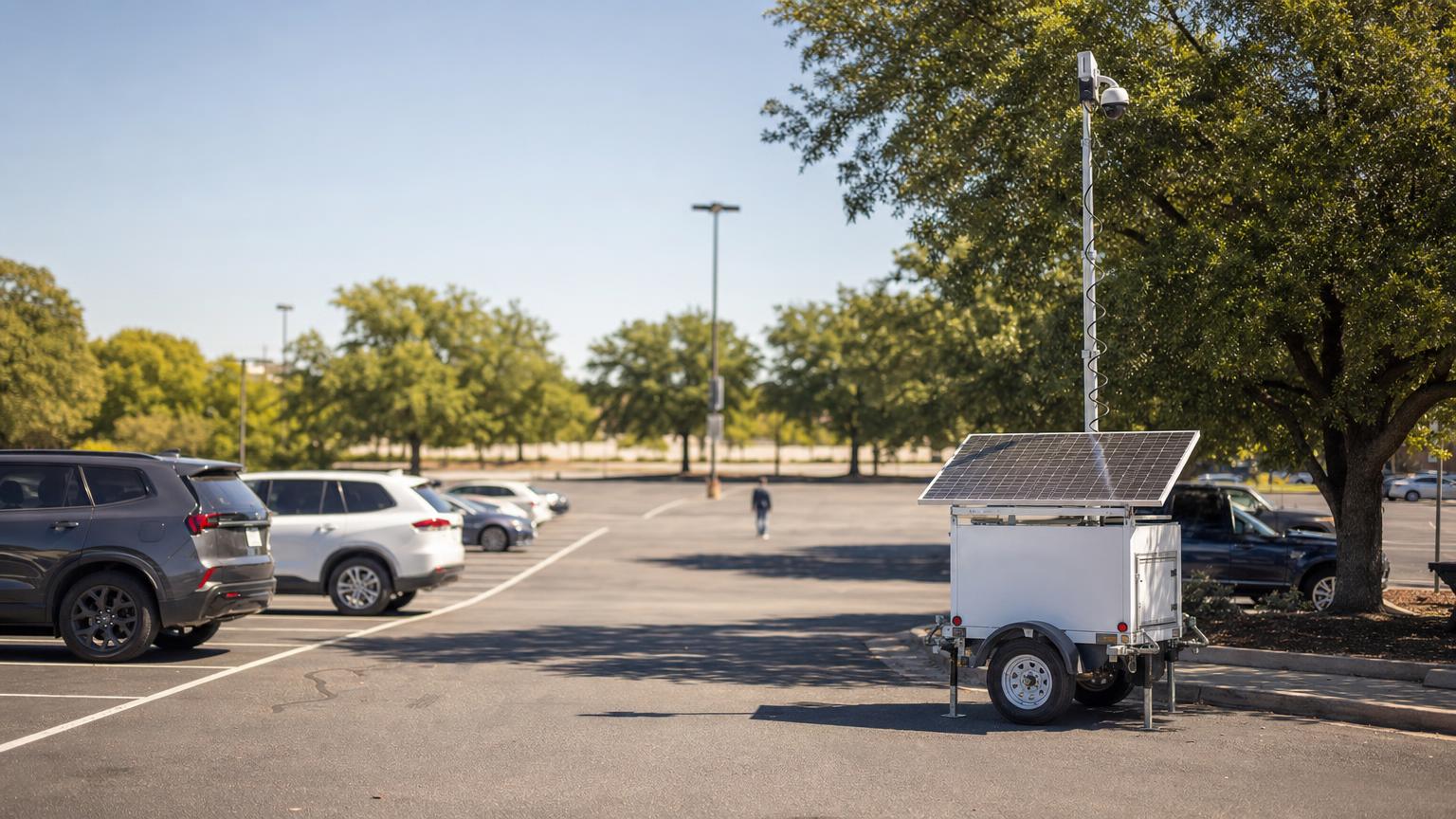


What a security trailer is, and what the one in the parking lot is doing
A security trailer is a towable, self-powered unit that carries cameras, lighting and a speaker on a telescoping mast, and it exists to put video security on a site that has no mains power, no fixed network and nobody on it overnight. You have probably walked past one at the far end of a retail lot or behind a jobsite fence, mast up, panels tilted at the sky. The category sells under several names, including camera trailer, mobile surveillance trailer and CCTV trailer, none of which tells you the part worth knowing: whether the unit only records what happens, or does something about it while it is still happening.
Key takeaways
- A security trailer is a towable unit carrying cameras, light and a speaker on a mast, run on solar and battery power, with video moving over a cellular link.
- Seven parts appear on almost every unit: mast, camera housings, solar array, battery, backhaul radio, speaker and strobe, and the recorder.
- The split that decides the outcome is recording against acting: footage the next morning, or a response while somebody is still on site.
- Spot AI is one example of the second kind, with its AI Security Guard classifying the scene and triggering strobes, horns and talk-down in seconds.
- Running cost is four lines, not one: the unit, connectivity, monitoring and moving it. Monitoring is the line that grows with hours.
The parts on a unit, and what each one does
Every unit in the category has the same short list underneath.
- The mast. A telescoping pole, cranked or winched up, that lifts the cameras above fences, vehicles and stacked material.
- The camera housings. Weather-sealed enclosures holding the imagers. Fixed cameras hold one view, pan-tilt-zoom cameras sweep and zoom, and thermal imagers read heat rather than light.
- The solar array. Panels on adjustable arms that charge the battery through daylight, sized for the worst month of the year at that latitude.
- The battery bank. The energy store that carries the unit overnight and through overcast days. Capacity, not panel area, decides whether it survives a dark week in January.
- The backhaul radio. The cellular modem or satellite terminal that moves alerts and clips off the site. On rural sites it is the usual limiting factor.
- The speaker. An amplified horn for addressing whoever is on site, with a recorded message or a live or automated voice. It turns observation into interaction.
- The strobe and floodlight. Lamps that fire on a detection. They signal that the site is not unobserved, and they raise the light the cameras work with.
- The recorder. The on-board unit that stores video locally, so footage survives a dropped link and only the interesting parts cross a metered connection. On legacy third-party gear this is an NVR. Spot AI calls its own the Intelligent Video Recorder, or IVR, keeping full-resolution video on site and sending only metadata.
The lighting parts earn their place on evidence. Researchers assessing 38 cameras under Detroit's Green Light Project in 2023 found night-time effectiveness closely tied to the number of streetlights around each camera (Source: Journal of Criminal Justice). A unit in an unlit corner brings its own light, and the solar and cellular guide sizes that properly.
What happens when a unit detects something
Five steps run between something moving and somebody acting, and how many the unit performs on its own places it in the category.
- Something enters a watched zone. Zones are drawn on the camera view at setup, so a vehicle crossing the gate line counts and the road beyond the fence does not.
- The system decides what it is looking at. A basic unit registers pixel change, which is why headlights and rain set it off. A video AI unit classifies the object and reads the behavior: loitering at 2am, not walking through at noon.
- A response fires, or does not. Some units do nothing beyond writing a clip. Others escalate on site, with floodlight and strobe coming on and a voice through the speaker addressing the person.
- A human is notified. An alert reaches a phone, a monitoring center or both, with the clip attached. A staffed service adds a person who reviews it and calls the police.
- The evidence is retained. Clip, timestamp and triggering detection are stored together, which is what makes footage usable later.
Step three is the fork: a recording unit leaves it to whoever reads the alert, an acting unit does not.
Where these units turn up, and why those sites
Deployments cluster on sites with three things in common: no mains power, no fixed network, and nobody there during the hours that matter. Construction qualifies on all three, which is why jobsites were the category's first home, along with laydown yards and substations. Retail came later, for the outer edges of car parks where trenching cable costs more than the camera.
Two triggers move a site onto that list: temporary exposure, such as a store trading through a refit, and a lot that empties at ten at night. For that second case, the guide to parking lot security cameras covers the fixed alternative.
Size the requirement on your own history, not the national picture. US property crime fell an estimated 12.4 percent from 2024 to 2025, with motor vehicle theft down 22.7 percent (Source: Federal Bureau of Investigation), and a falling national trend tells one dark corner of one car park nothing. Blackmon Oil, an 11-location fuel and convenience business in rural Arkansas, puts the overnight gap plainly.
"We've set up a Spot AI vehicle loitering filter to keep our parking lots clean and safe, especially for our 24/7 stores. Even with a smaller overnight crew, we want eyes on the lot at night."
Kelsey Blackmon, Marketing & Technology VP, Blackmon Oil Co.
What separates a unit that records from one that acts
This is the distinction the category name hides, and it outranks any spec comparison. Two units look identical across a car park and behave nothing alike at 2am.
What happens | A unit that records | A unit that acts |
|---|---|---|
Detection | Pixel change, so weather and headlights count as events | Object and behavior classification, so loitering reads differently from a passing car |
Response on site | None, or one recorded message on any movement | Strobes, horns and talk-down matched to the detection. Spot AI's AI Security Guard is one example |
Who is on the other end | Nobody, or an operator whose queue fills with false alarms | Software first, a person for events that warrant one |
The next morning | Hours of video and a rough timestamp | A short clip attached to the detection that caused it |
Best fit | Documenting what happened | Reducing the likelihood it finishes happening |
What makes that matter is where the footage ends up. In a February to April 2026 survey of 66 retail companies representing 143 brands and $1.7 trillion in annual sales, 63 percent said store theft incidents go unreported to law enforcement, with 54 percent citing concerns about the response (Source: National Retail Federation). Evidence nobody reports does little work, while an interruption at the moment of the event needs nobody to file anything.
Neither kind removes incidents, and no honest description of the category claims otherwise. Spot AI runs the same video AI on fixed cameras, poles and towable units, so a site can start on a trailer and keep its detections when permanent cameras go up (Spot AI platform overview).
Key terms
- Backhaul. The link carrying video and alerts off the unit, usually cellular.
- Talk-down. Speaking to a person on site through the unit's speaker, as a recorded message, a live operator, or an automated voice.
- Detection zone. The part of the camera view that counts as an event when something enters it, drawn at setup to keep public roads out of scope.
- Autonomy. How much of the detect, decide and respond sequence the unit performs without a person.
What a unit costs to run, and what sets each line
Quotes arrive as one monthly figure, and that figure is four things added together.
- The unit. Rental, lease payment or amortized purchase price of chassis, mast, array and battery, set by how long the site runs and how many units it needs.
- Connectivity. A data plan per unit per month, set by how much video leaves the site rather than how much it captures, which is why local recording changes the bill.
- Monitoring. The largest and most movable line. A staffed service is priced by covered hours; a software detection layer is priced by site.
- Moving it. A charge per relocation, the crew hours around it, and the hours the site sits uncovered.
All four get measured against what a person standing there would cost. Median pay for security guards was $18.29 per hour in May 2025 (Source: U.S. Bureau of Labor Statistics), before employer burden and agency margin. The rent, lease or buy analysis runs that comparison properly.
Ask one question before reading a spec sheet: what does the unit do in the seconds after it detects something. That sorts the whole category into the recording kind and the acting kind.
Split any single-number quote into those four lines first. A staffed service is priced by covered hours and a detection layer by site, so two quotes level on one location separate at the second.
Where to read next
The mobile security trailer buyer's guide covers what differs between units, the provider comparison gives the criteria to score suppliers on, and the security tower rental guide explains what a hire agreement covers.
Frequently asked questions
What is a security trailer?
A security trailer is a towable, self-powered unit that carries cameras, lighting and a speaker on a telescoping mast, and it exists to put video security on a site that has no mains power, no fixed network and nobody on it overnight. Solar panels and a battery bank keep it running, and a cellular link carries alerts off the site.
How does a security trailer work with no power or internet on site?
Power comes from solar panels charging a battery bank sized to carry the unit overnight and through a run of dull days, so arrays are sized on the worst month of the year. Connectivity comes from a cellular modem, or satellite where there is no signal, and an on-board recorder stores video locally so footage survives a dropped link.
What happens when a security trailer detects someone at night?
On a basic unit, movement in a zone writes a clip and sends an alert, and everything after that waits on a person. On a unit running video AI, the system classifies the object and the behavior first, then escalates on site. Spot AI's AI Security Guard works this way, triggering strobes, horns and natural-conversation talk-down in seconds.
Is someone watching the cameras on a security trailer?
Usually not continuously, because paying a person to watch an empty lot is the cost the category exists to avoid. Staffed services put an operator on the alert queue rather than the live view, and video AI systems classify events in software. Spot AI's video AI reads objects and behavior, and does not use biometric identification.
Are a security trailer, a camera trailer and a surveillance trailer the same thing?
In practice yes: the naming is a quirk of how the market grew. Security trailer, camera trailer, mobile surveillance trailer and CCTV trailer all describe a towable mast carrying cameras, power and a link. What matters is whether the unit records the event or acts on it.
About the author
Nate Lee, AI Architect
Nate Lee is an AI Architect at Spot AI who designs the computer-vision models and edge-cloud pipelines that power the company’s Video AI Agents.

