




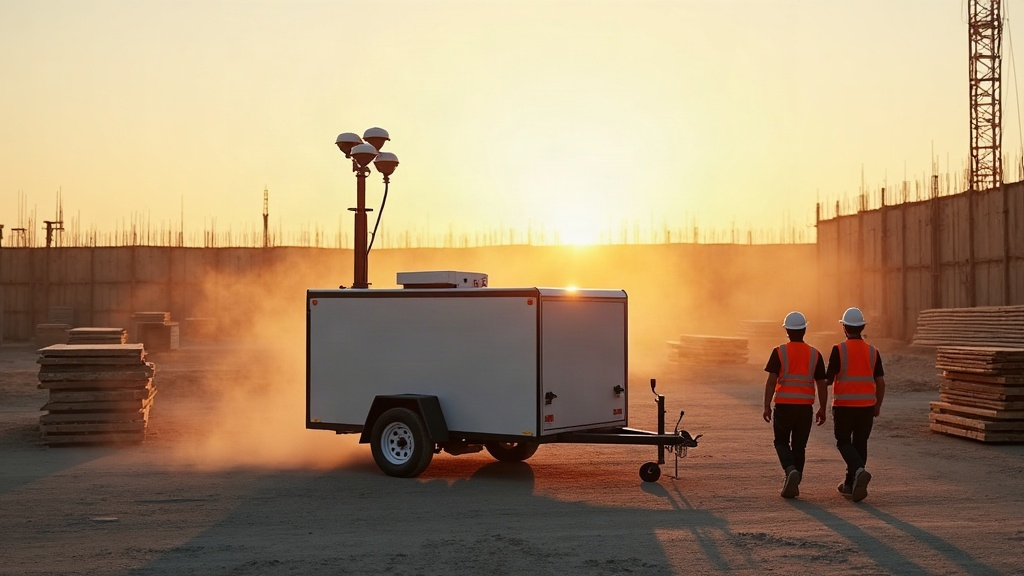


Mobile security trailers: a 2026 buyer's guide
A mobile security trailer is a self-powered, relocatable unit that carries cameras, power and connectivity onto a site that has none of the three. What separates one unit from another in 2026 is not mast height or battery bank. It is what the system does in the sixty seconds after a detection, and whether that detection layer survives the tow to the next site. The exposure keeps moving: construction companies and job sites lose as much as $1 billion annually from equipment theft (Source: Security Magazine), across an asset base where total construction spending ran at a seasonally adjusted annual rate of $2,157.6 billion in July 2026 (Source: U.S. Census Bureau).
Key takeaways
- Spot AI treats the deployment form factor as a choice rather than a product, so the same video AI runs on fixed cameras, pole-mounted units and towable trailers, and the buyer is not locked into one shape of hardware.
- Spot AI frames the work an unmanned site actually needs as four jobs: detect in context, deter in seconds, alert the right person, and document for a case. Most product pages in this category cover the first and stop.
- Power and connectivity are a runtime budget, not a spec line. VigilanteX, Spot AI's deployment partner, pairs an approximately 1.9 kW bifacial solar array with integrated Starlink connectivity on its Argos platform so a unit keeps working where grid power and cellular coverage both fail.
- Spot AI keeps detections, configuration and evidence attached to the site record rather than to the chassis, which is what makes relocating a unit survivable instead of a reset.
- Spot AI's advice before comparing prices: ask what happens when the unit moves, what the deterrence ladder actually does, and how evidence leaves the system.
What a mobile security trailer is, and what changes when video AI runs on it
Strip the category down and a unit is four things on a towable chassis: a mast, cameras, power and a backhaul. VigilanteX's Argos platform is a representative build, with an approximately 20-foot telescoping aluminium mast, three 4MP PTZ cameras with 35x optical zoom, an approximately 1.9 kW bifacial solar array, integrated Starlink satellite connectivity, a fully DOT-compliant towable chassis and a reinforced off-road frame on all-terrain tires. Those specifications tell you where a unit can go and how long it stays. They say nothing about what it does while it is there.
That second question is where the category has changed. A unit built around recording produces footage somebody reviews later. A unit running video AI produces a decision as the event happens. Spot AI's layer is the second one: its video AI turns the cameras on the mast into AI coworkers that assess what they are seeing in context, trigger deterrence, and assemble the clip and the case record without a person watching a screen.
The practical difference shows up in what triggers an alert. Motion alerting on an unmanned site fires on headlights, wind in a tarpaulin, a fox and a delivery driver with equal enthusiasm, which is why so many units end up with notifications muted inside a fortnight. Detection in context means distinguishing a person loitering at a fence line from a vehicle passing on the road behind. Spot AI's limit here is worth stating plainly: it reduces false alerts, it does not remove them, and tuning on a new site takes a few days of real traffic before the thresholds settle.
The second difference is the one buyers discover late. Most of this market sells a trailer. Spot AI sells the video AI and treats the mounting as a deployment decision, so the same detection layer and the same case record run on a fixed camera estate, on a pole-mounted unit at a permanent site, and on a towable unit at a temporary one. VigilanteX builds all three shapes against it: Argos for mobile deployment, Vue as a solar-powered wireless node extending coverage to perimeter fencing, staging areas, remote gates and parking lots, and the Remote Security Agent as a pole-mounted fixed unit with an integrated loudspeaker and a 4MP Starlight IR PTZ camera carrying 35x optical and 16x digital zoom. All three report into one Spot AI dashboard, one alert stream and one system of record.
If you are still working out what the category is before you work out what to buy, start with what a security trailer is and how one works.
The four jobs a unit has to do on an unmanned site
A site with nobody on it at 2 AM needs four things to happen in sequence. Judge any unit, and any provider, on all four rather than the first.
Detect in context
Spot AI's detection layer classifies what it sees rather than reacting to pixel change, which is the difference between an alert that means something and an alert that means a branch moved. The capability has edges: coverage is only what the cameras on the mast can see, a 20-foot mast on a large site leaves ground that is genuinely uncovered, and no configuration removes every blind spot. The honest way to size a unit is to map the approaches you care about, not the acreage.
Deter in seconds
Deterrence separates a camera from a security system, and it has to happen while the intruder is still deciding. Spot AI drives a response ladder off the detection itself: a spoken talk-down through the unit's loudspeaker, lighting, and escalation to a human where the site warrants it. VigilanteX's Remote Security Agent carries an integrated loudspeaker for exactly this. Deterrence raises the cost of staying. It does not guarantee somebody leaves, and a provider claiming otherwise is selling a promise nobody can keep.
Alert the right person
An alert landing in a shared inbox at 2 AM is not a response. Spot AI routes the detection to the person or monitoring service that can act on it, clip attached, so the decision rests on evidence rather than a description. One Spot AI customer, a top-five North American EV charging network, put the outcome plainly.
"We've reduced incidents by 80% without any kind of human monitoring."
Jeremy N., Sr. Manager of Operations & Maintenance, EV charging network
Document for a case
The fourth job pays for itself after the incident. Storage Asset Management runs approximately 50 virtually-managed storage facilities with no on-site staff. Its system detected intruders at 1 AM, police arrived during the crime, and that facility recorded zero subsequent break-ins. A top-10 homebuilder captured a serial copper thief and the vehicle plate within approximately two minutes, which let law enforcement apprehend a suspect. In both cases the value was not that footage existed, but that it was findable, timestamped and shareable while the event still mattered.
The four jobs are a buying checklist, not a description. When you demo a unit, ask the provider to walk you through one incident end to end: what fired the detection, what the site heard, who got the alert, and what the case file looked like an hour later. A provider who can only answer the first question is selling a camera on a mast.
The criteria matrix: five things that actually differ
Most comparisons in this category put trailers against trailers. The more useful comparison is across deployment approaches, because the right answer for an eight-month site differs from the right answer for a twenty-year yard.
| Criterion | Fixed camera estate | Pole-mounted fixed unit | Towable mobile unit |
|---|---|---|---|
Power | Grid power, so runtime never becomes a design question. Spot AI's IVR runs on site using the building's existing supply. | Grid or solar. VigilanteX's Remote Security Agent is built for permanent and semi-permanent sites in a weather-sealed industrial enclosure. | Self-generated. VigilanteX's Argos carries an approximately 1.9 kW bifacial solar array, so the power budget rather than the camera count sets the ceiling. |
Connectivity | The site network. Spot AI runs over the connection the building already has. | Site network or cellular, depending on how remote the pole is. | Satellite or cellular. Argos integrates Starlink, which is what makes a site with no coverage workable at all. |
Detection quality | Spot AI runs its video AI on the cameras a business already owns, so the detection layer does not change with the mounting. | The same Spot AI detection layer. VigilanteX's RSA uses a 4MP Starlight IR PTZ camera with 35x optical zoom for low light. | The same Spot AI detection layer. Argos carries three 4MP PTZ cameras with 35x optical zoom on an approximately 20-foot mast. |
Deterrence and response | Depends on what is installed. Spot AI drives talk-down, lighting and escalation where the site hardware supports it. | VigilanteX's RSA has an integrated loudspeaker for voice deterrence, triggered by the Spot AI detection. | Voice deterrence and lighting at the unit, fired by a Spot AI detection rather than by motion alone. |
Evidence | Spot AI keeps case-ready clips and the case record in one place. | The same, tied to the site. | The same, and Spot AI keeps the record with the site rather than the chassis when the unit relocates. |
Read the bottom row twice. Nobody asks about it during procurement and everybody hits it on the second deployment.
What happens when the unit moves
A mobile unit exists because it relocates, and relocation is where badly designed systems lose what made them useful. Three things are at stake, each worth a separate question.
- Detections and tuning. The thresholds you spent a fortnight settling on the last site are either portable or they are not. Ask whether zones and rules travel with the unit as a template or have to be rebuilt from scratch.
- Configuration and access. Whoever had permission to view the old site should not automatically inherit the new one, and the crew on the new site needs access on day one. Spot AI handles this with role-based access tied to sites rather than to devices.
- Footage and case records. The incidents that happened at the last site are evidence that may be needed months later. Ask where they live after the unit leaves, who can still reach them, and for how long.
Relocation is also the sharpest test of the platform argument. If the detection layer belongs to the trailer, moving the trailer moves your security. If it belongs to the account, the trailer is just the shape the coverage took this quarter.
Deployment models: rent, lease or buy
Three commercial models suit different situations. Renting fits a project with a defined end date and an unclear renewal: the exit is cheap and mobilisation is somebody else's problem. Leasing fits a rolling program of sites where you want predictable monthly cost without a capital request. Buying fits an operator running units continuously, where utilization is high enough that ownership beats the rental margin.
The arithmetic turns on deployment length, concurrent sites, and what happens to the unit between projects. The rent, lease or buy decision guide works it through with the cost drivers and the break-even, and the security tower and trailer rental guide covers what a rental agreement includes and excludes.
The guard comparison, done as arithmetic rather than a slogan
Nearly every provider leads with a comparison against a posted guard, and nearly every one quotes a number without showing the sum. Here is the honest version.
The U.S. Bureau of Labor Statistics puts the median hourly wage for security guards at $18.29 in May 2025, with a median annual wage of $38,020 (Source: U.S. Bureau of Labor Statistics). That figure is a wage, not a billed rate, and using it as a contract price is the single most common distortion in this category's marketing. A fully loaded cost to the buyer adds employer burden, supervision, a vehicle, overtime for the hours nobody wants, and the agency's margin.
Build it as a formula. Spot AI's position is that every line below carries your own number, not a vendor's, because the comparison only means anything on your hours and your sites.
Cost line | How it is calculated | Where the number comes from |
|---|---|---|
Guard post, per year | Covered hours per week, times the billed hourly rate, times 52 | The rate your agency quotes, never the published median wage, which is pay rather than price |
Number of posts | One post per approach you mapped, not one per site | Your own coverage map from the siting section above |
Relief cover | A percentage uplift for absence, holiday and turnover | Your agency states the uplift if asked |
Unit and relocation | Purchase, lease or rental of the unit, plus a charge per move | The provider's quote, itemised. Ask the relocation charge before you need it |
Detection and response software | Spot AI's subscription, plus any monitored response hours you buy on top | Spot AI quotes the software layer. Monitored response is priced separately |
Connectivity | Satellite or cellular plan, per unit, per month | The connectivity provider. Confirm whether it is bundled, it often is not |
One structural fact belongs here. There were 1,283,470 security guards employed nationally, and the occupation is projected to grow 1 percent from 2025 to 2035, slower than the average for all occupations (Source: U.S. Bureau of Labor Statistics). A staffing model barely growing gets harder to fill at 2 AM on a remote site. So a unit does not replace a guard. Spot AI reduces the guard hours you buy and covers the hours you were never able to staff.
What the risk numbers actually say
Two credible figures point in opposite directions this cycle, and a guide quoting only the frightening one is not worth reading. Property crime decreased an estimated 12.4 percent from 2024 to 2025 in the FBI's First Look data, drawn from more than 17,000 agencies covering 96 percent of the population (Source: Federal Bureau of Investigation). At the same time, retailers reported an 18 percent increase in the average number of shoplifting incidents per year in 2024 against 2023, with threats or acts of violence during theft events up 17 percent over the same period (Source: National Retail Federation).
Both are true. Aggregate property crime is falling while the specific incidents organizations staff against are rising, and the organized end is moving outward from the shop floor: more than half of surveyed retailers reported increases in organized retail crime groups targeting merchandise theft, at 52 percent, and cargo or supply chain theft, at 50 percent (Source: National Retail Federation). Yards, staging areas and forecourts are where that shift lands, and they are exactly the spaces a permanent camera estate was never built to cover.
Key terms
- Backhaul. The connection carrying video and detections from the unit to the platform. On a remote site this is satellite or cellular, and it is the first thing to check when a unit goes quiet.
- Power budget. The daily energy a unit generates against what its cameras, radio and compute consume. Undersize it and the unit browns out in the third week of winter, not on day one.
- Voice-down deterrence. A spoken warning played through the unit's loudspeaker, triggered by a detection. Spot AI fires it from a classified event rather than from raw motion, which is what keeps it credible instead of constant.
- IVR. Spot AI's Intelligent Video Recorder, the on-site device that holds full-resolution video locally while the platform works on it.
Siting and coverage: where units underperform
Most disappointing deployments are siting failures, not equipment failures. A few rules hold across sites.
Place for sightlines first and sun second, then check the compromise. A mast angled for perfect southern solar exposure that looks at the back of a container stack is a unit generating power to watch nothing. Cover the approaches rather than the perimeter: intruders arrive through gates, gaps and the one section of fence nobody repaired, and a mast positioned to see those three points beats a mast in the geometric center. Expect the second week to change your mind.
Weather and season deserve their own line. Solar sizing that works in July fails in December at the same latitude, which is why power is a runtime question rather than a wattage question. The solar and cellular deployment guide works through sizing, backhaul choices and failure modes in detail.
Before you sign anything, run a two-week pilot on your worst site rather than your easiest one. The site with poor coverage, awkward sightlines and a genuine intrusion history will tell you in a fortnight what a specification sheet will never tell you, and it is the only way to see how a provider behaves when a unit misbehaves.
What to ask before signing
Take this list into the demo. The answers separate providers faster than any specification sheet.
- What exactly triggers an alert, and what does the system do with a detection it is not confident about?
- Walk me through the response ladder. What does the site hear, how long after the detection, and who decides to escalate?
- When this unit moves to another site, what travels with it and what has to be rebuilt?
- Where does footage live, who can reach it after the unit leaves, and how long is it retained?
- What is the runtime in the worst month of the year at this latitude, and what happens when the battery falls below reserve?
- What is the mobilisation time from order to a working unit on site, and who performs it?
- If we later want the same detection on a permanent building, does that run on the same platform and the same account?
- What is not included: relocation charges, connectivity, monitoring hours, and what happens at contract end?
Question seven is the one buyers most often leave out and most regret. A provider that only builds trailers has to answer no, and that no arrives two years later as a second platform, a second login and a second set of evidence nobody can search across. For how providers differ on these axes, see our comparison of mobile security trailer providers.
If you want to see what the detection, deterrence and case layer looks like running on a real site rather than in a specification, book a demo with Spot AI and bring the eight questions above.
Frequently asked questions
What is a mobile security trailer and what does it actually do?
Spot AI defines a mobile security trailer as a towable, self-powered unit carrying cameras, power and connectivity onto a site with no permanent infrastructure. The hardware provides coverage where none exists. What makes it useful is the layer on top: whether the system classifies what it sees, responds while the event is happening, and produces a usable case record. Units marketed as mobile surveillance trailers vary enormously on that second point.
How much does a mobile security trailer cost to run?
Spot AI's guidance is to build the number as a formula rather than accept a quoted figure, because running cost splits across the unit, the software or monitoring subscription, connectivity, relocation charges and contract length. Deployment duration and the number of concurrent sites move it most. The rent, lease or buy guide sets out the cost drivers and break-even arithmetic in full.
Do security trailers work without power or internet on site?
Yes, and that is the point of the category. VigilanteX's Argos platform, deployed with Spot AI, generates its own power from an approximately 1.9 kW bifacial solar array and carries integrated Starlink connectivity, so it runs where there is neither grid power nor cellular coverage. The design question is runtime, not capability: solar sizing comfortable in summer can fall short in midwinter at the same latitude.
Is a security trailer better than hiring a security guard?
Spot AI's honest framing is that a unit reduces the guard hours you need to buy rather than replacing the role. A unit covers continuously and does not get tired, while a human handles judgement, physical intervention and anything unpredictable. The comparison is worth doing as arithmetic with your agency's actual billed rate, not the published median wage, which is a wage and not a contract price.
What happens to the footage and the detections when the trailer moves?
Spot AI keeps detections, configuration and case records attached to the account and the site record rather than to the chassis, so relocating a unit does not reset the tuning or strand the evidence from the previous deployment. This varies by provider and it is worth asking directly, because a system that ties everything to the hardware turns every move into a fresh setup and leaves past incidents difficult to retrieve.
About the author
Joshua Foster, IT Systems Engineer
Joshua Foster is an IT Systems Engineer at Spot AI, where he focuses on designing and securing scalable enterprise networks, managing cloud-integrated infrastructure, and automating system workflows to enhance operational efficiency. He is passionate about cross-functional collaboration and takes pride in delivering robust technical solutions that empower both the Spot AI team and its customers.

