






Mobile security trailer providers compared (2026)
Comparing mobile security trailer providers on hardware gets a buyer nowhere: put four proposals side by side and you will read about a mast, a solar array, a PTZ camera and an app four times. Spot AI's view is that providers separate on six axes instead: detection quality, whether the unit acts or only alerts, who is watching and when, how evidence leaves the system, what it connects to, and what the contract says about moving and leaving. Only 23 percent of organizations report scaling an agentic AI system anywhere in the enterprise, against 62 percent at least experimenting with AI agents, across 1,719 respondents surveyed between 4 May and 8 June 2026 (Source: McKinsey), so the word AI on a provider's page covers both a system that acts and a system that writes a report. Human guard forces remain in most security programs too, with 41 percent of security leaders using both proprietary and contract officers, 37 percent contract officers only and 22 percent proprietary only (Source: Security Magazine).
Key takeaways
- Spot AI treats hardware as a floor rather than a differentiator, because masts, solar arrays and PTZ cameras are broadly equivalent here and none of them tells you what happens at 2 AM.
- Spot AI found the same gap in all five providers reviewed: price, term, retention and service levels go unpublished by every one of them, Spot AI included.
- Spot AI treats "does it act, or only alert" as the axis that decides the rest, because a notification needs somebody awake to read it and an action does not.
- Spot AI holds detections, configuration and case records against the site and the account rather than the chassis, which is the axis buyers hit on their second deployment.
- Spot AI's advice is to run this in writing: put the six axes to every provider on the same day, and file the blanks next to the answers.
Why hardware is the wrong place to start
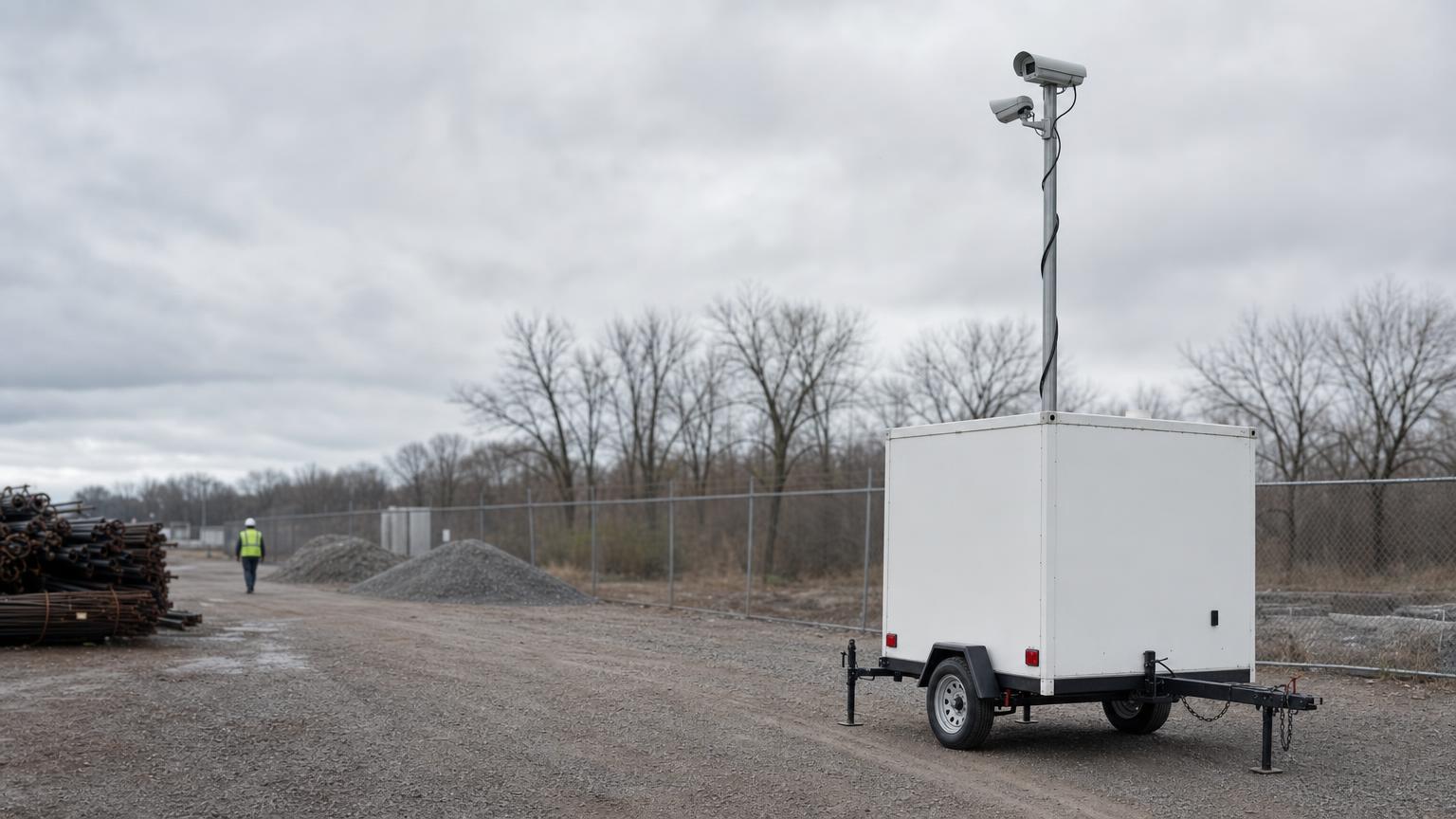
Mobile units converged on the same build years ago: a roughly 20-foot mast, a solar array with battery storage, a cellular or satellite link, one to three PTZ cameras. Two providers publishing an identical specification can still deliver entirely different outcomes on the same yard, because the specification governs where a unit can stand and how long it lasts, and nothing else.
Several providers also publish an efficacy percentage with no source, no sample and no measurement window attached, so none of those figures appears here. What follows is a framework rather than a ranking: no winner and no score out of ten, because the right provider depends on how long your sites live and who is awake at night.
Who is in this comparison, and one disclosure
Five providers appear below as worked examples of a filled cell. Each represents a different service model, and the models differ far more than the hardware does. Every cell traces to that provider's own documentation, read September 2026.
One disclosure belongs here, in front of the table rather than in a footnote. VigilanteX is Spot AI's named deployment partner for trailer-based deployments, and VigilanteX also competes in the category this guide compares. That is a commercial relationship, read every VigilanteX line here with it in mind, and the axes applied to VigilanteX are the same ones applied to everybody else.
Provider | Service model, as published | Who watches | Not publicly specified |
|---|---|---|---|
Spot AI | Spot AI is a camera-agnostic video AI platform, running on a site's existing cameras and on deployable units from its partner VigilanteX, whose Argos publishes a 1.9 kW bifacial solar array and integrated Starlink | Spot AI acts first and notifies second, so monitoring is an option on top, not a dependency | Price, term, retention, SLA |
LiveView Technologies (LVT) | Towable units plus the LVT Platform and app, two 400 watt solar panels, optional smart generators, multi-network cellular | Self-monitoring, plus monitoring partners who verify events, speak down and call law enforcement | Mast height, price, term, retention, SLA |
WCCTV | Managed rental on solar trailers standing up to 20 feet, deployable in about 20 minutes for basic systems | Trained operators at US-based centers verifying incidents live, around the clock | Solar and battery sizing, price, term, retention, SLA |
Pro-Vigil | Monitoring service with its own solar and cellular units, mountable on a trailer, pole or structure. UL certified | Human monitored around the clock, coordinating video-verified police response | Mast height, camera specifications, price, term, retention, SLA |
PPG Security | Regional integrator owning the whole chain: its own solar tower with 30x optical zoom PTZ, monitoring and guards | A 24/7 team driving live talk-down and its own armed or unarmed guards | Mast height, runtime, connectivity, price, term, retention, SLA |
Read the right-hand column first. Not one of the five publishes a price, a term or a retention period, so the comparison you need has to be generated in writing.
The criteria matrix, and how to fill it in
Copy this table, add one column per provider, and make each complete it. The third column shows a cell filled from something a provider has published.
Axis | The question that settles it | What a filled cell looks like |
|---|---|---|
Detection quality | Which classes does it detect, and what does it do with a detection it is unsure about | Spot AI publishes 15+ pre-trained Video AI Agents plus Iris for custom detections in natural language. LVT publishes object and motion detection, license plate recognition and 180 degree radar |
Act or alert | When a detection fires at 2 AM, what happens with no human in the loop | Spot AI triggers strobes, horns and natural-conversation talk-down from the classified detection itself. VigilanteX's RSA carries the loudspeaker and flood lighting |
Monitoring model | Who is watching, during which hours, and what are they authorized to do | WCCTV states operators verifying incidents live. Pro-Vigil states human monitoring coordinating video-verified police response. PPG Security states a 24/7 team that dispatches its own guards |
Evidence handling | In what format does footage leave, who can reach it later, and for how long | WCCTV states audit-ready reports and sensor logs of up to 180,000 time-stamped records. Spot AI keeps case-ready clips against the site and the account |
Integration | What does it connect to, and through what | Spot AI publishes open APIs and webhooks including Procore and BuilderTrend, plus access control and a read-only MCP endpoint. WCCTV publishes license plate recognition and IoT sensors |
Contract and relocation | What does a move cost, what happens at the end of the term, who owns the data | WCCTV publishes that relocation and end-of-hire decommissioning are included in its rental. None of the five publishes a price, term or retention period |
Each axis gets its own section below: how to test it, and what getting it wrong costs.
Detection quality, and the low-confidence case
Every provider here says it has AI. Almost none publishes how the detection behaves when it is uncertain, and that behavior decides whether your team keeps the alerts switched on.
Test it rather than read about it. Ask for a two-week trial on your least convenient site, count the alerts by class, and count how many a person would have wanted. Then ask what the system does with a detection below its confidence threshold: suppress it, escalate it to a human, or send it anyway. Spot AI's own answer is that classification in context reduces false alerts without removing them, and that a new site needs a few days of real traffic before the thresholds settle. A provider claiming near-zero false alerts on day one is describing a demonstration. Get this wrong and the alerts get muted in the first fortnight, which nobody notices until an incident nobody was told about.
Whether the unit acts or only alerts
This is the axis the category's vocabulary hides. "AI-powered monitoring" describes both a system that classifies an event and responds to it, and a staffed room using detection software to decide what an operator sees. Both are legitimate, they are not the same purchase, and they do not fail the same way.
Ask for the response ladder as a sequence with times attached. What does the site hear, how many seconds after the detection, who escalates, and what happens when nobody answers. Spot AI drives that ladder from the detection itself with strobes, horns and natural-conversation talk-down, and VigilanteX's pole-mounted RSA carries the loudspeaker and flood lighting that execute it. Deterrence raises the cost of staying without guaranteeing anybody leaves, and a provider promising otherwise is promising what no system can hold to. Get this axis wrong and you have bought a very expensive witness.
The monitoring model, and what it rests on
Three of the five build their offer around people watching screens. That model is good at judgement calls, and it is right for sites where somebody has to decide, in the moment, whether to send a human being. It also rests on a labour pool that is not growing.
The U.S. Bureau of Labor Statistics counts 1,304,000 people employed in the security guard occupation in 2025, projects 1 percent growth from 2025 to 2035, slower than the average for all occupations, and projects about 157,200 openings a year, most of them replacements (Source: U.S. Bureau of Labor Statistics). Coverage priced against that pool thins quietly: the staffed hours shrink before anybody tells you.
Ask three questions and put the answers in the contract. Which hours are staffed, what is the operator-to-site ratio during them, and what is the documented response when the operator is already handling another event. Spot AI's position is that an automated layer should carry the routine so human attention goes to the events that warrant a person, which is why monitoring operations run on top of Spot AI rather than instead of it. The three service models are compared in our guide to remote monitoring, remote guarding and the AI Security Guard, and the case for an always-on layer under a human team is in our piece on round-the-clock coverage without a posted officer.
Evidence handling, the axis you use last and regret first
Footage matters at the moment somebody outside your company asks for it, and the receiving end is less standardized than buyers assume. NIST's December 2025 evidence management report found that practices inside law enforcement evidence rooms vary on tracking, policy and training, and recommended standardized classification plus routine audits (Source: NIST). When the recipients vary, the failure mode is yours: an incident you can describe and cannot produce.
So ask for the export rather than for reassurance. A published profile exists for it, NIST Interagency Report 8161 revision 1, specifying a CCTV digital video export profile (Source: NIST), and naming it in an evaluation beats a dozen questions about cloud storage. Then ask three more: how long footage is retained by default, who can still reach an incident after the unit leaves, and what leaves with you if you leave. Spot AI keeps time-stamped, case-ready clips and the case record against the site and the account, with full-resolution video held on site by the IVR so only metadata crosses the network.
Storage Asset Management runs approximately 50 virtually-managed storage facilities with no on-site staff, a fair test of whether this layer holds up without people. A Spot AI notification went out around 1 AM, police arrived while the incident was still in progress, and that facility has had no break-in since.
"With Spot AI, these facilities are more secure and better watched than the ones we staff traditionally, where we pay for a full-time person on-site."
Lee Kunkel, Director of Virtual Operations, Storage Asset Management
If you run one test across all six axes, run the export. Ask each provider to produce a full incident package from a real detection during your trial: clip, time stamps, detection metadata and audit trail, in a form you can hand to a third party unedited. Providers who manage that in an afternoon tend to be strong everywhere else.
Integration, and the second-login problem
A deployable unit rarely stays the only system you run, so the question is whether it joins your estate or sits beside it. Ask what the provider exposes: an API, webhooks, a documented event schema, single sign-on, and role-based access tied to sites rather than devices. Spot AI publishes open APIs and webhooks with named construction integrations including Procore and BuilderTrend, alongside access control, two-way audio and a read-only MCP endpoint that lets an AI assistant query the data. WCCTV publishes license plate recognition, PPE and smoke detection and IoT environmental sensors on its own units.
The cost is cumulative rather than dramatic: two years on you have two logins, two evidence stores and no way to search across them, which is where a temporary deployment turns into a permanent tax.
Contract, relocation and the exit
This is where the published record runs out. Of the five providers here, only WCCTV publishes any commercial term at all, stating that relocation and end-of-hire decommissioning are included in its rental. Get this axis wrong and you have a program that works at one site and turns unaffordable at nine. Treat the silence as a task, and put five things in writing before signature:
- The relocation charge, per move, and how much notice the provider needs to execute one.
- The contract length, the renewal mechanism, and what happens if a project finishes early.
- What the monthly figure includes and excludes, naming connectivity and monitoring hours, which are commonly separate.
- The retention period for footage, and what happens to incidents recorded at a site you have left.
- Who owns the detections, the configuration and the case records at the end of the term, and in what form you get them back.
Whether to rent, lease or buy is a separate calculation with its own break-even, worked through in our rent, lease or buy decision guide, and what a rental agreement typically covers is set out in the security tower and trailer rental guide.
Key terms
- Confidence threshold. The score below which a detection is treated as uncertain. Behavior at that boundary, suppress, escalate or send, is worth asking every provider about, because almost nobody publishes it.
- Response ladder. The sequence after a detection: light, sound, spoken warning, notification, escalation. Spot AI fires it from the classified detection rather than from raw motion.
- IVR. Spot AI's Intelligent Video Recorder, the on-site device that keeps full-resolution video in the facility while only metadata crosses the network.
- Video-verified response. A person confirms an event on camera before police are called, the model used by several monitoring-led providers here.
Run the comparison one axis at a time, putting the same question to every provider on the same day. Mixed conversations produce mixed answers, and a provider precise on detection and vague on contract terms has told you which they would rather you looked at.
What a finished comparison looks like
The output is not a score. It is a filled matrix with visible blanks, and the blanks carry information: a provider who will not put a relocation charge in writing during a competitive process rarely becomes more forthcoming after signature. If you are earlier than this, start with what a security trailer is and how one works, then the 2026 buyer's guide to mobile security trailers. For the head-to-head most often requested here, see Spot AI compared with LVT, and the detection and case layer itself on the Spot AI product overview.
To see the six axes answered on live video from your own site rather than on a specification sheet, book a demo with Spot AI and bring the matrix.
Frequently asked questions
How do I compare mobile security trailer providers?
Spot AI recommends six axes rather than hardware: detection quality, whether the unit acts or only alerts, the monitoring model, evidence handling, integration, and contract and relocation terms. Build those six as rows and add a column per provider. Hardware specifications look broadly the same here, so they rarely decide anything.
What should I ask a mobile surveillance trailer provider before signing?
Spot AI's shortlist is the five commercial questions that decide the contract: the relocation charge per move, the contract length and early-exit terms, what the monthly figure excludes, the default retention period for footage, and who owns the detections and case records at the end of the term. Get each answered in writing.
Why do mobile security trailer companies not publish prices?
Across the five providers reviewed for this guide, none publishes pricing, contract length, retention or service levels, and that includes Spot AI. Deployments differ by site count, duration, monitoring hours and connectivity, so the category quotes rather than lists. A price comparison therefore has to be generated in writing.
What is the difference between remote monitoring and a system that acts on its own?
Spot AI draws the line at what happens with no human in the loop. Remote monitoring means trained operators watch verified events and decide what to do, which is strong on judgement and bounded by staffing hours. An autonomous system classifies the event and responds directly, triggering strobes, horns and talk-down before anybody reads a notification. Many sites want both.
Who owns the footage and the detections when the contract ends?
Spot AI holds detections, configuration and case records against the site and the account rather than the chassis, so moving a unit does not reset the tuning or strand earlier evidence. None of the five reviewed here publishes its position, so ask directly what you take with you, in what format, and how long past incidents stay reachable.
About the author
Rish Gupta, CEO and Co-founder
Rish Gupta is CEO and Co-founder of Spot AI, leading the charge in business strategy and the future of video intelligence. With extensive experience in AI-powered security and digital transformation, Rish helps organizations unlock the full potential of their video data.

