






Virtual security guard in 2026: what an AI Security Guard does, and where a posted guard still fits
Virtual security guard is what buyers search for when they want a site covered at night without paying for a person in every hour. Spot AI's answer is the AI Security Guard: software on the cameras a site already owns that detects activity in context, deters it within seconds, and documents what happened as a timestamped case. Guard posts also turn over constantly. BLS expects about 157,200 openings a year in an occupation that held about 1.3 million jobs in 2025 and is projected to grow just 1% through 2035, with most openings replacing people who leave (Source: U.S. Bureau of Labor Statistics).
That is about one opening for every eight jobs each year, so a posted guard is a standing hiring commitment as well as a budget line. This guide covers what an AI Security Guard does and does not do, which duties stay with a person, and how the two share one site.
Key takeaways
- Spot AI's AI Security Guard is software, not a staffing service: it runs on existing cameras, detects, deters, and documents, then hands a person the case.
- Spot AI takes the first action on site with automated deterrence (talkdown, strobes, and horns), so nobody has to walk up to an intruder alone at night.
- Spot AI's AI Security Guard cannot detain anyone, see past its cameras, or satisfy a contract naming a licensed officer, and those limits decide where people stay.
- Spot AI can take patrol, video review, and first-line deterrence off a guard's list, while access decisions and physical response stay human.
- Spot AI's plate-of-interest alerts matter most in the week after an incident, when burglary research finds repeat risk is raised, much of it tied to the same offender.
Key terms
- AI Security Guard: Spot AI's named solution for perimeter and interior protection. Spot AI runs it on existing cameras to detect intent rather than motion, deter in seconds, and deliver case-ready evidence.
- Natural-conversation talkdown: a spoken warning generated for the scene that addresses a person by what they are wearing and doing. Spot AI escalates it on its own if the person stays.
- Plate of interest: a license plate on an alert list. Spot AI raises an alert when that plate is read again.
What a virtual security guard is, and what Spot AI means by AI Security Guard
The term covers remote monitoring centers, remote guarding firms, and software. In a staffed service, a person at a monitoring center decides what happens after a camera sees something; Spot AI's AI Security Guard takes the first step itself, on site, then brings a person in with the evidence. Our comparison of remote monitoring, remote guarding, and an AI Security Guard sets out the cost and response trade-offs.
Spot AI is camera-agnostic: any ONVIF IP camera connects, and older analog cameras come in through the Intelligent Video Recorder (IVR). The IVR keeps full-resolution video in the facility and sends only metadata across the network. The platform is NDAA-compliant and follows SOC 2 practices, most sites go live in days, and the AI Security Guard overview shows the full flow.
To see what changes, take the duties BLS lists for security guards, who usually work rotating shifts of about 8 hours with night shifts common, and ask who does each one on a combined site (Source: U.S. Bureau of Labor Statistics).
Guard duty (from the BLS list) | Spot AI's AI Security Guard | A person |
|---|---|---|
Patrol property | Spot AI applies its rules to all connected cameras at once, day and night | Walk-throughs of areas no camera covers |
Monitor alarms and video | Spot AI evaluates each detection in context and screens out nuisance events | Deciding on the cases it escalates |
Deter criminal activity | Spot AI triggers automated deterrence within seconds: talkdown, strobes, and horns | Visible presence where people expect an officer |
Conduct security checks | Spot AI runs a rule per zone for the hours it matters, such as anyone in the yard after close | Hands-on checks of locks, gates, and equipment |
Write reports | Spot AI builds a timestamped case with clips and a log of each action | Context, statements, and follow-up |
Control building access | Spot AI flags tailgating at badge doors and plates of interest at the gate | Admitting visitors and handling exceptions |
Enforce property rules | Spot AI warns people in closed areas and records the outcome | Conversations that need judgment or authority |
Respond to emergencies | Spot AI alerts the right team and can lock down doors | First aid, evacuation help, and physical intervention |
Sort each post's logged tasks into these rows before touching a schedule. A post that spends its hours on patrol and video review is a candidate to change, and one that spends them admitting people and handling exceptions is one to keep.
Detection: telling the AI Security Guard what matters on your site
Spot AI uses context-aware detections instead of motion rules, so a person walking to a car at shift change and a person moving along a fence line at 2am are different events, even when the pixels move the same way. Most of a deployment's work is writing those rules, and the ones that hold up share three parts:
- A place. A named zone, such as the trailer yard, the employee lot, or the fence behind the docks.
- A time. The hours the rule applies, because a loading dock at 2pm and at 2am need opposite rules.
- A behavior. What counts as an incident there and then, such as a person inside the fence or a vehicle stopped in the lot long after the last shift left.
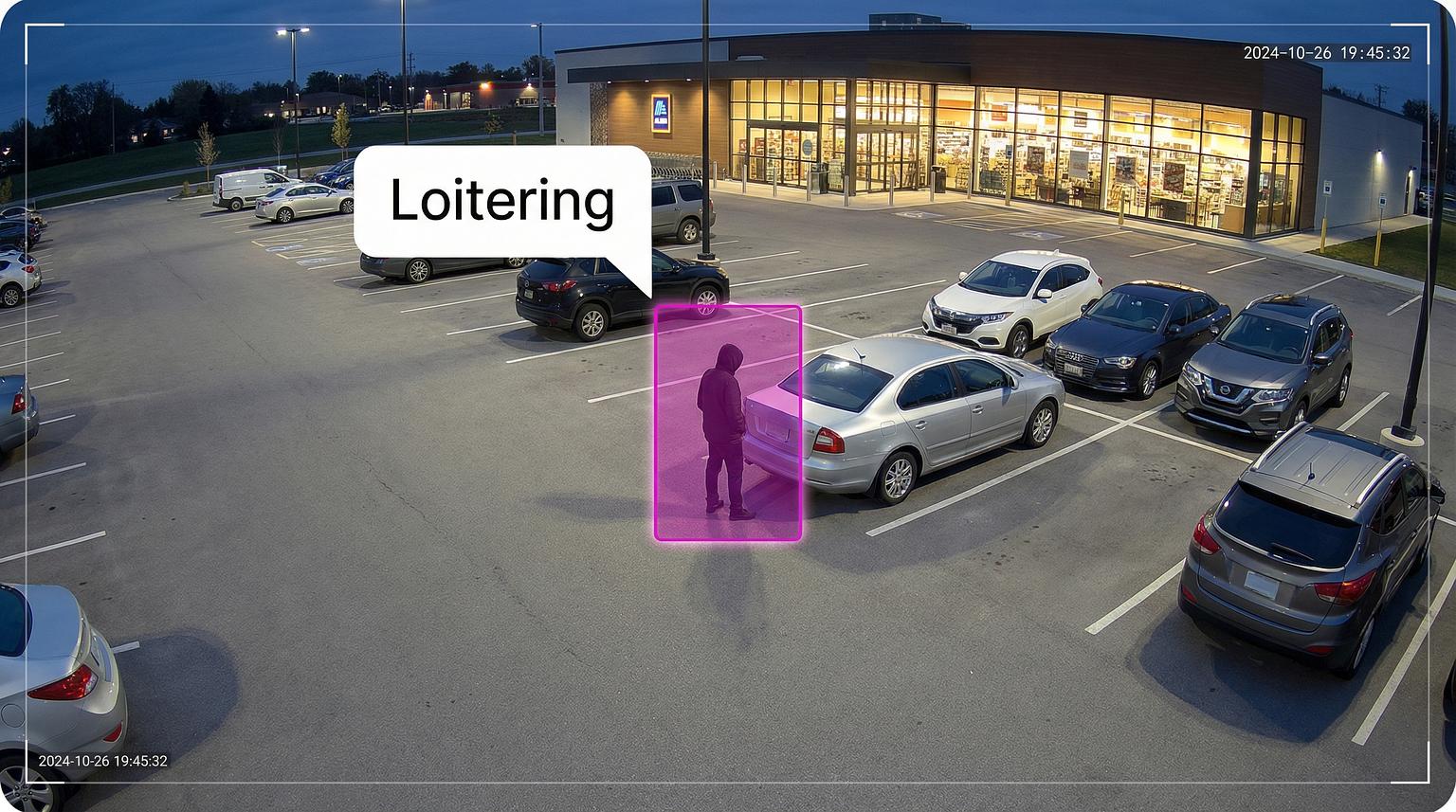
Spot AI ships 15+ pre-trained Video AI Agents for common security cases, including unauthorized entry, loitering, fence jumping, car break-in, tailgating, and license plates of interest, and Iris builds a custom detection from a plain-language description in about eight minutes. Tune the first weeks against real activity: a rule that fires on the cleaning crew every evening needs a schedule or a smaller zone, not a louder alarm.
Deterrence: what happens before a person gets involved
Spot AI's AI Security Guard acts without waiting for anyone to pick up a radio. For an after-hours intrusion, a typical escalation runs in three steps, each with a clear owner:
- Deter. Spot AI triggers automated deterrence on its own, using strobes, horns, and a natural-conversation talkdown that names what the person is wearing and where they are, and escalates it if the person stays.
- Alert a person. Spot AI sends the event, with video, by text, email, Slack, or Teams, and can lock down doors through access control, so a person now holds the decision.
- Document or dispatch. If the person leaves, the event stays on record as a documented case; if they remain, whoever the alert reached sends an on-call manager, a patrol, or law enforcement.
The cheapest incident is the one that ends at the first warning, and at least one large guarding firm has reached the same design: Security Magazine's 2025 Annual Guarding Report describes one that uses video analytics to give people an automated warning that they are on camera, and a chance to disperse, before a human guard confronts them (Source: Security Magazine). Decide before go-live what each zone's warning asks a person to do; our voice-down setup guide covers thresholds and wording. A warning that names the jacket and the fence tells them they have been seen, which a looped recording cannot.
Tracking repeat offenders: plates of interest and the week after an incident
Burglary research gives a practical rule for the days after an incident. A 2025 study of solved residential burglaries in Edmonton, Canada, using 2007 to 2008 data, found raised risk within 700 meters of a burgled home for 7 days, with the same offender returning a plausible explanation for much of it (Source: PubMed). It studied homes, not commercial sites, but the point carries: returns cluster soon after the first incident, and on a commercial site the vehicle is the easiest thing to recognize. A short routine puts that to work:
- Pull the plate from the case. Spot AI reads plates from existing cameras at entrances and exits, so the plate and its times sit in the case file.
- Add it as a plate of interest. Spot AI then alerts the moment that vehicle is read again.
- Tighten the zone that was hit. For the next week or two, shorten loitering thresholds, trigger deterrence sooner, and route alerts to someone awake.
- Share a pattern, not a clip. Give investigators every visit by that vehicle on one timeline.
The same list covers quieter repeat problems, such as a former employee barred from the property. Plates read best at choke points, the entry and exit lanes rather than mid-lot, so check angles and night lighting first; our license plate recognition guide covers placement.
Securing parking lots: zones, hours, and a person for the walk to the car
Parking lots suit an AI Security Guard: large, open, unevenly lit, and empty for long stretches, they are costly to patrol on foot and simple to cover with cameras that act. A lot plan that works splits the space by use:
- Entrances and exits, where plates are read and plates of interest raise an alert.
- Employee rows, where the after-shift rule is a person moving between cars or a vehicle idling after the shift left.
- The perimeter and any fenced storage, where anyone present after close is an incident.
- Visitor spaces, where daytime rules stay loose so guests are left alone.
Keep one job human: the walk to the car. OSHA lists working alone or in isolated areas, and working late at night, among the factors that can raise the risk of workplace violence (Source: Occupational Safety and Health Administration). That describes a lone overnight guard confronting someone in a dark lot. Let Spot AI's automated deterrence make first contact, send a person with the case in hand, and keep staff escorts a person's job.
Lots without usable cameras, power, or a network need hardware first. There, a pole-mounted unit with a loudspeaker and LED flood lighting, deployed through VigilanteX, Spot AI's deployment partner, reports into the same Spot AI dashboard as the AI Security Guard. For temporary and remote sites, VigilanteX supplies its Argos solar trailer with Starlink, which it describes as reporting into the same dashboard. Our security tower rental guide covers short-term options, and the parking lot camera guide covers permanent placement.
Documentation: the case that outlasts the incident
When deterrence works, the incident is over in a minute and the record is what remains. Spot AI builds the case as the event happens: timestamped clips from every camera involved, the plate if a vehicle was part of it, and a log of each action the AI Security Guard took. A case showing a person inside a fence at a stated time gives a dispatcher and an investigator something to act on.
Storage Asset Management shows this across a portfolio of about 50 virtually operated storage facilities without traditional on-site staff. At one facility that had been dealing with break-ins, Spot AI detected intruders around 1am and law enforcement arrived while the break-in was still in progress. After the arrest was publicized, the company reports, that facility has had no break-ins since.
What an AI Security Guard does not do
Honest limits make a combined plan work. Spot AI's AI Security Guard does not:
- Detain, search, or escort anyone. It can warn, light up a zone, lock a door, and call people in, but it cannot put a hand on anything.
- See past its cameras. Coverage follows camera placement, so a blind spot stays blind until a camera is added or moved.
- Promise a result. Deterrence lowers the odds of a loss, and a determined person can ignore every warning, so each zone's plan ends with a named person who attends.
- Catch what nobody configured. It acts on the zones, hours, and behaviors it has rules for, so a new kind of incident goes unflagged until someone writes a rule, which Iris turns into minutes of work.
Where a posted guard is still the right answer
Keep a person on post when the job needs one, and name the job. Four tests settle it:
- Someone has to decide about a person at the door. Visitors, contractors without badges, and off-schedule deliveries need a judgment call.
- The response has to be physical and fast. First aid, evacuation help, or stepping between two people cannot happen through a speaker.
- The post is written into an agreement. Where a contract, lease, insurer, or regulation names an officer, the AI Security Guard supports that officer but does not satisfy the requirement.
- Presence is the service. A staffed lobby where employees and visitors expect to see someone does its job by being seen.
Presence carries weight: workplace violence ranked as the top concern for enterprise security leaders in 2024 and looking ahead to 2025, in Security Magazine's benchmark survey (Source: Security Magazine). A combined site changes where that person spends the hours: at the doors and desks where presence matters, not on a patrol loop through an empty yard.
How the two are combined on a real site
Take a 24-hour distribution center with a gatehouse, a truck yard, an employee lot, a fenced perimeter, and loading docks, covered by two posts around the clock: a gate officer and a patrol. Each post is 168 hours a week, or 21 eight-hour shifts, so the site fills 42 shifts every week. A combined plan keeps the gate officer and changes the patrol:
Zone | Hours | Spot AI's AI Security Guard | The person |
|---|---|---|---|
Truck gate | Around the clock | Spot AI reads plates on the approach and flags plates of interest | The gate officer checks drivers and decides on exceptions |
Employee lot | Shift change and overnight | Spot AI detects people moving between parked cars, or vehicles idling after the shift leaves, and triggers automated deterrence | The responder escorts staff on request and attends escalations |
Truck yard and fence line | After hours | Spot AI treats anyone inside the fence as an incident: automated deterrence, then an alert to the responder | The responder attends with the case; law enforcement gets a case link |
Loading docks | Nights and weekends | Spot AI flags people or vehicles at closed docks and can lock down doors | A supervisor reviews the case next shift |
Main entrance | Business hours | Spot AI flags tailgating at badge doors | Reception or the officer admits visitors |
The patrol becomes a response role. Instead of walking a loop and hoping to be in the right place, the responder starts each job from a case: what happened, where, and what the AI Security Guard has already done. At sites that never needed anyone on hand, the comparison can come out in the software's favor, and Storage Asset Management runs both kinds of facility:
"With Spot AI, these facilities are more secure and better watched than the ones we staff traditionally, where we pay for a full-time person on-site."
Lee Kunkel, Director of Virtual Operations, Storage Asset Management
Even there, people still come to site: Storage Asset Management keeps contracted representatives for the work that needs hands and uses the same system to confirm those visits, which is the combined model at portfolio scale.
A four-step changeover plan
Move from posts to a combined plan in small, reversible steps:
- Inventory the duties. Sort each post's last 90 days of logs and incident reports into the duty rows of the first table.
- Write the escalation matrix. For each zone and hour, name the first action Spot AI takes, who is notified, and who attends.
- Run side by side. Keep current coverage for at least a month while Spot AI runs, and compare what each caught.
- Change one post, then measure. Start with the hours when nobody else is on site, and track incidents, time to first action, and weekly escalations before the next change.
Spot AI adopts existing IP cameras without new wiring, so speakers, strobes, and plate-capture angles set the pace more often than cameras do; our guide to adding AI to an existing camera network covers that audit.
Put the escalation matrix in writing before any post changes. Then change the empty hours first, and keep every post the four tests say a person should hold.
To see the AI Security Guard on your own footage, book a demo and bring one site map and last quarter's incident log. Our customer stories show how other operators split the work.
Frequently asked questions
What is a virtual security guard?
Virtual security guard is the umbrella term for guarding delivered without a person on site, and Spot AI's product in that category is the AI Security Guard. To tell offers apart, ask each provider to walk through one real incident with timestamps, from first detection to close. Minutes before the first action point to a person reviewing a queue, while seconds point to software acting first.
Can an AI Security Guard talk to people on site?
Spot AI's AI Security Guard can, through standard speakers mounted near the cameras, so giving a zone a voice does not mean replacing its cameras. Where a site has two-way audio, a staff member can take over once the case reaches them, which helps when the person on camera is a lost driver. Aim speakers at the approach to each zone, so the warning lands before someone reaches the fence.
Will law enforcement respond to an alert from an AI Security Guard?
Spot AI sends the video and the case to whoever the escalation matrix names, but each agency sets its own response rules. Ask the local department before go-live what a verified alarm must include and how it wants to receive one. At most Storage Asset Management sites, local law enforcement receives the same Spot AI notifications and alerts the company does.
Can an AI Security Guard work with our current guard company?
Spot AI's AI Security Guard can route escalated cases, with video, to a contracted guard company the same way it routes them to your own team. Then revisit the contract: pay for the posts you keep and for response to escalated cases, not for patrol hours the software now covers, and put attendance times in writing.
What happens if the site loses its internet connection?
Spot AI's IVR keeps recording full-resolution video on site, so the record survives an outage even when remote viewing does not. Notifications need a network path, so remote sites use cellular or Starlink back-haul, and every site should alert someone when a camera or recorder goes offline. Test that alert in the pilot by unplugging one camera.
About the author
Sud Bhatija, COO and Co-founder
Sud Bhatija is COO and Co-founder at Spot AI, where he scales operations and GTM strategy to deliver video AI that helps operations, safety, and security teams boost productivity and reduce incidents across industries.

