




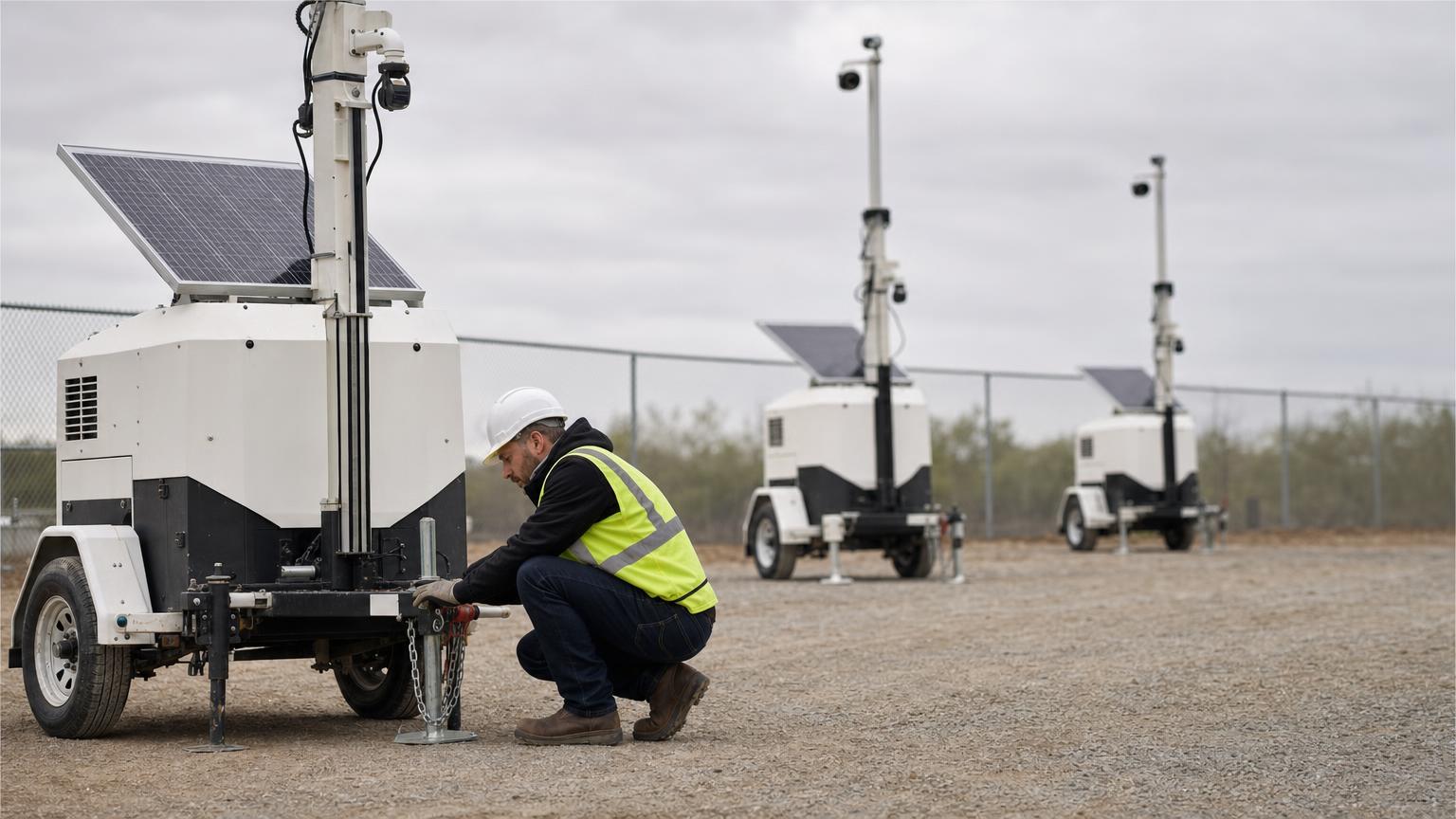


Rent, lease or buy a security trailer: the deployment decision
Three numbers decide this, and none is the monthly rate on the quote: how many months the site runs, how many sites run at once, and what it costs to walk away. A security trailer rental wins when the end date is real and close, owning wins when a unit spends most of the year deployed, and leasing buys a flat line in the budget. Every quote is measured against a guard post, where the published median pay for security guards was $18.29 per hour and $38,020 per year in May 2025 (Source: U.S. Bureau of Labor Statistics), and 64 percent of U.S. security heads expect budget increases for physical security (Source: Security Magazine).
Key takeaways
- Spot AI's rule: rent when the exit date matters more than the rate, lease when a predictable monthly line matters more than the total, and buy when utilization beats the rental margin.
- Spot AI splits a deployment budget into six drivers: the unit, monitoring and response, power, connectivity, relocation and contract length, each a calculation rather than a figure to accept.
- The break-even has a closed form: the share of the purchase price you never get back, divided by the monthly rental rate minus your own running cost.
- Spot AI attaches detections, configuration and case-ready evidence to the site and the account rather than the chassis, which decides what relocating a unit or ending a contract costs.
- Spot AI's portfolio rule: own to the base concurrency you have held for two years, rent the peak above it, and never buy for a site you have not won.
What each model actually commits you to
Providers quote a monthly figure against all three models, and the figure is not the commitment. What separates them is who carries the unit when it is not earning and what you hold at the end.
Renting commits you to a term and buys you an exit
A rental is a short dated agreement, usually month to month or tied to a project window, where the provider owns the asset, maintains it and takes it back. You are buying the right to stop, and its price is the rental margin on the provider's cost of capital, maintenance and utilization risk. Rent when the site has a firm end date, when scope could still move, or when a first deployment should be cheap to get wrong. Read the term before the rate: minimum hire periods, notice periods and early return charges decide what a project finishing early costs. The security tower and trailer rental guide sets out what an agreement covers.
Leasing commits you to the whole term and buys a flat line
A lease runs a fixed multi-year term at a fixed payment, and the interesting question is what happens at the end. An operating lease returns the unit to the lessor and keeps the asset off your balance sheet. A finance lease transfers ownership for a nominal figure and puts it on your books from day one. The two price differently, so establish which one the paper describes before comparing payments. Lease when sites run as a rolling program and a capital request would outlast the project it funds.
Buying commits you to the residual, the maintenance and the idle months
Ownership removes the rental margin and hands you three obligations back: maintenance, storage between deployments, and the residual value you recover or write off. The upside is control, because an owned unit moves to the site that needs it most on a Friday afternoon without a purchase order. Buy when utilization is high and predictable, when units have somewhere to sit between jobs, and when one named person owns the maintenance. Tax treatment differs enough across the three to reorder them, so run the shortlist past your finance team.
The six cost drivers, written as calculations
Quotes arrive as a single monthly figure. Break it into these six lines and the three models become comparable. Every input is yours.
Cost driver | What sets the number | The calculation | Where your number comes from |
|---|---|---|---|
The unit | Purchase price, rental rate or lease payment for the chassis, mast and battery | Monthly unit cost, times units, times months deployed | The provider's itemised quote, with the minimum hire period on it |
Monitoring and response | Whether a person watches the feed, and for how long | Monitored hours per day, times the hourly rate, times 30 | Your provider for a staffed service. Spot AI prices the video AI layer that classifies and acts with nobody watching a screen |
Power | Array size against what the cameras, radio and compute draw in winter | Daily generation in the worst month, minus daily draw | The provider's runtime figure for your latitude, never a summer number |
Connectivity | Cellular or satellite service, per unit, per month | Data plan per unit, times units, times months | The connectivity provider. Confirm whether it sits inside the rate |
Relocation | Charge per move, plus crew hours and the hours a site sits uncovered | Moves per year, times the per-move charge, plus crew hours | Your own move history. Settle it before you need it |
Contract length | Minimum term, notice period and early termination charge | Remaining months, times the payment, times the termination percentage | The contract. This line decides what a cancelled project costs |
Those six lines are also the ones most likely to be missing from the provider's own page. Take PPG Security, a Las Vegas based provider who supplies the tower, runs the monitoring and dispatches their own guards. Their page documents real capability: a solar-powered camera tower, HD PTZ cameras with 30x optical zoom and night vision, a strobe and two-way talk-down, and a 24/7 monitoring team. Mast height, battery runtime, connectivity, contract terms and the service level are not publicly specified. That is the category's normal condition, and it is why this piece hands you formulas rather than a price list.
The benchmark: what an hour of covered site time costs
Almost every quote is positioned against a guard post, so build that side yourself: published wage, plus employer burden, plus what the agency adds.
Employer compensation costs for private industry workers averaged $46.89 per hour worked in June 2026: $32.82 of wages and $14.07 of benefits, so benefits made up 30.0 percent (Source: U.S. Bureau of Labor Statistics). Apply that split to the guard median above and the employment cost of an hour lands near $26.13, because $18.29 is roughly 70 percent of it. That is still not a billed rate: supervision, a vehicle, overtime and the agency's margin sit on top, and only your agency can tell you how much.
Run it out and the arithmetic is unavoidable. A 12-hour overnight post covered seven nights a week is 84 hours a week, about 364 hours a month and 4,368 hours a year. At $26.13 an hour that is roughly $9,510 a month and $114,100 a year for one post at one gate, before a dollar of margin, and two approaches double it. Staffing also keeps getting harder: guard employment is projected to grow 1 percent from 2025 to 2035, with about 157,200 openings a year, most replacing people who leave (Source: U.S. Bureau of Labor Statistics).
Spot AI's framing inside a cost model is the same as anywhere else: a unit running the AI Security Guard reduces the guard hours you buy and covers the hours you could never staff, rather than removing the role. The comparison of remote monitoring, remote guarding and an AI security guard separates those models before you price any of them.
Price the monitoring line separately from the unit line, always. A quote that merges them hides the driver that moves most between providers, because staffed monitoring scales with hours while an AI detection layer scales with sites. Split them and comparing three providers takes ten minutes.
The break-even, as algebra you can run
Renting against owning has a closed form, simpler than the spreadsheet you were about to build. Express everything as a share of the purchase price of one unit, so no price list is needed.
- s is the residual share: what the unit is worth when you are finished, as a fraction of what you paid.
- r is the monthly rental rate as a fraction of that purchase price.
- o is your monthly cost to run an owned unit, also as a fraction of that price: maintenance, storage, insurance and the software you would pay for either way.
The crossover in months is (1 minus s) divided by (r minus o). Below that many months of deployment, renting is cheaper. Above it, owning is. Worked through: at a 40 percent residual, a rental of 5 percent of the purchase price a month and running costs of 1 percent, the crossover is 0.60 divided by 0.04, which is 15 months. Soften the rental to 4 percent and lift running costs to 1.5 percent and the same unit needs 24 months on site before ownership wins.
Two adjustments keep it honest. Add relocation charges to the rental side only where the provider bills per move and you would move an owned unit yourself. Then charge the ownership side for the months a unit sits in the yard, because it costs o whether or not it is earning. That second adjustment ends most ownership cases.
Deployment shape | The question to answer | What usually wins |
|---|---|---|
Under 6 months, one site | Is the minimum hire period shorter than the project | Renting, because the crossover rarely lands below six months |
6 to 18 months, one site | Where does (1 minus s) divided by (r minus o) fall against the project | Renting or leasing, decided by whether a capital request moves faster than the project |
Over 18 months, or a known next site | Will the unit be deployed in most months of the next three years | Buying, provided one person owns maintenance and storage |
Rolling program, several sites | The smallest number of sites you covered simultaneously over 24 months | A mixed fleet: own to that floor, rent above it |
Portfolio budgeting when several sites run at once
A single site is an arithmetic problem. A portfolio is a utilization problem, and utilization is the figure almost nobody computes before buying. Take the unit-months you deployed last year and divide by twelve times the units you own. Under roughly 60 percent, ownership is subsidising empty months.
The rule is to own the base and rent the peak. Your base is the smallest number of sites covered at once over the last 24 months. Own that many units, rent everything above it, and let the provider carry the idle months. This is also the budget that survives contact with reality: half of security leaders reported an increased budget against the previous year, at an average increase of 12 percent, while those whose budgets fell reported an average decrease of 7 percent (Source: Security Magazine). A fleet sized to the floor absorbs a 7 percent cut. A fleet sized to the peak does not.
Workload direction belongs here too. Construction spending in July 2026 ran at a seasonally adjusted annual rate of $2,157.6 billion, 3.8 percent below July 2025 (Source: U.S. Census Bureau). When the pipeline contracts, the option to hand a unit back carries real value, and that value is the rental margin you were trying to avoid.
Scale changes the arithmetic rather than the logic. One Spot AI customer, a top five North American EV charging network, went from 0 to 10 to 120 sites in about a year across unmanned locations where guards were never feasible and copper theft cost about $5,000 per incident in replacement alone.
"We've reduced incidents by 80% without any kind of human monitoring."
Jeremy N., Sr. Manager of Operations & Maintenance, EV charging network
One caution on sizing. Property crime decreased an estimated 12.4 percent from 2024 to 2025 and larceny-theft fell 9.8 percent, in FBI data covering 96 percent of the population (Source: Federal Bureau of Investigation). A national trend moves one way while one yard full of copper moves the other, so size the program on your own incident history, site by site.
What happens to footage, detections and configuration when a unit moves or a contract ends
This is the line nobody quotes and everybody meets. Three assets leave with the unit if you let them: the detection tuning you spent weeks settling, the access configuration, and the evidence from every incident on that site.
Spot AI holds all three against the site record and the account rather than the chassis, so relocating a unit moves hardware rather than resetting a deployment. Put these five questions in the contract rather than the sales call:
- When a unit relocates, do detection zones, rules and thresholds travel as a template, or does the new site start from scratch?
- Who holds the footage once the unit goes back, in what format, and for how long?
- Is there an export path for case-ready evidence, and does it cost anything after the contract ends?
- Does access follow the site or the device, so a crew leaving a project loses the view of it?
- If you later want the same detection layer on a permanent building, does it run on the same account, or start a second platform?
Question five separates a hardware purchase from a platform decision. Spot AI runs the same video AI on the cameras a business already owns, on pole-mounted units and on towable units, so a trailer rented this quarter does not strand the evidence trail you will want in two years. The Spot AI platform overview covers how one account spans those deployments.
Key terms
- Loaded hourly cost. The wage plus the employer's benefit burden, before supervision, vehicle, overtime and agency margin.
- Utilization. Unit-months deployed divided by unit-months owned, across a year. It tells you whether the fleet is the right size.
- Residual share. What a unit is worth at the end of its life, as a fraction of what you paid.
- Relocation charge. What a provider bills to move a unit. On a portfolio that redeploys often it outweighs the gap between two rates.
Ask each provider for the same scope twice: once as a 6-month hire, once as a 36-month commitment, both itemised across the six drivers. The gap between them, per month, is the price of flexibility, and it is the number this decision turns on.
The decision in five questions
Take these in order. The first that lands decides it.
- Does the site have a firm end date inside 12 months? Rent, and check the minimum hire period against the program.
- Will this unit redeploy to a known next site? Run the crossover on your own r, s and o before treating that project as free.
- Is a capital request slower than the project it would fund? Lease, and confirm whether the paper is operating or finance.
- Have you covered this many sites simultaneously for two years? Own that many units and rent the rest.
- Will you want the same detections on permanent sites later? Choose the platform first, because the chassis decision is the easy one to reverse.
To see the detection, deterrence and evidence layer on a real site before you commit, book a demo with Spot AI and bring your own r, s and o. On the units, the mobile security trailer buyer's guide covers what separates one from another, the solar and cellular deployment guide sizes power and backhaul, and the provider comparison gives the criteria to score them on.
Frequently asked questions
Is it cheaper to rent or buy a mobile security trailer?
Renting is cheaper below the crossover point and owning is cheaper above it, and the crossover is computable. Divide the share of the purchase price you will not recover by the monthly rental rate minus your running cost, both as fractions of that price. At a 40 percent residual, a rental at 5 percent a month and running costs of 1 percent, it lands at 15 months.
How long does a security trailer rental have to run before buying is cheaper?
For most realistic inputs the answer sits between 12 and 30 months of active deployment, and the word active is doing the work. Months parked between projects still cost maintenance, storage and insurance, so a unit deployed eight months a year takes longer to justify. Spot AI's advice is to run the crossover on deployed months, not calendar months.
What is covered by a security trailer rental, and what is charged on top?
The rate normally covers the unit, routine maintenance and the provider's own monitoring where they run it. Billed separately: connectivity, relocation, monitored response hours beyond the standard package, and early termination. Ask for the quote itemised across all six drivers, because that is where two apparently identical rates diverge.
Can you lease a security trailer instead of buying one?
Yes, and the question to settle first is which kind of lease. An operating lease returns the unit at the end and keeps it off your balance sheet, while a finance lease transfers ownership and sits on your books from day one. Confirm which the contract describes before comparing payments.
What happens to the footage and the detections when a rental ends?
Spot AI holds detections, configuration and case-ready evidence against the site record and the account rather than the unit, so handing hardware back does not take that site's history with it. Providers differ, and the difference only shows up at contract end. Settle the retention period, the export path and who holds the footage in the contract itself.
About the author
Sud Bhatija, COO and Co-founder
Sud Bhatija is COO and Co-founder at Spot AI, where he scales operations and GTM strategy to deliver video AI that helps operations, safety, and security teams boost productivity and reduce incidents across industries.

