






Data center physical security: what video AI does from the fence line to the cage
Data center physical security is the set of layered controls that keeps unauthorized people away from servers, from the property line to the locked rack. Spot AI's AI Security Guard runs on the cameras a data center already has, detecting fence breaches, tailgating and after-hours presence at each layer, verifying events before anyone is dispatched, and keeping time-stamped evidence next to the access control record. The estate to protect is growing fast: Gartner expects data center systems spending to reach $822 billion in 2026, up 62.5% on 2025 (Source: Gartner). The federal baseline for the job is short: monitor physical access to the facility to detect and respond to physical security incidents, and review the access logs (Source: NIST).
Key takeaways
- Data center physical security works in six layers: property line, fence and gates, building shell and yard, lobby and mantrap, data hall, and cage and rack. Each layer needs its own detection rule and schedule.
- Spot AI's AI Security Guard covers what badge readers cannot see: a person climbing the fence, a second person through a door on one badge, someone in the data hall outside approved hours, or a loiterer by the generators and fuel.
- Spot AI verifies each event with video context before it pages anyone, so the person on call decides with a clip in hand instead of an alarm code.
- Spot AI keeps full-resolution video on site in its Intelligent Video Recorder (IVR) and sends only metadata across the network, which suits unmanned edge sites on thin connections.
- Spot AI works alongside the access control system and the cameras already installed. It does not replace badge readers, mantraps or locks.
The six layers of data center physical security
Spot AI's AI Security Guard maps its detections to the layers a data center security plan already uses, so every camera gets a rule that fits where it points. The logic of the layers is old and sound: each ring slows an intruder down, and each one leaves a record, so a person who beats the fence still has to beat the door, the mantrap, the hall reader and the cage lock. Data centers are recognized targets. In 2021 a Texas man was sentenced to 10 years in federal prison for plotting to bomb an Amazon data center in Virginia, after trying to obtain explosives from an undercover FBI employee (Source: U.S. Department of Justice).
The table below sets out what each layer protects, which control carries the load today, and what video AI adds on top:
Layer | What it protects | Control doing the work today | What Spot AI's AI Security Guard adds |
|---|---|---|---|
1. Property line and approach | Access roads, parking, setbacks | Lighting, patrols, signage | Spot AI flags vehicle loitering and license plates of interest on the approach after hours |
2. Fence line and gates | The site boundary | Fence, vehicle gates, bollards, gate readers | Spot AI detects fence jumping and unauthorized entry, then triggers strobes, horns and talkdown |
3. Building shell and yard | Walls, roof access, loading dock, generators, fuel, chillers | Locked doors, door contacts, dock procedures | Spot AI watches no-go zones around generators and fuel and flags dock activity outside delivery windows |
4. Lobby and mantrap | The first credentialed entry | Visitor management, guard desk, mantrap or turnstile | Spot AI detects tailgating when two people pass on one badge or a door is held open |
5. Data hall | The white space where racks sit, plus power and network rooms | Badge and PIN readers, escort rules | Spot AI flags presence in restricted zones outside approved hours and pairs it with the badge event |
6. Cage and rack | One tenant's or one system's equipment | Cage and rack locks, tenant access lists | Spot AI ties presence at a cage to the access record, with clips a reviewer can open |
Fence line and gates: the first detection point
Spot AI's AI Security Guard watches the fence for the behavior that matters, a person climbing, cutting or crossing it, rather than for every headlight and wind-blown branch that moves. It runs as a fence jumping and unauthorized entry agent on the cameras already covering the boundary, with a zone drawn on the fence and a strip just inside it, so traffic on the public road never fires a rule. At the vehicle gate, the same cameras read plates and flag license plates of interest, such as a vehicle tied to a contractor whose access ended last week.
Once a rule fires, Spot AI can act on site before a person is involved: strobes, horns and natural-conversation talkdown that escalates if the person stays. A practical setup for a data center fence:
- Overlap the views. Every stretch of fence should sit in two fields of view, so a climb point hidden by a post on one camera shows on the next.
- Draw the zone tight. Cover the fence and a strip inside it, and leave the road, the sidewalk and the neighbor's lot outside the polygon.
- Arm the fence all day. Nobody has a reason to climb a data center fence at noon either, so the fence rule needs no business-hours exception.
- Escalate on a timer. Strobe first, then horn, then a spoken message naming the area and the exit, then a page to the on-call lead with the clip.
- Log every gate exception. A gate held open for a fuel delivery is a scheduled window, not a nuisance alarm to mute, and the schedule belongs in the rule.
For the tradeoffs between cameras, buried or fence-mounted sensors, and guards, the perimeter intrusion detection guide compares each approach on industrial sites.
Walk the fence at night with the live view open on a phone before go-live. A dip in the ground, a light pole shadow or a gap behind a generator enclosure is obvious on foot and invisible on a site plan.
Building shell, loading dock and the generator yard
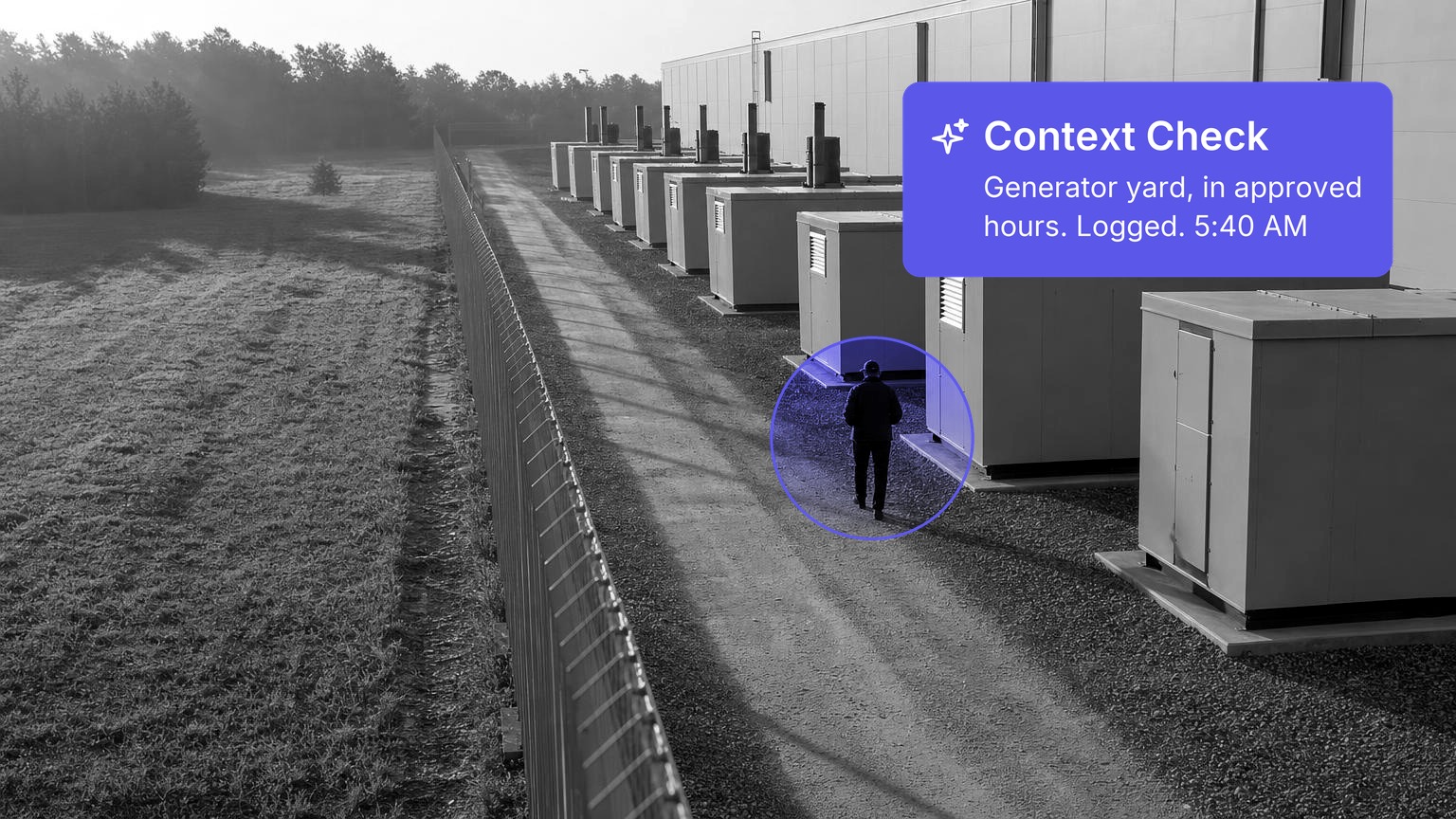
Spot AI's AI Security Guard treats the yard behind the building as its own zone, because generators, fuel tanks and chillers keep the hall running and they sit outside the badge-controlled shell. A person lingering by a fuel fill point or a generator enclosure outside a maintenance window is worth a page; the same person in a hi-vis vest during a scheduled service visit is not, so the rule carries the schedule.
The loading dock is the busiest weak point on most sites. Servers, GPUs and replacement parts arrive and leave there, and the hardware is worth stealing: Security Magazine noted in June 2026 that GPU-heavy computing hardware already attracts organized theft (Source: Security Magazine). Useful dock and yard rules include:
- Person enters a no-go zone around generators, fuel and transformers outside maintenance windows.
- Loitering by the dock apron or a roof access ladder after hours, with a threshold under a minute.
- Vehicle enters a no-go zone where only scheduled fuel and delivery trucks should stop.
- Activity at the dock outside delivery windows, routed to the shift lead rather than the whole security team.
Lobby and mantrap: catching the second person through the door
Spot AI's AI Security Guard detects tailgating at the doors where a badge reader already decides who may enter, flagging when two people pass on a single badge or when a door is held open. Tailgating is a person following an authorized employee through without their knowledge; piggybacking is the same thing with the employee's consent. Both defeat a badge reader, because the reader only knows that one valid credential opened the door.
Mantraps and full-height turnstiles enforce single passage in hardware, and where they exist they do that job well. Most sites still have doors without one: the dock's interior door, stairwells, the office-to-hall corridor, emergency exits. Staccato, a firearms manufacturer on an 800-acre Texas campus, uses Spot AI to alert when multiple people enter on a single badge swipe or a door is held, a job its team previously did by human observation alone. The same method applies at construction site access points.
Visitors add one more rule: a visitor badge moving through a corridor alone is an event, and the clip of who escorted whom is the record a reviewer wants when a visit is questioned later.
Data hall and cage: after-hours presence and the access record
Spot AI's AI Security Guard flags people in restricted zones outside approved hours and pairs each event with the badge record, so a reviewer sees who badged in and what they did next. In the hall, the rule is simple: each restricted zone has an armed schedule that matches its staffed hours and change windows, and presence outside that schedule is an event.
The cage is where colocation gets specific. The provider usually owns the cameras in the aisles, and a tenant may or may not be allowed to add cameras inside its cage, so check the contract before planning coverage. Three placement habits hold either way:
- Cover the cage door, not the screens. Point cameras at the entry and the aisle, never at console screens or keypads, so the footage records people without recording credentials.
- Match zones to tenancy. One zone per cage keeps an event tied to the right customer and the right access list.
- Keep the reader and the camera in sync. Badge events and video timestamps must agree to the second, or the pairing an auditor samples falls apart.
Key terms
- Mantrap. A two-door vestibule where the second door opens only after the first has closed, enforcing one person per credential.
- Tailgating and piggybacking. An unauthorized person following an authorized one through a controlled door, without or with that person's consent.
- IVR. Spot AI's Intelligent Video Recorder, which keeps full-resolution video in the facility and sends only metadata over the network.
Verification before dispatch
Spot AI verifies an event with the video context around it before anyone is paged, so the person on call decides with a clip in hand rather than an alarm code. At a data center a false dispatch burns a guard's night and a missed event burns uptime. The sequence runs in six steps:
- Detect. An agent fires on behavior in a zone: a climb at the fence, two people through one door, presence in the hall after hours.
- Verify. Spot AI reasons about the scene: a person rather than an animal, inside the line rather than outside it. Where access control is integrated, the reviewer also sees whether a badge event matches.
- Deter. At the perimeter, strobes, horns and natural-conversation talkdown play while the person is still deciding what to do.
- Notify. The alert reaches the right people by text, email, Slack or Teams, or a monitoring center by webhook, with the clip attached.
- Dispatch. A human decides to send a guard or call police, with location and footage in hand.
- Document. Spot AI files the clips and a time-stamped log into a case for the incident review.
Verification is also what keeps a monitoring team listening. A leading SOC platform integrated with more than 20 VMS platforms reports a single-digit false-positive rate on Spot AI, against about 50% false alarms on traditional VMS, a customer-reported figure rather than a benchmark.
The same holds when an outside monitoring partner takes the page. Allied Stone's CIO puts it this way:
"We partner with a monitoring services company, and the quality of Spot AI's data and features helps make that monitoring service even more effective."
Brock Harlow, CIO, Allied Stone
Unmanned edge sites and sites under construction
Spot AI's AI Security Guard runs detection at the edge, which is why it fits edge data centers, modular halls and network huts where nobody is on site to hear an alarm. The IVR keeps full-resolution video in the facility and only metadata crosses the network, so a site on a thin or cellular link still gets full-resolution evidence locally, and Starlink back-haul is supported where there is no wired link at all.
Three things change when a site is unmanned:
- A dark camera is an incident. Spot AI alerts when a camera goes offline, and at an empty site that alert deserves the same routing as a fence event.
- Deterrence carries more weight. When the nearest responder can be an hour away, the strobe and the spoken warning are the response in the first minutes.
- Sites change before they settle. Spot AI also runs on security trailers, which cover a fence line during construction or before fixed cameras are cabled, and the trailers and fixed cameras then run as one system.
The same playbook runs at utility sites. The substation security guide covers intrusion and copper theft at unmanned yards, and the solar and cellular trailer guide covers power and connectivity where there is neither.
Working alongside access control
Spot AI works alongside the access control system a data center already runs: the badge reader decides who may open a door, and Spot AI's AI Security Guard shows who actually walked through it. Spot AI lists integrations with cloud access control platforms such as Brivo, Kisi and ProdataKey on its integrations page, using access events to pull the matching clips, and it runs on existing ONVIF and RTSP cameras with no rip-and-replace. The split of work looks like this:
Question after an event | What access control answers | What Spot AI adds |
|---|---|---|
Did a valid credential open the door? | Yes, from the event log | Spot AI shows the person who carried the credential |
How many people went through? | Not recorded | Spot AI flags two or more people on one badge |
Was the door held or propped? | A door-held alarm, if a contact is fitted | Spot AI shows who held it and for how long |
Did anyone get in without badging? | A forced-door alarm, if a contact is fitted | Spot AI detects the climb, the cut or the crossing |
Where did the person go next? | The next reader they used, if any | Spot AI search follows the same person across cameras toward the cage |
The video platform has to pass the same review as any other system that touches the hall. Spot AI's published security controls include role-based access set per camera and per feature, single sign-on through SAML, AES-128 encryption at rest and TLS 1.2 in transit, SOC 2 Type II and NDAA. The SOC 2 and enterprise security checklist for video platforms covers how to test those claims during procurement.
The audit trail auditors ask for
Spot AI produces the physical-access evidence auditors sample: clips, time-stamped logs and case files tied to the badge events under review. An auditor rarely asks for hours of footage. They pick a handful of badge events, terminations and visitor entries, and ask the team to show what happened at the door. A person still pulls that sample together; what Spot AI changes is that the clip for each event is already indexed to the event.
Of SOC 2, ISO/IEC 27001 and PCI DSS, only PCI DSS v4.0.1 names a number: three months of stored video or access control data for sensitive areas, unless law restricts it. The other two leave the window to you. The control-by-control map of data center security standards sets out each clause, and the video retention and chain-of-custody guide covers how to hold evidence once it matters.
Choosing a response model for a data center
Spot AI's AI Security Guard is one of four ways a data center can answer an after-hours event, and the right mix follows headcount, site count and how much evidence the audit needs. The comparison below is by approach, not by vendor:
Approach | What triggers a response | After-hours coverage | Evidence left behind | Where it falls short |
|---|---|---|---|---|
Guards on patrol | A guard sees something on rounds | Only where the guard is standing | A written report | Gaps between rounds, and one post per site |
Alarm panel with remote monitoring | A door contact or motion sensor trips | Yes | An alarm code and a time | No picture of what tripped it unless an operator pulls video |
Motion-triggered VMS analytics | Pixels change in a region | Yes | Clips, often many | Weather, animals and headlights drown the real events |
Spot AI's AI Security Guard on existing cameras | Behavior in a zone: a climb, a tailgate, presence after hours | Yes, with on-site deterrence | Clips, a time-stamped log and a case | Needs camera coverage at each layer, and works with locks and readers rather than replacing them |
Most data centers end up with a blend: guards at the lobby, access control on every door, and video AI covering the fence, the yard, the doors without a mantrap and every site without a guard. To see Spot AI's AI Security Guard run against your own layers, book a demo and bring the camera list for each one.
Before any pilot, put these questions to every option on the shortlist:
- Does it run on the cameras already installed, over ONVIF or RTSP, or does it need new hardware?
- Can a zone carry its own schedule, so the fence is armed all day and the dock only outside delivery windows?
- Does it read the access control event log, and can a reviewer open the clip for a given badge event?
- What leaves the building, full video or metadata, and where is full-resolution footage stored?
- What happens on site when the network drops, and how is a camera that goes dark reported?
- Can it export a case with clips and a time-stamped log for an auditor or police?
Run the pilot on the hardest layer first, usually the fence or the generator yard at night. A system that is quiet and accurate there will be quiet and accurate at the lobby, and the reverse is rarely true.
A data center that already has cameras and access control can have Spot AI's AI Security Guard live in days, not months: zones per layer, schedules per zone, and the access control integration switched on, on the cameras already in place. The wider picture of how energy, water and telecom sites approach the same problem sits in what critical infrastructure physical security covers. When the camera map is ready, book a demo with Spot AI and walk it layer by layer.
Frequently asked questions
What are the layers of data center physical security
Spot AI's AI Security Guard works across the six layers most data centers use: property line, fence and gates, building shell and yard, lobby and mantrap, data hall, and cage and rack. Layers 1 to 3 are mostly outdoors and empty at night, so detection and deterrence lead there; layers 4 to 6 are badge-controlled, so video corroborates the access record.
How does video AI detect tailgating at a data center
Spot AI counts people against credentials at the doorway behind a badge reader. When two people pass on one swipe, or the door stays open after a valid badge, it raises a tailgating event with the clip attached. Mantraps enforce single passage in hardware, and video covers the doors that lack one.
Does video AI replace access control in a data center
Spot AI does not replace access control, because the two answer different questions. Access control decides whether a credential may open a door and logs that it did. Spot AI shows how many people went through, flags fence breaches no reader sees, and opens the clip for a badge event through integrations such as Brivo, Kisi and ProdataKey.
How do you secure an unmanned edge data center
Spot AI secures unmanned edge sites by running detection on site, keeping full-resolution video in the IVR and sending only metadata over the network. Fence and yard rules fire with strobes, horns and talkdown, camera-offline alerts route like intrusions, and Starlink back-haul covers sites with no wired link.
Where should cameras point in a data center
Spot AI works best when cameras cover the entry and exit of every layer: overlapping views of the fence, the vehicle gate, the generator and fuel yard, the dock, both sides of the mantrap, and each cage door. Point them at people and doors, never at console screens or keypads.
About the author
Joshua Foster, IT Systems Engineer
Joshua Foster is an IT Systems Engineer at Spot AI, where he focuses on designing and securing scalable enterprise networks, managing cloud-integrated infrastructure, and automating system workflows to enhance operational efficiency. He is passionate about cross-functional collaboration and takes pride in delivering robust technical solutions that empower both the Spot AI team and its customers.

